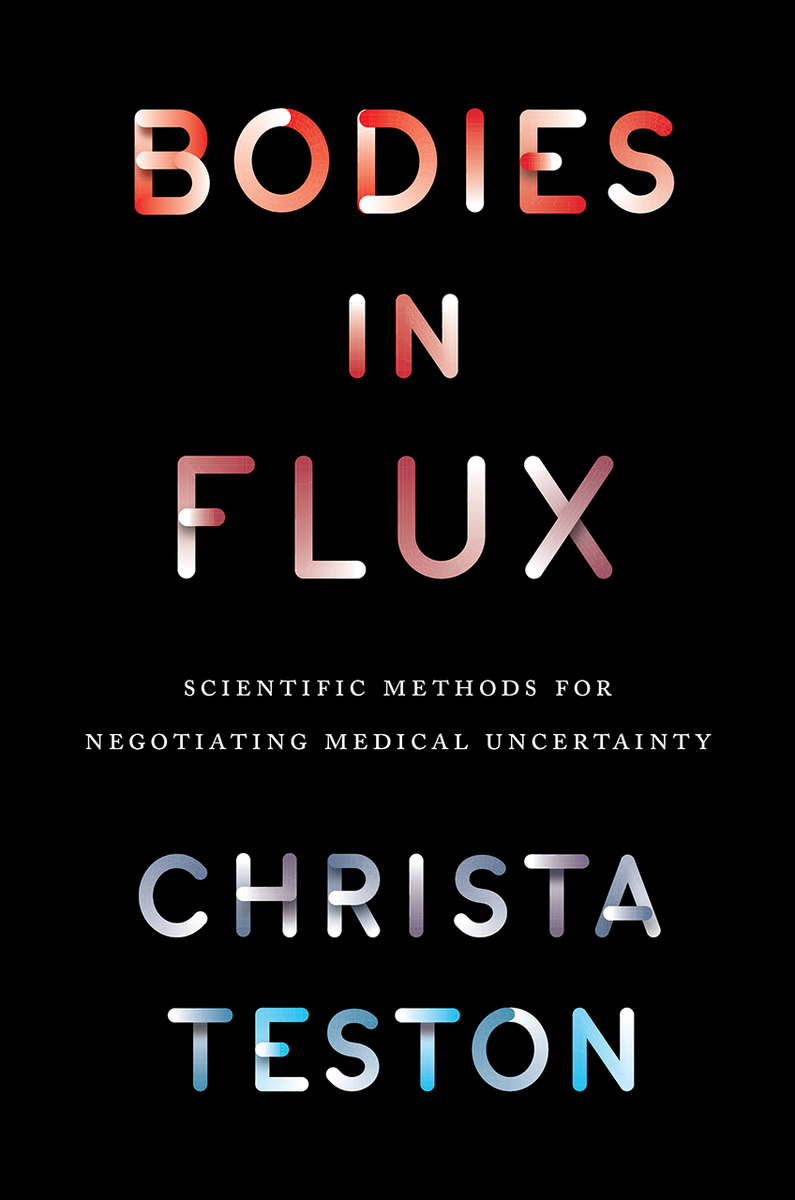
REVIEWS
“Teston takes new materialist theory to the scene of medical diagnosis, clinical trials, and deliberation, grappling with unruly bodies as emergent and medical practices as indeterminate and contingent. A fascinating, potent study that should be required reading for transcorporeal humans, who find ourselves dwelling within—not isolated from—flux.”
— Stacy Alaimo, author of Exposed: Environmental Politics and Pleasures in Posthuman Times
“In one of the most compelling accounts to date, Teston’s Bodies in Flux demonstrates quite strikingly how evidence is produced as much as it is analyzed, and that rather than avoid uncertainty, we can and should embrace the contingency of bodily materialities. The book is a must-read for humanities scholars, biomedical researchers, physicians, and patients looking for alternative ways of thinking about and, indeed, actively practicing the uncertainty and potentiality of embodied being.”
— Kelly E. Happe, author of The Material Gene: Gender, Race, and Heredity after the Human Genome Project
“Thoughtful and extensively referenced.”
— Choice
TABLE OF CONTENTS
1. Evidential Matter(s) - Christa Teston
DOI: 10.7208/chicago/9780226450834.003.0001
[backstage;scientific methods;rhetorical theory;material feminism;shadow work;attunement;intra-action;agency;material-discursive;uncertainty]
How are evidential worlds assembled from bodies in perpetual flux? What backstage methods, protocols, and procedures elevate everyday biological activities to positions of argumentative authority? This chapter sets the stage for exploring such questions and provides the historical, theoretical, and practical exigencies for investigating four scientific methods that help to mitigate medical uncertainty. Such methods provide a set of observable practices that rhetoricians can analyze to understand how medical professionals attune evidentially to bodies—especially when such attunements are made all the more complex due to ongoing biological and technological change. Key constructs in rhetorical theory and material feminisms are introduced, including shadow work, ambient attunement, intra-action, rhetorical agency, and “material-discursive” as a descriptor for the kind of rhetorical labor that occurs in the biomedical backstage. The chapter also introduces each of the four case studies to follow, which include: a study of the suasive role medical images play during cancer care deliberations; a study of how inferential statistics help FDA members reason about a pharmaceutical intervention’s effectiveness; a study of how cancer screening recommendations hail from an arduous process of synthesizing hundreds of clinical trials; and a study of how genetic testing companies compute and commoditize human health. (pages 1 - 25)
This chapter is available at:
https://academic.oup.com/chica...
2. Evidencing Visuals - Christa Teston
DOI: 10.7208/chicago/9780226450834.003.0002
[medical images;oncology;pathology;cancer;dwelling;kairos;matter;movement;time;medical decision-making]
Making disease visible is often the first step in mapping a plan for how to navigate medical uncertainty—especially when caring for patients with cancer. To better understand the backstage biomedical methods and materials that make visual evidences persuasive, this chapter reports on results from a case study of how medical images are used during medical deliberations. Interviews with an oncologist and a pathologist provide details about the behind-the-scenes activities associated with capturing, slicing, cover-slipping, staining, and viewing cancer cells. Analyses of three patients’ cancer-care deliberations illustrate how medical professionals use these visual evidences to make sense of bodies in constant flux. Ultimately, the chapter argues that bodies in flux always outpace the human gaze; anthropocentric narratives about fighting cancer or battling bodies leaves little room for dwelling with a body’s unpredictability. In place of such narratives, the chapter proposes kairos as a key rhetorical skill for patient care. Kairos accounts for the ways in which matter, movement, and time are suasive contributors to medical decision making. To dwell kairotically suggests that one is skilled at attuning to spatial and temporal contingencies of constantly changing phenomena. (pages 26 - 59)
This chapter is available at:
https://academic.oup.com/chica...
3. Assessing Evidence - Christa Teston
DOI: 10.7208/chicago/9780226450834.003.0003
[FDA;assessment;statistics;probability;enthymeme;deliberation;poiesis;grounded theory;risk-benefit ratio]
During FDA hearings, participants deliberate about the risks and benefits associated with new pharmaceutical interventions. But when drugs are on trial, competing evidences collide. To unearth how deliberators from a wide range of stakeholder positions (e.g. patients, medical doctors, insurance companies, pharmaceutical companies) navigate the complexity caused by competing evidences, this chapter uses grounded theory methodology to analyze transcripts from nineteen FDA pharmaceutical hearings. Results suggest that deliberators rely on inferential statistical analyses to resolve conundrums associated with having to assess many and multiple forms of evidence. That is, in order to make inferences about how larger patient populations will be effected by a particular drug, deliberators quantify and assess the risk-benefit ratio of a much smaller sample patient population. A chain of enthymematic, statistical premises aid deliberators in assessing the probability that their study population’s experiences can be generalized to other patient populations. Because of their making-power, or what classical rhetoric terms “poiesis,” enthymematic premises (hazard- versus time-based measures, confidence intervals, effect size, and p values) help deliberators engage in probabilistic reasoning. The chapter concludes by arguing that evidential assessment in medicine is a rhetorical practice. (pages 60 - 93)
This chapter is available at:
https://academic.oup.com/chica...
4. Synthesizing Evidence
DOI: 10.7208/chicago/9780226450834.003.0004
[Cochrane Systematic Review;synthesis;clinical trials;cancer screening;methodology;evidential cuts;Stephen Toulmin;stasis theory;genre;homogenize]
Medical professionals are inundated continually with new findings from clinical trials. To counter the otherwise overwhelming task of knowing how best to diagnose, treat, and prevent disease, small teams of medical professionals take responsibility for aggregating evidence from clinical trials, systematically assessing said evidence, and summarizing what they find in a single, standardized written genre called the Cochrane Systematic Review (CSR). To better understand the rhetorical labor involved in synthesizing evidence in the biomedical backstage, this chapter takes as its object of study three CSRs. Each CSR provides cancer screening recommendations for lung, prostate, and breast cancers. By mobilizes Stephen Toulmin’s model for argumentation and classical rhetoric’s stasis theory, the chapter maps each CSR’s textual features, traces reviewers’ synthesizing activity, and conducts rhetorical analyses of CSRs’ extratextual features. Findings suggest that CSR reviewers end up cutting from their syntheses more evidence than they include. Ultimately, how evidences are cut, flattened, or homogenized is a matter of methodology. Given evidence-based medicine’s methodological fetishization, the chapter concludes by proposing a novel analytic heuristic for uncovering and critiquing evidential cut-making practices. Such a heuristic may help to prevent what some critics call “conceptual cul-de-sacs” in cancer care.
This chapter is available at:
https://academic.oup.com/chica...
5. Computing Evidence
DOI: 10.7208/chicago/9780226450834.003.0005
[genetic testing;23andMe Inc;Color Genomics Inc;situational analysis;reference material;mutation;computation;boundary infrastructure;shadow work;algorithm]
Genetic tests help us negotiate the uncertainty posed by a body’s inherited genetic legacy. In the United States, it has never before been more affordable and available. On what behind-the-scenes rhetorical tactics do genetic scientists and testing corporations rely, though? How do ancestries, geographies, environments, politics, economies, and technologies intra-act in the genetic backstage? This chapter deploys Adele Clarke’s situational analysis method in order to unearth how two genetic testing companies (23andMe, Inc. and Color Genomics, Inc.) employ next-generation genetic sequencing. Analyses reveal that genetic scientists enact a host of computational cuts that affect how genetic data are interpreted, how mutations are defined, and how disease risk is calculated. By mobilizing the explanatory power of Susan Leigh Star’s boundary infrastructure, the chapter describes how the choices a laboratory makes about which reference materials, analytic procedures, and algorithms they use ultimately render different results. The chapter concludes by discussing the ideological, economic, and algorithmic machines—or shadow work—that help to navigate genetic uncertainty. Readers are encouraged to interrogate politicized promises of a more personalized and precise approach to medical practice and to take care when choosing to purchase, use, and make medical decisions based on results from genetic tests.
This chapter is available at:
https://academic.oup.com/chica...
6. Dwelling with Disease - Christa Teston
DOI: 10.7208/chicago/9780226450834.003.0006
[care;phronesis;dwelling;disability;method;relationality;tuche;technai;metis;tinker]
This concluding chapter summarizes the book’s three major findings: evidences are the result of rhetorical attunements, methods matter, and biomedical practice (not just health) is relational. Given these three findings, the chapter explores what it might look like to dwell with disease, or to be radically present and attuned to ongoing and pervasive change. The chapter draws on classical rhetorical theory, including constructs such as tuche, technai, episteme, metis, and phronesis, to posit that contemporary care practices might need to be more improvisational than predictive. Under the rubric of medical practice as phronesis, medical professionals accept statistical assessments and aggregated data as mere guides. Medical practice as phronesis requires rhetorical skill—including methods for tinkering and acting with (rather than on) material phenomena. Phronetic practices require localized attunements and an uncomfortable, vulnerable, affective state of dwelling with dis-ease and disability in a way management, control, and precision eschew. The chapter concludes with a methodological coda that encourages researchers in rhetorical studies to find innovative methods for attuning and capturing the complexity of the nodes and knots that connect people and things. (pages 169 - 186)
This chapter is available at:
https://academic.oup.com/chica...