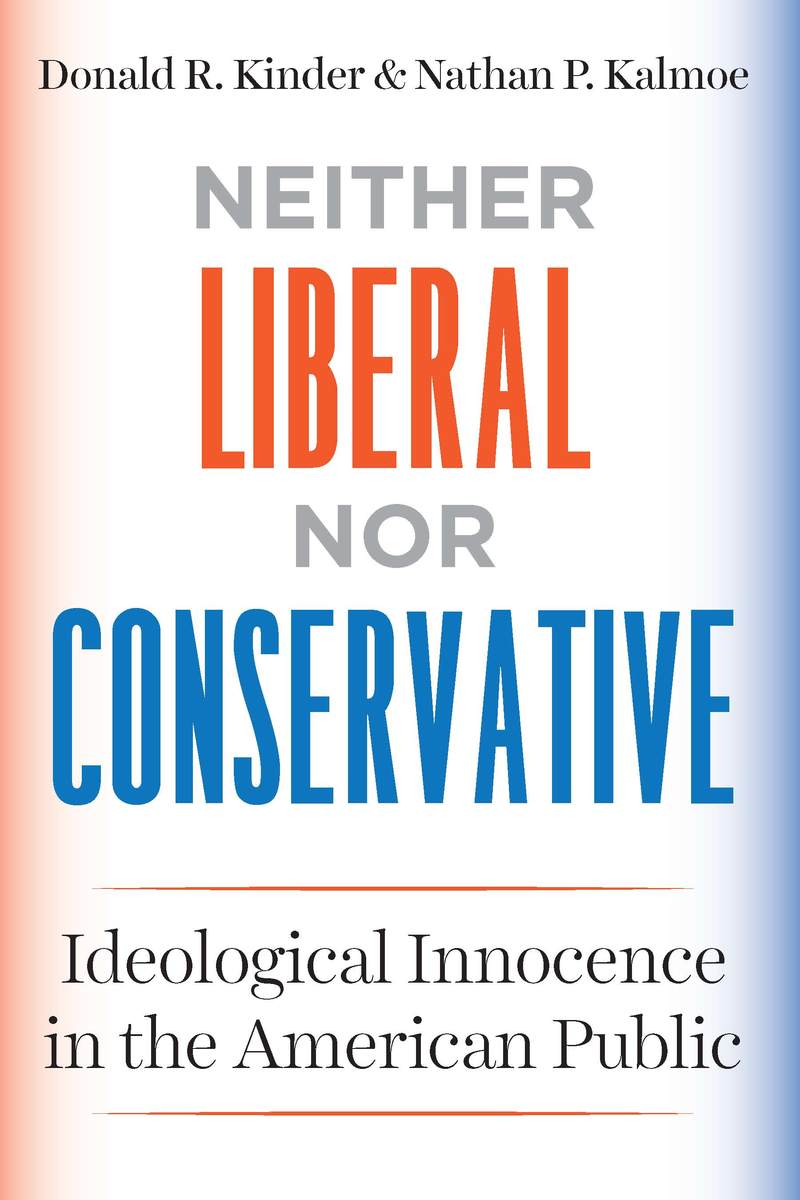
Neither Liberal nor Conservative
Ideological Innocence in the American Public
University of Chicago Press, 2017
Cloth: 978-0-226-45231-9 | Paper: 978-0-226-45245-6 | Electronic: 978-0-226-45259-3
DOI: 10.7208/chicago/9780226452593.001.0001
Cloth: 978-0-226-45231-9 | Paper: 978-0-226-45245-6 | Electronic: 978-0-226-45259-3
DOI: 10.7208/chicago/9780226452593.001.0001
ABOUT THIS BOOKAUTHOR BIOGRAPHYREVIEWSTABLE OF CONTENTS
ABOUT THIS BOOK
Congress is crippled by ideological conflict. The political parties are more polarized today than at any time since the Civil War. Americans disagree, fiercely, about just about everything, from terrorism and national security, to taxes and government spending, to immigration and gay marriage.
Well, American elites disagree fiercely. But average Americans do not. This, at least, was the position staked out by Philip Converse in his famous essay on belief systems, which drew on surveys carried out during the Eisenhower Era to conclude that most Americans were innocent of ideology. In Neither Liberal nor Conservative, Donald Kinder and
Nathan Kalmoe argue that ideological innocence applies nearly as well to the current state of American public opinion. Real liberals and real conservatives are found in impressive numbers only among those who are deeply engaged in political life. The ideological battles between American political elites show up as scattered skirmishes in the general public, if they show up at all.
If ideology is out of reach for all but a few who are deeply and seriously engaged in political life, how do Americans decide whom to elect president; whether affirmative action is good or bad? Kinder and Kalmoe offer a persuasive group-centered answer. Political preferences arise less from ideological differences than from the attachments and antagonisms of group life.
AUTHOR BIOGRAPHY
Donald Kinder is the Philip E. Converse Collegiate Professor in the Department of Political Science and research professor in the Center for Political Studies of the Institute for Social Research at the University of Michigan. He is the coauthor, most recently, of The End of Race? Obama, 2008, and Racial Politics in America. Nathan Kalmoe is assistant professor of political communication and political science at Louisiana State University.
REVIEWS
“Kinder and Kalmoe have given us a carefully developed and compelling defense of Philip Converse’s assessment of the ideological sophistication of the American public. While there is a lot of evidence to suggest that the mass public has become more partisan, there is little evidence to suggest that it has become more ideological. This is an important book for understanding the role of ideology in orienting the public in politics.”
— John Mark Hansen, University of Chicago“Neither Liberal nor Conservative is sophisticated, well written, and packed full of fascinating findings about the nature of ideological identification among Americans. It will be widely read by political scientists and interested scholars and students hoping to understand the effects of ideology on voting.”
— Gabriel S. Lenz, University of California, Berkeley"Neither Liberal nor Conservative stands as an important corrective to the prevailing narrative that American voters are becoming more ideological."
— Washington MonthlyTABLE OF CONTENTS
Preface
Introduction: Innocent of Ideology?
Converse and His Critics
Chapter 1. Converse’s Claim
Chapter 2. The Great Debate
The Nature of Ideological Identification in Mass Publics
Chapter 3. Meaning and Measurement of Ideological Identification
Chapter 4. Becoming Ideological
Chapter 5. In the Long Run
Chapter 6. Consequences?
Conclusion
Chapter 7. Findings and Implications
Appendix A: Alternative Measures of Ideological Identification
Appendix B: Are Moderates Ideological?
Notes
References
Index