REVIEWS
“TheInvention of the Oral is distinctly original, challenging long-accepted claims, further refining recent refinements, and burrowing into new, relevant, and sometimes oddly overlooked categories. McDowell is a superb archivist and a skilled interpreter of both detail and trend."
— Cynthia Wall, author of The Prose of Things: Transformations of Description in the Eighteenth Century
“By focusing on how the idea of the oral was the product of a major media shift—not unlike the one we find ourselves in the midst of now with print and the digital—McDowell has given us a new critical framework with which to understand the eighteenth-century invention of the idea of modernity itself.”
— Helen Deutsch, author of Loving Dr. Johnson
“In this rigorously researched and boldly conceived study, McDowell pursues the origins of the idea of ‘oral culture’ from canonical figures such as Swift, Defoe, and Johnson to ballad collectors, elocutionists, and Billingsgate fishwives. Everyone interested in the history of mediation in the eighteenth century will want to read this book.”
— Tom Mole, author of Byron’s Romantic Celebrity: Industrial Culture and the Hermeneutic of Intimacy
“McDowell’s smart insistence that the voice and its gestural embodiments be placed in contrast to the long triumphant march of letters gives us pause to consider where we are now. For, as McDowell intimates, if we are to understand the move from the medium of print to the textualizations of the electronic age, we would do well to examine an earlier era in which the affordances of new technologies—both print and orality—were examined with care.”
— Peter de Bolla, author of The Architecture of Concepts: The Historical Formation of Human Rights
"McDowell draws attention to the extent to which the democratization offered by print created unease. In an original fashion, she focuses on changing attitudes to oral opinion and transmission. Doing so enables her to discuss both the period as a whole and also the conceptual, methodological, and historiographical issues involved in the dialogues between oral and literate societies. This then is an important contribution to cultural studies. It is also a finely tuned one, able to discern important nuances...an invigorating book."
— H-Net Reviews
“The most valuable work in The Invention of the Oral establishes how ideological retrofitting created the category of something we now call the oral tradition. . .demonstrates with multiple enlightening evidences the complex eddies between print, orality, and manuscript culture. . .persuasive and erudite.”
— Times Literary Supplement
"Makes an important contribution. . .The close readings are acute, the prose is clear, and the larger case is convincing. This major work will be of interest to all readers of 18th-century literature and absolutely required reading for those interested in orality. Essential.”
— Choice
Won
— John Ben Snow Prize
“Fascinating . . . . Any scholar studying in literacy and orality in the eighteenth century will have to consult this significant new volume from one of our leading practitioners.”
— Journal of Folklore Research
Won
— CHOICE Outstanding Academic Title of 2018
"This is an ambitious book which sets out to trace the development of a concept of 'oral culture' specifically as a response to the increased production of print during the eighteenth century....Ballad scholars stand to learn a lot from McDowell's book, especially if they read it in its entirety."
— Folk Music Journal
"The difficulty here, of course, is that our knowledge of oral practices is necessarily mediated by written and printed sources and by visual and material clues that are themselves subject to all the vagaries of preservation as well as to generic constraints and exclusions, biases, and lacunae, which complicate and hinder our access to the past....Paula McDowell makes [this difficulty] a springboard for her scholarship....The strengths of The Invention of the Oral are that it brilliantly reproduces eighteenth-century writers’ 'both-and' thinking—their habit of seeing and productively deploying multiple sides of an issue rather than plumping for one side of an 'either-or;' that it fully demonstrates the interest and value of paying closer attention to contemporaries’ comments on orality and print; and that this leads us to question and critically reexamine our modern scholarly terms and taxonomies."
— Journal of Modern History
"A highly original and important account of eighteenth-century culture and its contribution to media history, McDowell’s book will quickly become essential reading for scholars....The Invention of the Oral changes the ways we see the development, circulation, and consumption of media in the eighteenth century. Importantly, it also helps us to think critically about the ongoing cultural construction of digital culture and arguments that yoke literature and print, turning literary studies into an anachronism and forgetting the ways in which literature has always transformed and been transformed by new media."
— Modern Philology
"McDowell has constructed an intricate narrative of the emergence of the concept of oral culture out of heterogeneous views expressed in diverse textual and pictorial sources of the long eighteenth century. The meticulous analysis of the debates on orality enhances our understanding of the concept and of the process of its formation, and encourages us to reconsider the prevalent evolutionary model of media shift."
— Eighteenth-Century Fiction
"This book covers a variety of notable topics and contains many striking observations. The motivating questions are presented in innovative and clever ways… What is particularly remarkable is the book’s rigorous reconstruction of a growing attention to and thematization of orality in a variety of contexts, which speaks to a certain breadth of its relevance."
— Zeitschrift für Historische Forschung (translated from German)
TABLE OF CONTENTS
Introduction 1 - Paula McDowell
DOI: 10.7208/chicago/9780226457017.003.0001
[concept formation;stadial models;Marshall McLuhan;media shift;orality-literacy heuristic;oral tradition;print commerce;print culture;Walter Ong;transmission of knowledge]
In 1695, the lapse of the Licensing Act ended pre-publication censorship and restrictions on the number of presses. Fugitive Voices traces how contemporaries understood historic developments concerning printing, but its central concern is how perceptions of media shift helped to shape modern notions of oral discourse, oral tradition, and oral culture. At this time of spreading print, antiquarians, poets, and others valorized the spoken word in new ways and modeled themselves as rescuers of valuable oral traditions that they depicted as being lost. The spread of print displaced some oral forms, but it energized others. Entrepreneurs reevaluated the power of the spoken word, then harnessed oral discourse, along with print, to new commercial and ideological ends. Literate models of oral tradition were constructed in opposition to not only the perceived corruptions of the expanding print market but also contemporary oral discourses and practices that were seen as politically or morally dangerous. Just as in the eighteenth century, new ideas of the oral emerged in a dialectical relationship with reflection on the spread of print, so in the twentieth century concepts of "print culture" and "orality" were developed in tandem by media theorists such as Marshall McLuhan and Walter Ong. (pages 1 - 26)
This chapter is available at:
https://academic.oup.com/chica...
1. Oral Tradition in the History of Mediation - Paula McDowell
DOI: 10.7208/chicago/9780226457017.003.0002
[Enlightenment;folklore;mediation;popular superstitions;old wives tales;probability of testimony;Royal Society;Rule of Faith;secularism;theological debates]
This chapter examines the long eighteenth-century interrogation of oral tradition, considering both post-Reformation theological debates and new secular uses of this idea. The question of tradition was a key issue of doctrinal differentiation between Protestants and Catholics, who debated whether the scriptures or the Tradition of the Church was the "Rule of Faith." In Restoration England, this question took on urgent political importance, as the nation saw the accession of two Catholic kings. The Enlightenment saw a profound examination of the methods by which knowledge is passed down across generations; in comparing the reliability of oral tradition, writing, and printing, clergymen, members of the Royal Society, poets, and philosophers were discussing what we now call issues of mediation. By the 1730s, a shifting political and religious climate increasingly allowed authors to address the question of tradition from a protoethnographic, rather than purely doctrinal, standpoint, and the concept of what would later be called "folklore" was forged. In the long eighteenth century, the idea of tradition was scrutinized, debunked, and reconstituted in its modern form; furthermore, the emergence of our modern secular notion of oral tradition was at once a break from and an outgrowth of earlier dominant theological meanings. (pages 27 - 60)
This chapter is available at:
https://academic.oup.com/chica...
2. Oral Tradition as A Tale of a Tub: Jonathan Swift's Oratorial Machines - Paula McDowell
DOI: 10.7208/chicago/9780226457017.003.0003
[acoustics;asses;ears;Epicurean materialism;ephemera;hearing;liberty of the press;oral tradition;print commerce;revolution]
In 1695 the lapse of the Licensing Act ended prepublication censorship and restrictions on the number of presses. The decade that saw an exponential increase in the number of printers also saw the genesis ofA Tale of a Tub. The narrator alludes to “Revolutions.” But in celebrating the “Liberty . . . of the Press,” he also declares that “no Revolutions have been so great . . . as those of human Ears.” The Taleis now typically read as a satire on “print culture,” but this chapter reads Swift's satire in the context of ideas about oral tradition, oral communication, and the emergent science of acoustics. In his meditations on print commerce, Swift also exhibits an intensive concern with orality (and aurality) and their intersections with a newly unrestrained and commercialized press. In a section on “Oratorial Machines,” he draws an “Analogy” between genres of cheap print and types of oral discourse. He engages with ancient philosophical debates on the materiality of sound, scientific debates about hearing, and theological debates concerning Oral Tradition. Swift's harshly negative depiction, both of popular oral practices and of the idea of oral tradition, provides a striking contrast with later eighteenth-century sympathetic representations. (pages 61 - 91)
This chapter is available at:
https://academic.oup.com/chica...
3. The Contagion of the Oral in A Journal of the Plague Year - Paula McDowell
DOI: 10.7208/chicago/9780226457017.003.0004
[Bills of Mortality;credibility of print;media shift;newspapers;old wives' tales;parish government;rumors;soundscape;superstition;women searchers]
This chapter contributes to a history of evolutionary models of media shift through a reading of Daniel Defoe. Defoe helped to shape an emergent hierarchy of media forms with print at its apex. Published in 1722 but depicting events of 1664–65, his historical fiction A Journal of the Plague Yearrepresents temporal distance in terms of shifts in modes of communication. Modes that in reality are coexistent and interdependent are here represented as parts of a linear, progressive development. A key structuring binary of the Journal opposes a backward past associated with orality to a new, print-oriented modernity linked to the collection and reproduction of accurate statistics and true report. The chapter first examines Defoe’s handling of the “Women-Searchers,” old women employed by parish governments to search bodies to determine cause of death, whose judgments and oral reports formed the basis for the printed bills of mortality. The chapter then considers Defoe's depiction of forms of cheap print such as newspapers, almanacs, and broadside ballads and their relationship to rumors, the noise of the London soundscape, and an oral street culture that is associated with old wives' tales, error, and contagious superstition. (pages 92 - 114)
This chapter is available at:
https://academic.oup.com/chica...
4. Oratory Transactions: John “Orator” Henley and His Critics - Paula McDowell
DOI: 10.7208/chicago/9780226457017.003.0005
[elocution;debating societies;entrepreneur;freedom of speech;John Henley;modernity;multimedia;orator;public sphere;popular education]
This chapter focuses on John “Orator” Henley, a preacher, entrepreneur, and elocutionist who for thirty years operated an oratory in the heart of London. Henley was an Anglican minister who broke with the church to set up a new kind of religious and educational institution in the metropolis: one open to men and women of all backgrounds and social ranks. From its beginning, church and government leaders worked to shut down the Oratory, and Henley was satirized by authors such as Henry Fielding, Alexander Pope, and Christopher Smart. But it was not so much Henley’s heterodox ideas, this chapter argues, that most alarmed his contemporaries. Rather, it was his multimedia program of sermons, orations, and publications that made him a threat to the status quo in his own time -- and makes him an illuminating figure for us today. In the later eighteenth century, the rise of public debating societies played a key role in the formation of the secular public sphere that we associate with modernity. Henley's Oratory was foundational to this movement, and it may also have served as a bridge between the radical movements of the seventeenth century and the ideological upheavals of the 1780s and 1790s. (pages 115 - 161)
This chapter is available at:
https://academic.oup.com/chica...
5. How to Speak Well in Public: The Elocution Movement Begins in Earnest - Paula McDowell
DOI: 10.7208/chicago/9780226457017.003.0006
[action in rhetoric;Hugh Blair;debating societies;Dissenters;elocution;English language;gesture;preachers;public speaking;Thomas Sheridan]
This chapter examines English contributors to the elocution movement after John Henley, as well as their French precursor Michel le Faucheur. After the Toleration Act granted freedom of worship to Protestant Dissenters, Anglicans argued that their clergy needed to pay greater attention to the oral delivery of their sermons, or they would lose audiences to charismatic Dissenting preachers. Anglicans debated the use of action (gesture) in the pulpit, and they critiqued Methodist preachers for their use of gesture and media-savvy use of print. The chapter considers the later eighteenth-century transformation of the elocution movement. While Thomas Sheridan is now often assumed to be the founder of the movement, this chapter shows how Sheridan took over where Henley left off. After Henley died, Sheridan delivered lectures on elocution, then published them as A Course of Lectures on Elocution. Sheridan expanded Henley's market for public speaking by tying it to the cause of nationalism, and unlike Henley, he praised speech at the expense of writing and print. Indebted to the elocutionists' legacy, clergyman and rhetorician Hugh Blair introduced the new elocution-focused rhetoric to Scottish universities, yet he warned against the new public debating societies, which he viewed as fomenting social disorder. (pages 162 - 191)
This chapter is available at:
https://academic.oup.com/chica...
6. “Fair Rhet’ric” and the Fishwives of Billingsgate - Paula McDowell
DOI: 10.7208/chicago/9780226457017.003.0007
[Billingsgate;bookish men;Dunciad;fishwife;female orators;London Cries;oratory;rhetoric;street criers;satiric prints]
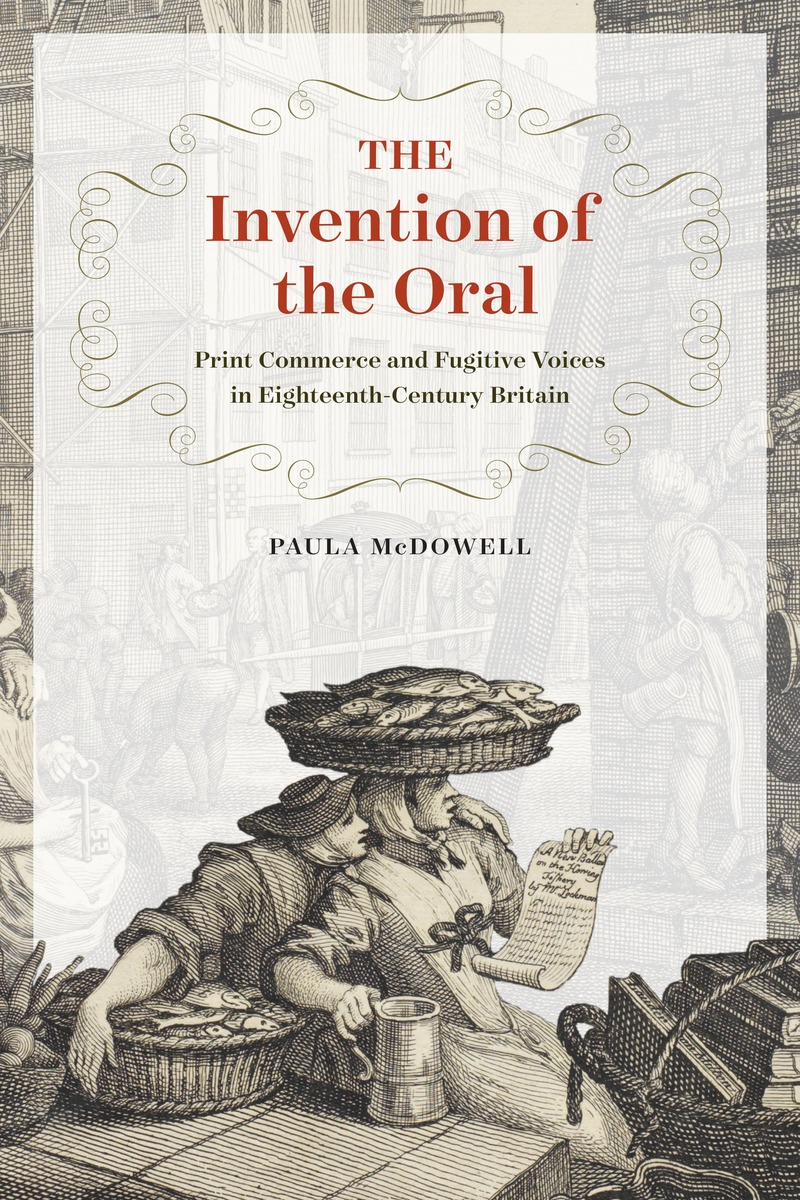
This chapter is the first detailed analysis of the topos of “Billingsgate eloquence” in Restoration and eighteenth-century poetry, periodical essays, novels, rhetorical discourse, and satiric prints. Billingsgate was a fish market, and Billingsgate fishwives were street vendors who relied on their voices to sell their goods. After providing historical background on these working women, this chapter scrutinizes representations of fishwives' voices in verbal and visual texts. In eighteenth-century Britain, "Billingsgate" came to signify a type of discourse, and this chapter argues that authors and artists used the trope of Billingsgate eloquence to work through growing anxieties pertaining to print commerce and to politeness. Critics used representations of oral discourse to comment on the expanding world of print. A surprising number of depictions of fishwives suggest concerns regarding the consequences of literacy: particularly, traditionally elite oratorical skills supposedly being surrendered through negligence to “vulgar” (sometimes threatening) social groups. Fishwives are often depicted as shaming literate gentlemen. Meanwhile, elocutionists argued that "bookish gentlemen's" reliance on texts was undermining their speaking skills. Examining the relationship between the trope of Billingsgate rhetoric and the oral practices of fishwives can help explain the use of this trope by rhetoricians such as Adam Smith. (pages 192 - 228)
This chapter is available at:
https://academic.oup.com/chica...
7. “The Art of Printing Was Fatal”: The Idea of Oral Tradition in Ballad Discourse - Paula McDowell
DOI: 10.7208/chicago/9780226457017.003.0008
[ballad revival;binary model of orality and literacy;displacement model of media shift;Homer;media shift;minstrels;oral poetry;oral tradition;Ossian;Thomas Percy]
Eighteenth-century Britain saw the emergence of an extensive print discourse about ballads. Whereas early eighteenth-century commentators such as Joseph Addison took for granted the multimedia nature of balladry (oral, manuscript, printed), later ballad scholars such as Thomas Percy and William Motherwell posited a distinct “oral tradition” of balladry that was antithetical to and threatened by commercial print. The later eighteenth century saw landmark arguments for oral tradition: Robert Wood advanced the first detailed case for Homeric orality, while James Macpherson claimed to have translated the works of a third-century "Homer of the Highlands," Ossian. This chapter argues that eighteenth- and early nineteenth-century ballad scholars, influenced by and influencing these related debates, contributed significantly to the emergence of our modern secular concept of “oral tradition.” Editors and theorists such as Percy and Motherwell printed groundbreaking collections of ballads, yet their hostility towards broadside ballads (and more generally, commercial print) contributed to a problematic “displacement” model of media shift still with us today, whereby one mode of communication is imagined as destroying (rather than preserving) another. Ballad scholars also contributed to a binary model of orality and literacy by forging a sharp conceptual (not actual) separation between “oral” and “printed” ballads. (pages 229 - 250)
This chapter is available at:
https://academic.oup.com/chica...
8. Conjecturing Oral Societies: Global to Gaelic - Paula McDowell
DOI: 10.7208/chicago/9780226457017.003.0009
[comparative media studies;conjectural history;Homer;literacy;media history;Samuel Johnson;Ossian;Scotland;stadial models;travel writing]
Travel writings constituted a major branch of the book trade, and the dissemination of information about sophisticated global populations seemingly without writing generated interest in what we might now call oral societies. Texts by diplomats, missionaries, and others addressed oral tradition in societies from China to Peru. These texts influenced debates concerning Homeric illiteracy, and they generated new interest in the possibility of oral traditions within Britain. Meanwhile the Ossian debate inspired readers to imagine how tradition worked. The second half of this chapter reads Samuel Johnson’s Journey to the Western Islands of Scotland as a critique of conjectural history and a political argument pertaining to orality and literacy. Conjectural historians attempted to make sense of the diversity of human societies by placing these societies along a single evolutionary chain, but in so doing they arguably separated them further from one another. Departing from earlier interpretations, this chapter argues that the Journey exposes the implications of the elite idealization of oral tradition at a time when many Britons (including most Highlanders) could not read. Johnson’s distrust of his contemporaries’ valorization of oral tradition was tied to his sense that in the world of print, poverty and illiteracy would go together. (pages 251 - 284)
This chapter is available at:
https://academic.oup.com/chica...
Coda: When Did “Orality” Become a “Culture”? - Paula McDowell
DOI: 10.7208/chicago/9780226457017.003.0010
[anthropology;culture;ethnography;E. B. Tylor;Marshall McLuhan;load-bearing concept;media history;oral culture;popular culture;Walter Ong]
In eighteenth-century Britain, “culture” referred to the care of crops or animals. No author used the term "oral culture," for the anthropological idea of a culture as a way of life did not exist. In the nineteenth century, the idea of culture as the outcome of a process of human cultivation developed into what anthropologist Edward Burnett Tylor called culture in its "wide ethnographic sense." In the 1960s, Walter Ong popularized “oral culture" -- as Marshall McLuhan popularized "print culture" -- and the idea of oral culture generated major research in fields such as history, sociology, folklore, and literary studies. The term dates to the 1960s, but the idea long preexisted the term. The reflection on oral tradition and oral discourse analyzed in this book represents a key phase in the history of these concepts. Throughout the eighteenth century, one finds ethnographers, anthropologists, and theorists of what we would now call oral culture. To trace the historical development of an abstract concept of the oral has required us to identify and analyze embryonic ideas as well as explicit statements. This book argues that the eighteenth-century invention of the category of the oral was a back-formation of the spread of print. (pages 285 - 288)
This chapter is available at:
https://academic.oup.com/chica...