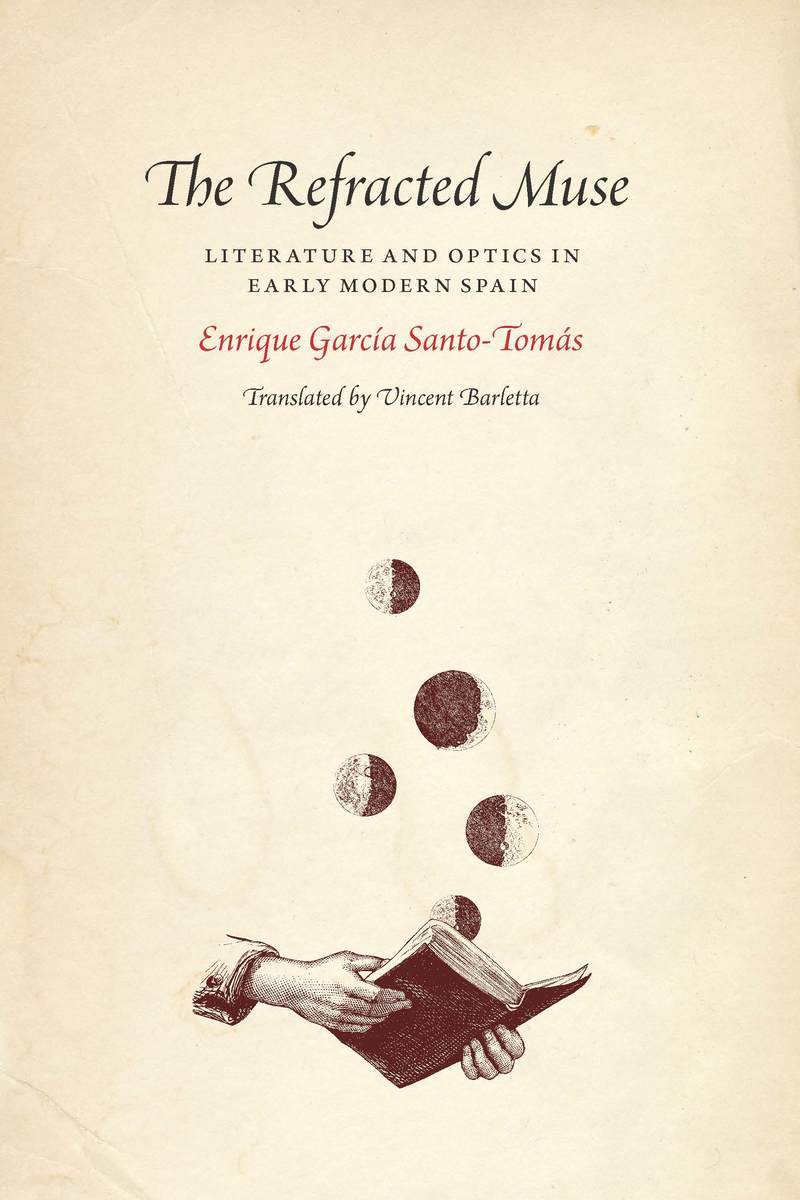
REVIEWS
“The greatest merit of The Refracted Muse is that by conceiving of the realms of scientific and cultural production as existing in a ‘shared universe’ it can explore how discipline-specific language accrues new meaning as it moves into new modes of artistic expression and audiences. This approach allows García Santo-Tomás to consider a significant number of examples—novels, essays, poems, and theater—through which to explore the reception and adoption of the telescope in Baroque Spain. There is no book in English on this subject—let alone one that surveys as effectively as this book does the telescope’s influence in both scientific and literary production of the Spanish Golden Age.”
— María M. Portuondo, Johns Hopkins University
“An immensely erudite and suggestive book, The Refracted Muse is not only a major contribution to the development of Spanish literature but also to the intersection between literature, astronomy, and optics. This new revised and translated version surpasses even the original. The translation is crisp, nuanced, and accurate, exhibiting the original as if it were through a lens that captures, clarifies, and amplifies its most important insights.”
— Frederick de Armas, University of Chicago
"The Reflected Muse presents a refreshing perspective on the interaction between Baroque Spanish literature and the scientific developments of the seventeenth century, displaying both erudition and insight."
— Isis
"One of those rare books that contribute to redefining a field . . . . The sheer erudition might in fact be overwhelming were it not for García Santo-Tomás’s engaging style and adept articulation of arguments that sustain one’s interest. . . . We are very fortunate to have this book, now exquisitely rendered in both the original Spanish and—owing to Vincent Barletta’s superb translation—in English . . . . If Enrique García Santo-Tomás hadn’t written it, I don’t know of anyone so knowledgeable and insightful about both seventeenth-century science and literature capable of doing so: we would have been left pretty much in the dark."
— Modern Philology
"This fascinating book rewrites the history of astronomy and optics in early modern Spain. . . . a ground-breaking study that shows that Spain did not turn away from science, but that it considered, discussed, and utilized some of the Italian experiments in the many literary genres of the period, and particularly in the novel. Lucid and learned, it is bound to fascinate those interested in early modern science and in the relations between science and literature, while providing new approaches to Spanish texts. Curious readers that turn their occhiali to this volume will be rewarded with new vistas and insights as the author unveils startling discoveries and shows the intimate relation between inventions and genres."
— Hispanic Review
"Insightful and interesting. . . . This book offers an important overview of the ways in which scientific ideas and instruments were debated and represented in seventeenth-century Spain and how they were used to understand the social world—maybe announcing in some ways ideas that would become central to the Enlightenment. I benefited immensely from this book’s analysis of seventeenth-century Spanish authors, their works, and their ideas about eyeglasses and science."
— Bulletin of the Comediantes
"A richly detailed study of admirable erudition that explores the material and discursive production brought about by the Scientific Revolution in early modern Spain. . . . Santo-Tomás has produced a splendidly learned and rigorous study of an area that was in much need of exploration, a most valuable contribution to the legacy of scientific knowledge in Baroque Spain."
— Bulletin of Spanish Studies
TABLE OF CONTENTS
Introduction - Enrique García Santo-Tomás, Vincent Barletta
DOI: 10.7208/chicago/9780226465876.003.0001
[Galileo;ecclesiastical authorities;Spain;theoretical framework;methodological framework]
The Introduction establishes the theoretical and methodological framework for the itinerary through the book. It also sets the stage on which to build the different networks between cultures and agents. From this historical perspective it pays close attention to the different social and scientific parameters that surrounded Galileo’s work, his achievements, and his frustrations. It also includes—albeit briefly, since this is not its primary goal—a summary of Galileo’s tempestuous relationships with the civil and ecclesiastical authorities of his era, to provide a sense of what Spain did and did not absorb from all these polemics. (pages 1 - 26)
This chapter is available at:
https://academic.oup.com/chica...
1. Observations - Enrique García Santo-Tomás, Vincent Barletta
DOI: 10.7208/chicago/9780226465876.003.0002
[Academy of Mathematics;Bartolomé Leonardo de Argensola;Galileo;Madrid;telescope;Imperial College;Benito Daza de Valdés;ophthalmology;treatises]
“Observations” begins with the section “Galileo’s telescope and the Spanish gaze,” which examines the voyage of Galileo’s telescope to the Spanish court and its arrival in Madrid’s academic and scientific circles. It delves into the different diplomatic networks established between Tuscany, Rome, and Madrid, as well as into Galileo’s own attempts to travel to Spain through contacts like the Spanish poet Bartolomé Leonardo de Argensola (1562–1631). It also includes a cursory survey of the history of the famous Academy of Mathematics (Academia de las Matemáticas)—later turned into the powerful Imperial College (Colegio Imperial)—paying particular attention to those figures who were pivotal in its development. This chapter also examines the role of certain agents in the social and political arena that will later appear throughout the study. The second section, “First symptoms: The ‘new physics’ and the treatises on optics,” analyzes a number of passages from the most important and comprehensive treatise of its time, Benito Daza de Valdés’s Uso de los anteojos (Use of eyeglasses, 1623). This is a text that incorporates a number of findings from Galileo’s Sidereus nuncius (Starry messenger, 1610) without ever mentioning the name of the famous astronomer or his groundbreaking treatise. (pages 29 - 66)
This chapter is available at:
https://academic.oup.com/chica...
2. Foundations - Enrique García Santo-Tomás, Vincent Barletta
DOI: 10.7208/chicago/9780226465876.003.0003
[Miguel de Cervantes;Luis de Góngora;Lope de Vega;Salas Barbadillo;Tirso de Molina]
“Foundations” concentrates on the years in which Spanish fiction begins absorbing new ideas, dialogue with foreign titles, and understanding the uses of new measuring instruments as they arrived in the Iberian Peninsula. Its first part, “Science (and) fiction: Elements for a new mechanics,” examines a number of texts by Miguel de Cervantes (1547–1616), Luis de Góngora (1561–1627), Lope de Vega, Alonso Jerónimo de Salas Barbadillo (1561–1635), and Tirso de Molina (1579–1648). It highlights the different tensions that arise from a personal and from an institutional point of view when these writers—some of them members of the church and educated under a Ptolemaic vision of the cosmos—incorporate new ideas coming from the writings of Johannes Kepler, Tycho Brahe, and Nicolaus Copernicus, among others. (pages 69 - 90)
This chapter is available at:
https://academic.oup.com/chica...
3. Assimilations - Enrique García Santo-Tomás, Vincent Barletta
DOI: 10.7208/chicago/9780226465876.003.0004
[Trajano Boccalini;Italian influence;Tomaso Garzoni;Suárez de Figueroa;eyeglass;vanity]
In “Assimilations,” the “Italian influence and the culture of knowledge” is represented by two pieces that are seminal to the understanding of why some optical tools reached such levels of controversy: the polemical anti-Spanish invective Ragguagli di Parnaso (Newsletter from Parnassus, 1612) by Trajano Boccalini (1556–1613)—a piece that was read by many Spaniards in its original language—and Tomaso Garzoni’s La piazza universale di tutte le professioni del mondo (The universal plaza of all the world’s professions, 1585) translated quite loosely by Cristóbal Suárez de Figueroa (1571–1644) as Plaza universal de todas ciencias y artes (The universal plaza of all sciences and arts, 1615). These two titles in particular help understand why certain fictional scenarios—the city, the market, the optical shop, Mount Parnassus—allowed for the critique of the eyeglass as a symbol of vanity and, by extension, of a society in complete decay. (pages 91 - 114)
This chapter is available at:
https://academic.oup.com/chica...
4. Inscriptions - Enrique García Santo-Tomás, Vincent Barletta
DOI: 10.7208/chicago/9780226465876.003.0005
[Juan de Espina;collecting;poetry;Alonso de Castillo Solórzano;Anastasio Pantaleón de Ribera;Juan de Piña]
“Inscriptions” focuses on how the circulation of technical expertise between Spain and certain Italian territories facilitated the propagation of a new model of scientific endeavor in Spain that was influenced by the prestige of the Italian accademia. The section “Visible intermittence: The voyage of the secret and the creation of the virtuoso,” argues that a figure like the famous collector Juan de Espina (ca. 1563–1642) illuminates how specific forms of scientific dissemination, and in particular those stemming from the nuova scienza, succeeded in Spain. Espina was a Spanish virtuoso, whose life and deeds intrigued and fascinated many of his neighbors, and whose network of contacts went all the way up to the monarchs. The mystery and appeal of his famous house, in which he stored a Galilean telescope, resulted in a number of literary tributes by the most illustrious writers of his time, including Alonso de Castillo Solórzano (1584–1647), Anastasio Pantaleón de Ribera (1580–1629), Juan de Piña (1566–1643), and Luis Vélez de Guevara (1579–1644). (pages 115 - 132)
This chapter is available at:
https://academic.oup.com/chica...
5. Situations - Enrique García Santo-Tomás, Vincent Barletta
DOI: 10.7208/chicago/9780226465876.003.0006
[city;watchtower;Rodrigo Fernández de Ribera;Antonio Enríquez Gómez;satire]
“Situations” examines a number of imaginary places—although in many cases one can identify specific locations—in the most important fictional accounts of the first thirty years of the seventeenth century. The chapter’s two sections (“The city’s refracted space” and “Watchtowers, visions, horizons”) can be read as a long sequence in which to establish a number of parameters for the study of urban spaces in the Spanish Baroque. It explains how a number of specific pieces captured the anxieties and concerns of the time. It analyzes two satires by Rodrigo Fernández de Ribera (1579–1631) and Antonio Enríquez Gómez (1601–1661), which offer a fascinating glimpse of the city from an allegorical watchtower, to acquire a more precise and unbiased view of their surroundings. (pages 135 - 156)
This chapter is available at:
https://academic.oup.com/chica...
6. Explorations - Enrique García Santo-Tomás, Vincent Barletta
DOI: 10.7208/chicago/9780226465876.003.0007
[satire;Madrid;aerial voyage;social critique;Vélez de Guevara;El Diablo Cojuelo;Juan Enríquez de Zúñiga]
“Explorations” gives an account of a slightly different perspective, that of the aerial voyage, as it reveals the impact of Galileo’s oeuvre on the writers who chose this narrative device. The section “The social critique in the universe of glass” reviews the novel that most comprehensively contributed to this dialogue, Luis Vélez de Guevara’s El diablo cojuelo (The limping devil, 1641), which provides the first direct mention in Spanish of the famous astronomer. “Dream/vigil: Moons, moles, and lunatics in the poetry of the Baroque” traverses the literary skies with Juan Enríquez de Zúñiga (ca. 1580–1642) and Anastasio Pantaleón de Ribera in their particular conflation between the Ptolemaic and the Copernican, mixing the old and the new in a bitter denunciation of contemporary mores. (pages 157 - 178)
This chapter is available at:
https://academic.oup.com/chica...
7. Interventions - Enrique García Santo-Tomás, Vincent Barletta
DOI: 10.7208/chicago/9780226465876.003.0008
[spyglass;politics;vision;Francisco de Quevedo;Diego de Saavedra Fajardo;emblem]
“Interventions” reflects on the impact of the spyglass and the telescope in two political satires. The section “The political intervention I: The transatlantic prism” deals with the sophisticated view of the spyglass in the vignette “Los holandeses en Chile (The Dutchmen in Chile),” included in the satire La hora de todos (The hour of all, 1650) by Francisco de Quevedo (1580–1645)—a writer who may have met Galileo in Rome in 1616, and who portrays himself as a lynx in his treatise to Philip IV El lince de Italia u zahorí español (The lynx of Italy or the Spanish diviner, 1628). The second section, “The political intervention II: The transalpine prism,” studies an emblem, empresa 7 from Diego de Saavedra Fajardo’s Empresas políticas (Political advice, 1640). With the motto auget et minuit (waxes and wanes) and a telescope as the pictura, or image, the Spanish moralist offers a fascinating meditation on the limits and abuses of absolutist power. (pages 181 - 210)
This chapter is available at:
https://academic.oup.com/chica...
8. Reverberations - Enrique García Santo-Tomás, Vincent Barletta
DOI: 10.7208/chicago/9780226465876.003.0009
[theater;illusion;Calderón de la Barca;Andrés Dávila y Heredia;Francisco Santos;eyewear shop]
“Reverberations” revisits a number of pieces published at the end of the century in which the understanding of new cosmology is still met with traces of doubt, and even resistance. The section “Foreign muses, local verses” opens the discussion with the playwright Calderón de la Barca (1600–1681)—for some, a full-fledged Copernican—and follows with two poets based in Northern Europe, Bernardino de Rebolledo (1597–1676) and Miguel de Barrios (né Daniel ha-Levi, 1635–1701), whose work combines the modern tastes of academicism (from Copenhagen and Amsterdam, respectively) with the traditional flavor of Castilian poetics. But the fatigue and disillusion so typical of the late Baroque can be felt in Spain too with the creation of new scenarios like the bazaar, where one can purchase all kinds of eyeglasses that allow for a disenchanted examination of the present. The section “Strained vision: The eyewear shop” closes this itinerary with two important moralists, the soldier and professor of mathematics Andrés Dávila y Heredia (fl. 1674) and the novelist Francisco Santos (1623–1698), who were very popular in their time, and who prove extremely useful when it comes to understanding how optics was used to comment on contemporary mores at the sunset of this kaleidoscopic century. (pages 211 - 234)
This chapter is available at:
https://academic.oup.com/chica...
Conclusions - Enrique García Santo-Tomás, Vincent Barletta
DOI: 10.7208/chicago/9780226465876.003.0010
[Spain;literary history;philosophy of science;history of science]
This section explores certain “lights, shadows, eclipses” of Spain’s literary history through a number of texts and authors of the last four centuries. It gives some coherence to the previous chapters while offering new venues of study through a number of questions that remain open for discussion. These questions, it argues, not only are posed to the literary critic but also pertain to the domains of the history and philosophy of science, given that it is from these three territories that the analysis began. (pages 235 - 242)
This chapter is available at:
https://academic.oup.com/chica...