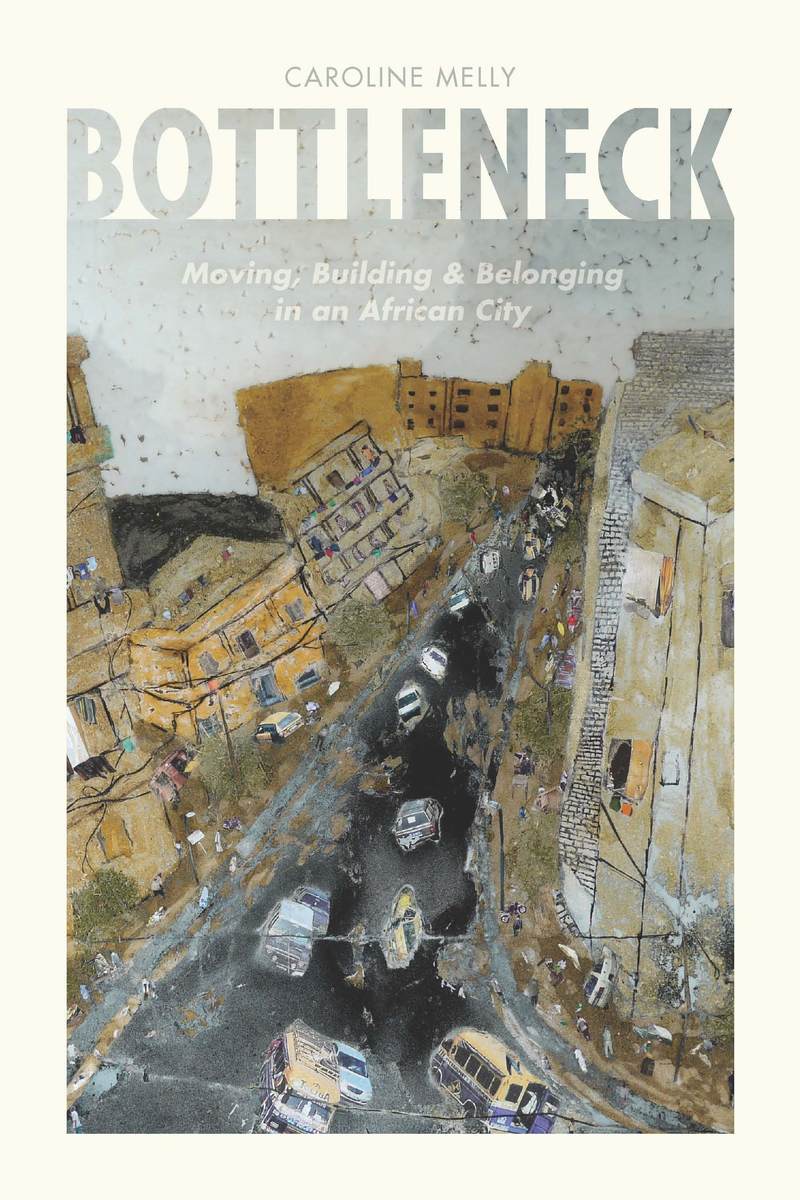
TABLE OF CONTENTS
Introduction/ Embouteillage - Caroline Melly
DOI: 10.7208/chicago/9780226489063.003.0001
[bottleneck;infrastructure;gender;ethnographic research;bureaucracy;citizenship;migration;Africa;structural adjustment;mobility]
This chapter introduces the reader to the profound cultural paradox at the heart of this book: that mobility—particularly transnational migration—is both a cherished collective value and an increasingly restricted and impossible goal for the majority of Dakar’s residents. Beginning with the anthropologist’s story of “arrival” in the field, the introduction considers the urban embouteillage as a tangible expression of this paradox and as a critical indigenous framework for making sense of its contradictory effects on urban life and policy. The chapter does three things: It familiarizes the reader with the concept of the bottleneck and its everyday uses. It reflects on the challenges and opportunities offered by ethnographic research in this volatile context. It elaborates the bottleneck as an instance and site of infrastructural overload; a gendered experience of citizenship; an everyday bureaucratic reality after structural adjustment; and a critical vantage point for writing about Africa’s worldliness. (pages 1 - 26)
This chapter is available at:
https://academic.oup.com/chica...
One/ Making Mobility Matter - Caroline Melly
DOI: 10.7208/chicago/9780226489063.003.0002
[colonialism;postcolonialism;Dakar;Senegal;history;mobility;urban space;authority;citizenship;migration]
Chapter 1 opens as youth clash with Senegalese gendarmes on the storied campus of Université Cheikh Anta Diop, their skirmish reportedly fueled by officers’ taunting reminders that the students’ credentials were of little value if not earned abroad. By situating this heated encounter—and the questions it raises about migration, citizenship, and governance in contemporary Dakar—within both urban space and historical context, this chapter argues that urbanites’ preoccupations with mobility and embouteillage are at once enduring and newly urgent. The remainder of the chapter touches down at key moments in Dakar’s colonial and postcolonial history to highlight how conceptions of citizenship became entangled through time with experiences of urban and global mobility, the built environment, and shifting forms of authority, thus setting the scene for the chapters that follow. (pages 27 - 48)
This chapter is available at:
https://academic.oup.com/chica...
Two/ Trafficking Visions - Caroline Melly
DOI: 10.7208/chicago/9780226489063.003.0003
[urban space;construction;infrastructure;taxi driver;bottleneck;traffic;transportation;belonging;ethnography;transportation]
Accompanying cab drivers as they move along the city’s emergent highways and neglected side roads, this chapter considers what citizenship and governance look like for many urban residents in an era of intense urban construction and infrastructural impasse. The chapter argues that the traffic bottleneck indexed deep concerns about the suspension of lives and itineraries, but it also offered unexpected strategies and occasions for recuperating the meantime—for elaborating networks, hatching plans, revising legitimate practices, and claiming identities that helped bridge the inescapable present with far-off, mobile futures. In doing so, the chapter positions taxi drivers’ experiences and perspectives as normative rather than derivative, alternative, or contrary to official visions for the city. It thus works toward developing the embouteillage as a critical ethnographic framework for thinking about the paradoxes of contemporary urban belonging in Dakar more broadly. (pages 49 - 76)
This chapter is available at:
https://academic.oup.com/chica...
Three/ Inhabiting Inside-Out Houses - Caroline Melly
DOI: 10.7208/chicago/9780226489063.003.0004
[housing construction;squatters;laborers;migration;citizenship;dwelling;building;urban landscape;neoliberalism]
This chapter employs the lens of embouteillage to consider another seemingly stalled urban project: the construction of concrete houses and villas, often funded by diasporic Senegalese. While scholarly literature would be inclined to see these often “empty” and unoccupied houses as evidence of the incapacity of the adjusted state and the failure of neoliberalism, urban residents’ narratives and engagements highlighted these houses as sites and signs of mobility’s dramatic potential to transform both the city and citizenship. Drawing on ethnographic work with returned migrants, families with loved ones abroad, state workers, and residents “stuck” in the city, this chapter explores the city landscapes, social networks, and economies that these structures both generated and sustained. Dakar’s bottlenecked houses created rare opportunities and spaces in the city for rural residents who came to work as laborers in the construction sector, tend to vacant properties, or squat in unoccupied structures while looking for work in the city. Despite their evident erosion, this chapter argues, these structures also enabled urban residents to make particular kinds of future-oriented claims on the city, thereby shaping the ways people thought about dwelling, building, citizenship, and migration. (pages 77 - 100)
This chapter is available at:
https://academic.oup.com/chica...
Four/ The Adjusted State in the Meantime - Caroline Melly
DOI: 10.7208/chicago/9780226489063.003.0005
[diasporic entrepreneur;structural adjustment;postcolonialism;Africa;state;bureaucracy;transnational migration;development;investment;failure]
Drawing on ethnographic research within an elite, quasi-state organization called APIX, this chapter examines bureaucratic bottlenecks and their implications. Faced with sluggish foreign investment rates, APIX administrators worked to construct a program that would transform remitting migrants into large-scale investors in Senegal’s “emergent” economy. The project reflected both global trends in development and local strategies for linking transnational migrants and the communities they left behind. What was particularly striking about APIX’s Diasporic Entrepreneur program was that it remained in the planning stages for many years, without enrolled investors, caught between the grim economic realities of the present moment and its ambitious future goals. Rather than theorizing employees’ efforts as indicative of the failure, emptiness, or dysfunction of the postcolonial African state, this chapter adapts the bottleneck concept to examine how various institutional actors used the stalled project as a platform upon which to build alliances, exchange ideas, and redefine the contours of legitimate economic intervention. In doing so, APIX officials cast the African state as newly relevant, future-focused, and present through its strategic and purposeful of absence. Moreover, they institutionalized new visions of the productive citizen, casting the affluent, absent—and indeed mythical—migrant as a spectacularly present national leader. (pages 101 - 130)
This chapter is available at:
https://academic.oup.com/chica...
Five/ Telling Tales of Missing Men - Caroline Melly
DOI: 10.7208/chicago/9780226489063.003.0006
[clandestine migration;failure;entrepreneurialism;risk;crisis;rumor;storytelling;state;West Africa]
This chapter focuses on the most tragic of Dakar’s bottlenecked flows: in 2006 alone, tens of thousands of clandestine migrants, the vast majority of whom were men, departed from West Africa’s shores aboard rickety fishing boats called pirogues, headed for “Europe”—despite the well-known fact that nearly all of these voyages ended in repatriation or death. Why participate in a voyage—one that required a steep financial investment—that was almost certain to end in failure and loss? At first glance, these doomed voyages may appear to be evidence of the state’s or neoliberalism’s failure or, seen from another perspective, as the epitome of entrepreneurial risk taking and casino capitalism. Taking a different approach, this chapter uses the concept of embouteillage to analyze the vibrant if volatile economies, identities, and programs that pirogue voyages produce. It pays specific attention to the lively rumor and storytelling conventions that publicly criticized and celebrated clandestine migration. These everyday efforts to come to terms with and manage “crisis,” this chapter argues, in fact query the utility of that term in the first place, drawing attention instead to the modes of self- and state-making made possible by these failed voyages. (pages 131 - 158)
This chapter is available at:
https://academic.oup.com/chica...
Conclusion/ Embouteillage and Its Limits - Caroline Melly
DOI: 10.7208/chicago/9780226489063.003.0007
[bottleneck;Great Recession;housing foreclosure;predicament;governance;authority;belonging;United States;Africa]
The conclusion considers the adaptability and utility of the concept of embouteillage at other moments and in other places. It first argues that the bottleneck remained a culturally relevant and analytically powerful way of understanding life and policy in Dakar after the road projects were complete and the traffic has eased. It then moves beyond the African continent to ask how the concept of embouteillage might help us understand predicaments of governance, authority, and belonging unfolding on other terrains. Focusing in particular on bottlenecked lives and landscapes in the United States in the time of the Great Recession and widespread housing foreclosures, this chapter considers embouteillage as a framework that is at once expressly Senegalese and surprisingly flexible and adaptable. In doing so, the conclusion explores the generative possibilities that are opened up when insights gathered in Dakar are centralized as a normative and productive standard for understanding life lived elsewhere. (pages 159 - 170)
This chapter is available at:
https://academic.oup.com/chica...