ABOUT THIS BOOK
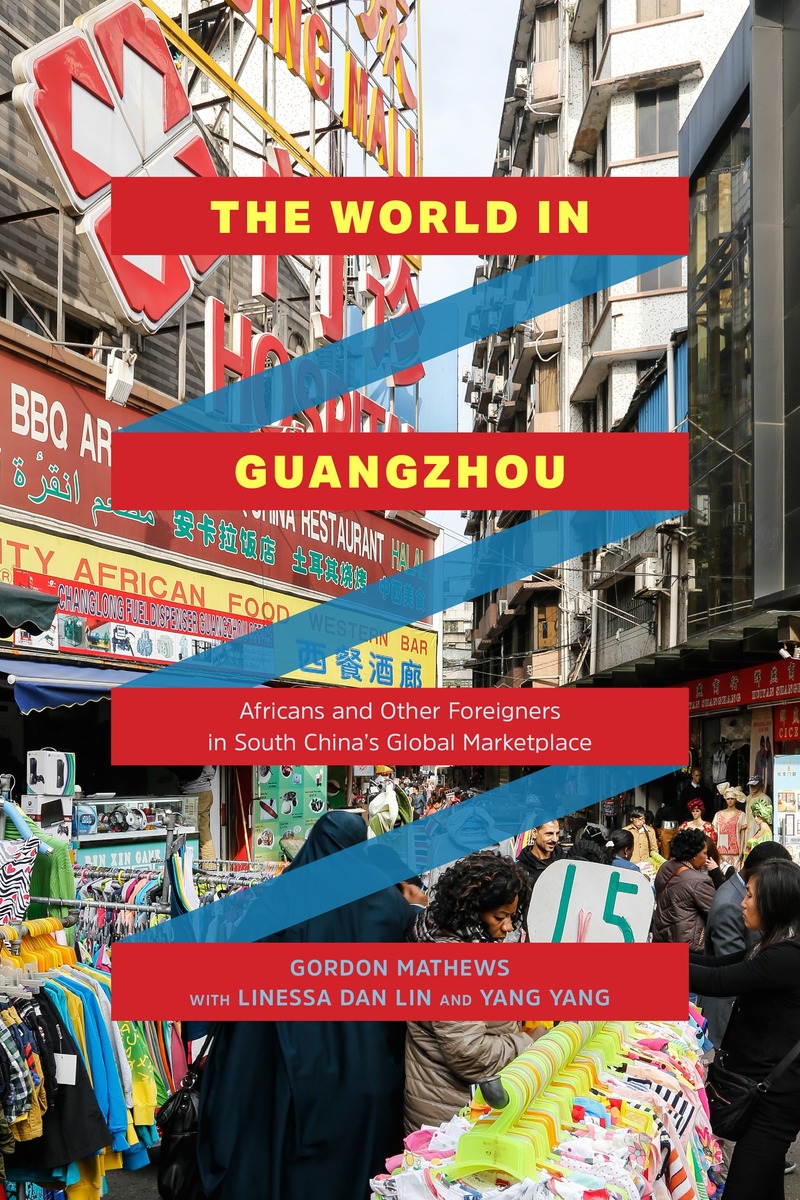
Only decades ago, the population of Guangzhou was almost wholly Chinese. Today, it is a truly global city, a place where people from around the world go to make new lives, find themselves, or further their careers. A large number of these migrants are small-scale traders from Africa who deal in Chinese goods—often knockoffs or copies of high-end branded items—to send back to their home countries. In The World in Guangzhou, Gordon Mathews explores the question of how the city became a center of “low-end globalization” and shows what we can learn from that experience about similar transformations elsewhere in the world.
Through detailed ethnographic portraits, Mathews reveals a world of globalization based on informality, reputation, and trust rather than on formal contracts. How, he asks, can such informal relationships emerge between two groups—Chinese and sub-Saharan Africans—that don't share a common language, culture, or religion? And what happens when Africans move beyond their status as temporary residents and begin to put down roots and establish families?
Full of unforgettable characters, The World in Guangzhou presents a compelling account of globalization at ground level and offers a look into the future of urban life as transnational connections continue to remake cities around the world.
REVIEWS
"[A] pioneering and landmark study. . . . Based on extensive field-work in China and Africa, the book is characterized by a perfect combination of classical ethnographic structure and relaxed jargon-free presentation. It contributes a model of urban ethnography to professional anthropologists and lays the groundwork for laypersons concerned about the prospect of globalization in the post-Coronavirus age."
— Journal of Chinese Overseas
“Compelling stories of corruption and cutthroat competition at the heart of low end globalization in Guangzhou make this the perfect sequel to Mathews’ Ghetto at the Center of the World. The World in Guangzhou is filled with riveting and disturbing tales of racial others, migrants’ dreams of getting rich, and relationships between foreigners—mostly African traders and entrepreneurs—and local Chinese.”
— Nicole Constable, University of Pittsburgh
“I continue to be impressed by Mathews’s combination of a long, skillful buildup of local knowledge with a great sense of how to communicate with a wide readership. To understand Guangzhou and the human face of low-end globalization is to understand a lot about today’s world.”
— Ulf Hannerz, author of Writing Future Worlds: An Anthropologist Explores Global Scenarios
"...a fascinating portrait of the daily functioning of low-end globalization during the early decades of this century."
— newbooks.asia
"Gordon Mathews’ study of Guangzhou, the most important urban center in the probably fastest-growing manufacturing area of the world, addresses the arrival of foreigners to traditionally ethnically homogenous China...Mathews’s peculation about a Chinese Obama who may become the product of this new migration regime illustrates the tensions that play out in today’s world as racial discrimination but also as profit for middlemen bridging the different cultures."
— New Global Studies
TABLE OF CONTENTS
1 Introduction
DOI: 10.7208/chicago/9780226506241.003.0001
[low-end globalization;China;multicultural;Xiaobei;fieldwork;Africans]
This introductory chapter explains what The World in Guangzhou is about andsets forth its two key questions: How can low-end globalization effectively work in a cross-cultural context,and will China ever become truly multicultural?This chapteroffers a brief glimpse of Guangzhou as a city past and present, and discusses its relation to foreigners over its history. It then depicts the foreign neighborhoods of Guangzhou, taking the reader, with the aid of maps and photographs, on an extended walking tour of Xiaobei, the business and recreational center for Africans in Guangzhou.Finally it discusses how Mathews, Lin, and Yang conducted thefieldwork in this book.
2 Foreigners in Guangzhou
DOI: 10.7208/chicago/9780226506241.003.0002
[foreigners;Guangzhou;nationality;race;Japanese;Nigerians;rumor]
This chapter provides portraits of foreigners who have settled for the time being in Guangzhou: a Canadian writer and dreamer, a Nigerian visa overstayer fleeing the police, an American educational entrepreneur, an Arab middleman, beer-drinker, and proselytizer for Islam, a wealthy Ethiopian boutique owner, a penniless European consultant, a young Kenyan woman considering sex work, and an Iranian atheist fleeing calls to prayerThe chapter considers the interplay of “race,” nationality, and money as factors shaping the racial hierarchy of foreigners in Guangzhou; it compares lives within Guangzhou’s two largest communities of foreigners, Japanese and Nigerians; and it examines the large role played by rumor in the lives of foreigners in Guangzhou.
3 African-Chinese Relations
DOI: 10.7208/chicago/9780226506241.003.0003
[African-Chinese relations;deception;cross-cultural miscommunication;quarrels;Chinese;Africans]
This chapter examines African-Chinese relations in Guangzhou. It first provides a broad overview of African traders in the city, and how they live their lives and practice their livelihoods.It thenthen examines business deception, in light of the claim so often made by African traders that “Chinese cheat!” and analyzes this as, most essentially, a problem of cross-cultural miscommunication.It thendepicts and analyzes at lengthtwo business quarrels between Africans and Chinese . It then considers a Chinese NGO seeking to aid Africans in Guangzhou. Finally, it explores Chinese views of Africans, based on the Chinese shopkeepersMathews, Lin and Yanginterviewed, and African views of Chinese.
4 Low-End Globalization
DOI: 10.7208/chicago/9780226506241.003.0004
[low-end globalization;trade;copies;knock-offs;customs;trade circuits]
This chapter discusses “low-end globalization”— trade based in trust and reputation rather than law and contracts, more or less under the radar of the law—in the context of the trade between China and Africa.The chapter discusses at length how low-end globalization works in the sourcing of goods, the sending of money, and copies and knock-offs and how to get these goods through customs in China and into different African countries.The chapteroffers personal accounts of those engaged in low-end globalization, contrasting an American inventor’s frustrations over his copied products with an Arab trader’s delight at the profits he can make through copies. Andthe chapter depicts low-end globalization’s trade circuits from Yiwu to Bangkok to Dubai to Istanbul to Nairobi to Accra, and discusses how low-end globalization works within and between its different global nodes.
5 Legal-Illegal in Guangzhou
DOI: 10.7208/chicago/9780226506241.003.0005
[overstayers;visa;passports;police]
This chapter examines the two very different paths followed by Africans and other foreigners in Guangzhou: those who are legal residentsin the city and those who are illegal overstayers, and thus must constantly be on the lookout for police.Itexamines the visa and passport worries that every foreigner in Guangzhou must be concerned with;itdiscusses police in Guangzhou; and it explores how overstayers survive and pursue their profits while staying a step ahead of police seeking to catch them.It also offers the accounts of overstayersdiscussing their lives and prospects in Guangzhou, with some able to save up enough money to return home, others relying on their Chinese girlfriends, and still others relying on God for their sustenance.
6 Logistics Agents, Middlemen, and Cultural Brokers
DOI: 10.7208/chicago/9780226506241.003.0006
[logistics agents;cargo handlers;customs;middlemen;cultural brokers;cultural ambassadors]
This chapter considers the particular roles of African logistics agents in Guangzhou. They are the ones responsible for sending the goods of traders back home, and have a remarkable store of knowledge as to how to get goods past customs at minimal cost. These logistics agents very often play the role of middlemen between African traders and Chinese suppliers looking to make deals; everyone seeks to be a middleman oneself without having to use middlemen. The chapter also examines the role of African cargo handlers and logistics agents as cultural brokers between China and their ethnic and national compatriots, helping out with a vast array of issues from dealing with police to medical concerns to defusing cheating accusations; more than anyone else in Guangzhou, they are indeed de facto cultural brokers and cultural ambassadors, not from altruism but because this is how they can maintain their business.
7 Religion in a Foreign World
DOI: 10.7208/chicago/9780226506241.003.0007
[religion;Islam;Christianity;underground churches;African traders;China]
This chapter examines the powerful role of religion in traders’ lives, whether Islam or Christianity, and the moral pole that religious belief provides them in an uncertain foreign world. The ongoing litany of many African traders is that “we believe in God but Chinese believe only in gold”; and indeed, the degree of religiosity among most although not all traders is extraordinary. This may be either in terms of Islam or of Christianity, both of which this chapter explores in some detail. The chapter offers extended personal accounts of a deeply religious Muslim trader, a Christian pastor and his wife presiding over an underground church, and a heterodox prophet conversing with God and persuading his fellow traders to give him their tithes. Finally the chapter explores the implications of religion: might the ultimate historical role of African traders in Guangzhou be to make China a religious nation?
8 Romance, Love, Marriage, and Families: A Chinese Barack Obama?
DOI: 10.7208/chicago/9780226506241.003.0008
["African-Chinese";romances;relationships;middlemen;copies;China's future]
This chapter considers romance and relationships between Chinese and Africans, to ask, will Guangzhou become multi-cultural?Itbegins by looking at those few Africans we have met who truly have become “African-Chinese.” It then looks at the travails of Chinese-African romantic relationships, with both sides looking out for their own interests, and with ever-present cultural gaps--although some of these relationships do indeed succeed. Finally,the chapterexamines the larger significance of Africans and other foreigners in Guangzhou. China’s historical role in the early 21st century has been that of bringing globalization to the developing world through copies and knock-offs; but it may be that the role of Africans in Guangzhou may be temporary, as Chinese in Africa may supplant Africans in China in the vaunted role of middleman. Nonetheless, given the inevitable convergence of the developing and developed world, Guangzhou, in its current multi-culturalism, may be a harbinger of the world’s future.