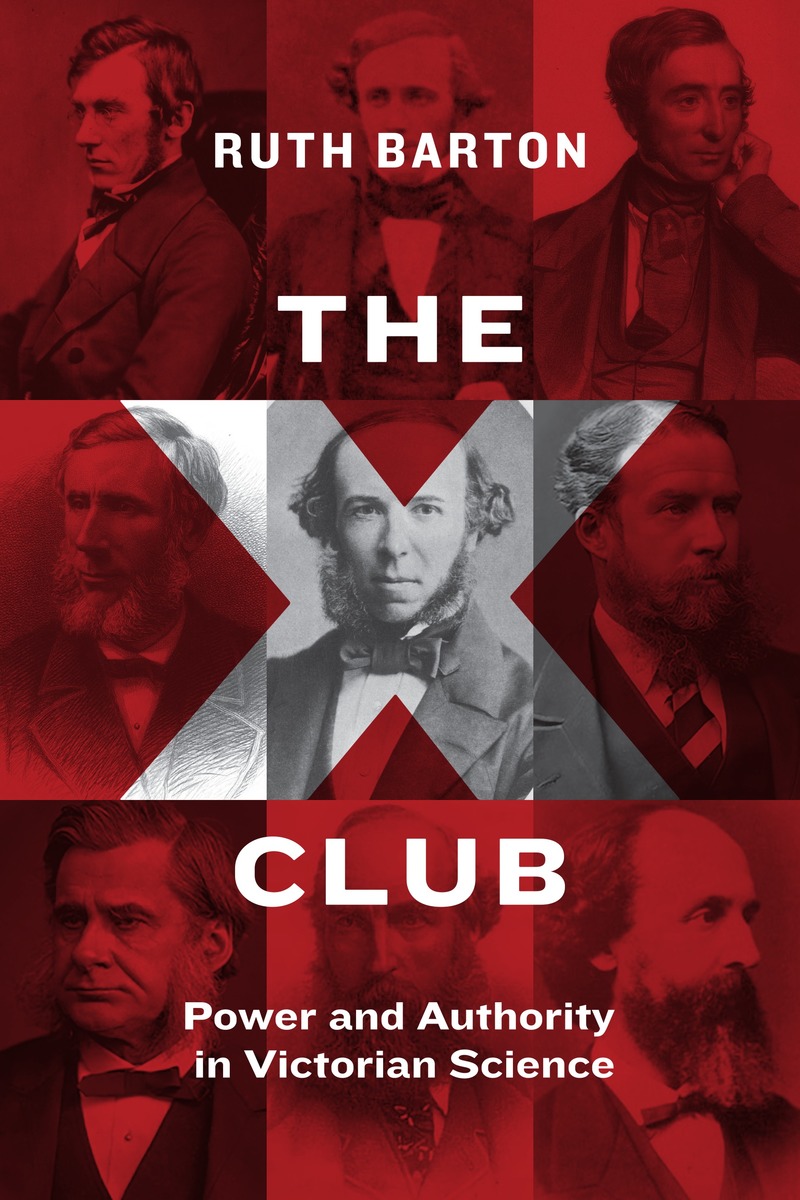
The X Club Power and Authority in Victorian Science
by Ruth Barton
University of Chicago Press, 2018
Cloth: 978-0-226-55161-6 | Electronic: 978-0-226-55175-3
DOI: 10.7208/chicago/9780226551753.001.0001
ABOUT THIS BOOKAUTHOR BIOGRAPHYREVIEWSTABLE OF CONTENTS

ABOUT THIS BOOK

In 1864, amid headline-grabbing heresy trials, members of the British Association for the Advancement of Science were asked to sign a declaration affirming that science and scripture were in agreement. Many criticized the new test of orthodoxy; nine decided that collaborative action was required. The X Club tells their story.

These six ambitious professionals and three wealthy amateurs—J. D. Hooker, T. H. Huxley, John Tyndall, John Lubbock, William Spottiswoode, Edward Frankland, George Busk, T. A. Hirst, and Herbert Spencer—wanted to guide the development of science and public opinion on issues where science impinged on daily life, religious belief, and politics. They formed a private dining club, which they named the X Club, to discuss and further their plans. As Ruth Barton shows, they had a clear objective: they wanted to promote “scientific habits of mind,” which they sought to do through lectures, journalism, and science education. They devoted enormous effort to the expansion of science education, with real, but mixed, success. 

​For twenty years, the X Club was the most powerful network in Victorian science—the men succeeded each other in the presidency of the Royal Society for a dozen years. Barton’s group biography traces the roots of their success and the lasting effects of their championing of science against those who attempted to limit or control it, along the way shedding light on the social organization of science, the interactions of science and the state, and the places of science and scientific men in elite culture in the Victorian era.

AUTHOR BIOGRAPHY

Ruth Barton has taught history at the University of Auckland; social science methodology at Curtin University of Technology in Perth, Western Australia; and mathematics at Victoria University of Wellington.

REVIEWS

"As the author says, she has ‘lived with these men for decades.’  With meticulous and insightful research, she brings to life the complex lives and campaigning of the nine famous X more fully than ever before, revealing them with extraordinary clarity. The roles played by their wives are shown to be significant. Barton’s scholarship maintains a delicate balance between group and individual biography and probes the intellectual and social contexts of 19th century science, challenging previous interpretations. It is a tremendous achievement." 
— Sophie Forgan, coauthor of Urban Modernity: Cultural Innovation in the Second Industrial Revolution

"In her much anticipated book on the X Club, Ruth Barton sets out to draw a colorful and detailed picture of the scientific scene in London in the second half of the nineteenth century.  Barton does not disappoint.  Based on meticulous research, this is the definitive study of the small, exclusive dining club that tried to control British science in a quest for power and scientific authority.  By writing a collective biography of the X Club that does not focus too much on Huxley or any other member, Barton provides a lively, balanced examination of the successes and failures of this fascinating collection of individuals bent on changing the face of modern science."
— Bernard Lightman, author of Victorian Popularizers of Science: Designing Nature for New Audiences

“In Victorian Britain, no one worked more tirelessly or creatively to make science part of public culture than the nine members of the X Club.  Ruth Barton's magisterial group biography gives us the men and their world in the richly rewarding detail we have long needed.  From their diverse backgrounds and beginnings, to the complex challenges they faced, to the importance of friendship in meeting those challenges, we see close up how Thomas Huxley, Joseph Hooker, John Tyndall, and the others exercised power and influence in the service of a new, still influential vision of science and society.”
— Gregory Radick, author of The Simian Tongue: The Long Debate About Animal Language

“For decades in the late 1800s, nine scientific luminaries (among them biologist Thomas Henry Huxley and botanist Joseph Dalton Hooker) dined together as members of the ‘X Club’. This socio-economically diverse group, formed in part to promote Charles Darwin’s achievements, is a telling case study in the dynamics of Victorian class and science. Historian Ruth Barton’s magisterial chronicle traces the careers of the 'X-men' and their agile promotion of science; Huxley, in particular, emerges vividly as wily, belligerent, and obstructive to women entering science.”
— Nature

"Having taught history, social-science methodology, and mathematics at universities in New Zealand and Australia, Ruth Barton is better equipped than most to tackle a group biography of the nine men with whom she has 'lived for decades'. . . . [Barton] takes a fresh approach to the hoary old question of 'science versus religion' in the 19th century . . .  As the 137 pages of end matter attest, detail is 'crucial to the argument of this book'. Serious students of Victorian Christian thought should attend to the detail, while the general reader can enjoy the view, which is panoramic."
— Church Times

"[Barton's] analysis is detailed, convincing and long awaited."
— Geoscientist

"Barton achieve[s] both breadth and depth in her account of mid- to late nineteenth-century scientific careers, and consistently demonstrates the role of social status in shaping the careers of her subjects. . . . Looking beyond the more outspoken X Club members, Barton gains fresh insight into well-worn topics. . . . She has set a significant benchmark in scholarship on the X Club that will no doubt remain the chief reference work on the subject for some time."
— The British Journal for the History of Science

"The outcome of several decades of research, Ruth Barton’s magisterial group biography of the nine men who made up the X Club was well worth waiting for. . . . Barton displays a truly impressive command of both detail and broader historical themes, combining macro- and micro-historical approaches to impressive effect. . . . Her lively sympathy with the dilemmas and challenges facing her protagonists brings them imaginatively to life. The X Club is to be warmly recommended to anyone with an interest in British science in the nineteenth century. It provides an exemplary study of the interactions between class, expertise and the institutions of Victorian science, and has important resonances for the study of other times and contexts in the history of science and for historical studies more generally."
— Intellectual History Review

"A detailed account of one of the most influential networks in Victorian science. It is a book that no other scholar could have produced. Rarely does a historian exhibit such thorough knowledge of the historical actors under investigation. . . . This is a scholarly volume that changes a lot of what we think about the X Club, which is important. As Barton observes, this was a group that wielded social influence and institutional power throughout two crucial decades in which the role of science in society was profoundly changed. It is a subject that matters to historians of science and to a wider readership concerned with science’s relationship with society and the state. The X Club promises to be the definitive work on this influential network for a long time to come."
— Isis: a Journal of the History of Science Society

"The book is more than a story of the X Club members; Barton gives deserved attention to a wide range of previously neglected collaborators, members of what she terms the wider ‘X-network’ including, crucially, nonscientific actors from the worlds of rational dissent, liberal theology and the universities. In so doing, we are able to understand, more clearly than ever before, the complex ways in which members of the X Club formed part of a wider cultural elite in mid-to-late nineteenth-century England. . . . What Ruth Barton has achieved with The X Club is no mean feat. . . . [It] will make a significant contribution to the historiography of Victorian science, not least because of the depth and intricacy of the archival research on which it is based. It is a rich, detailed and insightful microhistory of the lives, relationships and wider networks of a very significant grouping of scientific men."
— Metascience

"The X Club is Barton’s long-awaited “big book”—a culmination of immense amounts of research and writing into the subject of these characters, of 'living with these men for decades'.  As always, her scholarship is superlatively precise. . ."
— Journal of British Studies

"Ruth Barton’s magnificent book. . . . is the product of years of labor in the archives and is destined to become the most authoritative source on the X Club and its meaning for science. It is written by an author at the top of her game. Much more than this, it deserves to be read by any Victorianist interested in how science as a profession emerged from more general natural philosophy in the middle years of the nineteenth century, and how scientists became significant members of the new intellectual and cultural communities emerging in Victorian London. It is a highly accessible account of genuinely momentous movements in Victorian culture that are often overlooked by scholars who may not be inclined to steep themselves in the scholarship of the history of science."
— Victorian Studies

TABLE OF CONTENTS

- Ruth Barton
DOI: 10.7208/chicago/9780226551753.003.0001
[dining clubs;group biography;non-heroic history;Darwinism;scientific naturalism;professionalization;cultural authority;Victorian religion;secularization]
The nine men of the X Club and the approach and themes of the book are introduced. The members, in birth-order, were George Busk, Joseph Dalton Hooker, Herbert Spencer, John Tyndall, Thomas Henry Huxley, William Spottiswoode, Edward Frankland, Thomas Archer Hirst and John Lubbock. They dined together as a formal club from 1864 to 1892. Such dining clubs were common in gentlemanly London. The approach taken is non-heroic. Like group biographies of families and women, it is as much interested in the ways in which the protagonists were representative as those in which they were powerful. Although the members were among Darwin’s leading defenders, their Darwinism must be loosely interpreted to include non-Darwinian developmental schemas. Similarly, scientific naturalism, with which the X Club has been closely associated, is reinterpreted to include its pre-Darwinian and metaphysical sources alongside the scientific aspects usually emphasized. The historiography of professionalization, and the continuing importance of gentlemanly status and manners within science are discussed. Approaches to cultural authority from outside history of science suggest that the range of claimants to cultural authority be broadened beyond “science” and “the Church.” Finally, the variety and importance of religion in Victorian life is emphasized, and “secularization” interpreted. (pages 1 - 36)
This chapter is available at:
    https://academic.oup.com/chica...

- Ruth Barton
DOI: 10.7208/chicago/9780226551753.003.0002
[cultures of science;gentlemanly London science;provincial Dissent;mechanics institute culture;Balliol College, Oxford;specialism in science;London’s scientific societies;changing religious beliefs]
This chapter identifies the diverse cultural contexts that shaped the future members of the X Club: gentlemanly London science (Busk, Hooker and Lubbock), Balliol College, Oxford (Spottiswoode), radical provincial Dissent (Spencer and Huxley), and the mechanics institutes and mutual improvement societies of the industrial north (Frankland, Tyndall and Hirst). The variety of their social backgrounds, scientific ambitions, and religious beliefs opens windows onto early Victorian science more generally. The future X-men included wealthy amateurs pursuing their scientific interests, medically trained men seeking to make reputations and careers in science, and social outsiders seeking to rise in the world through scientific employment. Most saw specialist expertise as the route to scientific recognition. They were all aware of the subtle distinctions of social status and religious belief that shaped Victorian life. Even scientific societies, it is shown, marked their status by the level of their fees. Religious skeptics were expected to constrain their conversation in polite society to avoid giving offence to orthodox believers. The changing religious beliefs of the nine are investigated: varieties of Anglicanism; reinterpretations of religion that rejected dogmatic formulations and associated “true” religion with deep feeling; the politics of Church reform and disestablishment. (pages 39 - 108)
This chapter is available at:
    https://academic.oup.com/chica...

- Ruth Barton
DOI: 10.7208/chicago/9780226551753.003.0003
[careers in science;patrons;social status and scientific recognition;John Tyndall;John Lubbock;J. D. Hooker;Linnean Society of London;specialist journals;Athenaeum Club;shaping public opinion through journalism]
The chapter examines the routes to careers in science in mid-Victorian England–the ways in which reputations were made, the roles of patrons, and the practice of pluralism (that is, the accumulation of supplementary examining, cataloguing, consulting and other contracts in order to make a middle class income). By comparing the early careers of Tyndall and Lubbock the chapter shows that scientific recognition in the Victorian period was based on both social status and scientific achievement; recognition came more easily to the well-born than to the lowly. The chapter then examines the earliest efforts of the X network – led initially by Hooker – to reform scientific institutions, for example, to make the elite but moribund Linnean Society useful to serious researchers. More frequent publication of the society’s journal was a priority that the X-men demonstrated again in other societies. By the late 1850s Hooker and his friends were secure enough in their own careers to move beyond personal concerns. They began to promote broader recognition and appreciation of science and scientific men, for example, by getting men of science elected to the elite Athenaeum Club. Their first collaborative efforts to shape public opinion through journalism date from this time. (pages 109 - 169)
This chapter is available at:
    https://academic.oup.com/chica...

- Ruth Barton
DOI: 10.7208/chicago/9780226551753.003.0004
[theological controversy;Darwin’s Origin of Species;the Natural History Review;filling the gap between apes and humans;the science and politics of race;“liberal opinion”;the Reader;the Lubbock household;the Busk household]
Various controversies in the early 1860s – over Darwin’s Origin, heretical publications by clergymen, and the science and politics of race – drew Lubbock and Spottiswoode into joint action with Hooker, Huxley, and Busk. Huxley, Busk and Lubbock set new directions in their research, focusing on the gaps between apes and humans and between “savage” and “civilised” humans. They took over the Natural History Review, which carried this new research. Lubbock, Spottiswoode and Hooker sought to rouse scientific men to defend free enquiry in theology. In an effort to keep anthropology free from association with extreme racist politics, Lubbock, Huxley, and Busk became active in the Ethnological Society of London. In 1864, as controversy over the relationship between scientific enquiry and theological orthodoxy intensified, Spencer drew his scientific friends into alliance with liberal thinkers in politics and Church to contribute science articles to the weekly Reader and make it an organ of “liberal opinion.” At the same time as this common cause brought naturalists, physical scientists and Spencer together, the households of the Busks and the Lubbocks became the social centers for the growing network. From the common friendships and common causes the X Club was formed in November 1864. (pages 170 - 224)
This chapter is available at:
    https://academic.oup.com/chica...

- Ruth Barton
DOI: 10.7208/chicago/9780226551753.003.0005
[scientific societies;Ethnological Society of London;Anthropological Society of London;Anthropological Institute;Linnean Society of London;British Association for the Advancement of Science;Royal Society of London;the infrastructure for scientific research;maintaining the dignity of science;George Busk]
Through examination of the activities of the X-men within scientific societies this chapter reveals much about the mundane operation of scientific societies, their characteristic organisational structure, the roles of officers, and Victorian expectations as to the roles appropriate to persons of different social statuses. The concerns of the X-men were chiefly with the public image of science, that science be dignified and socially respected, judged by scientific criteria alone. Their specifically professionalizing concerns focused on building the infrastructure for scientific research. They devoted considerable effort to getting themselves elected to high positions in the Royal Society, and ensuring that high birth was no longer a criterion for the presidency. In the Ethnological Society of London, Lubbock, Busk and Huxley sought both scientific and social respectability for the science of man. They succeeded in reuniting the squabbling Ethnological and Anthropological Societies, and in holding the amalgamated Anthropological Institute together. By contrast, in the Linnean Society Hooker lost his long control, largely because Busk and Lubbock refused to act as his lieutenants. Through the British Association they shaped public opinion more widely, using public lectures and presidential addresses to interpret the tendencies and directions of modern science to large audiences. (pages 229 - 291)
This chapter is available at:
    https://academic.oup.com/chica...

- Ruth Barton
DOI: 10.7208/chicago/9780226551753.003.0006
[science education;state aid to science;examinations;the Science and Art Department;the Devonshire Commission;the School of Science, South Kensington;science in liberal education;Thomas Archer Hirst;gender;the X Club wives]
The chapter examines changing modes of support for scientific research and science education. The X-men were deeply committed to the expansion of science education but, contrary to historiographical opinion, were not leading lobbyists for state aid to science. Their activism in education was sustained by the belief that science would change “ways of thinking.” They lobbied, sat on committees, examined, and wrote textbooks. Most notably, Huxley and Lubbock were members of the Devonshire Royal Commission on the advancement of science. They failed to persuade elite public schools and the well-endowed ancient universities that science was essential to a liberal education, but were successful at lower levels, through the burgeoning examination system of the Science and Art Department, which met the aspirations of middling sorts of people. Thus, the School of Science at South Kensington, a school for training teachers, became the chief institution of science education in England and the School of Mines, from which it was carved, diminished in status. Finally, the chapter focuses on Hirst, whose career in science education provides vignettes of the social life of the X Club and of gender issues– including the roles of the Club wives and contemporary controversies on education for women. (pages 292 - 361)
This chapter is available at:
    https://academic.oup.com/chica...

- Ruth Barton
DOI: 10.7208/chicago/9780226551753.003.0007
[representation of scientific men;self-image;scientific missionaries;naturalistic explanation;agnosticism;combativeness;Unitarian allies;positivist allies;cultural authority;anti-Sabbatarian societies]
The chapter examines the X-men’s roles as spokespersons for science. The chief publicists devoted enormous energy to lectures, speeches, and articles addressed to general audiences. They saw themselves as scientific missionaries, converting ignorant “heathen” English to scientific ways of thinking; they represented all scientific men as especially reliable in their reasoning and virtuous in their concern for the public good. The quieter members, it is shown, shared the naturalism of the leading publicists. Naturalism is here reinterpreted as a project to provide a naturalistic account of the universe, from the original fiery nebula to the development of life, mind, and emotion– rather than as based on particular “scientific” theories. They emphasized continuity through deep time, from plant to animal, ape to human, savagery to civilization. By contrast, their statements of agnosticism reveal little common ground. They also differed over the degree of combativeness appropriate in their circumstances. Their interactions with other cultural elites demonstrate both shared goals and conflicts, their own growing cultural authority and the multi-dimensional nature of Victorian cultural authority. Most notably, in anti-Sabbatarian Sunday societies, they cooperated with reforming lawyers, positivists, and Unitarians to oppose devout culture by offering improving lectures as an alternative to Sunday sermons. (pages 362 - 444)
This chapter is available at:
    https://academic.oup.com/chica...

- Ruth Barton
DOI: 10.7208/chicago/9780226551753.003.0008
[rise and decline of the X Club;death of Nelly Lubbock;objectives of the X Club;allies of the X Club;successes and failures of the X Club]
The “Retrospective” provides an overview of the rise and decline of the X Club. Interacting theological, political, and scientific controversies in the early 1860s gave naturalists, physical scientists, and the philosophical Spencer a shared sense of beleaguerment against common enemies. As the Club formed in late 1864 their concerns culminated in an alliance with political and theological liberals to expand the science columns in the weekly Reader. By 1870 their tentacles were everywhere – in scientific societies and education lobbies, and as recognized spokespersons for science. However, as they gained more individual authority the Club became less important as a lobby group. By the late 1870s they often had different priorities and were sometimes critical of one another. In the early 1880s, with the death of Nelly Lubbock, Lubbock’s remarriage, and the deaths of Spottiswoode and Busk, the social centers of the group and the moderating influences among the friends were lost. Club meetings were poorly attended. Nevertheless, in the 1880s they had cultural authority and occasionally united in controversial causes. The chapter sums up their objectives, emphasizes the many allies who were crucial to their successes, acknowledges their failures, and discusses the larger context of their successes. (pages 445 - 466)
This chapter is available at:
    https://academic.oup.com/chica...