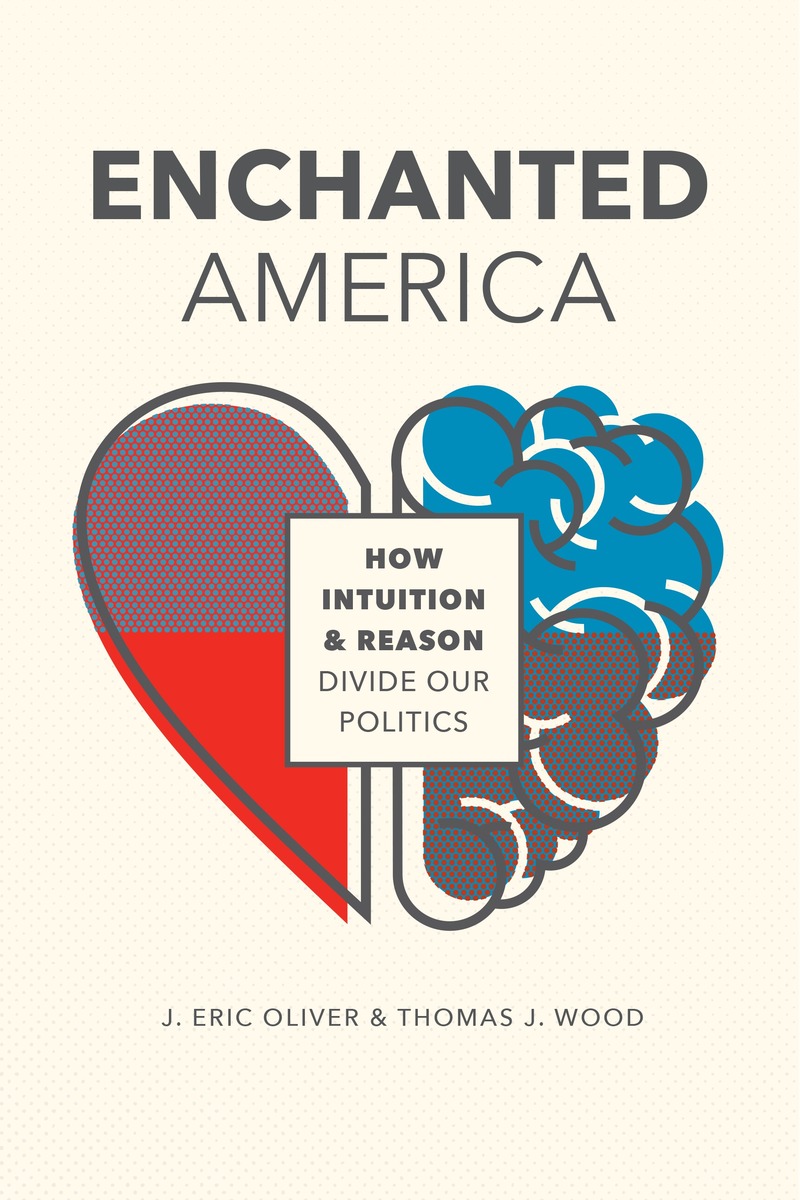
Enchanted America
How Intuition and Reason Divide Our Politics
University of Chicago Press, 2018
Cloth: 978-0-226-57847-7 | Paper: 978-0-226-57850-7 | Electronic: 978-0-226-57864-4
DOI: 10.7208/chicago/9780226578644.001.0001
Cloth: 978-0-226-57847-7 | Paper: 978-0-226-57850-7 | Electronic: 978-0-226-57864-4
DOI: 10.7208/chicago/9780226578644.001.0001
AVAILABLE FROM
University of Chicago Press (paper, ebook)DeGruyter Multi-User Ebook Program
EBSCO eBooks (formerly NetLibrary)
OverDrive
University Press Scholarship Online (UPSO)
ABOUT THIS BOOKAUTHOR BIOGRAPHYREVIEWSTABLE OF CONTENTS
ABOUT THIS BOOK
America is in civic chaos, its politics rife with conspiracy theories and false information. Nationalism and authoritarianism are on the rise, while scientists, universities, and news organizations are viewed with increasing mistrust. Its citizens reject scientific evidence on climate change and vaccinations while embracing myths of impending apocalypse. And then there is Donald Trump, a presidential candidate who won the support of millions of conservative Christians despite having no moral or political convictions. What is going on?
The answer, according to J. Eric Oliver and Thomas J. Wood, can be found in the most important force shaping American politics today: human intuition. Much of what seems to be irrational in American politics arises from the growing divide in how its citizens make sense of the world. On one side are rationalists. They use science and reason to understand reality. On the other side are intuitionists. They rely on gut feelings and instincts as their guide to the world. Intuitionists believe in ghosts and End Times prophecies. They embrace conspiracy theories, disbelieve experts, and distrust the media. They are stridently nationalistic and deeply authoritarian in their outlook. And they are the most enthusiastic supporters of Donald Trump. The primary reason why Trump captured the presidency was that he spoke about politics in a way that resonated with how Intuitionists perceive the world. The Intuitionist divide has also become a threat to the American way of life. A generation ago, intuitionists were dispersed across the political spectrum, when most Americans believed in both God and science. Today, intuitionism is ideologically tilted toward the political right. Modern conservatism has become an Intuitionist movement, defined by conspiracy theories, strident nationalism, and hostility to basic civic norms.
Enchanted America is a clarion call to rationalists of all political persuasions to reach beyond the minority and speak to intuitionists in a way they understand. The values and principles that define American democracy are at stake.
The answer, according to J. Eric Oliver and Thomas J. Wood, can be found in the most important force shaping American politics today: human intuition. Much of what seems to be irrational in American politics arises from the growing divide in how its citizens make sense of the world. On one side are rationalists. They use science and reason to understand reality. On the other side are intuitionists. They rely on gut feelings and instincts as their guide to the world. Intuitionists believe in ghosts and End Times prophecies. They embrace conspiracy theories, disbelieve experts, and distrust the media. They are stridently nationalistic and deeply authoritarian in their outlook. And they are the most enthusiastic supporters of Donald Trump. The primary reason why Trump captured the presidency was that he spoke about politics in a way that resonated with how Intuitionists perceive the world. The Intuitionist divide has also become a threat to the American way of life. A generation ago, intuitionists were dispersed across the political spectrum, when most Americans believed in both God and science. Today, intuitionism is ideologically tilted toward the political right. Modern conservatism has become an Intuitionist movement, defined by conspiracy theories, strident nationalism, and hostility to basic civic norms.
Enchanted America is a clarion call to rationalists of all political persuasions to reach beyond the minority and speak to intuitionists in a way they understand. The values and principles that define American democracy are at stake.
AUTHOR BIOGRAPHY
J. Eric Oliver is professor of political science at the University of Chicago. Thomas J. Wood is assistant professor of political science at Ohio State University.
REVIEWS
"This may well be the single most important book on public opinion in the last quarter century. The authors challenge our fundamental understanding of how individuals form opinions and engage in politics. It will surely stimulate debates for a generation, while at the same time dramatically enhancing what we know about citizens."
— James N. Druckman, Northwestern University“For decades, we have observed low information responses from a proportion of the mass electorate and thought we were observing a defective version of deductive reasoning. Enchanted America tells us that it isn’t defective deduction but something else entirely. And that changes everything; a truly exciting read.”
— James A. Stimson, University of North Carolina at Chapel HillTABLE OF CONTENTS
Introduction: You Believe in Reason, and I Believe in the Bible 1 - J. Eric Oliver, Thomas J. Wood
Chapter 1: If There’s No Monster in the Closet, Then Why Am I Afraid? - J. Eric Oliver, Thomas J. Wood
Chapter 2: Taking Measure of Our Intuitions - J. Eric Oliver, Thomas J. Wood
Chapter 3: Who Is an Intuitionist? - J. Eric Oliver, Thomas J. Wood
Chapter 4: Intuitionists and Ideologues - J. Eric Oliver, Thomas J. Wood
Chapter 5: Truthers and Trumpenvolk - J. Eric Oliver, Thomas J. Wood
Chapter 6: Feeling White and Hating Foreigners - J. Eric Oliver, Thomas J. Wood
Chapter 7: Scary Foods and Dangerous Medicine - J. Eric Oliver, Thomas J. Wood
Chapter 8: A Nation Divided by Magic - Calvin TerBeek