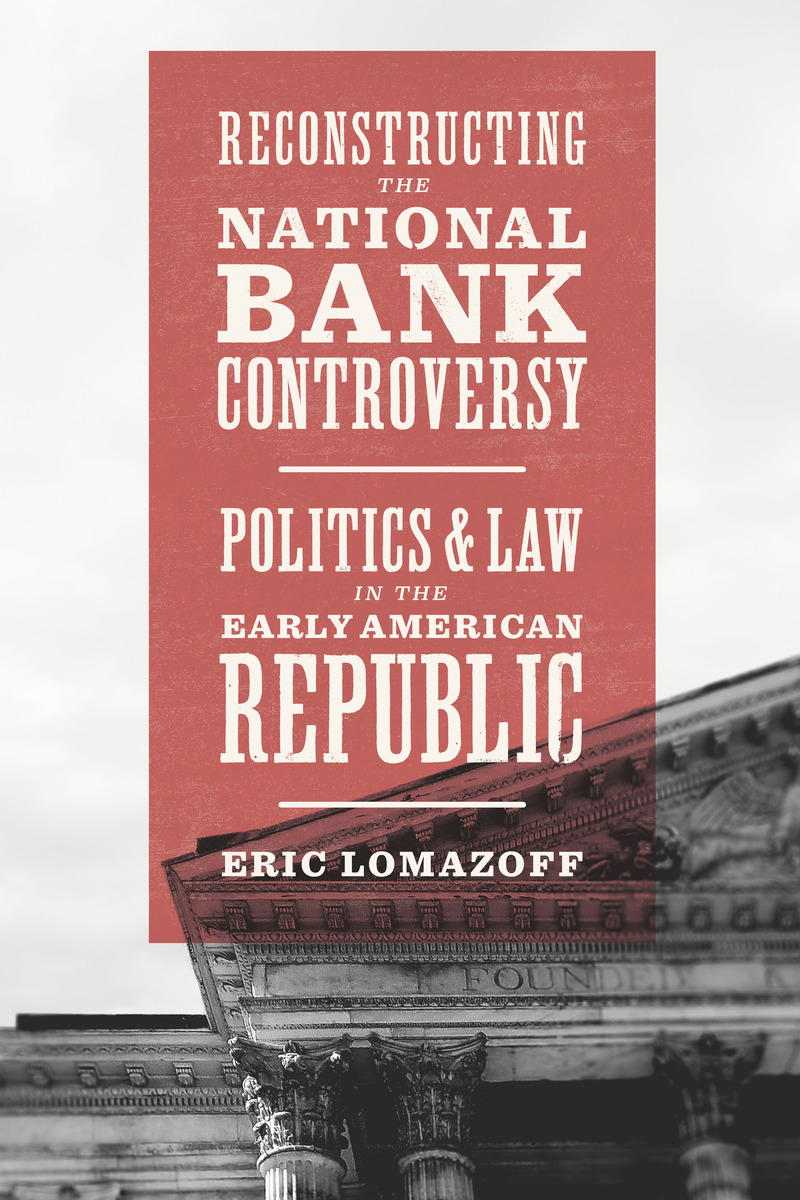
REVIEWS
“Lomazoff presents a far more nuanced account of the constitutional politics of national banking. He convincingly demonstrates that the constitutional foundations of a national bank shifted over time and that this shift reflected in large part the changing functions of the Bank of the United States. The combination of economic, political, and constitutional development is first-rate, and the results shed new light on an important constitutional controversy.”
— Mark Graber, University of Maryland School of Law
“A complex and sparkling reinterpretation of the debates over the constitutionality of the chartering of a national bank by Congress from its proposal by Alexander Hamilton in 1791 until its eventual dissolution in the 1830s. Whereas previous studies have portrayed this forty-year constitutional drama as a straightforward debate over the Necessary and Proper or Sweeping Clause of the Constitution, Lomazoff busts this pervasive myth by also highlighting the importance of the Coinage Clause. This is an important book.”
— Alan Gibson, California State University, Chico
"Reconstructing the National Bank Controversy weaves together two strands of scholarship that have long been entirely separate...By showing how the issues of banking and monetary policy shaped constitutional arguments, Lomazoff puts the constitutional and economic studies in conversation. Lomazoff therefore fills a significant gap in the scholarship of American legal history and constitutional development...an important and valuable addition to the literature on the fifty-five-year constitutional debate over a national bank."
— David S. Schwartz, Michigan Law Review
"Lomazoff argues that the controversy over the creation of the Bank of the United States was much more dynamic than a debate over the 'necessary and proper' clause of the US Constitution and was shaped as much by politics as by law. He finds that three forces—changes within the Bank itself, growing tension over federal power within the Republican coalition, and the endurance of monetary turmoil beyond theWar of 1812—drove the development of the key early dispute over the scope of federal power."
— Law and Social Inquiry
“Eric Lomazoff’s book offers a substantial reappraisal of the constitutional debate on the National Bank of the US (1791-1832)… [It] is of great interest to history, political science, and law scholars of Early American banking... The methodological approach of the book makes it also a paradigmatic piece for historians of economics.”
— History of Economic Ideas
TABLE OF CONTENTS
Introduction: Getting the Ship out of the Bottle
DOI: 10.7208/chicago/9780226579597.003.0000
[public law;constitutional history;American political development;Bank of the United States;national bank;Early American Republic;Coinage Clause;Necessary and Proper Clause;Democratic-Republican Party;McCulloch v. Maryland (1819)]
This chapter presents an overview of the book’s central arguments. The conventional wisdom surrounding the national bank controversy – namely that it was a recurring two-sided struggle over the meaning of the Necessary and Proper Clause – is reviewed but quickly dismissed. In its place, the chapter supplies a revisionist narrative in which constitutional claims respecting the institution were both more diverse and repeatedly evolving between 1791 and 1832. It also outlines an explanation for this diversity and evolution, one that prioritizes the stuff of ordinary politics: ideological strife, institutional change, and economic stress. The chapter also explains the broader import of a revisionist national bank narrative, first by stressing that an account of constitutional development in which ordinary politics plays a crucial role is consistent with much recent work among historically-oriented students of public law, and second by outlining the ways in which the fine details of the national bank controversy refine our understanding of (1) how majority parties deal with internal quarrels over constitutional meaning, (2) how constitutional conflicts respond to change in the underlying object of controversy, and (3) how the size of an economic event relates to its downstream constitutional impact.
1. Varieties of Strict Interpretation
DOI: 10.7208/chicago/9780226579597.003.0001
[constitutional history;Bank of the United States;national bank;Early American Republic;Alexander Hamilton;James Madison;Thomas Jefferson;Necessary and Proper Clause;strict interpretation;broad interpretation]
This chapter offers a reexamination of the 1791 debates within Congress and the executive branch over Alexander Hamilton’s national bank bill. It jettisons a key feature of the traditional narrative surrounding those debates, namely the idea that all national bank opponents (a crowd that included, but was not limited to, James Madison and Thomas Jefferson) adopted a single, “strict” interpretation of the Necessary and Proper Clause. The chapter argues that there were actually varieties of strict interpretation, with different national bank opponents embracing different understandings of what it meant for means to be “necessary” for achieving ends. It does this first by distinguishing between (1) functional, (2) federal, and (3) frequency-based standards of necessity, and then by demonstrating how national bank opponents used different combinations of these standards to generate various tests for necessity.
This chapter is available at:
https://academic.oup.com/chica...
2. “Banco Mania” and Institutional Drift
DOI: 10.7208/chicago/9780226579597.003.0002
[economic history;Bank of the United States;national bank;Early American Republic;state banks;scripomania;institutional change;institutional drift;Alexander Hamilton;Thomas Jefferson]
This chapter examines the first of two changes within the Bank of the United States that would have downstream consequences for the debate over its constitutionality: its drift from a position of industry dominance. Between 1791 and 1811, a variety of forces – the public’s desire for profitable investment vehicles, local support for (or opposition to) the opening of a national bank branch, and credit access problems within particular communities – led to the proliferation of state-chartered banks; their number increased from five to 102 during this period, and their aggregate capital from $4.6 million to $56.2 million. The chapter both chronicles this expansion of the American banking industry and explains how that expansion, when coupled with the national bank’s stasis (the size of the institution’s capital remained at $10 million throughout the period), set the stage for claims in 1811 that the Bank of the United States was even less “necessary” than it had been in 1791.
This chapter is available at:
https://academic.oup.com/chica...
3. “The Great Regulating Wheel” and Institutional Conversion
DOI: 10.7208/chicago/9780226579597.003.0003
[economic history;Bank of the United States;national bank;Early American Republic;state banks;institutional change;institutional conversion;Thomas Willing;monetary policy;central bank]
This chapter examines the second of two changes within the Bank of the United States that would have downstream consequences for the debate over its constitutionality: its conversion from a purely fiscal auxiliary of the federal government to an institution with both fiscal and monetary functions. Between 1791 and 1811, not only did the number of state-chartered banks increase – the subject of Chapter 2 – but the Bank of the United States gradually developed and exercised the power to regulate their lending behavior and thereby control the nation’s money supply. The chapter explains how a combination of constitutional structures, federal and state policy choices, and early Treasury Department rules facilitated this functional evolution in the national bank. It also chronicles the early reception of the national bank as a monetary force, which featured dueling perspectives on the desirability of state bank regulation but was largely devoid of commentary on its constitutionality.
This chapter is available at:
https://academic.oup.com/chica...
4. More Than a Constitutional Rerun
DOI: 10.7208/chicago/9780226579597.003.0004
[constitutional history;Bank of the United States;national bank;Early American Republic;state banks;Democratic-Republican Party;Old Republicans;Nationalist Republicans;Necessary and Proper Clause;Eleventh Congress (1809-1811)]
This chapter addresses an oft-ignored episode in the national bank controversy: the recharter debate of 1811. The charter granted in 1791 ran for twenty years, and this left members of the Eleventh Congress (1809-1811) in a position to decide the institution’s fate. The chapter argues that the question of the national bank’s constitutionality resurfaced in 1811, but the answers to that question offered something more than a constitutional rerun of 1791. It stresses that while ideological strife played a role here – some members of the Republican majority, whose partisan forebears had criticized the 1791 bill as unconstitutional, openly asserted in 1811 that a national bank was “necessary” for managing the federal government’s fiscal affairs – the most important factor was the recent proliferation of state-chartered banks. Whereas critics of the 1791 bill had deployed a variety of claims respecting the meaning of the word necessary, most anti-recharter Republicans in 1811 converged upon a single argument: not only was a national bank too far removed from any enumerated power, but even if that problem could be overcome, the federal government’s ability to utilize a network of state banks for managing its fiscal affairs rendered the institution something less than “necessary.”
This chapter is available at:
https://academic.oup.com/chica...
5. The Compromise of 1816
DOI: 10.7208/chicago/9780226579597.003.0005
[constitutional history;Bank of the United States;national bank;Early American Republic;state banks;monetary policy;Democratic-Republican Party;Coinage Clause;Necessary and Proper Clause;Fourteenth Congress (1815-1817)]
This chapter chronicles the events that led to, and the constitutional claim that underwrote, the Republican majority’s revival of a national bank in 1816. The conventional wisdom surrounding this period identifies both the problem that revival was designed to solve (the federal government’s ability to finance wartime operations) and the rationale for Republicans’ constitutional about-face on a national bank (President Madison had waived the question in 1815 as “settled”). The chapter supplies alternatives on both points. It argues first that the motive for reviving the Bank was monetary, not fiscal; most state banks had suspended the payment of specie during the War of 1812, and had refused to resume payment after the Treaty of Ghent. It then suggests that leading Republicans offered a novel constitutional argument: insofar as a new Bank would help to restore the nation’s official money (i.e., specie) to circulation – that is, the institution would once again regulate state banks – chartering it represented an exercise of Congress’ power to “coin Money, regulate the Value thereof.” The chapter posits that Republicans gravitated toward this argument because it did not require them to fight anew amongst themselves over the meaning of the Necessary and Proper Clause.
This chapter is available at:
https://academic.oup.com/chica...
6. McCulloch (1819) in the Shadow of the Compromise
DOI: 10.7208/chicago/9780226579597.003.0006
[constitutional history;Bank of the United States;national bank;Early American Republic;U.S. Supreme Court;Democratic-Republican Party;Coinage Clause;Necessary and Proper Clause;John Marshall;McCulloch v. Maryland (1819)]
This chapter offers a reassessment of the Supreme Court’s work in McCulloch v. Maryland (1819) in light of the previous chapter’s claim that Republicans revived the national bank on the strength of the Coinage Clause. After observing that Congress’s power (or lack thereof) to charter a national bank was not originally part of the dispute between the institution’s Baltimore branch and the state of Maryland – it was added to the Court’s agenda at the last minute – the chapter finds that Republicans’ Coinage Clause argument from 1816 was mentioned in neither McCulloch’s oral arguments nor Chief Justice John Marshall’s decision for the Court. Insofar as Marshall’s decision rested (at least in part) upon claims about the meaning of the Necessary and Proper Clause, what emerged in 1819 was a gap between political and judicial understandings of the national bank’s constitutionality. The chapter then unpacks the implications of this fact, concluding that while the Court’s holding was “majoritarian” (i.e., it aligned with the preferences of the Republican majority), its reasoning was surely not (i.e., Marshall’s commentary on the meaning of the Necessary and Proper Clause could only serve to exacerbate divisions over the scope of federal power within that majority).
This chapter is available at:
https://academic.oup.com/chica...
7. A Tale of Two Clauses
DOI: 10.7208/chicago/9780226579597.003.0007
[constitutional history;Bank of the United States;national bank;Early American Republic;Coinage Clause;Necessary and Proper Clause;Andrew Jackson;McCulloch v. Maryland (1819);Democratic Party;Nicholas Biddle]
This chapter reexamines the closing episode in the national bank controversy: President Jackson’s extended assault upon the institution (1829-1832). The traditional narrative respecting the constitutional action from this period focuses on Jackson’s July 1832 veto of a bill to extend the national bank’s charter, and highlights both his written rejection of McCulloch v. Maryland (1819) as a definitive resolution of the national bank’s constitutionality and his attending claim that the institution was neither “necessary” nor “proper.” The chapter revises this narrative by drawing attention to the importance of the Coinage Clause in both the events that led to Jackson’s veto and the veto message itself. It posits that (1) the Democratic majority in Congress relied upon the power to coin money in passing a bill to extend the national bank’s charter, and (2) that reliance forced the president to explicitly reject the Coinage Clause argument in his veto message. In doing so, the chapter reveals that the power to coin money was relevant to the national bank controversy long after the events of 1815 and 1816.
This chapter is available at:
https://academic.oup.com/chica...
Conclusion: A Revisionist Bank Narrative—Lessons Timely and Timeless
DOI: 10.7208/chicago/9780226579597.003.0008
[constitutional history;Bank of the United States;national bank;Coinage Clause;Federal Reserve;American political development;Legal Tender Cases;Hepburn v. Griswold (1870);Knox v. Lee (1871)]
This chapter concludes the book by (1) outlining the role of the national bank controversy in shaping contemporary constitutional politics, and (2) returning to the broader import of a revisionist history of the controversy for the study of American constitutional development. With respect to the former, the chapter connects the Coinage Clause argument first offered in the 1810s on behalf of a national bank with the Coinage Clause argument offered today on behalf of the Federal Reserve; it argues that the early Legal Tender Cases (especially Hepburn v. Griswold [1870] and Knox v. Lee [1871]) represent the crucial link in this chain. As for the latter, the chapter revisits the propositions respecting American constitutional development that are either reinforced or refined by the book. Because ignorance with respect to what Kenneth Dam has called “economic facts” (e.g., the distinction between fiscal and monetary phenomena) permitted the traditional account of the national bank controversy to endure for so long, the chapter also invites historically-oriented public law scholars to both acquire knowledge of these facts and bring that knowledge to bear upon the (relatively understudied) fiscal and monetary provisions of Article I, Section 8.
This chapter is available at:
https://academic.oup.com/chica...