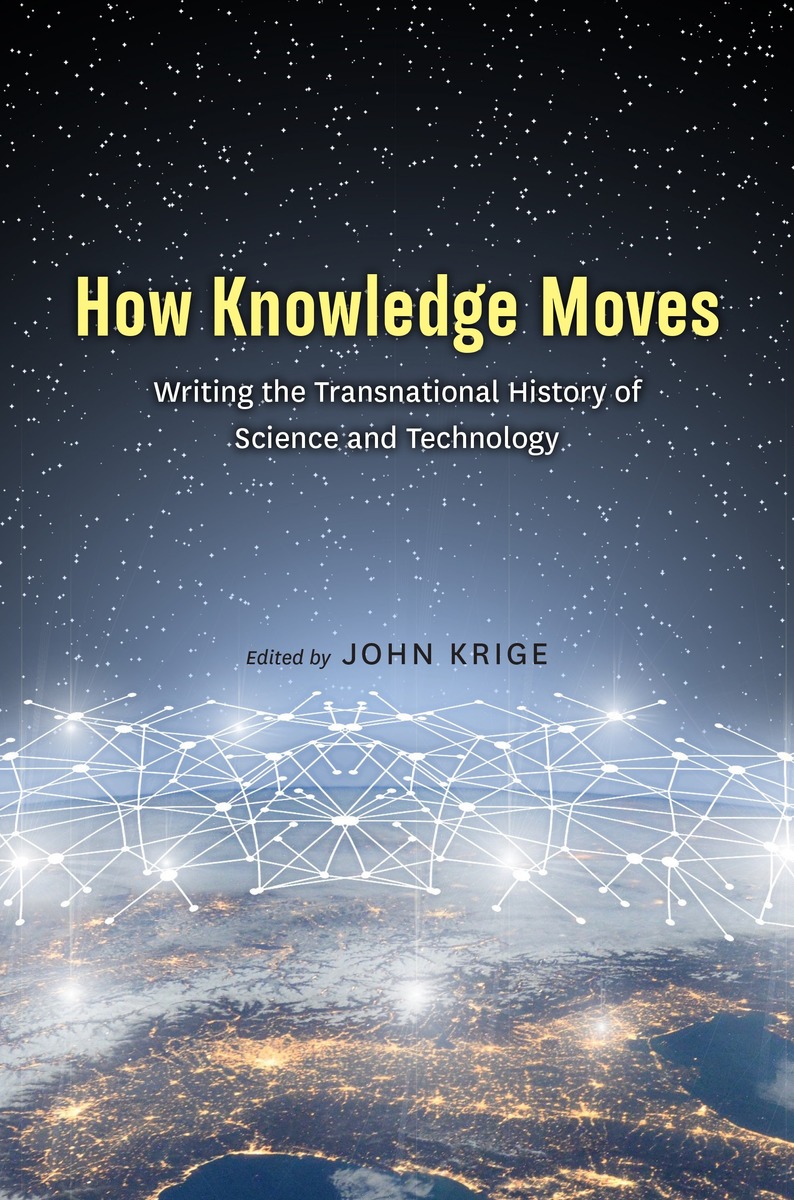
REVIEWS
"This volume will be extremely useful for historians, whether or not they study science and technology, because it attacks the difficulty of writing transnational history head-on and offers a truly diverse set of options and models.Transnational history emerges as messy, labor-intensive, and contingent; it emerges, as it should, as a co-creation of actors and analysts and not merely as a hidden perspective that's been overlooked. This forces us to think about why transnational history matters, and it allows even the voices that aren't fully articulated to still live and breathe. The volume is an invitation, not an answer."
— Grace Yen Shen, Fordham University
"This lively and innovative collection explores the diverse conditions that shape how--and whether--scientific knowledge travels across borders. It encompasses the full range of activities and circumstances, from the basic materiality of the everyday to the strictures of institutions, bureaucratic systems, and state structures, that define the transnational peregrinations of knowledge, 'knowledgeable bodies,' technologies, and scientific practices. How Knowledge Moves is an indispensable addition to the literature on science and transnationalism in the twentieth century."
— Jessica Wang, University of British Columbia
"In this volume John Krige has approached transnational science from the darker side of globalization. He asks: what if the earth isn’t flat, its surface not smooth, or travel not effortless? It is a very productive approach. Krige and his contributors write engagingly, often from a personal life experience of border crossings and shifts of nationalities about the friction of enduring territoriality, the intentional hegemonies of America as hub, of English as the lingua franca, and the monopolies of national curricula. He has seen the 'counter norms' that rule the world of scholarship in the regulatory state just as much as the Mertonian norms of openness and egalitarianism. Circulation of knowledge may still be the ideal; this book show that, in reality, circulation always comes at a cost."
— Sverker Sörlin, KTH Royal Institute of Technology, Stockholm
"A volume of erudite essays by historians of science and technology that breaks the national framework in which histories are often written. Instead, [Krige] takes knowledge as its central object, with the goal of unraveling the relationships among people, ideas, and things that arise when they cross national borders. . . . By concentrating on the conditions that allow for knowledge movement, these essays explore travel and exchange in face-to-face encounters and show how border-crossings mobilize extensive bureaucratic technologies. . . . While especially and unreservedly recommended for college and university library collections, it should be noted for the personal reading lists of students, academia, governmental policy makers, and non-specialist general readers."
— Midwest Book Review
"[Krige] has assembled 13 essays that represent the state of the art in transnational history of science. The collection joins recent works (such as Audra Wolfe’s Freedom’s Laboratory, 2018) that seek to go beyond mere comparison of national contexts or simple de-emphasis of the nation-state in the name of transnational history. Instead, it seeks to develop a nuanced and sophisticated account of how geopolitical forces (including nation-states) shaped the production, transmission, and reception of scientific knowledge. The volume begins with a detailed analytical introduction that sets out the motivating methodological agenda and closes with a brief afterword that situates it in the current political moment. The essays in between—which are tightly edited, accessible, and largely well written—offer a broad picture of 20th-century science from the perspective of the intellectual ties that bound its scientific communities together. The book presumes some familiarity with major issues in the history of science and technology, but constitutes an invaluable, agenda-setting resource for anyone with an interest in these subjects. . . . Highly recommended."
— CHOICE
"The present study's impressive collection of deeply researched, wide-ranging historical analyses is of foundational value in characterizing the issue and lays the groundwork for developing a more productive way of sharing scientific and technical knowledge internationally, especially when sovereign restrictions are expanding as information becomes an increasingly critical national resource."
— Journal of the Society for Technical Communication
"Focuses mainly on the transnational history of science in the context of the rise of U.S. hegemony . . . Thanks to this focus, the volume is compact, not merely an assemblage of disparate studies. . . . The main potential pitfall of edited volumes is that the editors sometimes fail to set the various subjects into one unifying framework. How Knowledge Moves avoids this drawback, providing a coherent narrative. Its clearly defined general context unifies the particular subjects, allowing details which might otherwise get lost to stand out and be fully appreciated. Editors clearly played an important role in this process."
— Centaurus
"A timely contribution and an excellent example of how to connect academic research with contemporary geopolitical debates on migration, geopolitics, and international commerce. . . . How Knowledge Moves unites a series of disparate but fascinating stories. . . . The volume conveys a thought-provoking call to focus on the obstacles to circulation, which can provide intriguing insights on current political debates on migrations, international commerce, and national identities. In any case, the volume is a fresh contribution to the literature and a timely reminder that, like civic liberties and human rights, science and knowledge are results of the action of humans and we should never take for granted that knowledge moves."
— Isis: A Journal of the History of Science Society
"Published fortuitously just before the onset of a global pandemic and the resulting competitiveness among nations to secure a COVID-19 vaccine, the volume provides a critical assessment of not only transnational approaches but also our understanding of the mobility of ideas and how this shapes the direction of knowledge accumulation over time. . . . This collection does much more than simply rehash the critiques of 1960s-era U.S. modernization campaigns. The value of the essays lies in their fine-grained explorations of identity, symbolism, and site issues. . . . This is a rich case-book of studies and methodologies on how to re-engage and rewrite the transnational history of knowledge circulation, this time by removing the United States as central pole and by acknowledging the uneven power relations that always underlie forms of mobility. As such, it is a fresh, engaging, and challenging addition to the literature on the history of technology, offering many new research paths to pursue."
— Technology and Culture
TABLE OF CONTENTS
Introduction: Writing the Transnational History of Science and Technology
DOI: 10.7208/chicago/9780226606040.003.0001
[travel;borders;the regulatory state;nationality;the local and the global;networks;standardization;scientific internationalism;reciprocity;modernity;practice]
This introduction provides an intellectual road map for the individual contributions to the volume that are summarized in the latter section. Five themes frame the analyses of the transnational movement of knowledge: the centrality of travel, the role of the regulatorystate, the meaning of "borders" and networks, the significance of nationality and political allegiance, and the intersection between the local and the global. By focusing on the practices of state power to police "borders," these themes demolish a widespread assumption that, in a global world, knowledge moves "by itself." The political economy of knowledge production and cross-border movement produces lumpy networks of unevenly distributed power. They are held together by various factors, including the ideology of scientific internationalism, the adoption or imposition of standards that facilitate knowledge exchange (including the increasingly dominant role of English in scientific exchanges) and the principle of reciprocity whereby both members of a dyad benefit, sometimes in quite different ways, from the transnational transaction, including the urge to be "modern." The performance of transnational history in these essays confirms its value as a way of seeing, opening new intellectual and political perspectives on how knowledgemoves in an interconnected world that is not "flat." (pages 1 - 32)
This chapter is available at:
University of Chicago Press
https://academic.oup.com/chica...
Part I. The US Regulatory State
Chapter 1. Restricting the Transnational Movement of “Knowledgeable Bodies”: The Interplay of US Visa Restrictions and Export Controls in the Cold War
DOI: 10.7208/chicago/9780226606040.003.0002
[knowledge circulation;border regimes;visa regulations;export controls]
This article argues against the popular notion that in a globalizing world national borders become ever more porous and incrementally lose their relevance, not least in the realm of research and development. In order to understand the impact national borders have on the circulation of knowledge, it is necessary to analyze the workings of border policing regimes. This study shows why and how since the 1950s and up to the present day the travels of scientists and students into the United States was closely regulated by an interplay of two bureaucratic regimes: visa restrictions and export control regulations. Closely tied to fears of the loss of technical data and know-how to enemies, the two regimes co-developed into a huge, rambling instrument of knowledge control that time and again established insurmountable obstacles to the mobility of "knowledgeable bodies." (pages 35 - 61)
This chapter is available at:
University of Chicago Press
https://academic.oup.com/chica...
Chapter 2. Export Controls as Instruments to Regulate Knowledge Acquisition in a Globalizing Economy
DOI: 10.7208/chicago/9780226606040.003.0003
[sensitive but unclassfied;national security state;intangible techology;know-how;deemed exports;Fred Bucy;Soviet Union;China;face-to-face interactions;foreign nationals]
Export controls do not only regulate international trade. They also regulate the transfer of information, knowledge, and know-how (intangible technology) to foreign nationals, both abroad and in the US (a so-called deemed export). They have become increasingly wide in scope, invasive, and nationalistic in the global space of knowledge production and circulation. The reach of the regulatory National Security State has expanded to embrace the education and training of scientists, engineers, and project managers in face-to-face interactions at both academic and corporate sites. Heavy fines and imprisonment have been imposed on US entities and individuals who violate the law, which is subject to constant (re)negotiation between diverse stakeholders who strive to balance academic freedom and access to markets with threats to American national economic and military security. This paper traces the historical arc of these developments from the late 1970s to the early 2000s. It highlights key moments when the sharing of sensitive but unclassified knowledge and know-how with foreign nationals was a major preoccupation of the National Security State. An increasingly restrictive export control regime was put in place to deal with threats from first the Soviet Union and then the People's Republic of China. (pages 62 - 92)
This chapter is available at:
University of Chicago Press
https://academic.oup.com/chica...
Part II. Colonial and Postcolonial Contexts
Chapter 3. California Cloning in French Algeria: Rooting Pieds Noirs and Uprooting Fellahs in the Orange Groves of the Mitidja
DOI: 10.7208/chicago/9780226606040.003.0004
[Frantz Fanon;Cloning;Colonial;Oranges;Algeria;California]
This chapter deals with the social and political dimensions of citrus production in Algeria under French rule illuminating the role of cloning practices that originated in California in the making of colonial relations. It details what travels and what gets transformed when technoscientific things such as oranges move. Building on Frantz Fanon’s powerful plea for bringing together apparently disparate colonial experiences, I hint at the value of transnational history grounded in concrete movements of people, ideologies, practices, and material artifacts. The aim is to probe the value of history of science and technology in replacing generic notions such as the global south with transnational historical dynamics tying together different spatial realities. (pages 95 - 119)
This chapter is available at:
University of Chicago Press
https://academic.oup.com/chica...
Chapter 4. Modalities of Modernization: American Technic in Colonial and Postcolonial India
DOI: 10.7208/chicago/9780226606040.003.0005
[colonial;missionaries;land grant;development;modernization;tractors]
This chapter specifies three specific moments in which quintessentially American ideas of modernization made an entry into the terrain marked by colonial improvement and nationalist development in India. Focusing on American tractors, Presbyterian missionaries, and land grant faculty in colonial and post-independence India, the chapter discusses the complex and contested legacy of development and modernization in the colony and the post colony. (pages 120 - 148)
This chapter is available at:
University of Chicago Press
https://academic.oup.com/chica...
Chapter 5. Transnational Knowledge, American Hegemony: Social Scientists in US-Occupied Japan
DOI: 10.7208/chicago/9780226606040.003.0006
[social science;modernization theory;US Occupation of Japan]
Many scholars have examined American support for natural sciences and engineering throughout the postwar world, resulting in a transnational network of knowledge production centered on the United States. Less well studied but no less important is social science, which promoted the values later espoused by modernization theory: democracy, capitalism, and peace. As the site of America’s longest postwar occupation, Japan poses a fruitful case for examining the geopolitical significance of social science as an ideological vehicle. Against the backdrop of a rift with the Soviet Union, the US primarily sought to refashion Japan into a bulwark against communism in Asia. Through texts, lectures, and especially collaborative fieldwork, American social scientists in Japan cultivated common values with Japanese colleagues, enabling the imagination of a joint future within the First World. (pages 149 - 174)
This chapter is available at:
University of Chicago Press
https://academic.oup.com/chica...
Chapter 6. Dispersed Sites: San Marco and the Launch from Kenya
DOI: 10.7208/chicago/9780226606040.003.0007
[San Marco;site;transnational science;postcolonial science;Cold War;Kenya;Italy;satellite;NASA]
In this chapter, I use “site” as a heuristic, and the example of the joint Italian-NASA satellite project known as San Marco, in a case study to interrogate assumptions about transnational science in the postcolonial setting during the Cold War. The project involved the use of rigs stationed off the coast of Kenya to launch satellites into equatorial orbit. The San Marco project has always been understood as a success because it has been seen as physically contained, as a discrete project. But in fact, using the perspective of the fragmented and dispersed site, and, particularly, the postcolonial site, with all its blurred edges and multiple claims, we see that its success was much more conditional and its legacy marred by deeply uncomfortable social realities. Here, defining it as a success depended critically on making the site coterminous with the project, thus excluding actors such as the Malindi area population, Kenyan parliamentarians, Italian immigrants and tourists, offshore laborers at Mombasa, and factory workers in Texas who built the Santa Rita—all of whom contributed to its implementation and ultimately to its ambiguous outcome, especially in the many illegal activities, including sex trafficking industry, that flourished in and around Malindi. (pages 175 - 200)
This chapter is available at:
University of Chicago Press
https://academic.oup.com/chica...
Chapter 7. Bringing the Environment Back In: A Transnational History of Landsat
DOI: 10.7208/chicago/9780226606040.003.0008
[nature;data;natural resources;hegemony;satellite;NASA;developing world;Africa;Brazil;Vietnam]
This essay analyzes the often overlooked, yet central, role played by the natural environment in the transnational history of science and technology. To illustrate this, it explores the history of NASA’s Landsat satellites as a case study to trace how technology developed within the United States became a hub that bound together a thick transnational network of space and ground communication systems, international and national agencies, American corporations and NASA, as well as indigenous engineers, technicians, and scientists attempting to better understand, and control, the natural environment. During the early 1970s, as the US government withdrew from the war in Vietnam and explored new means of engagement across the developing world, Landsat’s transnational network began helping scientists from Africa, Latin America, and Asia gather data regarding their countries’ natural resources. In the process not only did local environments from Botswana to Burma to Brazil influence the structure and functioning of this transnational network, but Landsat technology and the science it enabled also became mechanisms for both American hegemony and limited local control within the developing world. (pages 201 - 224)
This chapter is available at:
University of Chicago Press
https://academic.oup.com/chica...
Part III. Individual Identities in Flux
Chapter 8. Manuel Sandoval Vallarta: The Rise and Fall of a Transnational Actor at the Crossroad of World War II Science Mobilization
DOI: 10.7208/chicago/9780226606040.003.0009
[transnationalism;transnational actor;WWII science mobilization;inter-American relations;cultural diplomacy;Manuel Sandoval Vallarta]
This chapter reflects on the conditions that nourish or constrain transnationalism in science, through an analysis of the circumstances in which Manuel Sandoval Vallarta, a Mexican-born MIT physics professor, decided to leave the US in 1942. By then, he had consolidated a scientific career; concurrently, Vallarta became a transnational actor connecting US and Mexico’s physics communities. However, WWII altered his professional situation: unable to participate in MIT war research, he headed a US government-funded commission for the encouragement of inter-American scientific relations by means of cultural diplomacy. In this context, though, disputes over war effort priorities stressed national alignments at the expense of his transnationalism. This paper illustrates both the possibility of transnationalism, and its transient and fragile condition. (pages 227 - 253)
This chapter is available at:
University of Chicago Press
https://academic.oup.com/chica...
Chapter 9. The Officer’s Three Names: The Formal, Familiar, and Bureaucratic in the Transnational History of Scientific Fellowships
DOI: 10.7208/chicago/9780226606040.003.0010
[fellowships;Rockefeller Foundation;mathematicians;Latin America;bureaucracy;natural sciences]
This chapter uses Rockefeller Foundation fellowship files and related documentation for mathematicians in Latin America (especially Uruguayan communist José Luis Massera) to examine the multifarious work of scientific fellowship administration in a mid-twentieth century transnational bureaucracy. It focuses on Harry Milton Miller, a long-serving and far-traveling officer of Rockefeller’s Division of Natural Sciences, and his formal, familiar, and bureaucratic postures that correspond (broadly speaking) with three distinct ways he affixed his name or was addressed in his correspondence and records. Tracking the officer’s three names elucidates the interactions among the variety of relationships and practices Miller created and sustained in support of the Rockefeller Foundation’s fellowship programs in the natural sciences. In particular, they help explain how officials navigated political and institutional obstacles to establish durable transnational scientific networks. Their adaptations and improvisations both directly and indirectly shaped a scientific elite that would dominate emerging transnational formations. (pages 254 - 280)
This chapter is available at:
University of Chicago Press
https://academic.oup.com/chica...
Chapter 10. Scientific Exchanges between the United States and Brazil in the Twentieth Century: Cultural Diplomacy and Transnational Movements
DOI: 10.7208/chicago/9780226606040.003.0011
[scientific internationalism;Nelson Rockefeller;Arthur Compton;Gleb Wataghin;David Bohm;cosmic rays;Brazilian military dictatorship;McCarthyism;Cold War]
This chapter deals with the transnational movement of scientists, mostly physicists, between Brazil and the United States that began in World War II and continued through the Cold War and the Brazilian dictatorship. It tracks the intersection between scientific mobility and foreign policy, charting the tensions between the idealism of scientific internationalism and government restrictions on transnational movement in the name of national security. We begin when the OCIAA led by Nelson Rockefeller along with major foundations mobilized scientists and engineers (as well as film stars and movies) as cultural ambassadors for American democracy. Prominent in this story were cosmic-rays physicists Arthur Compton and Gleb Wataghin. Later, capitalizing on these networks, the physicist David Bohm could settle in Brazil, which provided a safe haven for his escape from McCarthyism. The Brazilian military dictatorship that took power in 1964 changed that. Notwithstanding an official American discourse favorable to democracy, successive US presidents covertly supported the new political system. However, American physicists welcomed Brazilian colleagues into the US and even lobbied successfully for their release from prison. This paper illustrates the importance of visas and passports as instruments used by the national security state to control the movement of scientists. (pages 281 - 307)
This chapter is available at:
University of Chicago Press
https://academic.oup.com/chica...
Chapter 11. The Transnational Physical Science Study Committee: The Evolving Nation in the World of Science and Education (1945–1975)
DOI: 10.7208/chicago/9780226606040.003.0012
[scales;transnationalism;science education;Cold War;UNESCO;United States;Latin America;PSSC;Physical Science Study Committee]
The Physical Science Study Committee (PSSC) was a major project that represents the rise of American science education as an influential international force during the Cold War. Its original conception responded to an agenda of nation building. For this reason, but also due to common historiographical practice, the PSSC has exclusively been studied in national perspective. In contrast, in this paper I focus on the international life of the PSSC. I consider how we can gain a fuller meaning of the PSSC by taking into account its different scales, including the local, national, regional, and international. I analyze the international agency of institutions such as the (US) National Science Foundation and UNESCO in the making of the PSSC worldwide and especially in Latin America. Finally, I examine the relevance of transnationalism for the PSSC by considering the role of actors such as the American (Mexican-born) Albert V. Baez (1912-2007) and the Israelite (German-born) Uri Haber-Schaim (1926-). (pages 308 - 342)
This chapter is available at:
University of Chicago Press
https://academic.oup.com/chica...
Part IV. The Nuclear Regime
Chapter 12. Technical Assistance in Movement: Nuclear Knowledge Crosses Latin American Borders
DOI: 10.7208/chicago/9780226606040.003.0013
[travel;itineraries;roads;radioisotopes;Latin America;contingencies;transnational;nature]
This paper focuses on the materiality of travel, and the intricate different kinds of networks, contacts, and flows that make the itineraries of knowledge possible. By tracing the itinerary of a Mobile Radioisotope Laboratory as it meandered on a huge truck from its point of departure at Oak Ridge National Laboratory in Tennessee, through the roads of several Latin American countries between 1960 and 1965 (Mexico, Argentina, Uruguay, Brazil, and Bolivia, to end up stationed in Costa Rica), we highlight the challenges and contingencies faced not only in crossing borders, but in traveling from one town to another within any one country. These challenges were not simply bureaucratic, but also related to the vagaries of nature itself. They reflect an inability to imagine what travel in a "developing" country entailed, and by a divergence of cultural norms and expectations between local officials and those in international organizations, such as the International Atomic Energy Agency. Writing transnational histories of science also helps to reveal the salient role of actors who are often invisible, in this case the truck’s Austrian driver. (pages 345 - 367)
This chapter is available at:
University of Chicago Press
https://academic.oup.com/chica...
Chapter 13. Controlled Exchanges: Public-Private Hybridity, Transnational Networking, and Knowledge Circulation in US-China Scientific Discourse on Nuclear Arms Control
DOI: 10.7208/chicago/9780226606040.003.0014
[American scientists;nuclear arms control;Cold War;transnational knowledge circulation;ethnic scientific networks;international diplomacy;history of science and technology;Chinese scientists]
In the mid-1980s, American and Chinese scientists began to engage each other in a low-key manner in nuclear arms control that would develop into wide-ranging bilateral interactions to the present, even withstanding geopolitical changes brought by the Tiananmen tragedy in 1989 and the end of the Cold War. This paper explores these important and yet little-known transnational scientific interactions and addresses a number of issues relevant to the writing of history of science and technology: the proper roles of scientists and experts in national policy and international diplomacy, the social and political values of transnational scientific discussions and ethnic scientific networking, the potentials and limits of transnational knowledge circulation in sensitive areas such as nuclear weapons, and the possibility of historical learning in policy making as the world struggles to deal with global problems such as nuclear proliferation and climate change. (pages 368 - 410)
This chapter is available at:
University of Chicago Press
https://academic.oup.com/chica...
Afterword: Reflections on Writing the Transnational History of Science and Technology
DOI: 10.7208/chicago/9780226606040.003.0015
[state power;border crossing;hybridity;portable knowledge;subaltern;national identity;cosmpolitanism;transnational analysis;historiography;international politics]
In this afterword, a senior and a junior scholar reflect on the project’s lessons for this field. We focus on the centrality of the United States as a locus for transnational movements of knowledge and expertise in the twentieth century. This centrality is symptomatic of the pertinence of state power and national identity to transnational analyses when knowledge moves. Contributors turn attention to travel rather than circulation to bring out the labor and contingency involved in crossing borders, and to expand the range of "actors" to include material infrastructure and equipment needed to produce knowledge at different sites. We recognize the challenges of incorporating subaltern as well as elite narratives, of distinguishing portable scientific knowledge from less formal but no less meaningful forms of knowledge, of integrating hybrid national and scientific loyalties and ideologies, of being sensitive to the dominant — but facilitating — role of English in transnational encounters, and of crossing disciplinary borders to open rich seams of historical activity and multifarious perspectives. We place this transnational engagement and its cosmopolitan foundations and ambitions within the present moment in international politics, joining the project’s historiographical stakes to the political stakes of living in an interconnected, interdependent world. (pages 411 - 418)
This chapter is available at:
University of Chicago Press
https://academic.oup.com/chica...
List of Contributors
Index