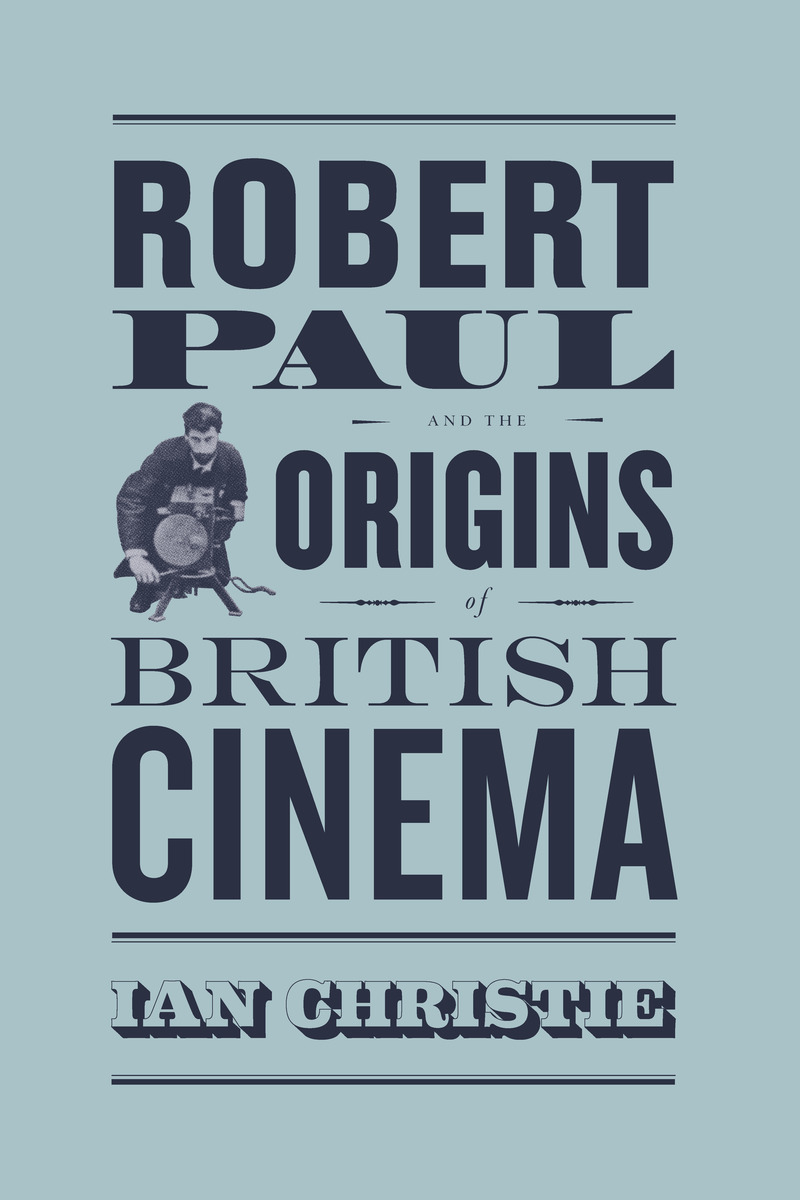
REVIEWS
“Robert Paul and the Origins of British Cinema will likely remain the definitive monograph on a fascinating and influential early British film pioneer. Christie provides novel insights into how British cinema in its earliest years documented historical events and lucidly traces the origins of motion picture copyright wars. This is an outstanding study that is certain to be welcomed by film scholars and to transform the study and teaching of the early years of cinema."
— Edward Dimendberg, Professor of Humanities, University of California, Irvine
"[Christie] has done an extraordinary job in creating an objective account of a moment in cinematographic history where there is often more emphasis cast on the importance of the early directors than the technologists that created the tools used to create the movies. It emerges that Paul was both; a combination that makes him unusually fascinating."
— Engineering & Technology Magazine
"I owe a debt to Ian Christie’s 2019 book for its extensive comments on the films and their historical and cultural context, and the context of Paul’s life and non-film activities. The coverage of Paul’s family, friends, business associates, and many related aspects including late Victorian education and turn-of-the-century industry and business, will be invaluable to everyone who reads this book. Also, it spurred me on to take a deeper look at Paul’s apparatus in particular, expanding my knowledge considerably. During a difficult period in December 2019, reading the book and responding to its contents provided a focus that I needed. Robert Paul and the Origins of British Cinema represents a great deal of work over many years and will be much used by students of early cinema. . . . Christie’s energetic and enthusiastic championing of Paul – culminating in exhibitions, illustrated talks, a book, graphic novel, and ongoing blog – has placed the somewhat enigmatic but important pioneer in a new spotlight, especially with the general public."
— Stephen Herbert, The Optilogue
"With this book, Christie delivers not only an important building block in the exploration of the beginnings of cinema, but also a work that should interest all who grapple with the media history of early modernity."
— MEDIENwissenschaf (translated from the original German)
"The product of years of painstaking research. . . . Christie reveals that Paul—by far the largest film producer in Britain in his era—was a significant competitor to the Lumières on the international stage. . ."
— Sight & Sound
"A clear labour of love and demonstration of dedication to research, Robert Paul and the Origins of British Cinema brings together the technical history of the evolution of British Cinema and the biography of one of its pioneers who, per Christie, has been sadly under-represented in narratives of the period so far. In order to work ‘toward making early film history accessible’ Christie blends research together into a narrative of technology and personal history. . . . required reading for students of British Cinema."
— Early Popular Visual Culture
"Ian Christie has been researching Robert Paul for many years, he mentions 1994 as a starting point, and he is conscious of how little original material is available on Paul. Christie compensates for his by offering a great deal of context not only in relation to the development of the early film industry, but also in relation to the broader context of turn of the century life, in London specifically, but also internationally. He pays particular attention to the development of scientific education and the growth of electrical engineering as these were significant aspects of Paul’s life and career in addition to film. This approach brings forward the vastness of this early industry, its reliance on established inventions and places of entertainment and its truly global reach."
— Historical Journal of Film, Radio, and Television
"Robert Paul is written with clarity and intelligence, is easy and enjoyable to read, and mainly avoids the jargon and theorizing that still complicate some approaches to cultural history... [It] acknowledges wider contexts and encourages the crossing of disciplinary boundaries."
— Technology and Culture
"Ian Christie’s thorough and careful study of Robert W. Paul is an impressive book, the culmination of many years of research, and an excellent complement to several recent histories of early British cinema."
— Nineteenth Century Theatre and Film
TABLE OF CONTENTS
Prelude
DOI: 10.7208/chicago/9780226610115.003.0001
[Edison;Lumière;Friese-Greene;Terry Ramsaye;biography;film studies]
Understanding the origins of moving pictures is important because of what the industry became, and debates about its significance as a symptom or cause of modernity. Robert Paul needs to be reinserted into this early history, having dropped out in comparison with Edison and the Lumières, and especially in his native Britain. Yet the obstacles lie in a lack of any personal documentation, and the disappearance of much of his output. In face of these absences, and little evidence of audience response to his work, any reconstruction of Paul’s achievement must remain speculative.
This chapter is available at:
https://academic.oup.com/chica...
1. Getting into the Picture Business
DOI: 10.7208/chicago/9780226610115.003.0002
[kinetoscope;stereoscope;patent;Friese-Greene;Birt Acres;Earls Court;camera]
Edison’s kinetoscope, launched in 1893 after his success with the phonograph, continued the 19th century’s fascination with reproductive novelties, also typified by the stereoscope. Kinetoscopes, however, were expensive and cumbersome, encouraging entrepreneurs to look for cheaper ways of acquiring them, which led two Greeks, Georgiades and Trajedis, to commission Paul to build machines for them, since the kinetoscope was not patented outside the United States. When Edison refused to supply new films, Paul turned to a photographer, Birt Acres, to collaborate with him in creating a camera. With this, they made some sixteen films in early 1895, the first to be successfully exhibited in Britain, before parting company acrimoniously at the end of May. Thereafter they would give different accounts of responsibility for the camera, while both continuing to use the films it had made. Paul opened his own kinetoscope display near his workshop in Hatton Garden, followed by a larger number running at the Empire of India exhibition in Earls Court, which he later said led to considering how to make such entertainment more efficient.
This chapter is available at:
https://academic.oup.com/chica...
2. Flashback: An Engineer’s Education
DOI: 10.7208/chicago/9780226610115.003.0003
[City of London School;Silvanus Thompson;William Ayrton;Theatrograph;Olympia;Egyptian Hall;Alhambra;cinematographe]
Robert Paul was the oldest of five children, born to a London shipping agent and a clergyman’s daughter in Islington in 1869. The family moved around London, while Robert seems to have been the only one to benefit from a public school education at the City of London, which was also among the first in Britain to offer science. He progressed to a new college, the Finsbury Technical, bringing him into contact with electrical pioneers such as Silvanus Thompson and William Ayrton, who would help him start in business on his own account in 1891, repairing and soon inventing instruments for the emerging electricity industry. By the end of 1895, both Paul and his former associate Acres were at work developing projectors that functioned like magic lanterns, throwing moving pictures on a screen. Paul premiered his Theatrograph in February 1896 on the same day as the first Lumière Cinématographe demonstration in London. Another of his shows led to Paul being hired to screen a programme at Olympia, soon followed by his projector appearing at the Egyptian Hall on Piccadilly, and then at the Alhambra music hall, next door to the Cinématographe at the Empire, both in Leicester Square.
This chapter is available at:
https://academic.oup.com/chica...
3. “Adding Interest to Wonder”: The First Year in Film
DOI: 10.7208/chicago/9780226610115.003.0004
[Animatograph;Alhambra;Soldier's Courtship;Derby;Prince of Wales;magician;Brighton;Spain;Portugal;Egypt]
Paul was launched on a hectic nightly round of screenings at London’s music halls by the success of his projector, yet urgently needed to make new films to enhance the programmes. The Alhambra manager suggested filming a comic scene on the roof of the theatre, and the resulting Soldier’s Courtship became an immediate success, with one of its actors, Ellen Daws, becoming Paul’s wife a year later. In June, Paul travelled to Epsom to film the Derby, and managed to show his film the following night at the Alhambra, where it was appreciatively encored. Soon the Prince of Wales, owner of the winning horse, came to see it. Magicians also played an important part in popularising the new entertainment, with David Devant presenting it at the Egyptian Hall and at the Henry Wood Promenade concerts, while Carl Hertz took Paul’s projector and films on a world tour. Paul was also active showing programmes around Britain, starting in Brighton, where he would inspire local filmmakers. In September, he sent Henry Short on a tour of Spain and Portugal, which yielded an impressive programme, and led to another expedition to Egypt.
This chapter is available at:
https://academic.oup.com/chica...
4. Time Travel: Film, the Past, and Posterity
DOI: 10.7208/chicago/9780226610115.003.0005
[H.G. Wells;Time Machine;Terry Ramsaye;British Museum;copyright;Diamond Jubilee]
After reading H. G. Wells’ The Time Machine in Autumn 1895, Paul lodged a provisional patent for a theatrical entertainment that would simulate travelling through time, and the two young men met to discuss its feasibility. Although this was never developed, its conception lodged Paul in the popular history of cinema published by Terry Ramsaye in 1926; and Wells would incorporate film into several of his early scientific romances, notably The Sleeper Awakes (1899). During 1897, Paul took stock of the potential of animated photography, copywriting some of his films, and offering samples of his work to the British Museum and seeking investment in a public company, both without success. However, the year brought a major commercial success with the filming of Queen Victoria’s Diamond Jubilee procession through London, recorded by Paul and many other companies, thus providing a record of the event for distant audiences and for posterity.
This chapter is available at:
https://academic.oup.com/chica...
5. “True Till Death!” Family Business
DOI: 10.7208/chicago/9780226610115.003.0006
[dancer;child;motorist;Café Royal;Muswell Hill;Kensington;grave]
The Alhambra dancer Ellen Daws married Paul in 1897, after an unconventional courtship, according to the memoir of a family friend. Neither family approved of this theatre romance, although Ellen had been supported in her career by an aunt who became Britain’s first female theatre licensee, and was later described as indispensable to Paul’s businesses. The first of their three children died at seven months, apparently after an accident linked to film making, and two subsequent children died shortly after their birth. Yet the Pauls appear to have been sociable, entertaining friends at the fashionable Café Royal, and studio employees at their country retreat. Paul was a keen motorist, fined for speeding in 1907 and later recorded tinkering with cars after moving from the house they had built beside the studio in Muswell Hill to an impressive residence near Olympia in Kensington. After his death in 1943, Ellen recorded their courtship motto on his grave.
This chapter is available at:
https://academic.oup.com/chica...
6. Home and Away: Networks of Nonfiction
DOI: 10.7208/chicago/9780226610115.003.0007
[Carl Hertz;Melbourne;Lisbon;Madrid;Stockholm;HMS Albion;whaling]
Early film programmes often followed the journey or visit pattern of lantern shows, ideally with a lecturer linking the many short films. The best-documented of all such presentations was Carl Hertz’s extended tour in 1896-7, during which he received new films from Paul, as he travelled from South Africa to Australia and New Zealand, with audiences avid for typically English scenes and events, before visiting India, China, Japan and Hawaii. Short’s films taken in Spain and Portugal were presented locally before coming to the Alhambra, where their success inspired an early story about the risk of being caught on camera. Paul visited Stockholm during the 1897 Art and Industry fair and his films were shown locally. In the following year, both Acres and Paul were filming the launch of HMS Albion on the Thames, when the spectators’ stands collapsed, resulting in many deaths. Acres withheld his film, accusing Paul of profiting from disaster. Paul explained that his camera was running automatically while he helped rescue survivors, and donated his film for charitable shows. Paul and his manager Jack Smith continued to seek newsworthy subjects up to 1909, with a documentary about whaling off the Irish coast one notable surviving film.
This chapter is available at:
https://academic.oup.com/chica...
7. Distant Wars: South Africa and Beyond
DOI: 10.7208/chicago/9780226610115.003.0008
[war;documentary;allegory;South Africa;China;Japan;Russia]
The declaration of war against Britain by the Boer republics in October 1899 led to an empire-wide military mobilization, and encouraged many film producers, including Paul, to send cameras to the Cape. Realising that the results would hardly satisfy audience interest, Paul staged reproductions of typical battlefield incidents in North London, while also offering a range of patriotic and sentimental war-related films. His extended 1900 documentary Army Life was apparently intended to stimulate recruitment during the conflict, in which his own brothers served. Other distant wars that prompted production by Paul included the 1900 Boxer rebellion in China, and a series of fictional films about the Russo-Japanese war in 1904-5, reflecting widespread British support for Japan, while several films about the repression of the 1905 uprising in Russia indicated a corresponding suspicion of Britain’s old adversary.
This chapter is available at:
https://academic.oup.com/chica...
8. Telling Tales: Studio-Based Production
DOI: 10.7208/chicago/9780226610115.003.0009
[studio;adaptation;comedy;stop-motion;chase;melodrama;Dickens]
In 1898, Paul bought land on the edge of North London to build a studio and factory, which made possible the scenic effects needed to tell longer and more varied stories. A group of dramatic subjects announced that Autumn included cinema’s first multi-scene films. Adaptations of popular classics followed, including The Last Days of Pompeii and Dickens’ Christmas Carol filmed as Scrooge and an increasing number of film based on spectacular stop-motion effects. Comedies based on chases were filmed nearby in the streets of Muswell Hill, along with crime-based melodramas, known largely from their elaborate catalogue descriptions. A final film involved setting fire to a house near the studio, and in spite of good reviews and sales, this seems to have persuaded Paul that large-scale production was now too risky to pursue.
This chapter is available at:
https://academic.oup.com/chica...
9. “Daddy Paul”: The Cultural Economy of Cinema in Britain
DOI: 10.7208/chicago/9780226610115.003.0010
[business;producers;copyright;market;Pathé;Edison;Exhibitors;Paris]
As the film business developed to become a substantial industry, Paul remained a leading and respected figure, helping to create a manufacturers’ association that would protect members’ interests and aim to raise standards of production and presentation. He took an early interest in the issue of defining film copyright, and was central to consultation about how to respond to Pathé unilaterally lowering its prices in 1903. By 1908 British producers faced sustained challenge from Pathé, now a multinational company, and from Edison, seeking to form a cartel that would exclude them from the North American market. Tension between producers and exhibitors probably contributed to Paul’s decision to leave the film business in 1909, after attending two Paris conferences which failed to produce overall agreement on terms of business.
This chapter is available at:
https://academic.oup.com/chica...
10 “My Original Business”: Paul’s Technical and Scientific Work
DOI: 10.7208/chicago/9780226610115.003.0011
[instruments;galvanometer;height-finding;magnetic mines;Cambridge Instruments;Pulsator;William Bragg]
Paul was establishing his career as an electrical instrument maker when he was drawn into moving pictures in 1894. Despite the rapid growth of the film business from 1896, he maintained his instrument manufacturing and in 1903 secured a lasting success with the Unipivot galvanometer, versions of which continued in production for nearly fifty years. His instruments won medals at major exhibitions in America and Belgium, and he opened an office in New York in 1911. During World War I, he contributed to aircraft height-finding and magnetic mine detection, then merged his company with Cambridge Scientific instruments in 1919, serving on the joint company’s board until his death. Although retired from technical design, he worked with Sir William Bragg in 1934 to create the Bragg-Paul Pulsator, a portable ventilator designed to help sufferers from respiratory illness, which saved many lives during polio and diphtheria outbreaks in the later 1930s.
This chapter is available at:
https://academic.oup.com/chica...
11. Paul and Early Film History
DOI: 10.7208/chicago/9780226610115.003.0012
[Royal Institution;Michael Faraday;film history;Georges Sadoul;Rachael Low;Brighton conference;John Barnes]
Paul was an active member of many organisations dedicated to promoting interest in science generally and especially electrical engineering, His major contribution to the 1931 Faraday Centenary exhibition, although largely anonymous, offered a hands-on survey of the history of electrical instrumentation. During the 1930s, he was drawn into recording his role in early film, giving a 1936 speech which appeared in print in Britain and America. However, when the history of British cinema began to be written in the late 1940s, his achievements started to be questioned, except by the French historian Georges Sadoul. Later British historians have challenged Paul’s account of his collaboration with Acres, and in the absence of any records, have attributed much of his more ambitious production to the work of employees.
This chapter is available at:
https://academic.oup.com/chica...
Epilogue
DOI: 10.7208/chicago/9780226610115.003.0013
[Mitchell & Kenyon;Hubert von Herkomer;Philippe de Loutherbourg;two cultures;Andrei Bely;H.G. Wells;cinema of attractions;media archaeology]
This study has placed Paul in a long tradition of inventive experimentation with spectacle and technology centred on London, arguing that he should be acknowledged one of the key pioneers of what became cinema. It has stressed how his engineer’s training encouraged him to develop early film forms, seeking to increase audience engagement, alongside his continuous efforts to improve film apparatus. If these achievements have not been widely recognised, this reflects Britain’s unevenly divided attitude towards literary culture rather than science, as well as its uneasy relationship with film as a technology-based popular art. However, with growing appreciation of the material basis of modern media, and the readier access to their archaeology afforded by digital media, wider recognition of Paul’s significance may finally be possible.
This chapter is available at:
https://academic.oup.com/chica...