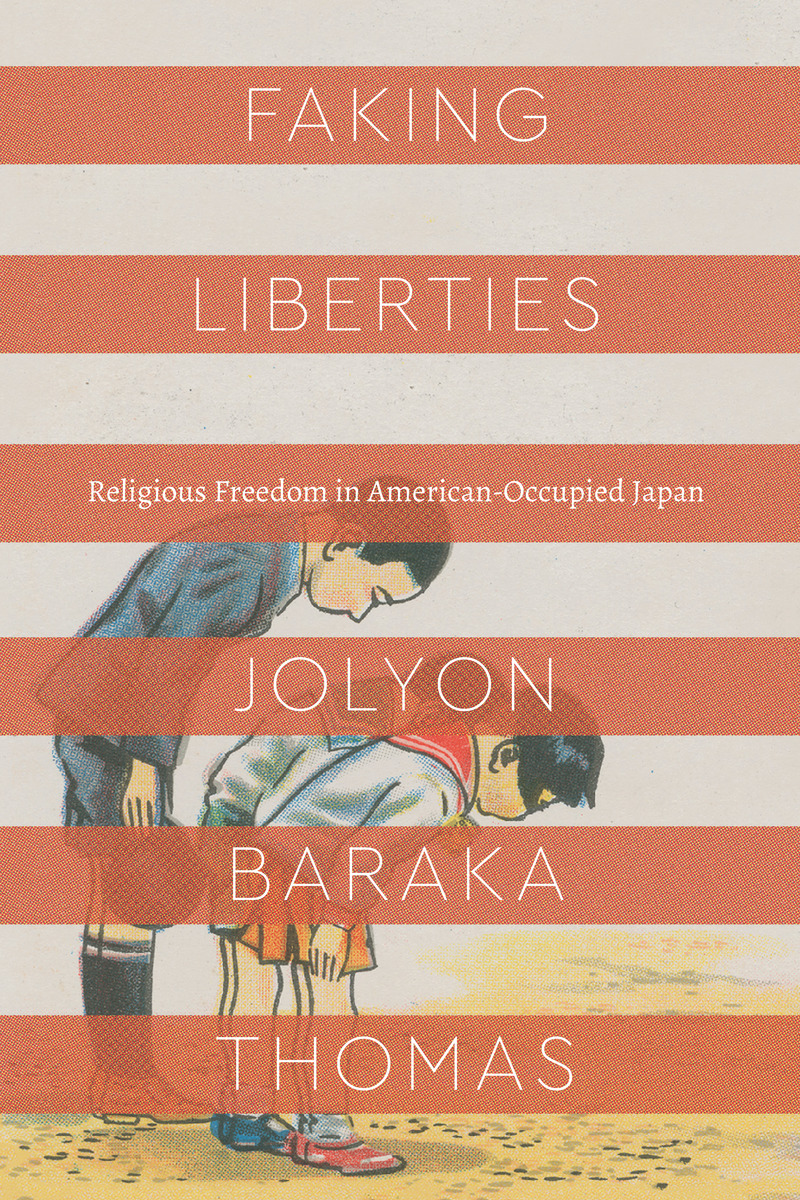
Faking Liberties Religious Freedom in American-Occupied Japan
by Jolyon Baraka Thomas
University of Chicago Press, 2019
Cloth: 978-0-226-61879-1 | Paper: 978-0-226-61882-1 | Electronic: 978-0-226-61896-8
DOI: 10.7208/chicago/9780226618968.001.0001
ABOUT THIS BOOKAUTHOR BIOGRAPHYREVIEWSTABLE OF CONTENTS

ABOUT THIS BOOK

Religious freedom is a founding tenet of the United States, and it has frequently been used to justify policies towards other nations. Such was the case in 1945 when Americans occupied Japan following World War II. Though the Japanese constitution had guaranteed freedom of religion since 1889, the United States declared that protection faulty, and when the occupation ended in 1952, they claimed to have successfully replaced it with “real” religious freedom.

Through a fresh analysis of pre-war Japanese law, Jolyon Baraka Thomas demonstrates that the occupiers’ triumphant narrative obscured salient Japanese political debates about religious freedom. Indeed, Thomas reveals that American occupiers also vehemently disagreed about the topic. By reconstructing these vibrant debates, Faking Liberties unsettles any notion of American authorship and imposition of religious freedom. Instead, Thomas shows that, during the Occupation, a dialogue about freedom of religion ensued that constructed a new global set of political norms that continue to form policies today.

AUTHOR BIOGRAPHY

Jolyon Baraka Thomas is an assistant professor of religious studies at the University of Pennsylvania.

REVIEWS

"Thomas draws on an impressive array of important sources to argue that although religious freedom solves problems of inequity and oppression, it creates new problems and is inherently coercive."
— Choice

"Given that the last decade has seen a number of scholarly works detailing the establishment of 'religion' as a concept in early Meiji Japan, Thomas’s efforts to show how the category of religion was negotiated in Japan during the entire first half of the twentieth century represents a welcome move forward in time. Meticulously researched, theoretically sharp, and elegantly written, Faking Liberties is an excellent study not only of how religious freedom was constructed as a transnational ideal through mutual negotiation during the period of American occupation, but also of how various actors interacted with religious freedom during the interbellum period. Faking Liberties is a welcome addition to the field of Japanese religious studies as well as to the critical study of religion and law."
— H-Net Reviews

"Faking Liberties is a challenging intervention into not only the historiography of modern Japan, but religious studies more generally."
— New Books Network

"Through archival prowess and intra-textual paradox, Thomas offers a well-timed reminder: to
stake out ground in the capacious is to take a partisan position. It is to recognize, again, the
ways that our critical projects remain enmeshed with hard-won visions of social good and with
so many ambivalent projects of humanism that—still, somehow—we cannot manage not to
want."
— Lucia Hulsether, Reading Religion

"By looking at the ways discourses about religious freedom regulated race, gender, and ritual practices in occupation-era Japan, we can see the double-standard of what America has advocated for abroad versus practiced at home. Thomas calls for deeper scholarly engagement with the category of 'freedom' and how freedom of religious expression has been racially coded as white in the United States. It is a cautionary tale with important pedagogical and institutional lessons. If we find that discussing 'diversity looks like activism,' he suggests, then 'we have a huge problem' that reveals why diversity in the academy is essential for discussing secularism, religious freedom, and religion today."
— Religious Studies Project

"Faking Liberties straddles the boundary between a historiographic exploration of religious freedom across the chronological divide of the US-led Allied Occupation of Japan and a critical reflection on the scholarly construction of religion and religious freedom. The vigilance with which Jolyon Baraka Thomas attends to the descriptive and prescriptive dimensions of scholarship in this impressive monograph opens up a number of important conversations. . . . I expect it will grace many reading lists and course syllabi for some time."
— Monumenta Nipponica

"Faking Liberties is a valuable and thought-provoking deconstruction of the concepts of religion and religious freedom, set in the interactions between Japan and the United States across the nineteenth and twentieth centuries. It is easily applicable to the field of religious studies more broadly, however. I believe that Thomas’s powerful and user-friendly writing, meticulous attention to detail, and illustration of the wide-ranging implications of the interconnections among religion, politics, and academia will see Faking Liberties become required reading for students and scholars of Japan, of religious studies, of new religious movements, and of world history alike."
— Novo Religio

"Excellent . . . [the] connection to contemporary policy debates makes Faking Liberties an enormously valuable read beyond the scholarly world of Japanese studies. . . .  Faking Liberties is an engrossing and valuable read for anyone involved in, or simply interested in, the interaction of scholarship and policy at the intersection of religion and international affairs."
— Judd Birdsall, The Review of Faith & International Affairs

"Faking Liberties is not only an innovative and meticulously researched example of transnational history that will become essential reading for historians of religion, Japan, and Japanese-American relations. Thomas’s method and his reflection on religious freedom would also benefit the work of political scientists, foreign service officers, policy makers and law makers, and anyone interested in thinking critically about religion and freedom."
— The Journal of Religion

“A powerful study of warring rhetoric on religious freedom within and between Japan and the United States, Thomas’s work presents a model analysis of debate on a foundational concept, minutely clarifying the stakeholders, the stakes, and the consequences of the argument. This book shows the Allied Occupation of Japan in an entirely new light and unprecedented detail through its examination of policy as hammered out by the occupiers and the occupied, on the basis of a rich heritage of thought in both countries on the meaning of religious freedom.”
— Helen Hardacre, Harvard University, author of Shinto and the State, 1868-1988

“Faking Liberties is a brilliant intervention in a burgeoning literature on the historical coercions of religious freedom. Thomas compares religious freedom regimes in Japan under pre-WWII Meiji rule and the postwar US occupation, exploding myths of Japanese exceptionalism (both negative and positive) and revealing how this freedom served in both cases as a project that defined and disciplined the limits of religion.”
— Tisa Wenger, Yale University, author of Religious Freedom: The Contested History of an American Idea

“Jolyon Thomas has written an original and enthralling account of the ideal of ‘religious freedom’ in the Allied Occupation of Japan. By tracing competing political, ecclesiastical, and academic discourses, Thomas shows that the ideal of religious freedom came to favor some groups at the expense of others and often resulted in the ossification of religious difference. The work is a timely and dazzling intervention with broad implications.”
— Jason Josephson-Storm, Williams College, author of The Invention of Religion in Japan

"Jolyon Thomas’s book serves as an astute religious history of the Us occupation of post-WWII Japan, and also provides a powerful corrective to misperceptions about religious freedom broadly and about prewar religious freedom in Japan specifically."
— Anne M. Blankenship, American Religion

"Faking Liberties, drawing richly from archival materials and prewar and wartime books and newspapers in both English and Japanese, is thus a major disruption of the received narrative about religion, and freedom, in Japan...a must-read for anyone who wants to learn more about religion and freedom in Japan or as 'universal' ideas."
— Jason Morgan, Journal of American-East Asian Relations

"This is a thoughtful, readable, well-researched and insightful book. Thomas not only describes the U.S. occupation, but also the preceding period in great detail. It will be especially helpful for religious studies scholars and students of church (religion) and state."
— Gwyn McClelland, Journal of Church and State

"Faking Liberties...sets new standards for methodological rigor in archival work on modern Japanese religions as it provides unprecedented access to key works by Buddhist and other religious figures, Japanese government officials, Occupation authorities, and numerous other contributors to discourse on religious freedom...Thomas’s attention to injustice animates an overdue destruction of long-standing myths about Japanese and American exceptionalism. The result is the most important book on Japanese religion of our scholarly generation. It rewrites Japanese religious history in a way that requires all of us to follow Thomas in calling out racialized mythologies maintained by the institutions we study. Like it or not, we are now in a post–Faking Liberties era."
— Levi McLaughlin, Journal of Asian Studies

"Faking Liberties is a critical and meticulous history of the use and evolution of discourses on religious freedom during the American Occupation of Japan. Thomas provides welcome rebuttals to the universalist premises of earlier historiography of this period through a careful investigation of religious freedom in Japan from the early Meiji period to 1952. Faking Liberties is a valuable contribution to a body of literature concerned with the “politics and ethics of who gets to define” religious freedom (5), and has broad significance for contemporary understandings of modern Japanese history."
— New Voices in Japanese Studies

"Thomas offers his readers a powerful lens to deconstruct the Occupation discourse of America providing Japan with religious freedom… This book, with its fresh and critical perspective, is a brilliant intervention on the prewar history of Japan and is a must read for all scholars of Japanese religion and history."
— Religious Studies Review

"Faking Liberties is an important contribution to the study of Japanese religions and to the study of religion as a whole, and it conveys complex ideas in a clear and accessible style."
— Journal of the American Academy of Religion

"...certainly relevant for everybody in religious studies in thinking about how our work matters and what the afterlife of that work might be."
— Religious Studies News

"This is an important book that will have an impact on a variety of ongoing debates in and outside of Japan studies and religious studies. It is also a model case in historical research that synthesizes an impressive array of archival materials from the early Meiji era to the postwar, producing a work that brings into clear focus the politics of religious freedom." 
— Social Science Japan Journal

” Thomas presents a masterful synthesis of both primary and secondary sources, which is executed in an admirable and at the same time highly accessible style. It is also worth pointing out that the publisher has beautifully designed the volume and has also made it available as a paperback right away, making it even more accessible. This is a must-read for scholars and students of modern religion in Japan, and I suspect that it will in the years to come become the standard work on state-religion relations in modern Japan that Japan studies practitioners will turn to.“
— Journal of Japanese Studies

"Faking Liberties is an exceptional book that cannot be ignored by scholars interested in the development of religious freedom during the occupation era, the extant religious liberties that arose during the Meiji Era, or the current state of religious freedom in Japan."
— Journal of Law and Religion

TABLE OF CONTENTS


DOI: 10.7208/chicago/9780226618968.003.0001
[religious freedom;occupation;human rights;religion-making;religious studies;State Shinto;coercion]
A widespread post-World War II narrative suggests that American occupiers liberated Japan by bringing the universal principle of religious freedom to a country captive to the particularist religion of “State Shinto.” But this chapter shows that by identifying Japan as the problem and religious freedom as a solution, the triumphalist Occupation narrative fails to account for the coercive qualities and historical particularities of religious freedom practice. Arguing that religious freedom is not an ethereal principle that is introduced to a nation or applied to a situation, the chapter suggests instead that freeing religion is a mundane project subject to political machination and discursive manipulation. Parties involved in this project include political leaders, policy makers, clerical authorities, and scholars of religion, all of whom “make” religion in order to free it.
This chapter is available at:
    https://academic.oup.com/chica...


DOI: 10.7208/chicago/9780226618968.003.0002
[secularism;secularity;constitutionalism;shrine rites;civil religion;state religion;State Shinto;religious freedom]
Although many professional observers have treated Japanese governance in the early twentieth century as unusually oppressive, in actuality Japanese practices of religious freedom under the Meiji Constitution (in effect 1890–1945) were quite normal insofar as they exhibited the typical functioning of secularist governance. The religion/not-religion distinction established in Japanese constitutional law prompted ongoing anxiety about how to properly separate religion from other aspects of social and political life. This uncertainty prompted a range of stakeholders to weigh in on the vexing question of whether compulsory participation in shrine rites constituted infringement on the constitutional right to religious liberty. Although there are documented cases of the Japanese state cracking down on religious minorities throughout the Meiji constitutional period, the debates over shrine rites reveal that the claim that the Meiji constitutional regime lacked religious freedom has little defensible historical basis. The upshot is not that the Meiji constitutional regime was benign, but rather that its method of distinguishing between religion and not-religion is similar to the secularist governance of religion in other times and places. The disturbing takeaway is that the Meiji constitutional regime looks familiar rather than peculiar: Secularist politics, not theocracy, created Japan's draconian police work and coercive ceremonialism.
This chapter is available at:
    https://academic.oup.com/chica...


DOI: 10.7208/chicago/9780226618968.003.0003
[religious freedom;customary rights;officially recognized religion;mixed residence;legislation;civil rights;statism;corporatism;latitudinarianism]
Japanese Buddhists developed sophisticated interpretations of religious freedom in response to three pressing legal issues in the late nineteenth century. First, a controversial decision concerning chaplaincy at the Sugamo Prison in northern Tokyo led Buddhists to decry Christians' ability to benefit from the constitutional religious freedom guarantee. Second, the prospect of "mixed residence" with foreign Christians, a result of bilateral treaty revisions long sought by the Japanese government, led Buddhists to advance the idea of making Buddhism Japan's sole "officially recognized religion" (koninkyo).Finally, an 1899 executive branch attempt to pass comprehensive religions legislation elicited strident responses from Buddhists skeptical of the cabinet's interpretation of the meaning and scope of religious freedom. Buddhists generally agreed that they needed cutting-edge theories of religious freedom to press their case with the state, but they disagreed vehemently with one another about which interpretations worked best. As Buddhist interest groups vied with one another over differing conceptions of political supremacy and legal legitimacy, they generated competing understandings of religious freedom as political norm and apologetic tactic. These statist, corporatist, and civil libertarian interpretations of religious freedom deeply influenced later debates over Japanese politics and the social roles of religions.
This chapter is available at:
    https://academic.oup.com/chica...


DOI: 10.7208/chicago/9780226618968.003.0004
[religious freedom;Buddhism;Imamura Yemyo;mikadoism;immigration;language schools;Japanese Americans;diplomacy]
In the 1910s and 1920s, Japanese representatives had to prove time and again that their country had truly embraced religious freedom. One problem was that a journalistic trope of “Mikadoism” (emperor worship) dominated anglophone media just as racial tensions were rising around the massive emigrations of Japanese contract laborers to the American west coast and Hawai‘i. Another problem arose when world leaders responded to Japan's proposal to include a racial equality clausein the League of Nations charter by suggesting that the equality proposal was antithetical to religious freedom. Against this tense diplomatic backdrop, Japanese Buddhists in Hawai‘i confronted challenges related to rights and race, land and labor. Because Buddhists ran language schools for second-generation Japanese children and regularly supported Japanese laborers in conflicts with plantation bosses, members of Hawai‘i’s white landowning class called for the eradication of the language schools as hotbeds of seditious ideology. Buddhists defended themselves in print by appealing to the American ideal of religious freedom, and they even won a supreme court case on the language school issue in 1927 (Farrington v. Tokushige). Yet the decision made no mention of religion, revealing that Japanese Americans remained largely unable to benefit from America's religious freedom guarantee.
This chapter is available at:
    https://academic.oup.com/chica...


DOI: 10.7208/chicago/9780226618968.003.0005
[religious freedom;resistance;complicity;martyrdom;Religious Organizations Law;Chikazumi Jokan;Ando Masazumi;Makiguchi Tsunesaburo;Peace Preservation Law]
While postwar scholars have described the 1939 Religious Organizations Law as the death knell for religious freedom in Japan, contemporaneous accounts by both Japanese and non-Japanese parties suggest that the story is more complicated. Some prominent Buddhist leaders who opposed the law, such as Chikazumi Jokan, did so because they found its egalitarian premises problematic, not because they thought it was particularly draconian. Meanwhile, Buddhist proponents of the law, such as former priest and government bureaucrat Ando Masazumi, suggested that the law worked to protect religious freedoms, not infringe upon them. Finally, Buddhists who were imprisoned by the Special Higher Police, such as Soka Kyoiku Gakkai leader Makiguchi Tsunesaburo, apparently had little use for the constitutional religious freedom guarantee. Juxtaposing interpretations of religious freedom advanced by these three lay, laicized, or lay-leaning Buddhist leaders between 1925 and 1945, this chapter challenges the intertwined presuppositions that political resistance to comprehensive religions legislation was necessarily liberal, that complicity with state initiatives was inherently illiberal, and that religious leaders' deaths in police custody made them martyrs for religious freedom. It also shows that American diplomats and journalists stationed in Tokyo regarded the 1939 Religious Organizations Law as unproblematic on religious freedom grounds.
This chapter is available at:
    https://academic.oup.com/chica...


DOI: 10.7208/chicago/9780226618968.003.0006
[religious freedom;State Shinto;religious studies;William Bunce;Shinto Directive;human rights;D.C. Holtom;Kato Genchi;Anesaki Masaharu;B.H. Chamberlain]
When the United States Department of State abruptly announced that Shinto would be disestablished as a state religion about a month into the Occupation, it placed the occupiers in an awkward position. Presurrender orders had said that they were to proclaim religious freedom for all, but their new mandate demanded that they target a particular religion for eradication. Their task was complicated not only because it was hard to guarantee universal religious freedom while simultaneously abolishing a particular religion, but also because Japan technically had no state religion in law. In fact, the constitution of 1889 had included a clear, if circumscribed, guarantee of religious freedom. Turning to religious studies experts for guidance in how to solve this dilemma, Civil Information & Education Section official William K. Bunce settled on using the previously obscure academic concept of "State Shinto" to create a vision of “bad secularism” against which the occupiers’ concept of religious freedom (“good secularism”) could be juxtaposed. This endeavor initiated a years-long collaborative process that enrolled both Japanese thought leaders and American officials in redefining religious freedom as a universal human right.
This chapter is available at:
    https://academic.oup.com/chica...


DOI: 10.7208/chicago/9780226618968.003.0007
[religious freedom;Christianization;democratization;Religion and Cultural Resources Division;education;land reform;transsectarian organizations]
American interpretations of religious freedom during the Occupation were far from uniform. Supreme Commander of the Allied Powers Douglas MacArthur wanted to Christianize Japan by any means necessary, while Religions and Cultural Resources Division chief William Bunce aimed to promote personalized, elective understandings of religious freedom. Meanwhile, the Occupation rank and file, Japanese citizens, and Occupation translators and clerical staff harbored a wide variety of assumptions about what religious freedom was and who should benefit from it. Forced to reconcile competing interpretations of religious freedom among the occupiers while simultaneously charged with fostering “a desire for religious freedom" in the Japanese populace, members of the Occupation Religions and Cultural Resources Division set about establishing a new, universal understanding of religious freedom. They did so primarily by interfacing with existing and newly formed transdenominational and transsectarian religious organizations. In so doing, the occupiers ironically reproduced a dynamic that characterized the close, collaborative relationships between Japanese religions and the state in wartime.
This chapter is available at:
    https://academic.oup.com/chica...


DOI: 10.7208/chicago/9780226618968.003.0008
[religious freedom;human rights;constitution;religious studies;Kishimoto Hideo;communism]
The overlapping jurisdictions and universalizing rhetoric of the Occupation created a situation in which the concept of religious freedom had to change. Two governments were in charge of the same territory and population, meaning that rights had to come from someplace beyond the state. Moreover, the occupiers did not trust Japanese political leaders to continue to guarantee religious freedom once the Occupation ended. The occupiers found a solution to this twofold enforcement problem through an outreach program premised onthe intertwined notions that all humans were inherently religious and that religiosity preceded (or superseded) national citizenship. Through popular media and public-facing outreach lectures explaining the American-drafted constitution that had been promulgated in November 1946, Japanese legal experts and scholars of religion helped the occupiers frame religious freedom as innate, universal, and unquestionable. But while religious freedom appeared in this discourse as a universal human right rather than as a parochial civil liberty, stakeholders continued to discriminate between what they saw as "good" and "bad" types of religion, effectively circumscribing the scope of the supposedly inalienable right. Simultaneously, American political leaders weaponized the ostensibly pacifistic concept of religious-freedom-as-human-right, making it a powerful ideological tool for their battles against "godless communism" worldwide.
This chapter is available at:
    https://academic.oup.com/chica...


DOI: 10.7208/chicago/9780226618968.003.0009
[religious freedom;State Shinto;Buddhist war responsibility;new religions;spiritual vacuum;religious studies;Kishimoto Hideo;William P. Woodard]
Scholars of religion eagerly took up the Occupation mandate to foster "a desire for religious freedom" in the Japanese populace. These efforts can be seen in three postwar concepts that have deeply structured the postwar academic study of Japanese religions, but that have also had global reach. The concept of "new religions" was born out of Occupation-era collaborations between representatives of marginal religious movements, military government officials, and scholars of religion as a way of protecting the rights of some minority religions by avoiding pejorative terms such as “superstition” (meishin), “lascivious heresies” (inshi jakyo), and “upstart religions” (shinko shukyo). In translation, the concept of “new religions” went on to become a broadly accepted category in the global religious studies academy. Similarly, the postwar notion of "Buddhist war responsibility" helped to structure the widespread expectation that Buddhism, more than other religions, is inherently politically progressive and indisputably pacifist. Finally, the concept of "State Shinto" served as an early example of a "perversion of faith," a problematic framing device that dominates "countering violent extremism" initiatives to this day.
This chapter is available at:
    https://academic.oup.com/chica...


DOI: 10.7208/chicago/9780226618968.003.0010
[religious freedom;geopolitics;human rights;religious studies;tolerance;public scholarship]
Religious freedom frequently appears in journalism, scholarship, and policy as an antidote to the ills of violence and political strife, but unreflective celebration of religious freedom as a universal principle and emancipatory ideal overlooks the contextually determined, often coercive, qualities of religious liberty discourse. Presidents, lobbyists, think tanks, and religious leaders all deploy the language of religious freedom in pursuit of their objectives, but their conflicting interpretations make it difficult to figure out where one person’s freedom infringes on another’s right to exist. Religious studies scholarship is hardly immune to these definitional problems, and scholars of religion have no better handle than any other stakeholders on how to “do religious freedom right.” However, scholarship on religion and politics can become more precise by rejecting simplistic claims about religious freedom as something that nations have or lack and instead focusing on the historically contingent, always localized, situations in which disputes about what counts as religion arise. In so doing, scholars of religion may not provide satisfactory answers to the normative question of how to free religion once and for all, but they can do a better job of describing who gets to define the operative terms, and with what effects.
This chapter is available at:
    https://academic.oup.com/chica...