ABOUT THIS BOOK
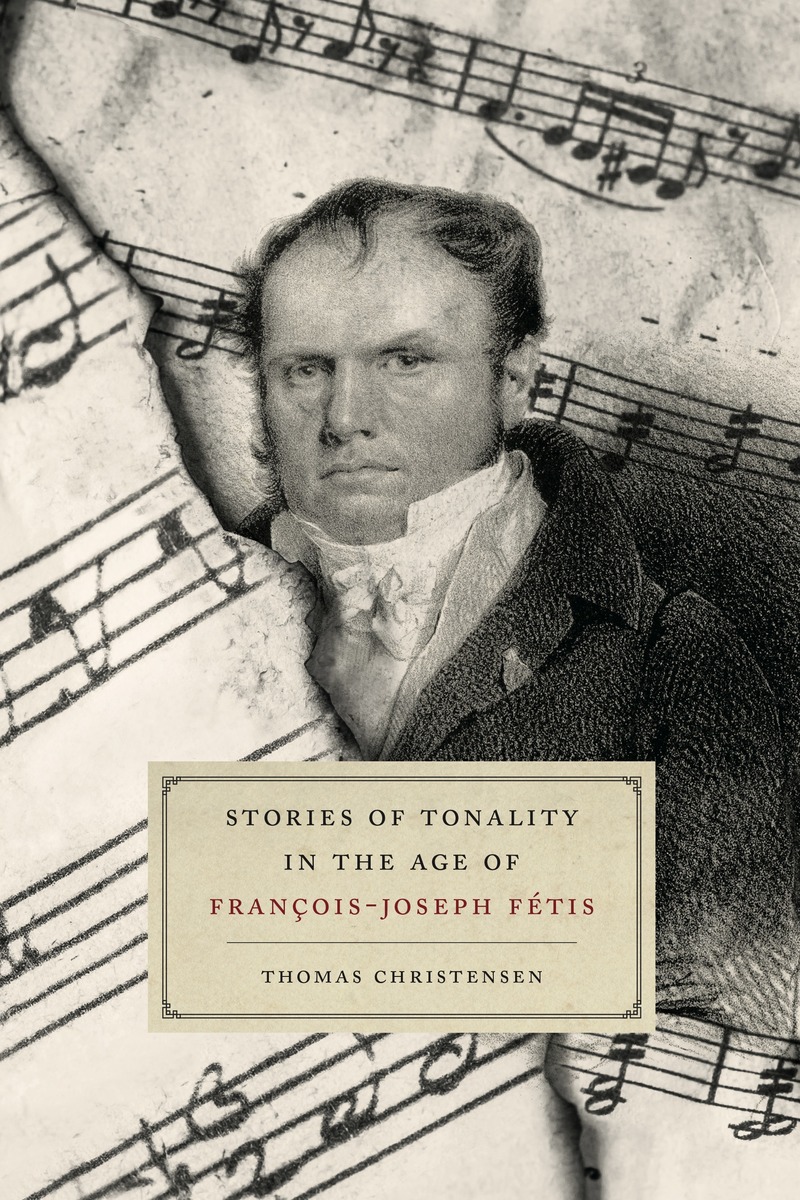
Stories of Tonality in the Age of François-Joseph Fétis explores the concept of musical tonality through the writings of the Belgian musicologist François-Joseph Fétis (1784–1867), who was singularly responsible for theorizing and popularizing the term in the nineteenth century. Thomas Christensen weaves a rich story in which tonality emerges as a theoretical construct born of anxiety and alterity for Europeans during this time as they learned more about “other” musics and alternative tonal systems. Tonality became a central vortex in which French musicians thought—and argued—about a variety of musical repertoires, be they contemporary European musics of the stage, concert hall, or church, folk songs from the provinces, microtonal scale systems of Arabic and Indian music, or the medieval and Renaissance music whose notational traces were just beginning to be deciphered by scholars. Fétis’s influential writings offer insight into how tonality ingrained itself within nineteenth-century music discourse, and why it has continued to resonate with uncanny prescience throughout the musical upheavals of the twentieth and twenty-first centuries.
REVIEWS
"This book challenges how we think of one of the most long-standing and contentious principles of music, tonality. Rejecting Rameau’s acoustic notion based on mathematics, the Belgian composer-theorist-historian F.-J. Fétis, inspired by Hegel, at first understood it as a function of the human intellect. Later, fascinated with non-western music, he came to believe that 'tonalities' reflect and express race and culture, their differences resulting from migration, transformation, and progress. Christensen deconstructs the origins of these theories and their implications. Looking to street cries, controversial practices in singing chant, and tonality’s purported capacity to unite mankind, he also interrogates the debates they evoked. Compelling and convincing, these Stories of Tonality offer a new approach to both intellectual history and musical biography."
— Jann Pasler, University of California San Diego
"Although we now credit François-Joseph Fétis with its dissemination, 'Qu’est-ce que la tonalité?' was a question neither Fétis nor anyone else was ever able to answer, not really. Born in a flush of romantic idealism, the concept committed his contemporaries to narratives that wavered between cultural loss and the promise of renewal before falling under the sway of the racial pseudosciences of the nineteenth century and the cultural politics that sustained them. In Thomas Christensen's retelling, those politics emerge more clearly than ever before, and stand as a cautionary tale to those who, like Fétis, would dream of music's history."
— Brian Hyer, University of Wisconsin-Madison
"Christensen's study if a valuable one for understanding a complex subject."
— Revue de Musicologie (Translated from French)
"Thomas Christensen’s wide-ranging and erudite book is the first sustained attempt in English to grapple with Fétis’s complex music-theoretical legacy... In so doing, he offers an extraordinary panorama of French musical culture and musical thought over the long nineteenth century."
— Music and Letters
"Stories of Tonality in the Age of François-Joseph Fétis deepens our understanding of [tonality] by tracing its origins and uses in discourse . . . The scope and breadth of this book make Christensen’s research a valuable contribution to scholarship. It speaks to a range of audiences beyond music theorists seeking deeper insight into the history of tonality."
— Notes
TABLE OF CONTENTS
Tonal Imaginations
DOI: 10.7208/chicago/9780226627083.003.0001
[Fetis;tonality;Choron;Idealism]
Chapter 1 begins with a historical account of Fétis’s theory of tonality, tracing its roots in earlier theoretical and philosophical traditions (in particular the writings of Alexandre Choron). While there is an “empirical” scale-based element to his notion of tonality, his theory ultimately is seen to represent a metaphysical conception of tonal relations that owes much to German Idealist philosophers such as Kant and Hegel; German Idealism also offered Fétis the grounding he needed to construct an ambitious universal history of tonality that encompassed all ages and cultures. In particular, the chapter focuses on the famous four “orders” of tonality by which Fétis reconstructed the evolutionary stages of Western musical tonality and dared thereby to predict its future.
Chant
DOI: 10.7208/chicago/9780226627083.003.0002
[plain-chant reform;Solemes;organ accompaniment;Joseph d'Ortigue]
This Chapter focuses on the early 19th-century plain-chant reform movement that so engaged French and Belgian clerics (long before, incidentally, the better-known work of the Solesmes monks after mid-century). Fétis’s reification of an original “plainchant” tonality provided the justification that many church authorities were seeking for purging chant practice of the chromaticism and other pernicious influences that were regarded as the anachronistic intrusions of a later, tonal practice, and return that repertoire to the unsullied, purified modality characteristic of the tonalité ancienne. But there was hardly any consensus on the matter. The debates that ensued—from the use of accidentals in Roman chant to the kinds of organ accompaniments that should be sanctioned in church--were only the first of many polemics that Fétis’s writings would generate.
This chapter is available at:
https://academic.oup.com/chica...
Origins
DOI: 10.7208/chicago/9780226627083.003.0003
[tonality;Edmond de Coussemaker;Rapheal Kiesewetter;musica ficta;Monteverdi;Joseph d'Ortigue;trouvères]
This chapter deals with the controversy regarding the origins of modern tonality. Fétis was quite sure that the beginnings of modern tonality could be dated quite precisely at the beginning of the seventeenth century in the music of Monteverdi. But as other musicologists (such as Kiesewetter and Coussemaker) began to learn more about the music of the Middle Ages, suspicions arose that tonality might have had a much older pedigree than Fétis had allowed. (The question of musica ficta was a key point of contention, as the introduction of a chromatic semitone by medieval singers within an otherwise pure diatonic fabric suggested to some editors the affective quality of leading tones, one of the key characteristics that Fétis attributed exclusively to modern tonality.) In addition, many of these same observers thought that much vernacular song from the Middle Ages, especially the music of the trouvères, was clearly tonal in orientation.
This chapter is available at:
https://academic.oup.com/chica...
Song
DOI: 10.7208/chicago/9780226627083.003.0004
[chanson populaire;popular song;Julien Tiersot;Brittany;Louis-Albert Bourgault-Doucordray;Théodore Hersart, vicomte de La Villemarqué]
A complicating factor in Fetis's theory of tonality was the repertoire of popular folk songs (the chansons populaires) that collectors were beginning to transcribe and publish in various anthologies throughout the nineteenth century. In this Chapter we see how some of these song catchers insisted that many of their songs, particularly those from the more remote provinces of France such as Brittany, seemed to be based on differing scale systems, some of which suggested modal origins that could be traced to the Middle Ages, or perhaps even earlier to the Greeks. But the picture was not clear. Some of the oldest of the popular songs sounded to many ears as if they were in simple major or minor keys. This evidence suggested that tonality might have roots in vernacular traditions, although a number of church musicians continued to insist that the modal system of the church represented the true, authentic musical language of the people.
This chapter is available at:
https://academic.oup.com/chica...
Orienting Tonality
DOI: 10.7208/chicago/9780226627083.003.0005
[race;Indo-European languages;Arthur de Gobinau;orientalism;phrenology;pentatonicism;Chinese music;Indian music]
This chapter widens our view to look at tonalities outside of Europe. The various scale systems of Arabic and Indian music that European scholars were discovering in the nineteenth century, with all their microtones and variable interval structures, was proof enough to Fétis that tonalities varied widely across the globe, and each was particular to the needs and character of the race that embraced it. As Fétis studied many of these musical traditions more closely, he began to wonder if the origins and filiations of these various tonalities might mimic those of the various language families that contemporary linguists were beginning to reconstruct. At the same time, though, Fétis fell under the sway of some of the more repugnant racial theories that French ethnologists were then beginning to promote. He concluded in some of his very last writings that biology and race must have played a more determinant role in the evolution of tonality that he had earlier thought. This led, then, to animated debates among many theorists about the historical genealogies of tonality across cultures and how they might have been transformed and changed over time.
This chapter is available at:
https://academic.oup.com/chica...
Theory
DOI: 10.7208/chicago/9780226627083.003.0006
[music theory;tonal theory;Charles-Simon Catel;Beethoven]
In Chapter 6, we will revisit some of Fétis’s theoretical arguments and subject them to closer scrutiny. In particular, we will examine Fétis’s criticisms of his theoretical predecessors and understand why he felt their many attempts to find a scientific basis for the theory and practice of music inevitably failed. Fetis was particularly critical of Rameau, whose music theory was perhaps the single most ambitious attempt to naturalize tonal harmony. If Fétis concluded that Rameau’s efforts (not to mention those of almost all of his theoretical successors) to ground tonality in natural laws of empirical science were ultimately chimerical, other investigators were not willing to give up the dream so easily. Many of them continued in their efforts to find a scientific basis for tonal music. This is a rich and extensive literature that is little known today, overshadowed as it is by so much German theorizing. But this literature, too, as we will see, was itself in almost constant dialogue and contestation with Fétis’s influential work.
This chapter is available at:
https://academic.oup.com/chica...
Tonal Futures
DOI: 10.7208/chicago/9780226627083.003.0007
[omnitonic;Liszt;atonality;Wagner;musical modalism]
Fétis famously designated some of the most chromatic music of his day as omnitonique, and he predicted that the rapid and often chromatically elaborated modulations to remote key areas characteristic of this order would continue to increase in number and intensity. Anxiety about the future of musical tonality was also on the minds of many composers, and some of them were well aware of Fétis’s writings and those of his critics. Liszt turns out to have been particularly drawn to Fétis’s theories. As French composers worried about their own national identity and musical patrimony—especially with the specter of Wagner looming from across the Rhine—the question of musical tonality assumed renewed urgency. For some, this meant keeping up with the most modern tonal practice then being exported by Wagner and his devotees; for others it was just the opposite: they retreated into an older modal language that was imagined to be part of the musical patrimony of France’s glorious past (unitonique music, as Fétis called it). Still others went in a differing direction altogether and experimented with exotic Oriental topoi and scale systems.
This chapter is available at:
https://academic.oup.com/chica...
Epilogue
DOI: 10.7208/chicago/9780226627083.003.0008
[tonality;music theory;Fétis]
The epilogue contains closing thoughts about the complicated legacy of Fétis'sproject and its uncanny resonance in current music-theoretical debates about the nature of musical tonality.
This chapter is available at:
https://academic.oup.com/chica...