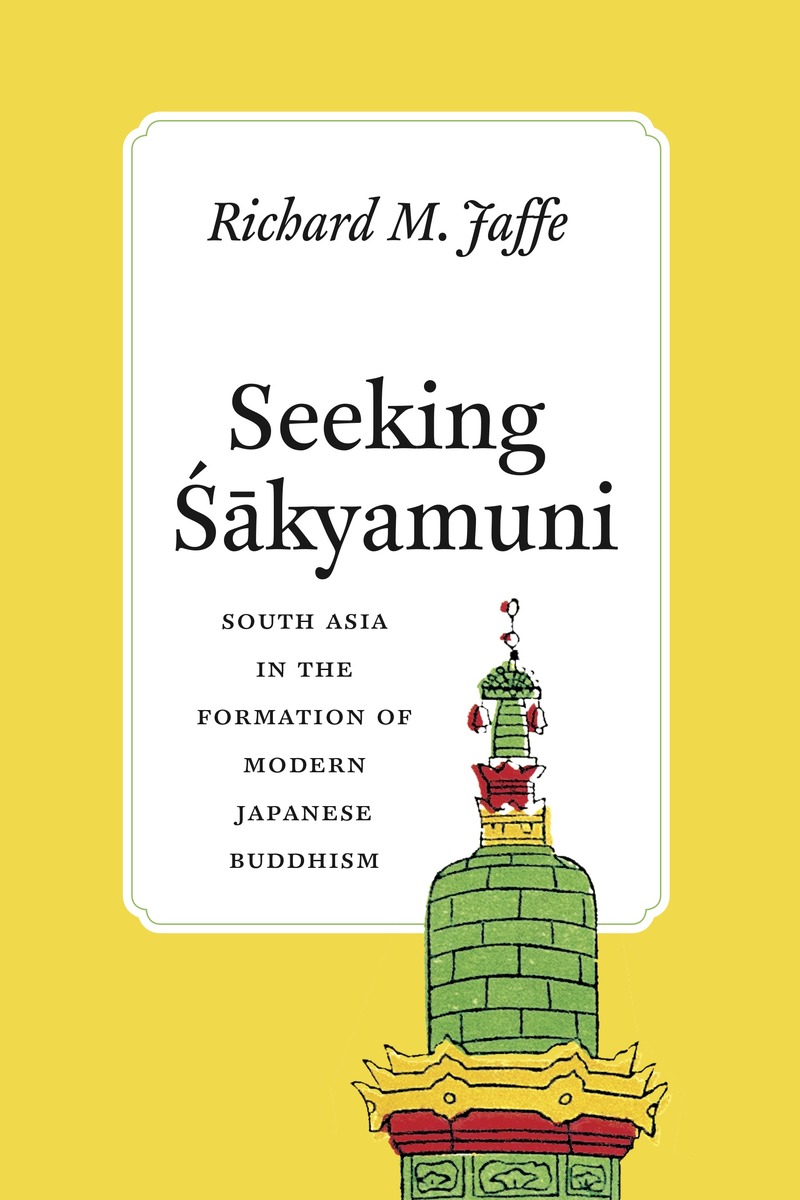
ABOUT THIS BOOK
Though fascinated with the land of their tradition’s birth, virtually no Japanese Buddhists visited the Indian subcontinent before the nineteenth century. In the richly illustrated Seeking Śākyamuni, Richard M. Jaffe reveals the experiences of the first Japanese Buddhists who traveled to South Asia in search of Buddhist knowledge beginning in 1873. Analyzing the impact of these voyages on Japanese conceptions of Buddhism, he argues that South Asia developed into a pivotal nexus for the development of twentieth-century Japanese Buddhism. Jaffe shows that Japan’s growing economic ties to the subcontinent following World War I fostered even more Japanese pilgrimage and study at Buddhism’s foundational sites. Tracking the Japanese travelers who returned home, as well as South Asians who visited Japan, Jaffe describes how the resulting flows of knowledge, personal connections, linguistic expertise, and material artifacts of South and Southeast Asian Buddhism instantiated the growing popular consciousness of Buddhism as a pan-Asian tradition—in the heart of Japan.
REVIEWS
"A fascinating account of Japanese visitors to India in the 19th and early 20th centuries. Notably, these were seekers and pilgrims, rather than pleasure-seekers. Their stories have been rehabilitated in Richard Jaffe’s recent book, Seeking Sakyamuni . . . In the political imagination of modern India, Japan is the land that gave succour to Subhas Chandra Bose and his Indian National Army (INA). In the technological imagination of modern India, Japan is the land that will quickly and efficiently connect the trading centres of Mumbai and Ahmedabad. Seeking Sakyamuni takes us back to a time before the INA and the bullet train, when the two countries were brought together by the interest of spiritually inclined Japanese in the greatest of all Indians."
— Hindustan Times
"Fascinating . . . Jaffe’s work consistently and elegantly brings the dynamic and changing world into his discussions of the flow of ideas, and it is made much stronger thereby. . . . I have long argued that readings of religion that ignore the history of their own time and place can be intriguing in an isolated and jewel-like capacity, but they also lack depth and the vibrancy possible in a dynamic, more fulsome history. Jaffe has provided us with just such a dynamic and fulsome history here."
— James E. Ketelaar, Harvard Journal of Asiatic Studies
"Jaffe explores the overseas travels made by Japanese Buddhists to India and the surrounding regions of South Asia between the beginning of the Meiji era and early twentieth century . . . As Jaffe demonstrates, Japanese Buddhists accepted and embraced nineteenth and twentieth-century Orientalist scholarship and Western (European and American) models of religious practices along with their South Asian and, to a lesser extent, Southeast Asian Buddhist roots to reconceptualize Japanese Buddhism during Japan’s modern era. More importantly, he notes that the emergence of Indian Buddhist and Sanskrit studies in Japanese Buddhist sectarian universities owes much to the importation of Western scholarship into Japan as well as to the training Japanese Buddhists received in South Asia. By the 1930s, Japanese Buddhists considered pilgrimage to Buddhist sites in India as a significant act of Buddhist devotion, and Japanese Buddhist scholars educated in South Asia were teaching in many of the sectarian universities in Japan."
— Journal of Asian Studies
"Seeking Śākyamuni merits a wide readership, which should include scholars and practitioners of Buddhism in South and Southeast Asia...This reviewer hopes that Seeking Śākyamuni will inaugurate new streams of research, and new ways of conceiving 'Buddhism in Japan,' for decades to come."
— Micah L. Auerback, Journal of Religion in Japan
"This book gives a stimulating inside view on the impacts that the significantly entangled areas of Buddhism and globality have on the real lives of actors in modern societies."
— Christian Koch, Reading Religion
"In the richly illustrated Seeking Śākyamuni: South Asia in the Formation of Modern Japanese Buddhism, Richard M. Jaffe reveals the experiences of the first Japanese Buddhists who traveled to South Asia in search of Buddhist knowledge beginning in 1873. Analyzing the impact of these voyages on Japanese conceptions of Buddhism, he argues that South Asia developed into a pivotal nexus for the development of twentieth-century Japanese Buddhism."
— Samee Siddiqui, New Books Network
"Jaffe’s Asia-centric focus also contributes significantly to research on modern Japanese Buddhism, introducing a number of important figures previously unknown to English-language readers, people who should be more widely known. . . . The extent and range of the personal records is one of the great strengths of the book. . . . The richly researched chapters are long and detailed; the translations and references generous, breaking ground for future studies."
— Journal of Japanese Studies
"Richly documented, engagingly narrated, and methodologically innovative. . ."
— Journal of the American Academy of Religion
"Seeking Śākyamuni: South Asia in the Formation of Modern Japanese Buddhismis an expansive, ambitious, and absorbing book. . . . Jaffe’s work here has the hallmarks of a superb history of modern Japanese Buddhism: it presents evidence gathered from a remarkably wide-ranging set of archives, engages with both individual thinkers and institutions as historical actors, and reveals a sure grasp of the economic and political contexts in which religious ideas were rearticulated without reducing the ideas to those contexts. At the same time, by reading Japanese Buddhist modernism in terms of flows taking place between Japan and South Asia, Seeking Śākyamuni pushes against the limits of modern Japanese Buddhist history as a category. Jaffe’s work here represents a provocative challenge to one way that the field of Buddhist Studies has organized itself, and a model of how to do things differently."
— Journal of Buddhist Ethics
"In this superb book of transnational history, Richard Jaffe uncovers the role that South Asia played in the shaping of modern Japanese Buddhism. Using a wide array of primary sources, he brings to light the forgotten stories of those scholars and seekers who make arduous journeys across the oceans, seeking the traces of the Buddha in the land of his birth. Seeking Śākyamuni is a landmark work of scholarship: rigorously researched, sharply analyzed, and beautifully written. It richly illuminates the religious and intellectual history of Asia, the world’s most populous and most prosperous continent."
— Ramachandra Guha, author of India After Gandhi
"Japanese Buddhism, like all religions, confronted a rapidly changing world in the nineteenth and early twentieth centuries, and had to remake itself in order to survive. The prevailing view has been that it did so by appropriating European models of religious learning and practice. Seeking Śākyamuni offers an important corrective to this view, demonstrating that South Asia—India, Sri Lanka, and Southeast Asia—loomed large in Japan’s new construction of Buddhism. Through thick description of Japanese scholar-priests residing long-term in South Asia, of wealthy Japanese tourists making “pilgrimages” to India’s Buddhist sites, of Japanese architectural innovations gesturing to Indian motifs, of South Asian monks participating in Japanese scholarly enterprises, and of much more, Jaffe shows that India left a visible imprint on Japan’s new Buddhism. This was not the result of a one-way transfer of religious culture in any particular direction. Rather, it was part of the creation of many modern Buddhisms out of cultural flows from East Asia, South Asia, and the West, which were 'entangled, circulatory, and inter-crossing.'"
— James Dobbins, Oberlin College
"Seeking Śākyamuni will entice and reward readers working on many corners of the Buddhist world. Revealing a 19th- and 20th-century history of complex Buddhist, commercial, and political networks and entanglements within and beyond Asia, Jaffe teaches us much about the more recent history of Japanese Buddhism. Simultaneously, he reveals the central role of intra-Asian engagements in the creation of new modes of Buddhist organization and expression in Japan as well as India, Sri Lanka, Burma and Thailand. Richard Jaffe's longstanding interest in Buddhist objects and aesthetic forms greatly enriches this study, reminding scholars of modern Buddhism not to neglect the changing visual and spatial arguments that reflected and shaped Japanese Buddhist mobility in Asia."
— Anne Blackburn, Cornell University
"An exceptionally well-researched and insightfully presented account of Japanese Buddhist travelers to South Asia during the late nineteenth and twentieth centuries, as well as the overall reception and impact of Indian Buddhism on the understanding and production of Japanese Buddhist temples, texts, and various aspects of intellectual and material culture in the modern period."
— Steve Heine, Florida International University
TABLE OF CONTENTS
1. South Asian Encounters: Kitabatake Doryu, Shaku Kozen, Shaku Soen, and the First Generation of Japanese Buddhists in South Asia 00
DOI: 10.7208/chicago/9780226628233.003.0001
[Kitabatake Doryu;Shaku Kozen;Shaku Soen;Ceylon;pilgrimage;India;Bodh Gaya;Hikka?uve Suma?gala]
This chapter examines some of the first Japanese contacts with South and Southeast Asia following the start of the Meiji era. Early pilgrimages to the subcontinent of India are examined as well as long-term study by Japanese Buddhists in Sri Lanka (Ceylon). The attitudes of Japanese Buddhists towards the archaeological sites and forms of Buddhist practice they encountered are analyzed. In addition, the chapter investigates the efforts by Japanese travelers to place Japanese Buddhism in the context of the emerging classification of Buddhism into Hinayana-Mahayana, and Southern-Northern categories.
This chapter is available at:
https://academic.oup.com/chica...
2. Kawaguchi Ekai, Globalization, and the Promotion of Lay Buddhism in Japan
DOI: 10.7208/chicago/9780226628233.003.0002
[Kawaguchi Ekai;lay Buddhism (zaike Bukkyo);India;lay Buddhism;Ram Avatara Sharma;Rashika Lal Bhattacarya;Sarat Chandra Das;Tibet;Nepal]
This chapter examines Kawaguchi Ekai's travels and study in India during the early twentieth century, including the role played by a series of Indian pandits in his study of Sanskrit and Tibetan. The chapter also includes an analysis of some of the ways Kawaguchi attempted to reform Japanese Buddhism following his return to Japan. The chapter looks at some of the reformist writings produced by Kawaguchi in the process of creating a series of lay Buddhist organizations in the Taisho and Showa periods, as well as his attempt to incorporate texts from outside the traditional Sino-Japanese Buddhist canon, for example, the Bodhicaryavatara, into Japanese Buddhist practice.
This chapter is available at:
https://academic.oup.com/chica...
3. Following the Cotton Road:Japanese Corporate Pilgrimage to India, 1926–1927
DOI: 10.7208/chicago/9780226628233.003.0003
[pilgrimage;espionage;Anglo-Japanese relations;cotton;Nippon Yusen Kaisha;Asian trade;Akegarasu Haya]
In the wake of World War I, Japanese pilgrimages to South and Southeast Asia increased in frequency. This chapter investigates one of the earliest corporate-sponsored Buddhist pilgrimages to South Asia that was managed by Nippon Yusen Kaisha, a major Japanese shipping company. The chapter investigates such factors as the growth of the cotton trade between Japan and India, as well as the increased strategic importance of the subcontinent for Japan, as supporting factors for the increased pilgrimage. In the chapter the reactions of such prominent Buddhists at Akegarasu Haya, Izawa Heizaemon, and Mamiya Eishu to their encounters with South Asian Buddhist sites and scholars are described and analyzed. The intertwining of Japanese economic and religious interests in South Asia are discussed.
This chapter is available at:
https://academic.oup.com/chica...
4. Buddhist Material Culture, “Indianism,” and the Construction of Pan-Asian Buddhism in Twentieth-Century Japan
DOI: 10.7208/chicago/9780226628233.003.0004
[temple architecture;Ito Chuta;Otani Kozui;stupa;Gandhara;temple architecture;relics;Hioki Mokusen;Indianism;Buddha images]
This chapter analyzes the ways in which Japanese Buddhist exchanges with South and Southeast Asia affected visual and material Buddhist culture in Japan, resulting in a trend towards "Indianism" in Japan. In the chapter new forms of polylingual calligraphy of Buddhist verses, sculpture, painting, and temple architecture reflected the Japanese encounter with South and Southeast Asia. The arrival of a portion of the purported relics of Sakyamuni Buddha to Japan, their display, and the creation of the Japan-Siam temple, Nissenji (today Nittaiji, Japan-Thai temple) are discussed as well.
This chapter is available at:
https://academic.oup.com/chica...
5. Global Waves on Omura Bay: The English Translation of the Gedatsu doron (The Path of Freedom)
DOI: 10.7208/chicago/9780226628233.003.0005
[Ehara Ryozui;Soma Thera;Kheminda Thera;Masuda Jiryo;Kimura Nichiki;Yamakami Sogen;Systems of Buddhistic Thought;Vimuttimagga]
This chapter discusses the transcontinental travel of several South Asian lay Buddhists to Japan, where, working with a Nichiren denomination cleric, they translated the workThe Path of Freedomfrom the Chinese text, theJietuo daolun (Japanese, Gedatsu doron) into English. The chapter details the various exchanges that occurred between Japanese scholars who studied and, subsequently, taught in Japan at the University of Calcutta, and English-language Buddhist studies publishing by Japanese Buddhist clerics residing in India.
This chapter is available at:
https://academic.oup.com/chica...
6. Deploying South Asian Buddhism
DOI: 10.7208/chicago/9780226628233.003.0006
[global history;circulatory history;Oiwa Isao;Nagoya;Siam;Yonezawa Kikuji;Rash Behari Bose;Kimura Nichiki]
The chapter further describes the deployment of South Asian expertise gained by Japanese Buddhists in the creation of the Greater East Asian Co-Prosperity Sphere during the Second World War/Fifteen Years'War.The chapter also summarizes briefly the ways in which the infrastructure of Buddhist exchange between Japan and South/Southeast Asia created in the period prior to the Fifteen Years' War served as an important pillar for the recreation of those ties in the post-war era. In addition, the chapter discusses how the episodes contained in the book reveal the nature of the global circulation of ideas and the importance of new historical models, for example, the notion of inter-crossing histories (histoires croisée) for understanding the emergence of twentieth-century Buddhism around the globe.
This chapter is available at:
https://academic.oup.com/chica...