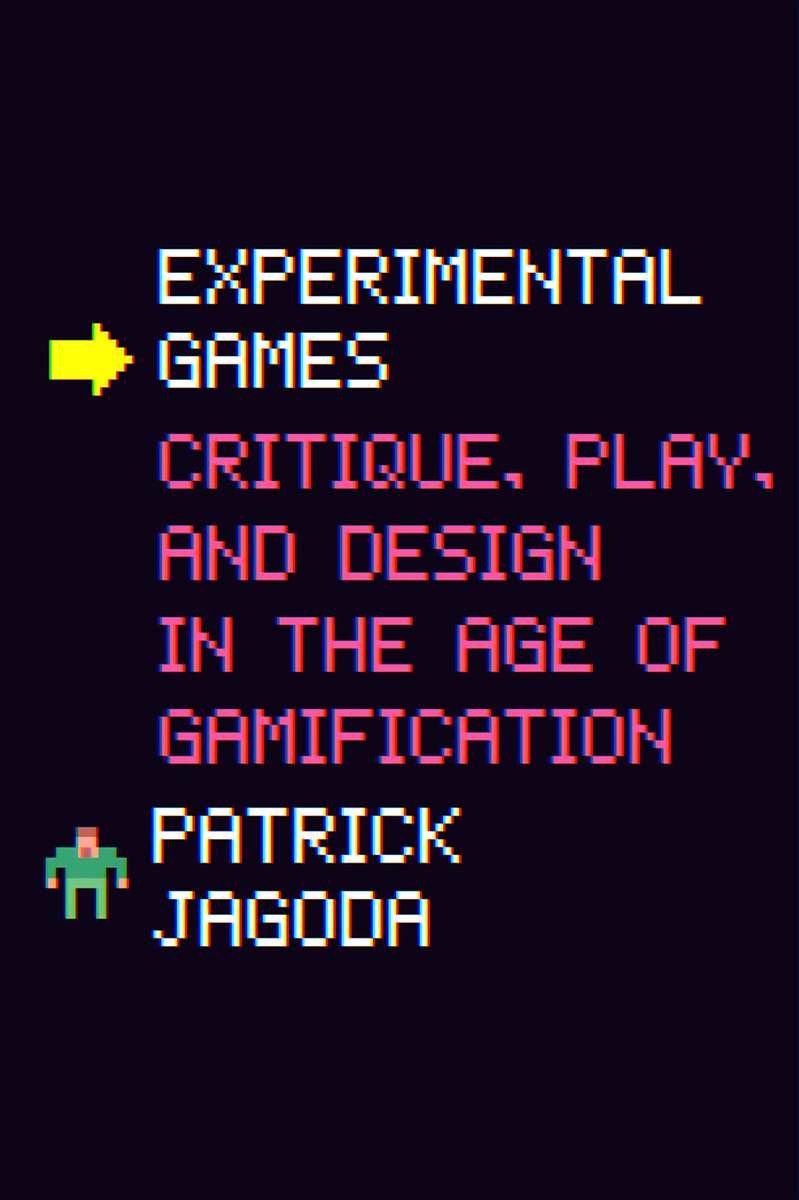
Experimental Games
Critique, Play, and Design in the Age of Gamification
by Patrick Jagoda
University of Chicago Press, 2020
Cloth: 978-0-226-62983-4 | Paper: 978-0-226-62997-1 | Electronic: 978-0-226-63003-8
DOI: 10.7208/chicago/9780226630038.001.0001
ABOUT THIS BOOKAUTHOR BIOGRAPHYREVIEWSTABLE OF CONTENTS
ABOUT THIS BOOK
In our unprecedentedly networked world, games have come to occupy an important space in many of our everyday lives. Digital games alone engage an estimated 2.5 billion people worldwide as of 2020, and other forms of gaming, such as board games, role playing, escape rooms, and puzzles, command an ever-expanding audience. At the same time, “gamification”—the application of game mechanics to traditionally nongame spheres, such as personal health and fitness, shopping, habit tracking, and more—has imposed unprecedented levels of competition, repetition, and quantification on daily life.
Drawing from his own experience as a game designer, Patrick Jagoda argues that games need not be synonymous with gamification. He studies experimental games that intervene in the neoliberal project from the inside out, examining a broad variety of mainstream and independent games, including StarCraft, Candy Crush Saga, Stardew Valley, Dys4ia, Braid, and Undertale. Beyond a diagnosis of gamification, Jagoda imagines ways that games can be experimental—not only in the sense of problem solving, but also the more nuanced notion of problem making that embraces the complexities of our digital present. The result is a game-changing book on the sociopolitical potential of this form of mass entertainment.
AUTHOR BIOGRAPHY
Patrick Jagoda is professor of English and cinema and media studies at the University of Chicago. He is a Guggenheim Fellow and executive editor of Critical Inquiry. He is the author of Network Aesthetics, also published by the University of Chicago Press, and coauthor of The Game Worlds of Jason Rohrer.
REVIEWS
“Experimental Games brings together three primary areas of thinking: economics, affect theory, and game studies. Jagoda successfully argues that games in general, but primarily digital video games, ought to be considered as experimental objects and processes in their own right, relevant but not beholden to the usual discourses on the value of trial and error. This is original, nuanced, and well-researched work, noteworthy in its ability to join social science, art, and the humanities in an equally weighted conversation.”
— Alenda Y. Chang, University of California, Santa Barbara
“Do we have a right to play? How about a right to fail? In this extensive meditation on the art of games, Jagoda shows how games are intricately intertwined with the logic of neoliberalism and the gamification of everyday life. From Starcraft to Dys4ia by way of Dwarf Fortress, Jagoda toys with a rich spectrum of games, paying particular attention to indie games and art games. What if the point of a game is not so much problem solving, but problem making?
— Alexander R. Galloway, author of Gaming: Essays on Algorithmic Culture
“Experimental art is obsessed with unfamiliarity of form and execution. For the most part, that’s also how game designers have envisioned ‘experimental games.’ Jagoda offers an ingenious new interpretation: What if games could become native hosts for experimentation the way scientific experiment does—posing questions about the world through games—rather than using them as aesthetic objects or instruments alone?”
— Ian Bogost, Georgia Institute of Technology
“Jagoda's Experimental Games is a thorough, insightful elaboration of an art-critical practice that he describes as a 'joyful study' of digital games in the twenty-first century. . . . Jagoda convincingly makes the case for games as inside agents in our historical present, offering alternative pathways to the stifling control and abject precarity of contemporary life.”
— Eric Stein, Ancillary Review of Books
"Jagoda’s lengthy history of game theory, neoliberalism, and the evolution of the video game form results in a kind of conundrum: if video games arise out of an alienating neoliberal logic, how can they also serve as a method of critique and experimentation? It’s here that Jagoda produces some of his most dazzling and thoughtful analyses of the ways in which games can work on us, and in which we can reciprocally work on games."
— Andrew Fleshman, Los Angeles Review of Books
"Experimental Games is an accessible, potent, humanistic analysis of games and gamification processes as sociopolitical phenomena rooted in the character-building project of daily life. As games, gamification mechanics, and neoliberalism continue to see contemporary growth, Jagoda’s exploration of their foundations and connections will be an important touchstone for further philosophical analysis."
— A. G. Holdier, Metascience
"Over the past decade, the work of media theorist, literary scholar, and game designer Patrick Jagoda has addressed digital games in this fashion: as media entangled with the aesthetic, epistemic, and socioeconomic structures of our historical present. . . . Jagoda’s oeuvre explores the game’s multivalent manifestations and connotations. In doing so, he furnishes a language for engaging games as means of both intensifying and intervening in power relations. Experimental Games marks an accomplished synthesis of his interdisciplinary practice that marries the critical and creative."
— Doug Stark, Qui Parle
“The dialectical tension between game and world, the uncanny way in which games interplay with our material reality, is the driving engine of Jagoda’s capacious book, which contextualizes video games within the twin historical developments of cold war ideology and neoliberal economics. . . . Jagoda provides exemplary close readings of specific game forms, focusing extensively on twenty-first-century games, which I found to be one of the most significant contributions of the book to game studies. Providing critical analyses of contemporary video games, both mainstream and obscure, gives the reader a wonderful inventory of objects to explore further.”
— Matthew N. Hannah, American Literary History
"This book is an important foundational text in the field of gamification, as it not only considers video games from a neoliberal point of view, but also does not forget its fundamental duality: '...video games have experimental affordances that create alternate ways of being and acting.'"
— MEDIENwissenschaft (translated from German)
"Experimental Games weaves neoliberalism with the transformative arts practices seen in games to conceptualize better how video games help provide new ways of thinking. Throughout this book, Patrick Jagoda makes thought-provoking assertions for an understanding of joy and transformation at the center of games."
— Adrianna Burton, American Journal of Play
TABLE OF CONTENTS
Introduction: Society of the Game - Patrick Jagoda
DOI: 10.7208/chicago/9780226630038.003.0001
[action;affect;competition;countergaming;experiment;neoliberalism;postindustrialism;tactical media;worldmaking;World of Warcraft]
The introduction argues that gamification operates as a formal and cultural counterpart to neoliberalism. Beginning in the 1970s, we see the alignment of the rise of neoliberalism as an economic and political form and video games as a prevalent cultural form. If film and television were still the quintessential mass media in the 1960s, then video games have ascended to an analogous cultural status. For scholars such as McKenzie Wark, Mary Flanagan, Alexander Galloway, and Nick Dyer-Witheford, games are paradigmatic forms that mediate the contradictions and dissonances of postindustrial life. In order to introduce the precise conjunctions of neoliberalism and games, thisintroduction foregrounds three concepts that are central to both of these forms: action, competition, and worldmaking. It also introduces the experimental potential of games. (pages 3 - 40)
This chapter is available at:
https://academic.oup.com/chica...
1. Gamification - Patrick Jagoda
DOI: 10.7208/chicago/9780226630038.003.0002
[Candy Crush Saga;behavioral economics;constructivism;game theory;gamification;military war games;neoliberalism;RAND Corporation;simulation games;Stardew Valley]
This chapter offers an overview of gamification as a historical paradigm that brings games to the forefront of social, political, economic, and aesthetic thought. Though the term gamification, and the design practice to which it refers, can be located within the 2010s, this paradigm has its roots in an earlier moment in the second half of the twentieth century. This chapter extends the history of contemporary gamification back to three US contexts from the mid-twentieth through the early twenty-first centuries: the economic method of game theory, the world-building program of neoliberalism, and the theories of behavioral economics. This historical and conceptual argument is followed by two video game cases—King Digital Entertainment’s mainstream mobile game Candy Crush Saga (2012) and Eric Barone’s independently designed simulator Stardew Valley (2016)—that demonstrate how these contexts yield gamification. (pages 41 - 72)
This chapter is available at:
https://academic.oup.com/chica...
2. Experimentation - Patrick Jagoda
DOI: 10.7208/chicago/9780226630038.003.0003
[affect;avant-garde art;Braid;experiment;experimental economy;problem making;serious games;StarCraft;video game sensorium;war gaming]
This chapter turns to the concept of experimentation in order to establish a constructive foundation for the remainder of the book, which contends that video games enable experiments with life in a historical moment characterized by digital media and networks. Games can be understood as experimental in ways that accord with both earlier experimental art forms (such as the modernist novel or avant-garde cinema) and with forms of scientific hypothesis testing (such as the randomized controlled trial). The unique experimentality of video games has much to do with the ways they condition experience and modulate affect as part of the video game sensorium. This chapter builds toward an engagement with two cases: Blizzard’s popular real-time strategy game StarCraft (1998) and Jonathan Blow’s independent platformer game Braid (2008). (pages 73 - 116)
This chapter is available at:
https://academic.oup.com/chica...
3. Choice - Patrick Jagoda
DOI: 10.7208/chicago/9780226630038.003.0004
[choice;conditioning;freedom;genocide;Moirai;network games;priming;rational choice theory;The Stanley Parable;Undertale]
This chapter takes up the concept of choice that is central to contemporary economics and the medium of video games. Rational choice theory bases all economic activity on decision-making undertaken by a rational subject. However, nonconscious decision-making informs everything from relations on social media to trades across financial markets. Video games serve as an ideal medium for exploring decision-making. This chapter delves into the limits and possibilities of choice in a digital era, exploring the first-person interactive metafictional game The Stanley Parable (2013), the networked game Moirai (2013), and the role-playing game Undertale (2015). My reading of these games moves from a model of rational decision-making to one of experimental construction of freedom. (pages 119 - 152)
This chapter is available at:
https://academic.oup.com/chica...
4. Control - Patrick Jagoda
DOI: 10.7208/chicago/9780226630038.003.0005
[avatar;control;Dys4ia;game feel;Luxuria Superbia;mechanics;non-sovereignty;Problem Attic;queer games;rules]
This chapter explores the concept of control that is significant to both video game interfaces and to contemporary political power. Video games train players to expect systems of control through modes of rationalism, individualism, and efficiency. Alongside this impulse toward sovereignty, digital games also make available alternative dynamics of non-sovereignty. This chapter analyzes three queer games. First, it attends to the interactive narrative techniques of Anna Anthropy’s Dys4ia (2012), an autobiographical browser-based assemblage of mini-games that explores processes of gender transition. Next, the chapter examines the formal properties of Liz Ryerson’s Problem Attic (2013), another autobiographical yet considerably more abstract platformer game that explores power and powerlessness as it relates to identity. The final case is Auriea Harvey and Michaël Samyn’s avant-garde, touch-screen video game Luxuria Superbia (2013), which uses multisensory stimulation and opaque feedback in a hands-on exploration of sexuality that challenges conventional control schemes. (pages 153 - 190)
This chapter is available at:
https://academic.oup.com/chica...
5. Difficulty - Patrick Jagoda
DOI: 10.7208/chicago/9780226630038.003.0006
[affective difficulty;art history;competition;emotion;Game, Game, Game, and Again Game;GamerGate;literary studies;Loved;interpretive difficulty;mechanical difficulty]
This chapter examines how video games serve as an instructive focal point for analyzing the concept of difficulty. From a neoliberal perspective, experiences of difficulty are frequently approached as the affective residue of competition. As an alternative way of encountering the historical present, this chapter proposes three discrete types of difficulty that video games bring to the forefront: mechanical, interpretive, and affective difficulty. Affect, in particular, allows us to think of video games not simply as solvable experiences, but as processes of ongoing sociopolitical experimentation. This chapter includes close readings of two independent platformer video games: Jason Nelson’s Game, Game, Game, and Again Game (2007) and Alexander D. Ocias’s Loved (2010). (pages 191 - 220)
This chapter is available at:
https://academic.oup.com/chica...
6. Failure - Patrick Jagoda
DOI: 10.7208/chicago/9780226630038.003.0007
[climate change;failure;fragility;homelessness;immigration;Little Inferno;precarity;proceduralism;SPENT;Thresholdland: An Expatriation in Ten Days]
This chapter turns to the concept of failure, analyzing video games that challenge the victory-oriented form of gamification while also foregrounding the failure perpetuated by neoliberalism. The three core cases in this chapter include the Urban Ministries of Durham’s browser-based roleplaying game SPENT (2011), Jörg Lukas Matthaei’s alternate reality game Thresholdland: An Expatriation in Ten Days (2010), and Tomorrow Corporation’s puzzle game Little Inferno (2012). These games shift attention from neoliberalism’s systems of choice and control to the everyday precarity, fragility, and structural inequality across intersecting zones of race, class, gender, and sexuality. Together, they complicate the value and potentials of the failure states that undergird most games. (pages 221 - 250)
This chapter is available at:
https://academic.oup.com/chica...
7. Improvisation - Patrick Jagoda
DOI: 10.7208/chicago/9780226630038.003.0008
[alternate reality game;collaboration;critical making;cultural probe;dissensus;experimental humanities;improvisation;the parasite;performance;transmedia storytelling]
This chapter turns to the concept of improvisation, a term that has become popular across several domains, from comedy improv, jazz, and even business practice. Games open up new ways of thinking about contingency, responsiveness, and performance, particularly within the digital environments. This chapter departs from exclusively screen-based games and considers the mixed reality form of alternate reality games. It focuses on a single case of a large-scale alternate reality game, the parasite (2017) that the author co-designed and executed at the University of Chicago. Drawing from methodologies of critical making and emergent frameworks, such as the experimental humanities, this chapter contends that both gameplay and experimental game design may encourage improvisational and unexpected responses to neoliberalism. More than any other part of the book, this final chapter offers the author's design alternative of experimental games that stand in distinction to gamification. (pages 253 - 282)
This chapter is available at:
https://academic.oup.com/chica...
Coda: Joy - Patrick Jagoda
DOI: 10.7208/chicago/9780226630038.003.0009
[fun;Ian Bogost;games;joy;pleasure;satisfaction;Baruch Spinoza]
The coda complicates the idea of fun that is omnipresent in discussions of game design. The concept of joy, adapted from affect theory, gestures toward an alternative approach to making games. Without dismissing fun altogether, this chapter argues that the intensification signaled by joy—a maintenance of contrasts that cannot be resolved—might help us think beyond the economic concepts of pleasure, satisfaction, and gratification. (pages 283 - 286)
This chapter is available at:
https://academic.oup.com/chica...