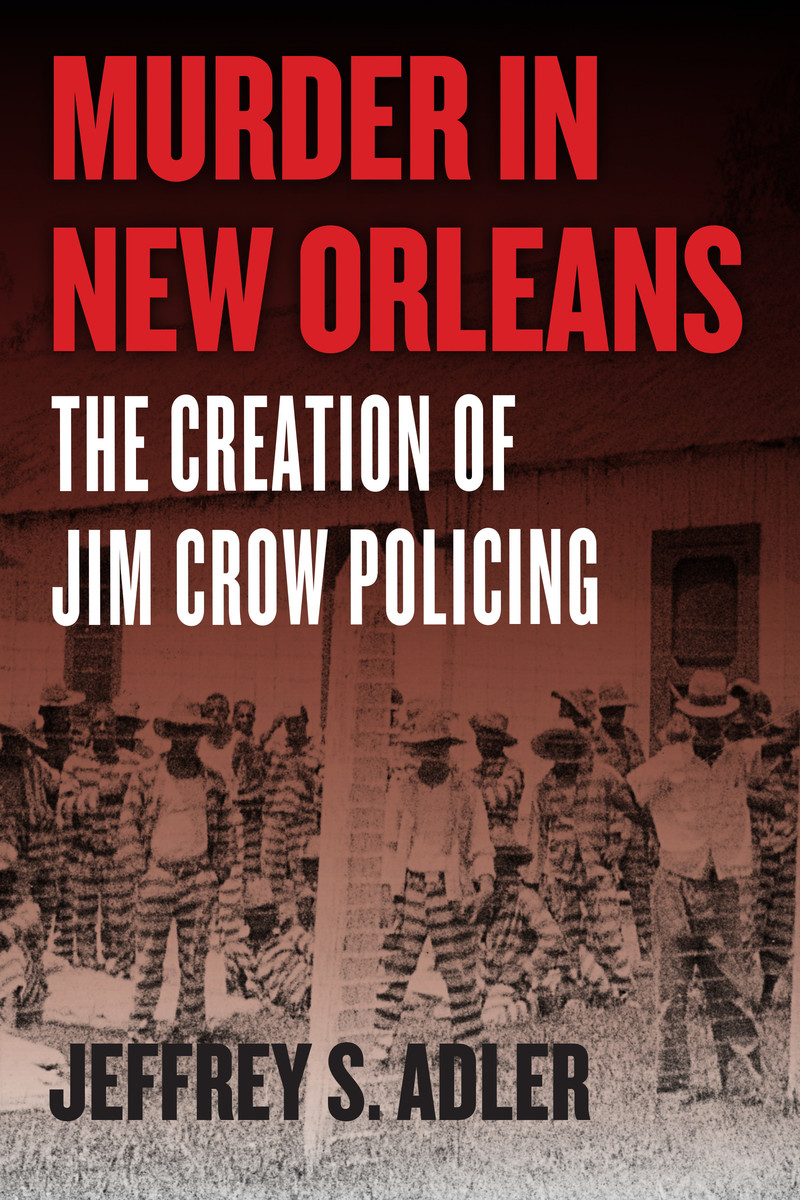
REVIEWS
“In this ambitious urban history, Adler authoritatively reconstructs the racist and violent policing forces in the Crescent City—he seems to leave no document unturned, unanalyzed, or uncontextualized. Prodigiously researched, Murder in New Orleans demonstrates that we must look to cities like New Orleans in the 1920s and 1930s if we hope to discover the origins of the nation’s current carceral state.”
— Ibram X. Kendi, National Book Award–winning author of Stamped from the Beginning
“Masterfully exploiting New Orleans’ rich police records, Adler forces us to rethink the origins of the racialized war on crime. Jim Crow criminal justice flowered in New Orleans in the 1930s and 1940s, despite a sustained fall in the city’s historically high homicide rates. Yet the decline in murder did not stay the hand of rough justice, as white New Orleanians came to associate African Americans with street violence and robbery. Adler shows how, in conflating race control and crime control, New Orleans’ unusually hard-boiled policing anticipated the mass arrest and incarceration practices of our own time.”
— David T. Courtwright, author of Violent Land
“Adler illuminates the experience of homicide in one of the most violent American cities as it moved from the Roaring Twenties through the depressed 1930s. The rates and nature of murder, and responses to it, reflected changing conceptions of honor and justice, migration patterns, economics, household structure, gender roles, and technology, with the only constants being racial difference and tight white dominance. This is a model of social history, its conclusions often surprising and always insightful.”
— Roger Lane, author of Murder in America: A History
“Murder in New Orleans is an important case study of racism in pre-World War II criminal justice that reveals how the past bleeds into the present.”
— Tony Platt, University of California, Berkeley
“Recommended. . . Murder in New Orleans reads like the script for a documentary film.”
— Choice
"The major strength of Adler’s work rests in the sources. He has succeeded in finding an urban area that had no dearth of crime and homicide statistics and records. Adler has reviewed a total of 2,118 homicide cases during the interwar period, and his primary source materials serve as a valuable foundation for any examination of criminal justice in New Orleans. He also expands his view beyond the courts, analyzing other diverse records such as coroners’ records and newspapers. Utilizing this fantastically cohesive body of primary sources, Adler helps explain the origins of the current incarceration crisis, which most assuredly rest in the interwar period."
— The Journal of Southern History
"Carefully researched and well written."
— Journal of Interdisciplinary History
"This most interesting book is a brilliant companion to an understanding of many elements of crime and the response to crime, not simply in interwar New Orleans but also more generally in America in this period."
— The Critic
"[Adler has a] remarkable ability to craft a narrative that brings the quantitative data set—2,118 homicide cases—to life in such vivid and gut-wrenching detail."
— Journal of African American History
TABLE OF CONTENTS
Introduction
DOI: 10.7208/chicago/9780226643458.003.0001
[criminal justice;New Orleans;homicide;Great Depression;Jim Crow]
The Introduction explores the thematic focus of the book and the theoretical underpinnings of its core argument. First, it introduces the general topic of homicide, explaining how a relatively unusual event occurs in distinct patterns that reveal larger social, political, legal and cultural forces. Second, the Introduction explains why I examine the 1920-1945 era, noting the impact of the powerful currents of the period, such as the Great Migration, the Roaring Twenties, the Great Depression, the institutionalization of Jim Crow, and World War II. Third, it discusses why I focus on New Orleans, the largest city in the South during an era of rapid change. And fourth, the Introduction identifies some of the theoretical perspectives on the connection between crime and criminal justice that inform my analysis.
This chapter is available at:
https://academic.oup.com/chica...
One: “It’s Only Another Negro Fight and Not Important”
DOI: 10.7208/chicago/9780226643458.003.0002
[policing;homicide;African American crime;criminal justice;street justice]
Chapter One analyzes the explosion of violence in New Orleans during the early 1920s and explains how changes in the local racial composition, in combination with shifts in the social ecology of the city and a languid criminal justice, encouraged street justice, triggering a spike in homicide. Though a period of considerable prosperity, early 1920s New Orleans, with overcrowding, high levels of mortality from disease, imbalanced sex ratios, and indifferent policing, experienced a perfect storm of conditions for a surge in violent crime. The city’s homicide rate soared, making New Orleans one of the most murderous urban centers in the nation. And yet local prosecutors rarely convicted anyone, regardless of race, class, or aggravating circumstances. Policemen and prosecutors especially ignored African American crime, insisting that such violence was unimportant because it seldom affected white New Orleanians.
This chapter is available at:
https://academic.oup.com/chica...
Two: “If You Hit Me Again I Will Stick You with This Knife”
DOI: 10.7208/chicago/9780226643458.003.0003
[common-law marriage;homicide;African American spouse murder;patriarchal authority;gender roles]
Chapter Two examines the fastest-increasing form of lethal violence in the city during the crime wave, which was African American spouse murder. Drawing from homicide reports, trial testimony, and other sources, the chapter explores the social and cultural forces that roiled gender roles and shattered family life in African American homes. It devotes particular attention to the impact of uneven sex ratios and the ways in which traditions of common-law marriage undermined patriarchal authority and encouraged women to be strong and independent. As a result of this tangle of pressures, African American husbands in the city struggled to establish dominance in their households, and African American wives refused to submit, resulting in soaring rates of family violence with women committing the lion’s share of spouse killings.
This chapter is available at:
https://academic.oup.com/chica...
Three: “She Made Me Her Dog”
DOI: 10.7208/chicago/9780226643458.003.0004
[stalking;spouse homicide;patriarchal terrorism;gender roles;suicide;domestic violence]
This chapter discusses white spouse homicide, which also increased sharply during the 1920s. It focuses on the social and cultural pressures fueling deadly domestic violence, particularly the ways in which white men engaged in what sociologists term “patriarchal terrorism.” Drawing particularly from suicide notes, the chapter explores the behavior of white husbands who responded to their wives’ decisions to terminate the marriage by stalking and then shooting them, after which the men frequently killed themselves. Thus, this chapter analyzes shifting gender roles in the city and the collision of failed expectations that erupted in violence in white households during the 1920s.
This chapter is available at:
https://academic.oup.com/chica...
Four: “Give Me the Gat”
DOI: 10.7208/chicago/9780226643458.003.0005
[racial inequality;homicide;African American violence;handguns;Great Depression;poverty]
Beginning in the late 1920s, rates of violence in New Orleans plummeted, and this chapter explains the complex set of factors that produced the decrease. Between 1925 and 1940, the local economy crumbled, poverty and racial segregation increased, racial conflict soared, and yet the city’s homicide rate plunged by nearly two-thirds. The chapter explores the ways in which shifts in the locations of social conflict and dramatic changes in the price and availability of handguns during the Great Depression contributed to tumbling levels on lethal violence. When African American violence moved from houses to streets, and when killers increasingly relied on knives rather than revolvers, fights became less deadly, and homicide plummeted, despite soaring levels of unemployment and racial inequality.
This chapter is available at:
https://academic.oup.com/chica...
Five: “The Iron Hand of Justice”
DOI: 10.7208/chicago/9780226643458.003.0006
[police brutality;crime wave;bank robbery;racial disparities;white supremacy]
This chapter charts a dramatic transformation in the city’s criminal justice system. While homicide rates fell, especially among African American New Orleanians, convictions rates skyrocketed for African American suspects and plunged for white suspects. The chapter examines a small surge in bank robberies during the late 1920s and early 1930s, explaining how this modest crime wave led to widening racial disparities in law enforcement and criminal justice. Police homicide and police brutality became tools of racial control during this period, increasingly targeting African American residents. Drawing from coroners’ reports, witness testimony, and court records, Chapter Five explores the shifting dynamics of police violence during the 1920s and 1930s. The chapter devotes particular attention to the district attorney who spearheaded the transformation of the local criminal justice system and used prosecutorial discretion to bolster white supremacy in the city.
This chapter is available at:
https://academic.oup.com/chica...
Six: “Cheaper than a Dime Sandwich”
DOI: 10.7208/chicago/9780226643458.003.0007
[World War II;African American homicide;law enforcement;Jim Crow;Great Depression]
Chapter Six examines the continuing drop in violence and the institutionalization of Jim Crow criminal justice—and how these trends intersected. It explores the impact of the Great Depression on urban violence. White violence became concentrated in homes, shielding it from public view. At the same time, African American homicide decreased but more often occurred in public settings, distorting white perceptions of race and street life. As a result, the white criminal largely disappeared from discussions about crime, and law enforcers focused their attention on African American criminals. New Orleans cops and prosecutors elided African Americans with crime and overlooked white violence. World War II cemented these changes, as white officials viewed African American homicide as a threat to the war effort and devoted little attention to white homicide. Patterns of criminal violence became disconnected from trends in law enforcement, contributing to growing racial disparities in conviction and incarceration.
This chapter is available at:
https://academic.oup.com/chica...
Conclusion
DOI: 10.7208/chicago/9780226643458.003.0008
[mass incarceration;violence;African American homicide;police violence;executions]
The Conclusion explores two themes. First, it places New Orleans trends in crime and punishment in national perspective. Although local pressures shaped violence and criminal justice, the broader forces that influenced New Orleans, such as the Great Migration and the Great Depression, affected cities across the country. Thus, New Orleans’s changes in crime and law enforcement echoed those of other urban centers. Chicago, for example, experienced a similar surge in homicide during the 1920s, a comparable decrease during the 1930s, and a nearly identical set of fluctuations in police homicide. Second, the Conclusion suggests the unsettling ways in which the transformation of criminal justice in early twentieth-century New Orleans established the foundation for late twentieth-century trends, when rates of African American homicide tumbled but rates of African American conviction, African American incarceration and execution, and police violence against African American residents increased. Mass incarceration and the modern crisis in race and criminal justice, in short, has deep roots.
This chapter is available at:
https://academic.oup.com/chica...