REVIEWS
“The Order of Forms offers a probing, ambitious, and innovative argument with far-reaching implications across fields. Kornbluh turns away from dominant particularist and historicist methods in literary and cultural studies and gives shape to a stimulating new set of strategies for thinking the political in the humanities and beyond. That she is capable of bringing together psychoanalysis, Marxism, literary formalism, and mathematics makes this a virtuoso work of theory.”
— Caroline Levine, Cornell University
“The Order of Forms is one of the most exciting books I’ve read in several decades. Staging the convergence of discourses that, however historically contemporaneous, have never been rigorously linked together, Kornbluh generates a series of provocative and convincing arguments about literature, criticism, and the agency of form. Her approach makes her a theoretical singularity.”
— Sianne Ngai, University of Chicago
"Kornbluh should revolutionize our understanding of literary realism and its relationship to representation."
— Rachael Scarborough King, Los Angeles Review of Books
"As proficient in contemporary critical theory, historical materialism, and formalist geometry as in theories of the novel. . .The Order of Forms makes a case for the 'world-building' nature of novels, which do not just unfold in particulars but also play in abstractions, performing and forming as well as reflecting their world."
— Victoria Baena, Los Angeles Review of Books
“Kornbluh anchors her brilliant and challenging book in the 19th-century realist novel but goes well beyond those confines to argue forcefully for the political dynamism and durability of forms and formalisms in our time. . . . In its formidable push toward abstraction, its utopian striving for collectivity, and its insistence on building new futures rather than dwelling in the past, The Order of Forms often feels like a study of 19th-century culture in high-modernist mode.”
— Public Books
“In [Kornbluh’s] dazzling book, formalist mathematics crystallises what forms can do, introducing new ways of organising thought and relationships. . . . Thinking about the co-emergence of aesthetic and mathematical formalisms in the 19th century alongside 21st-century psychoanalysis and Marxism, Kornbluh boldly gives shape to a new set of strategies for thinking politically in the humanities.”
— Times Higher Education
"Anna Kornbluh’s second monograph on Victorian-era literature,The Order of Forms: Realism, Formalism, and Social Space, joins a coterie of recent studies invested in the intersection of mathematics and eighteenth- and nineteenth-century literature. . .With The Order of Forms as an aid, instructors will feel more at liberty to introduce students to this interdisciplinary practice of reading literature formally using math as a framework. . .Kornbluh’s book demonstrates how grappling with mathematical concepts can open up new relations between people, spaces, as well as the text."
— Aaron Ottinger, Romantic Circles
“The Order of Forms: Realism, Formalism, and Social Science is an ambitious and timely work… An insightful and original study that warrants engagements from critics.”
— Victoriographies
"Kornbluh’s alternative position can be bracingly fresh."
— Victorian Studies
"Everyone seriously interested in Victorian fiction should read... The Order of Forms... [It mounts] sharp, polemical, hugely stimulating arguments about the basic categories, form and realism, that structures [its] topic."
— Victorian Literature and Culture
"Kornbluh works across several disciplinary registers. Hers is a daring and ambitious program of research, and on all terrains the discussion is enviably sophisticated, rigorous, and fluent... The Order of Forms brings studies of Victorian literature and thought to the cutting edge of contemporary theory. It will be immediately seized upon for its memorable polemic about the political import of formalism, and for its very close readings of major Victorian novels — down to their typography in some cases. The book will also be returned to and studied for its indications of the path ahead in materialist research."
— Genre
TABLE OF CONTENTS
Introduction: The Order of Forms: Mathematic, Aesthetic, and Political Formalisms - Anna Kornbluh
DOI: 10.7208/chicago/9780226653488.003.0001
[theory of the novel;social modeling;aesthetic formalism;political formalism;Victorian-era mathematics;law;state;antiformalism;Karl Marx;William Henry Fox Talbot]
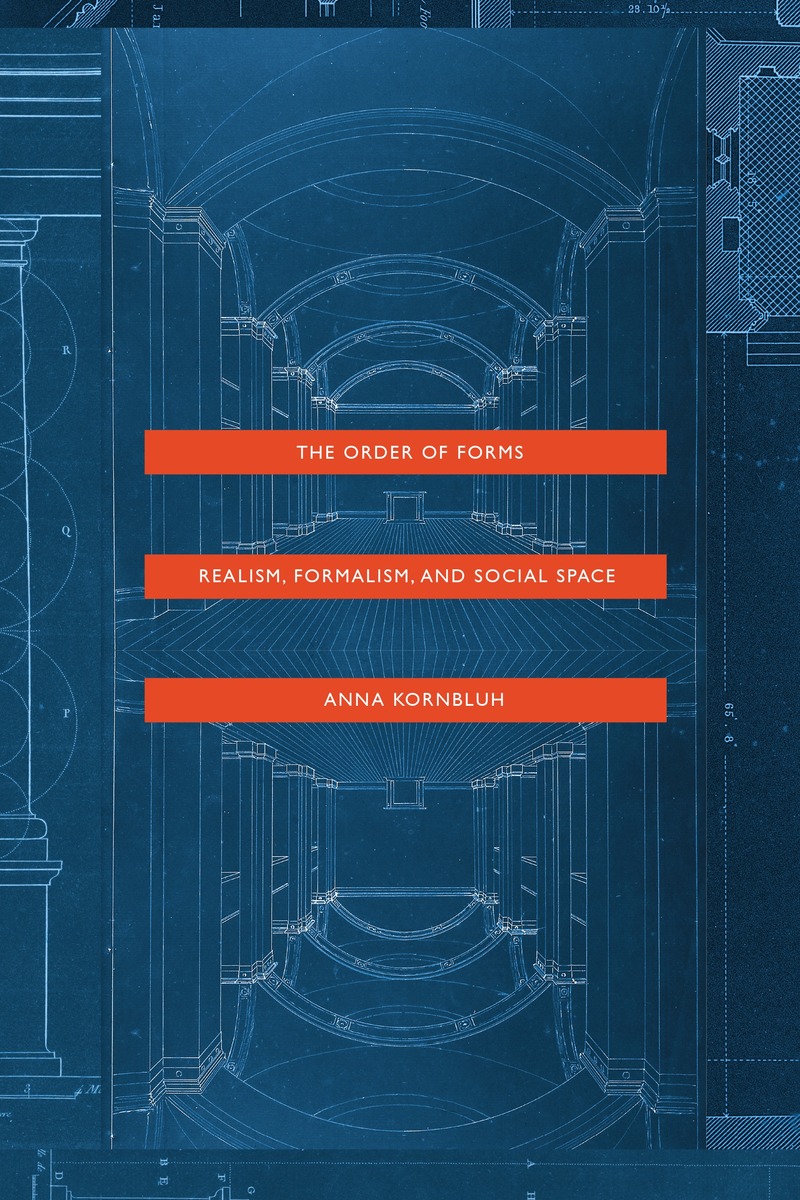
What does literature make, and what can literary criticism make with it? This book proposes a new theory of the novel as a social model, entailing a new program for literary critics and the humanities more broadly: reading aesthetic forms for how their composition of relations illuminates a general composedness of social life. The introduction names this new program“political formalism,”developing it in conversation with aesthetic formalism andthe revolutionary advancements in Victoria-era formalist mathematics. Political formalism regards the merely formal quality of the structures of social experience, from collectivity and the city to the law and the state.A position—and a positive affirmation of organized sociability that departs sharply from the negative critique prevalent in the humanities—and a method—an approach to the composition and agency of forms in the tradition of aesthetic formalism—political formalism serves a distinctive critical practice of recomposing forms of social being. Elaborating political formalism by overviewing antiformalist tendencies in critical theory, the introduction also provides an interpretative reading of constructive commitments in Marx’s German Ideology and Talbot’s Pencil of Nature (the first ever book of photography). (pages 1 - 32)
This chapter is available at:
https://academic.oup.com/chica...
1. The Realist Blueprint: For a Formalist Theory of Literary Realism - Anna Kornbluh
DOI: 10.7208/chicago/9780226653488.003.0002
[realism;novel;architecture;utopia;photography;Henry James;Georg Lukacs;Fredric Jameson;formalism;social space]
This chapter pursues an antimimetic theory of realism as production that emphasizes its faculty as social model and its affinity with the art of architecture. Drawing upon the understudied architectural tropes in novel theories from Henry James to Georg Lukacs to Fredric Jameson, and including discussion of the role of photography in James’s New York Edition,the chapter arguesthat realism is best understood as a speculative projection of hypothetical social space, where “social space” signals the medium of collective life. Where literary criticism has insistently maintained that realism is the least figurative, “more highly referential” of the literary modes, and where formalist criticism has usually abrogated the question of the novel in general and realism specifically, and where recent trends like new historicism and computational analytics/digital humanities underscore the calculative and indexical,the chapterpursues insteada coherent formalist account of the mode often thought formless. (pages 33 - 55)
This chapter is available at:
https://academic.oup.com/chica...
2. The Set Theory of "Wuthering Heights": Realism, Antagonism, and the Infinities of Social Space - Anna Kornbluh
DOI: 10.7208/chicago/9780226653488.003.0003
[Emily Bronte;Karl Marx;Manifesto of the Communist Party;antagonism;property;set theory;frame narrative;identity;infinity;bourgeoise]
This chapterjuxtaposes three paradigms from the moment of 1847/1848: the Manifesto of the Communist Party, Wuthering Heights, and the discovery of Set Theory.Each reckons with the question of infinity and its internal categorization: for mathematics, abstract infinity and its logical entailments/contradictions; for social discourse, infinite contradiction. It showsthat Wuthering Heights tacitly uses Set Theory, the study ofboundaries, classes, collections, belonging, as a trope of questions of boundedness, class, property, propriety.The novel fathoms multiple infinities, antagonisms, dispensations of space, whereas Marx and Engels reduce the infinite dimension of the contradictions they recognize. The novelunderstands private property as a source of unending social antagonism,in plot events concerning deeds and ownership and in setting (the tumultuous heath, violent hearths, contested houses), narration style (numerous frame narratives and individual narratives,suggesting the story is nobody’s property), the poetics of trespass (abundant figures of gates, doors, windows, and boundaries,striking images of ghosts, invasions, and disinterment), and the rhetoric of infinity, indivisibility, and uncanny identity.The power of thisnovel derives from this ability to mobilize metaphors of spatiality and plots of possession to theorize the particular problems of private property andthe universal difficulties in human sociality. (pages 56 - 78)
This chapter is available at:
https://academic.oup.com/chica...
3. The Limits of "Bleak House" - Anna Kornbluh
DOI: 10.7208/chicago/9780226653488.003.0004
[Charles Dickens;law;calculus;limits;maximalism;minimalism;house;split narration;realism]
This chapter explores the connections between Dickens’s Bleak House and developments in calculus around the concept of the limit.Apparently limitless, an eminently maximalist text, endlessly esteemed as “massive,” pedestaled as the very archetype of realism, Bleak House famously encompasses the biggest city in the nineteenth century and the foundational institution underwriting it: the law. Yet the form of this novel turns out to be conspicuously delimited in ways that pinpoint a surprising minimalism: bounded settings, a tight repertoire of architectural tropes, a small cast of pivotal actors, incomplete plotting, and the iconic split narration whittle and winnow this novel’s amplitude.The chapter showsthat limits in an aesthetic or social sense have often been understood as exclusive, but that their mathematical sense can help us to see their inclusiveness, what they generate and enable.Limits stipple the shapes of social space into perceptibly high relief.If you want to build, you have to start somewhere. (pages 79 - 103)
This chapter is available at:
https://academic.oup.com/chica...
4. Symbolic Logic on the Social Plane of Alice’s "Adventures in Wonderland" - Anna Kornbluh
DOI: 10.7208/chicago/9780226653488.003.0005
[Lewis Carroll;photography;abstraction;reduction;symbolic logic;sovereignty;nonsense;realism;syllogism;graphics]
This chapter asks what a nonsense novel reveals about realism. It shows that Wonderland’s overarching concerns with sovereignty, execution, and social ordering cohere with its commitment to nonsense, semantic games, and the development of symbolic logic.Presenting symbolic logic as a type of political theory elaborating the minima of social cohesion, the book does not merely think about logic.It constructs its own form as a symbolic logicization—a reduction to the letter—of literary realism.Along the way, the analysis considers photography and graphic textual design.Emulating the distinct form of its subject matter, this chapter proceeds through a series of syllogisms. (pages 104 - 121)
This chapter is available at:
https://academic.oup.com/chica...
5. Obscure Forms: The Social Geometry of Jude the Obscure - Anna Kornbluh
DOI: 10.7208/chicago/9780226653488.003.0006
[Thomas Hardy;city;geometry;sexuality;architecture;letter;law;antagonism;university;obscurity]
This chapterreads the most abject novel in the English canon and finds unexpected cause for optimism. Jude the Obscure makes a relentless tragedy fueled by criticizing institutions and exclusions, laws and harms. But it also exhibits great wonder at the constructions common to non-Euclidean geometry and human social schemes.Hardy described his text as “geometrically constructed,” and he crafted a novel that engages geometry imagistically, discursively, and narratologically. The chapter reads that engagement as instantiating a surprising exuberance about the shape of lines and letters, and consequently projecting the malleability of social lineaments, even as the novel tells the tale of lethally rigid norms.Through its geometric structure, Jude the Obscure contemplates the obscurity of social forms, an ambiguity and complexity deemphasized in biopolitical theory and anarchovitalism, but central to the constructive criticism in political formalism. (pages 122 - 138)
This chapter is available at:
https://academic.oup.com/chica...
6. States of Psychoanalysis: Formalization and the Space of the Political - Anna Kornbluh
DOI: 10.7208/chicago/9780226653488.003.0007
[Jacques Lacan;Sigmund Freud;political theory;the state;formalization;law;clinic;institution;psychoanalysis]
This chapter moves into latetwentieth centurypolitical theory, rendering explicitthe implications of the mathematical political imaginary explored earlier.Lacan viewed mathematical formalismas the “goal” of psychoanalysis, specifically as its political consummation.What enables math to figure the finest ends of psychoanalysis?In the letters of algebra and the diagrams of logic, Lacan located the best prospect for writing the project of psychoanalysis, "transmitting integrally" the specific, oblique modalities of knowledge, language, and social linkage that it practiced and to which it aspired.Formalization offered a mode of symbolization counter to word-writing, a kind of para-writing that relayed the kind of(para-)talking at the center of the clinic.Lacanand Freud both struggled with this,thoroughly pursuing the question of how to institute psychoanalysis, to make spaces, forms, practices, and discourses to advance the cause. Both struggled profoundly with institutes, societies, organizations, and associations, trying to find hospitable venues for affiliating around psychoanalysis. Institutionalization poses a permanent problem;the possibility of new discursive formations and new subjects poses the permanent horizon for psychoanalysis; then this commitment to structuration of the political field marks psychoanalysis as different from anarchovitalism and dissolutionism, but congruent with realist novels. (pages 139 - 155)
This chapter is available at:
https://academic.oup.com/chica...
Conclusion: Sustaining Forms - Anna Kornbluh
DOI: 10.7208/chicago/9780226653488.003.0008
[Jodi Dean;Fredric Jameson;the party;the military;constructive criticism;composition;making;building]
The conclusion extends the turn to political theory by reading political formalism between the lines of recent speculative experiments from Jodi Dean and Fredric Jameson.In their commitment to thinking about political relations in formalist terms, these theorists offer a way out of the dead end of antiformalism, dissolutionism, and negative criticism.Theory must prepare to build things up, and literature models that building. The book outlines a way of reading and thinking conducive to the affirmative project of revaluing the structuration of sociality by reappraising aesthetic form’s capacity to mediate that structuration. Literary critics, especially readers of novels, skillfully interpret blueprints for other social spaces. They can be ambassadors for architecture, advocates and strategists for building, for operationalizing off the page all the worldmaking of on-the-page models. The arts of social building exceed engineering to encompass imaginative projection, enabling abstraction, compelling storytelling, and creative synthesis. (pages 156 - 166)
This chapter is available at:
https://academic.oup.com/chica...