TABLE OF CONTENTS
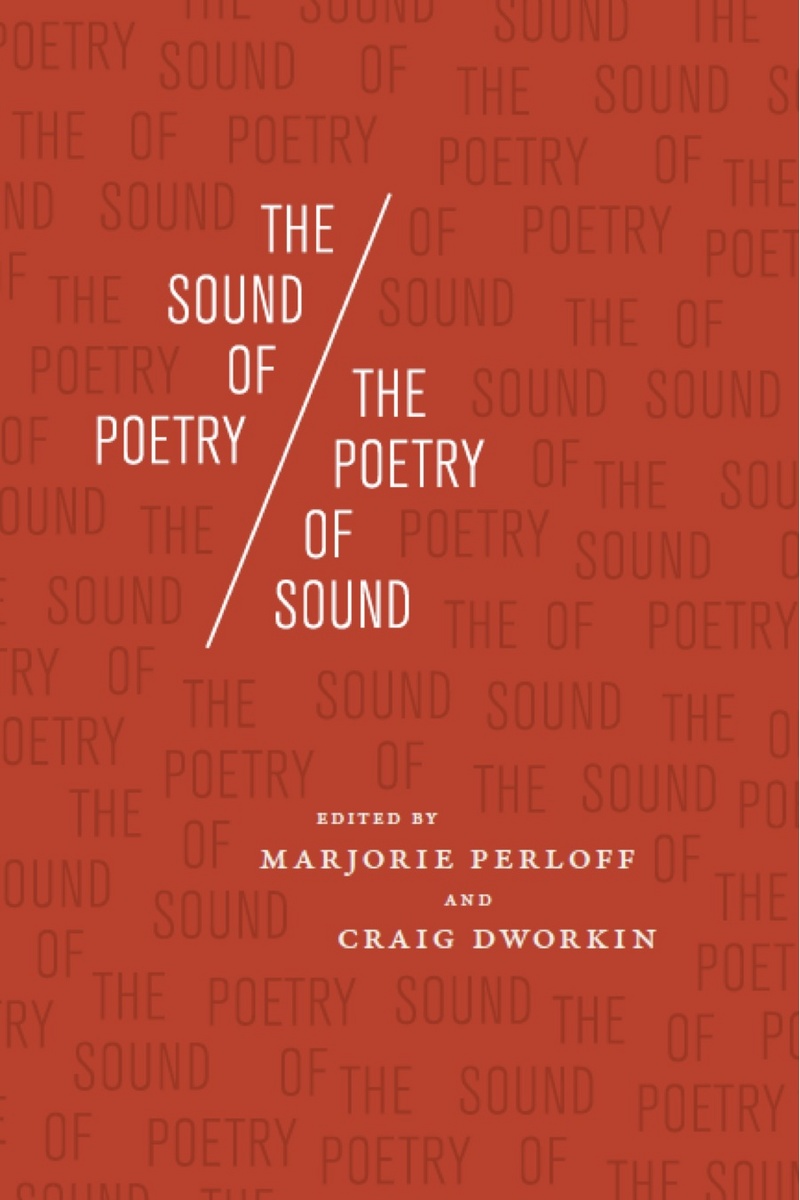
Introduction: The Sound of Poetry / The Poetry of Sound (Marjorie Perloff and Craig Dworkin)
Prelude: Poetry and Orality - Jacques Roubaud, Jean-Jacques Poucel
DOI: 10.7208/chicago/9780226657448.003.0002
[poetry, sound, linguistic studies, song, orality]
The Oulipo poet-theorist Jacques Roubaud provides a polemic prelude to the book. This prelude discusses the breaking of the bond between word and sound which occurred during the fourteenth century, and this is the concept of poetry. The prelude also discusses the other form which combines word and sound: namely, song. (pages 18 - 26)
This chapter is available at:
https://academic.oup.com/chica...
Part I: Translating Sound
Rhyme and Freedom - Susan Stewart
DOI: 10.7208/chicago/9780226657448.003.0003
[poem, writing, artistic freedom, individuality, natural flow, precision]
A poem would remain only a sketch of work if it remains predominantly in the form of writing and will never come alive to voice and to sounds as voiced. Artistic freedom reaches its apogee when intention approaches the rich cognitive moment on the brink of realized structure. Aldington indicates that the “individuality” of the poet has some basis in a “natural flow” that nevertheless also has a “precision.” Despite an apparently universal tendency for rhyming to be part of the process of language learning, most of the world's languages do not use poetic rhyme. Given the power of rhyme schemes of all kinds to lend particular semantic and visual weight to the place of unrhymed words, we might see the development of free verse as an unrhymed pause in the greater scheme of rhyme's poetic history. (pages 29 - 48)
This chapter is available at:
https://academic.oup.com/chica...
In the Beginning was Translation - Leevi Lehto
DOI: 10.7208/chicago/9780226657448.003.0004
[poetic sound, translating, poetry, poem, material dimension, natural language]
The poetic sound in translation is being described in this chapter because it would not even make sense to speak about translating poetry without accounting for the sound. The specific sound of a poem or a poet usually represents a new material dimension inside a natural language. In the history of translating poetry, Benjamin's method has been in wider use than is usually recognized. The chapter cites the example of transferring English, German, and French metrical patterns into Finnish poetry during its so-called traditional period (1880–1950). Translation forms the basis of cultures, that is, meaning, among other things, that translation is always also (already) political. Focusing the primacy of translation does not rule out the possibility that “original works” may contribute to the realization of the pure (read impure) language. (pages 49 - 52)
This chapter is available at:
https://academic.oup.com/chica...
Chinese Whispers - Huang Yunte
DOI: 10.7208/chicago/9780226657448.003.0005
[Chinese Whispers, sound, Chinese, silk, translations, language]
The game of “Chinese Whispers,” seems more like an instance of sound or homophonic translation, that is, what's specifically Chinese in the game of Chinese Whispers is the very word “Chinese” itself, which is derived homophonically, through hearsay, possibly from the Chinese term Chin, a dynasty in ancient China; or possibly from si, the Chinese term for “silk.” The question of sound in the domains of linguistics, music, and economics has become increasingly important in the age of empires and globalization. Besides personal names, the other proper names that intrigue in this chapter are those of currencies, whose meanings are often local and yet whose translations currently constitute a major part of the global flow of meanings, values, and power. Money may be a universal language, but currencies speak vernaculars of their own. (pages 53 - 59)
This chapter is available at:
https://academic.oup.com/chica...
Translating the Sound in Poetry: Six Propositions - Rosmarie Waldrop
DOI: 10.7208/chicago/9780226657448.003.0006
[sound, semantic dimension, poetry, phonetic, translate, translator]
Sound cannot be separated from the semantic dimension and sound in poetry is not a simple phonetic matter. Hence, it is impossible to translate the sound in poetry because the union of sound/sense will not be the same in any other language. It is not so delightful when the translator has a mechanical understanding of sound and form. An example of a poem given in this text helps to analyze how sound is used and, more generally, what goes on in the poem and how this relates to its language and tradition. The first step is to analyze what elements are dominant in a poem. There is no fixed rule as each poem requires its own approach and as such no translation is definitive. (pages 60 - 65)
This chapter is available at:
https://academic.oup.com/chica...
“Ensemble Discords”: Translating the Music of Maurice Scève's Délie - Richard Sieburth
DOI: 10.7208/chicago/9780226657448.003.0007
[Maurice Scève's Délie, Boethian model, translation, ensemble discords, typographical, printing]
This chapter elaborates the music of Maurice Scève's Délie (and the possibilities of its translation) in terms of this tripartite Boethian model, still very influential in mid-sixteenth-century Lyon through its more recent reformulation by Ficino. The chapter presents few examples of how Scève attunes the music of the spheres to the private tempers of the scorned lover's febrile body and soul. According to Scève, translation, like love (or music) involves being apart together, mutually ingathered by an interval or caesura renders “ensemble discords.” The chapter provides typographical feature of the original printing of Scève's Délie, a feature that only I. D. Mac-Farlane's 1966 edition of the poem retains, but that every single subsequent French edition omits. (pages 66 - 78)
This chapter is available at:
https://academic.oup.com/chica...
The Poetry of Prose, the Unyielding of Sound - Gordana P. Crnković
DOI: 10.7208/chicago/9780226657448.003.0008
[poetry, translation, prose, fiction, incomprehensibility, orality, translator's tools]
In the case of poetry, there are challenges, such as no translation that are accepted can approximate the texture and substance of a Dickinson lyric. In the case of prose, specifically contemporary prose fiction, it is generally assumed that the translation is the novel. The fiction of Eastern Europe is known in the anglophone world almost exclusively in translation. The “incomprehensibility” of language (as only referential, literal) works in different ways that is developed by intense sound patterning. The writing of an individual challenges the authoritative communal text and speech, by itself claiming the space of orality as the space of the social. If poetry and prose are not separate, if it is actually not the case that, in prose, a word merely “means what it says,” then the awareness of as well as sensitivity and allegiance to this incomprehensible enchantment of the sound of poetry, which plays tricks with the meaning of words, has to be a more assertive part of every prose translator's tools. (pages 79 - 94)
This chapter is available at:
https://academic.oup.com/chica...
Part II: Performing Sound
Sound Poetry and the Musical Avant-Garde: A Musicologist's Perspective - Nancy Perloff
DOI: 10.7208/chicago/9780226657448.003.0009
[sound poetry, text, critical writing, semantic, syntactic, John Cage, avant-garde]
The composition of sound poetry generally begins with a text and because of this critical writing on sound poetry has been the domain of poets and literary scholars, who study its semantic, syntactic, and linguistic attributes and the ways in which it redefines the function of language. In 1937, John Cage anticipated the importance of electrical instruments for musical composition when he spoke of the need to establish centers of experimental music, where composers could use “the new materials, oscillators, generators, means for amplifying small sounds, film phonographs” to make sounds. Both the Russian avant-garde poets and the Italian futurists explored the potential of language to produce nonreferential sounds. This chapter places sound poetry and avant-garde music within a shared history of sound and live performance. (pages 97 - 117)
This chapter is available at:
https://academic.oup.com/chica...
Cacophony, Abstraction, and Potentiality: The Fate of the Dada Sound Poem - Steve Mccaffery
DOI: 10.7208/chicago/9780226657448.003.0010
[sound poem, Hugo Ball, historical, grammalogue, Lautgedicht, transmogrification]
The twentieth-century sound poem has been shrouded in contradiction and uncertainty from its very inception. The German poet émigré Hugo Ball, who first performed his own samples on June 23, 1916, is responsible for the sound poem's “historical” origin and definition. By June 18, Ball had worked out not only a new genre of acoustic poetry but a new theory of the image; one carried not by words but by phonemic rhythm and called by him a “grammalogue.” Ball left a vivid record of his famous first (and last) presentation of the Lautgedicht in which he recalls his mental and emotional transmogrification during the performance. Notwithstanding the factual uncertainty of his psychosomatically induced state, the condition described attunes accurately with Ball's general theories of primordial memory and the complex imbrications of the child and the irrational. (pages 118 - 128)
This chapter is available at:
https://academic.oup.com/chica...
When Cyborgs Versify - Christian Bök
DOI: 10.7208/chicago/9780226657448.003.0011
[The Cyborg Opera, theurgical, linguistic soundscape, phonetic valences, machinic audience, poetic legacy, poets]
The Cyborg Opera is in part a critical reaction to some of the more “theurgical” traditions of modernism, that is, traditions that have striven to reclaim the magic of words from the mechanical utterances of everyday dialogue. It is a long poem in progress, which is a linguistic soundscape that responds to the ambient chatter of technology by arranging words according to their phonetic valences. The first generation of poets who can reasonably expect in their lifetime to write poems for a machinic audience, but despite the foretold approach of this artificial readership, poets continue to address only each other in the lyric voice of our human drama. This poem strives to extend this poetic legacy, a legacy that has sought to document the most primitive, most intuitive, utterance at the sudden moment when it emerges, both authentically and spontaneously, from the body of the ecstatic organism itself. (pages 129 - 141)
This chapter is available at:
https://academic.oup.com/chica...
Hearing Voices - Charles Bernstein
DOI: 10.7208/chicago/9780226657448.003.0012
[poem, read out, rythm, sound patterning, performance, audibility]
Though any reader can perform the written text of a poem, and indeed many poems need to be read out loud in order to make tangible the rhythm and sound patterning, a poet's reading of her or his own work has an entirely different authority. The poet's performance poses an arresting issue for poetry, for the differences among the alphabetic, grammaphonic, and live are not so much ones of textual variance as of ontological condition. Today's memorized recitations should not be conflated with the nonscripted poetry of analphabetic cultures or with the use of memory as part of the poetic process. Performance allows the poet to refocus attention to dynamics hidden within the scripted poem, refocusing emphasis and overlaying immanent rhythms. Thus, performance always exceeds script, just as text always outperforms audibility and the relation of script to performance, or performance to script, is necessarily discrepant. (pages 142 - 148)
This chapter is available at:
https://academic.oup.com/chica...
Impossible Reversibilities: Jackson Mac Low - Hélène Aji
DOI: 10.7208/chicago/9780226657448.003.0013
[reversibility, oscillation, visual, performance, Jackson Mac Low, irreversibility, sound event]
This chapter describes the reversibility or oscillation between sounding the visual in performance and visualizing sound either as a script for performance or in a transcript from performance. This is at the core of a number of contemporary works in American poetry, especially works by the late Jackson Mac Low. The specificity of Mac Low's practice lies in the way he bases his work on the execution of installations and processes that aim to redefine the poem as the integrated coexistence to form the complete work. Irreversibility is stressed when visual layout of the gatha becomes not just one source for several sound performances, but also one possibility among several visualizations for single sound event. Hence, what reversibility implies is the persistence of poles, departure points and arrival points, a departure text or audiovisual document and a resulting work that might in its turn be thought of as the departure piece. (pages 149 - 165)
This chapter is available at:
https://academic.oup.com/chica...
The Stutter of Form - Craig Dworkin
DOI: 10.7208/chicago/9780226657448.003.0014
[stutter, literary, speech, idiolect, stuttering, audible silencing, language]
The literary stutter has tended to be either a qualification of a characters' speech or a graphically approximated marker of idiolect that is merely registered in language. Stuttering is less a condition that does or does not exist than a rate at which one aspect of the normal mechanism of speech can no longer be overlooked or ignored. The audible silencing of language from a stutter in language to the stutter of language, can be clearly heard in the work of Alvin Lucier. Like Lucier, Pierre Guyotat has also attempted to smooth out the stutter, and with similar results: radically deforming the comprehensibility of language and transferring the logic of the stutter to the text itself. Thus, the stutter structures language in two opposing directions, both blocking certain aspects of speech and impeding the facile consumption of language, while at the same time permitting or producing literary compositions based on its formal characteristics. (pages 166 - 183)
This chapter is available at:
https://academic.oup.com/chica...
The Art of Being Nonsynchronous - Yoko Tawada
DOI: 10.7208/chicago/9780226657448.003.0015
[nonsynchronous, poetry, readings, language, music, sounds]
This chapter elaborates the poet's art of being nonsynchronous as poetry readings could relate to dubbing and shamanism. It is stated here that hearing a poet read his work only strengthens the impression that the voice is coming from far away or from a person not literally present. An onomatopoeic expression automatically entails the specification of what is being described. According to the chapter, language can produce an image from a sound or juxtapose several images. It can clumsily imitate various sounds and invent new words precisely because of its clumsiness. Language can link a sound to a color, or think up an adjective to go along with it while at the same time questioning its legitimacy. Therefore, various voices and the rhythms of various languages joined together with various movements can create a sort of music. (pages 184 - 196)
This chapter is available at:
https://academic.oup.com/chica...
Part III: Sounding the Visual
Writing Articulation of Sound Forms in Time - Susan Howe
DOI: 10.7208/chicago/9780226657448.003.0016
[writing, sound forms, Lethean tributaries, sentiments, philosophies, font-voices]
This chapter explains the varied writings of sound forms articulated in time series. The text provides narratives of the Reverend Hope Atherton and Steven Williams in George Sheldon's A History of Deerfield, Massachusetts, published in 1895 by the Pocumtuck Valley Memorial Association. It is summarized that the Lethean tributaries of lost sentiments and found philosophies had a life-giving effect on the process of the author's writing. The author is overjoyed and feels harmony while experiencing the fragmentary knowledge and the continual progress toward perfect understanding of the sound forms. The font-voices summon a reader into visible earshot and struggles of conscience are taken up as if they are going to be destroyed by previous states of fancy and imagination. (pages 199 - 204)
This chapter is available at:
https://academic.oup.com/chica...
Jean Cocteau's Radio Poetry - RubÉn Gallo
DOI: 10.7208/chicago/9780226657448.003.0017
[Jean Cocteau's Orpheus, sound poetry, radio, broadcasting, radiophonic medium, soundscape]
This chapter explores one of the most original attempts to compose a sound poetry inspired by radio, a radio-poetic experiment that was neither a poem nor a piece of music but a film: Jean Cocteau's Orpheus. Many of the early twentieth century's most radical poets were also interested in radio and in exploring the parallels between broadcasting and experimental writing. The possibilities of the new radiophonic medium inspired a new form of sound poetry: one that incorporated elements from the soundscape created by the new technology. The rise of radio attracted the attention of intellectuals around the world, who debated the virtues and shortcomings of the new medium. This chapter concludes that a poet can be original only by becoming unoriginal and embracing the practice of uncreative writing. (pages 205 - 218)
This chapter is available at:
https://academic.oup.com/chica...
Sound as Subject: Augusto de Campos's Poetamenos - Antonio Sergio Bessa
DOI: 10.7208/chicago/9780226657448.003.0018
[Poetamenos, Augusto de Campos, music, mirror-forms, concision, opulence]
The poetry of Augusto de Campos has persistently pursued a kind of writing fused with music. His microsequence of sparsely diagrammed poems Poetamenos helped launch concretism in Brazil and was admittedly inspired by Anton Webern's concept of Klangfarbenmelodie (tone-color-melody). The idea of mirror-forms had a great, long-lasting impact on Augusto de Campos's development of a concrete poetics. In Poetamenos, despite the fact that it's not addressed in the preamble, mirror-form technique is used to different effects, and throughout his career de Campos has refined Webern's practice, quite literally transposing it into poetic terms. Poetamenos is thus, a series that is remarkable, paradoxically enough, for both its concision and its opulence, its restrained formalism concealing a torrent of emotions. (pages 219 - 236)
This chapter is available at:
https://academic.oup.com/chica...
Not Sound - Johanna Drucker
DOI: 10.7208/chicago/9780226657448.003.0019
[sound, romantic poetry, poetic works, visual, print culture, graphical codes]
This chapter fuses the idea that the poetic production that are “not sound” with a discussion of Laura Mandell's work because her grounding in eighteenth- and early nineteenth-century romantic poetry is linked to her activities in digital humanities. In the modern period, poetic works based entirely in visual composition take their place in the canon alongside works whose composition derived from song or verse. This independent tradition pushes graphical features to an extreme, and its anomalous character makes it easy to bracket “visual” poetry off as if it were an exclusive domain. In early print culture, news ballads such as those announcing the defeat of the Spanish Armada are identifiable as ballads because of the distribution of lines on the sheet. The semantic contributions of graphical codes are also substantive elements of poetic, literary, and textual fields that have acquired their conventions and uses through historical and cultural circumstances. (pages 237 - 248)
This chapter is available at:
https://academic.oup.com/chica...
The Sound Shape of the Visual: Toward a Phenomenology of an Interface - Ming-Qian Ma
DOI: 10.7208/chicago/9780226657448.003.0020
[sounding the visual, poetry, auditory dynamics, visual phenomenon, extralinguistic, sound of the shape, shape of space]
Sounding the visual presents itself as one of the most intriguing tasks of performance in reading contemporary innovative poetry. In the auditory dynamics of sounding the visual as such, there exists, a silent space occupied by a peculiar visual phenomenon, a phenomenon that has remained acoustically unattended, and to which existing sound systems, whatever the kind, seem oddly inapplicable. The textual phenomenon in question is manifested in the interdisciplinary appropriations and deployments of extralinguistic signs that assume, in particular, two types of visual configurations discussed in this chapter. The sound of the shape of the visual is the shape of space in the visual becoming acoustically temporal; it is the shape of time in sound becoming visually spatial. The sound shape of the visual is, then, a phenomenological interface of becoming in a participatory process of fully experiencing the world. (pages 249 - 269)
This chapter is available at:
https://academic.oup.com/chica...
Visual Experiment and Oral Performance - Brian M. Reed
DOI: 10.7208/chicago/9780226657448.003.0021
[avant-garde, multimedia, poetry, nonphonocentric, narratives, poem, poets]
Fields such as early modern textual studies, African American studies, and the study of avant-garde writing have proven especially good at elucidating and theorizing the persistently “multimedia” character of the art of poetry, that is, its proclivity for dissemination via a variety of different channels of communication. Revamping the field of poetics so as to make it truly nonphonocentric will likely require a thorough reassessment of many of the discipline's basic concepts, that is, as well as of its cherished literary historical narratives. Nowadays many poets have Web pages that promote the full range of their work, including everything from blogs to poem drafts to webcasts of their latest public readings. Poets, as they experiment with transmediation, serially bring to light each medium's textures, contours, and inner logic. (pages 270 - 284)
This chapter is available at:
https://academic.oup.com/chica...
Postlude: I Love Speech - Genneth Goldsmith
DOI: 10.7208/chicago/9780226657448.003.0022
[poet, English, language, speech, writing, poem, poets]
The postlude is written by an American poet, in English. The postlude is about a love of language. It is about how to proceed after the deconstruction and pulverization of language that is the twentieth century's legacy. Do we need to take a new approach or carry on as we have been doing? A strategy of opposites is needed: unboring the boring, uncreative writing and valueless speech. The postlude expresses this task as simply to “mind the machines.” (pages 285 - 290)
This chapter is available at:
https://academic.oup.com/chica...
Notes
List of Contributors
Index