ABOUT THIS BOOK
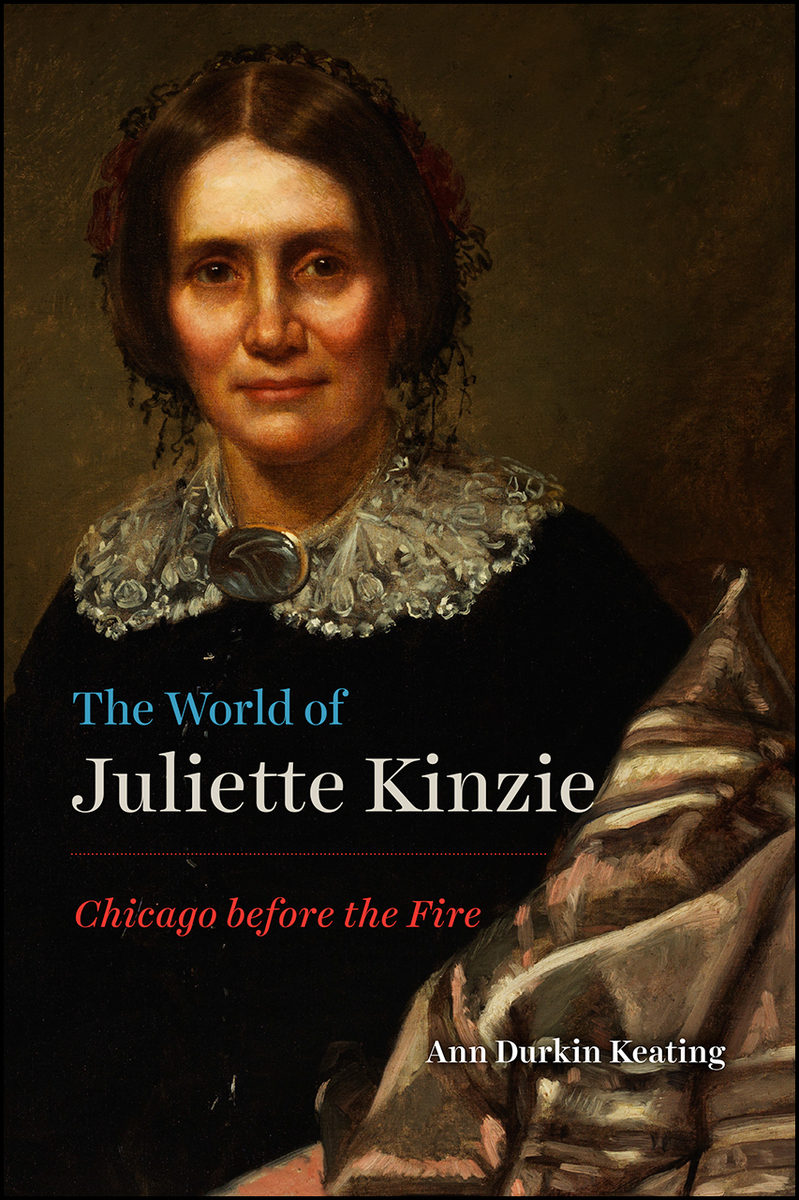
When Juliette Kinzie first visited Chicago in 1831, it was anything but a city. An outpost in the shadow of Fort Dearborn, it had no streets, no sidewalks, no schools, no river-spanning bridges. And with two hundred disconnected residents, it lacked any sense of community. In the decades that followed, not only did Juliette witness the city’s transition from Indian country to industrial center, but she was instrumental in its development.
Juliette is one of Chicago’s forgotten founders. Early Chicago is often presented as “a man’s city,” but women like Juliette worked to create an urban and urbane world, often within their own parlors. With The World of Juliette Kinzie, we finally get to experience the rise of Chicago from the view of one of its most important founding mothers.
Ann Durkin Keating, one of the foremost experts on nineteenth-century Chicago, offers a moving portrait of a trailblazing and complicated woman. Keating takes us to the corner of Cass and Michigan (now Wabash and Hubbard), Juliette’s home base. Through Juliette’s eyes, our understanding of early Chicago expands from a city of boosters and speculators to include the world that women created in and between households. We see the development of Chicago society, first inspired by cities in the East and later coming into its own midwestern ways. We also see the city become a community, as it developed its intertwined religious, social, educational, and cultural institutions. Keating draws on a wealth of sources, including hundreds of Juliette’s personal letters, allowing Juliette to tell much of her story in her own words.
Juliette’s death in 1870, just a year before the infamous fire, seemed almost prescient. She left her beloved Chicago right before the physical city as she knew it vanished in flames. But now her history lives on. The World of Juliette Kinzie offers a new perspective on Chicago’s past and is a fitting tribute to one of the first women historians in the United States.
REVIEWS
“Early Chicago settler, pioneering historian, cultural influencer, and defender of her household—Juliette Kinzie’s story carries extraordinary range. In this intimate portrait of an expansive life, Ann Durkin Keating has rescued Juliette from the dismissiveness of history. We experience the enormous changes of nineteenth-century America through Juliette’s eyes, as she participates in the dispossession of Native Americans, grieves during the Civil War, and suffers economically as Chicago grows from hamlet to metropolis. Keating explains how Juliette centered her worldview around the household, a choice that feels more strategic than antiquated, and one that guides Juliette through turbulent times. Chicago’s early history is not merely men boosting a speculative venture. It needs the voices of Juliette—and other women—to understand the creation of culture and community, in all its forms.”
— D. Bradford Hunt, Newberry Library
“Through her discovery of Juliette Kinzie’s correspondence Ann Durkin Keating has opened a revealing window on antebellum Chicago’s social and economic life. This intimate history restores a mostly forgotten founding mother of the city. At the heart of Keating’s analysis is the role of households forming and dissolving amid western migration, economic challenges, and the Civil War.”
— Theodore J. Karamanski, Loyola University Chicago
“Keating's thorough knowledge of local history grounds Kinzie’s story in its time and place. Bessie Louise Pierce . . . lamented that (Chicago) was 'preeminently a man’s city' in its early years, dominated by business tycoons and real estate speculators. The World of Juliette Kinzie challenges this narrative, shifting the spotlight from the exploits of a few prominent men to the lesser-known accomplishments of a remarkable woman.”
— Chicago Review of Books
“Kinzie should be considered one of Chicago’s forgotten founders. Her work, often uncredited because she was a woman, helped build the foundation of what would become a sophisticated, international city. The World of Juliette Kinzie makes heard a voice long muted, from inside the parlors, kitchens and gardens that contributed to the rise of Chicago.”
— Newcity
“A fascinating new biography.”
— Chicago Sun-Times
“Keating’s book captures a woman of her time who is also an individual. . . . Juliette’s is a Chicago story. And it’s also her story.”
— Third Coast Review
TABLE OF CONTENTS
Introduction: The Michigan Street House
DOI: 10.7208/chicago/9780226664668.003.0001
[John H Kinzie;Civil War;civic culture;slavery;women's rights;Hubbard Street;immigration;industrialization;1871 Fire;early Chicago]
Juliette Kinzie, alongside her husband John H. Kinzie, helped to create Chicago’s earliest civic culture by following rules and conventions she had imbued during a New England childhood. Juliette was not an advocate of women’s rights; she was neither a vocal proponent of slavery nor an abolitionist. This book is an effort to understand the structural constraints she faced and to recognize how these factors determined her ability to feel, to act, and to imagine in a world so very unlike our own. As well, this book provides a rich view of Chicago before the 1871 Fire. Juliette’s story and that of her family highlights the tension between individual entrepreneurial progress and the communitarian vision that structured early Chicago. Perhaps the most powerful symbol of early Chicago was the brick house on Michigan Street (now Hubbard Street) she helped design from profits her family made in Chicago real estate speculation. A landmark in 1836, it represented both success in the market and private civic engagement. However, industrialization, modernization, immigration, and the Civil War reshaped Chicago and the United States. By Juliette’s 1870 death, the house was overwhelmed by local and national change; it was consumed by the 1871 Fire.
1. Chicago and Middletown
DOI: 10.7208/chicago/9780226664668.003.0002
[Henry Rowe Schoolcraft;Alexander Wolcott Jr;Middletown Connecticut;Emma Willard;1819 Panic;Second US Bank;West Point;early textile mills;Arthur Magill]
Juliette Magill was twelve years old in 1818 when Alexander Wolcott, her mother’s younger brother, became the U.S. Indian agent at Fort Dearborn. Her uncle married into the Kinzie family who traded with area Potawatomi as well as soldiers stationed at Fort Dearborn. He wrote letters to Juliette and her family in Middletown about life in Chicago as well as his explorations with Henry Rowe Schoolcraft. Juliette grew up in Middletown when it was still the largest city in Connecticut. She was surrounded by extended family and received her early education within a web of related families. Eventually, she would attend Emma Willard’s Seminary. Her family was Episcopal and supporters of President Thomas Jefferson, putting them at odds with the Federalist and Congregationalist majority in Middletown. Her grandfathers invested in one of the first textile mills in the United States. Her father, Arthur Magill, gained the patronage position of cashier at local branch of the Second Bank of the US, but was brought down during the Panic of 1819. Her immediate family fled Middletown, settling first near the U.S. Military Academy at West Point and later along the newly opened Erie Canal at New Hartford, New York.
2. The West
DOI: 10.7208/chicago/9780226664668.003.0003
[Ho-Chunk;Wau-Bun;Black Hawk War;Potawatomi;John H Kinzie;Portage Wisconsin;real estate speculation;Indian Country;American Fur Company;US Indian Agents]
John H. Kinzie and Juliette Magill met in her grandmother’s Boston parlor in 1828 while Kinzie accompanied a Ho-Chunk delegation on an eastern trip. John, after serving an apprenticeship with the American Fur Company, had gained employment as a U.S. Indian Agent. The couple were married in 1830 and made their way west. Arriving in Portage, Wisconsin, Juliette made careful observations about the Ho-Chunk families who lived around her. Later, she published Wau-Bun, filled with stories of her time in Wisconsin, including the Black Hawk War. The Kinzies witnessed the expropriation of vast tracts of Indian Country east of the Mississippi by the U.S. government marking the final chapters of the active resistance of the Sauk, Ho-Chunk and Potawatomi to the American demands for land cessions. The opening of the Erie Canal in 1825 dramatically expanded the range of northeastern migrants into the western Great Lakes. Chicago’s first plan in 1830 set out basic characteristics of Chicago’s grid; the Wolcotts and Kinzies were among the first to purchase real estate as it became available for sale. Alexander Wolcott’s untimely death soon after this purchase, drew John and Juliette to Chicago to manage their real estate speculation.
3. Property
DOI: 10.7208/chicago/9780226664668.003.0004
[Chicago maps;Narrative of the Massacre at Chicago;Arthur Bronson;1833 Treaty of Chicago;Potawatomi;Kinzie's Addition;dower;Near North Side;real estate;metis]
In 1833, after supervising the survey of Kinzie’s Addition, John made preparations for the 1833 Treaty of Chicago where the Potawatomi ceded their lands in the region. John welcomed New York investors, Arthur Bronson and Charles Butler, who began purchasing Chicago real estate. Juliette often served as her husband’s secretary in real estate transactions, and also acquiesced to property transactions to waive her dower rights. In 1834, John and Juliette paid for the first published map of Chicago:Chicago with the School Section, Wabansia, and Kinzie’s addition.Very quickly older metis trading families were replaced by eastern families as well as Irish, German and Norwegian immigrants. The Kinzies were one of the few families that retained a privileged place in this demographic transformation. John and Juliette built a substantial brick house on Chicago’s Near North Side and welcomed a large extended family to Chicago. In 1844, Juliette published herNarrative of the Massacre at Chicagothat rested on the recollections of her mother-in-law and sister-in-law and established the preeminence of her family in Chicago history.
4. Culture
DOI: 10.7208/chicago/9780226664668.003.0005
[St. James Episcopal Church;cholera;Lake House;urban culture;Chicago Historical Society;Alexander Hesler;George P.A. Healy;Wau-Bun: the “Early Day” in the Northwest;1837 Panic]
As Chicago grew, Juliette Kinzie looked to create a western version of New England urban culture by organizing and supporting a rich array of societies and institutions. John and Juliette helped to establish St. James Episcopal Church across the street from their home in 1834. John and Juliette helped to open the Lake House, the city’s largest hotel, just a couple of blocks from their home. The 1837 crash hit Chicago hard and the couple borrowed money that they would never be able to repay. John left business and took a series of political appointments. Despite these setbacks, Juliette and John continued to support institutions that met the needs of their growing city. The arrival of cholera every summer between 1849 and 1854 challenged Chicago’s young and fragile social service infrastructure. John and Juliette supported the establishment of St. James Hospital, as well as the creation of the Chicago Historical Society. Juliette also published Wau-Bun: the “Early Day” in the Northwest, a history of Chicago that also included travelogue, ethnography, and family reminiscence. John and Juliette also commissioned photographs by Alexander Hesler and paintings by George P.A. Healy, to bolster the Kinzie family.
5. Industry
DOI: 10.7208/chicago/9780226664668.003.0006
[Walter Ogilby;Board of Trade;Illinois and Michigan Canal;railroads;steam power;women's rights;abolition;Whigs;Racine College;University of Chicago]
In Chicago, 1848 brought the first telegraph, the organization of the Board of Trade, the opening of the Illinois & Michigan Canal, and the first railroad. For the Kinzie family, these developments radically reshaped their neighborhood. The rapidly changing economy made it difficult for the couple to direct their children’s education and training. As Whigs, they were committed to the expansion of public education for not only their own children, but the broader population of Chicago. Oldest son John, after attending Racine Academy, followed his fascination with the steam engines into a series of jobs on railroads and steamships. Second son Arthur attended Kenyon College, while youngest son George worked his way to the new University of Chicago. In 1857, John and Juliette were hit hard by the relocation of St. James Church away from the commerce and industry that engulfed their neighborhood. In poor health, Juliette began to devote more time to writing the first of her novels, Walter Ogilby, where she showed little tolerance of the growing consumerism and individualism of American society. But she was not an abolitionist, a women’s rights advocate, or a supporter of labor organizations.
6. Uncertain Future
DOI: 10.7208/chicago/9780226664668.003.0007
[Kansas-Nebraska Act;Republican Party;women's rights;Savannah Georgia;wigwam;1860 Presidential Election;Abraham Lincoln;Civil War;Secession]
The decisions that Juliette and John made about their only daughter’s education offer glimpses of their attitudes towards women and their place in the world. After attending Chicago schools, Nellie went to finishing school in New York City where she met Yale student William Gordon, who was from Savannah, Georgia. A courtship developed but sectional politics marred their happiness. While John Kinzie joined the new Republican Party that opposed the 1854 Kansas-Nebraska Act, a position supported by Juliette and her daughter Nellie, William angrily affirmed the expansion of slavery. Despite this, the couple married in 1857, and Nellie learned that that married women had little legal power as individuals. In regular letters, Juliette encouraged her daughter to accept her subordination, despite a growing women’s rights movement. Juliette welcomed the 1860 Republican presidential nomination of Abraham Lincoln at the Wigwam, but Lincoln’s election only heightened William’s animosity for the north. He did not see Lincoln as a moderate force and supported Georgia’s January 1861 secession. Nellie remained at odds with her husband’s politics but stayed in Savannah. Now a civil war would divide both their homes and communities.
7. A Divided House
DOI: 10.7208/chicago/9780226664668.003.0008
[Union Army;Civil War;Thirteenth Amendment;Emancipation Proclamation;Abraham Lincoln;mail;letters;Confederate prisoners;Savannah]
The Civil War drove deep into the private realm of kin and personal networks. Beyond the immediate horrors, the conflict threatened extended families, like Juliette’s, who had spread out across the country over the first half of the nineteenth century. Juliette mailed long letters to stay close to far flung family and friends, but most especially to her daughter Nellie. While Juliette had been aligned with Republican Party efforts to halt the expansion of slavery at the start of the war, President Lincoln’s Emancipation and then the 13th Amendment strained her support. Juliette remained committed to hierarchical households as the base for American society. John and Juliette’s oldest son was killed during a naval battle on the Mississippi River. Their younger sons were both taken as Confederate prisoners. At the end of the war, when Nellie and her children were finally able to come to Chicago, their family reunion was marred by the sudden death of the elder John Kinzie who had overtaxed himself serving as a paymaster for the Union Army during the war.
8. Losses
DOI: 10.7208/chicago/9780226664668.003.0009
[Graceland Cemetery;widows;dower;William B. Ogden;probate;Mary Lincoln;Myra Blackwell;debt;Near North Side;lawyers]
After John’s death in 1865, Juliette adjusted to life as a widow. Her surviving sons had difficulty finding professional work; she tried to help them but was finally forced to give up her house on the Near North Side. Juliette also faced particular challenges as the country debated the extension of full equal rights to African Americans and women at the end of the Civil War. Some Chicagoans, like lawyer Myra Bradwell, argued that women too should have full and equal rights in American society. While Juliette did not endorse equal rights, she had to negotiate a changing probate world where widows were responsible for steering their households through the fraught waters of debt settlement. She was angered by the indignities of widowhood, joining Mary Lincoln among others who wrestled with their status. Juliette also took advantage of remaining dower laws that offered widows access to income from real estate their husbands sold without their permission. She sued hundreds of individuals between 1865 and her death in 1870, targeting William B. Ogden with particular vengeance. Her cases against Ogden continued until her death and burial in Graceland Cemetery in September 1870 after which her estate was settled as insolvent.
Epilogue: Erasing Juliette
DOI: 10.7208/chicago/9780226664668.003.0010
[Milo Milton Quaife;Wau-Bun: The ‘Early Day” in the Northwest;individual rights;households;Abolition;racial prejudice;women historians;market;patriarchal world]
Much of Juliette Kinzie’s legacy rests on continued interest in her 1856 Wau-Bun: The ‘Early Day” in the Northwest. What Juliette included is truthful, but she left out many people and stories that would cast a less than positive light on her family. She did not provide the documentation that historians like Milo Milton Quaife came to expect of history. Juliette was a significant woman, but not exceptional in her age. She was not an abolitionist, nor a proponent of slavery; yet she held deep racial prejudices. Juliette’s life suggests that alongside a narrative that emphasizes individual rights, historians should focus on household responsibilities to better understand the United States in the decades before the Civil War. By the end of Juliette’s lifetime, the household world of shared responsibilities was losing ground to an individualism that was at the heart of capitalism. While an end to slavery marked a significant gain for individual rights, Juliette and other women still encountered a patriarchal world, even as the market became the primary social and economic arbiter.