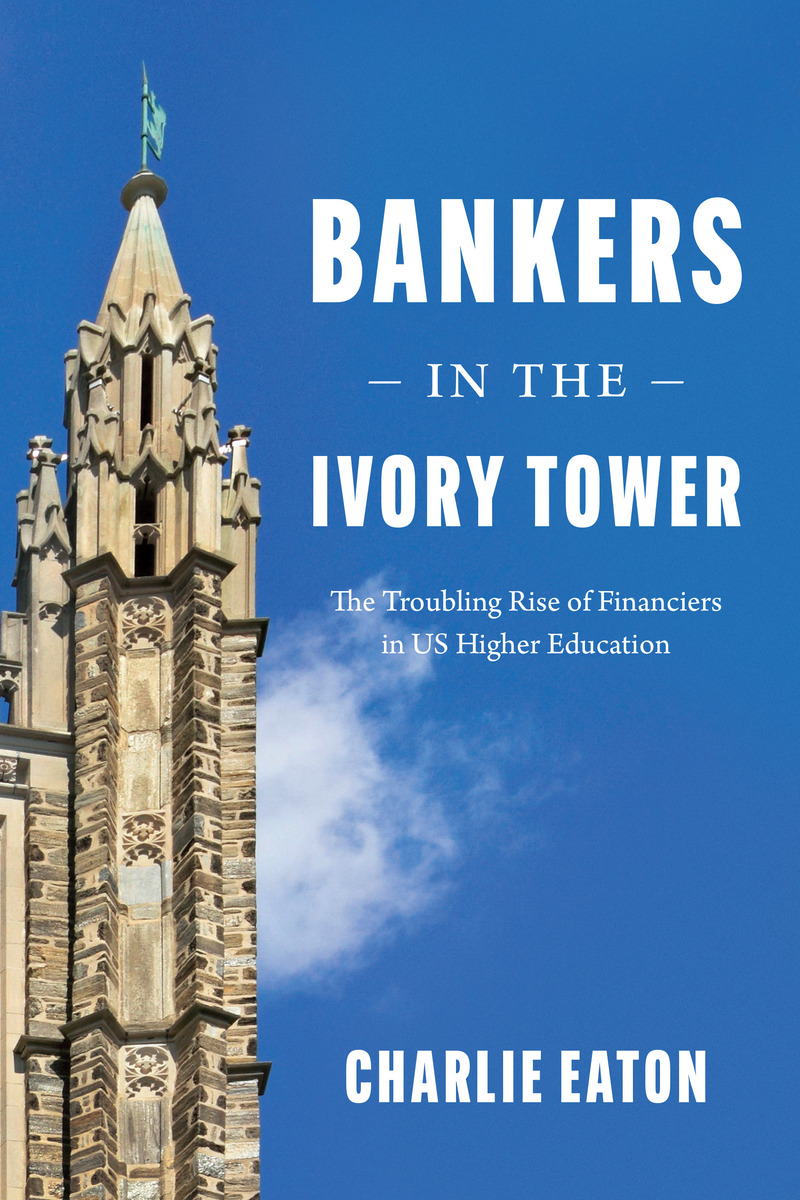
Bankers in the Ivory Tower
The Troubling Rise of Financiers in US Higher Education
by Charlie Eaton
University of Chicago Press, 2022
Cloth: 978-0-226-72042-5 | Paper: 978-0-226-85439-7 | Electronic: 978-0-226-72056-2
DOI: 10.7208/chicago/9780226720562.001.0001
ABOUT THIS BOOKAUTHOR BIOGRAPHYREVIEWSTABLE OF CONTENTS
ABOUT THIS BOOK
Exposes the intimate relationship between big finance and higher education inequality in America.
Elite colleges have long played a crucial role in maintaining social and class status in America, while public universities have offered a major stepping stone to new economic opportunities. However, as Charlie Eaton reveals in Bankers in the Ivory Tower, finance has played a central role in the widening inequality in recent decades, both in American higher education and in American society at large.
With federal and state funding falling short, the US higher education system has become increasingly dependent on financial markets and the financiers that mediate them. Beginning in the 1980s, the government, colleges, students, and their families took on multiple new roles as financial investors, borrowers, and brokers. The turn to finance, however, has yielded wildly unequal results. At the top, ties to Wall Street help the most elite private schools achieve the greatest endowment growth through hedge fund investments and the support of wealthy donors. At the bottom, takeovers by private equity transform for-profit colleges into predatory organizations that leave disadvantaged students with massive loan debt and few educational benefits. And in the middle, public universities are squeezed between incentives to increase tuition and pressures to maintain access and affordability. Eaton chronicles these transformations, making clear for the first time just how tight the links are between powerful financiers and America’s unequal system of higher education.
AUTHOR BIOGRAPHY
Charlie Eaton is associate professor of sociology at the University of California, Merced.
REVIEWS
"The book is a vivid reminder of how rich, exclusive and small the US Ivy League universities are. . . . But the book shows, too, the importance of universities. They can be a means of entrenching privilege or of spreading
opportunity. A well-designed system for funding universities can be a crucial driver of social mobility. But in the US it is not working well."
— Financial World
"This thoroughly researched, scholarly case study systemically examines the present higher education system. Eaton identifies the disparate players involved and examines their interactions . . . Eaton also offers a way to reimagine the current system that would realign it with its traditional values. He has provided a valuable public service in developing and presenting this thoughtful, well-researched analysis. Highly recommended."
— Choice
"A timely book. . . [that] analyzes the decades-long, intricate relationship between higher education leaders and financiers."
— Journal of Urban Affairs
"Eaton offers an empirically sound and rigorous analysis of how higher education relates to high finance."
— Social Forces
"Charlie Eaton’s Bankers in the Ivory Tower: The Troubling Rise of Financiers in US Higher Education is a necessary if not timely analysis for understanding the higher-education crisis in the contemporary United States."
— Exertions
"Bankers in the Ivory Tower offers a fascinating and data-driven investigation on how finance is transforming higher education in America for the worse. Instead of an engine of opportunity, it is becoming fuel for inequality with snowballing endowments for the top, student debt replacing public funding for the middle, and for-profit predation for the bottom. A must read."
— Emmanuel Saez, University of California, Berkeley, Chancellor's Professor of Tax Policy and Public Finance
"Until now, no one has connected the dots between ever-more-rarified Ivy walls, the expansion of predatory for-profit institutions, and the financialization of the US economy. With impeccable research, Eaton brilliantly shows that what happens at the top and what happens at the bottom (not to mention in the middle) are more closely connected than you think—and that the common thread is high finance."
— Elizabeth Popp Berman, University of Michigan, associate professor of organizational studies
“Many have criticized spending choices at colleges and universities and blamed them for both the rising cost of higher education and the corresponding, corrosive spread of student debt. But Eaton identifies the complex relationships that tie financial elites to these highly selective schools, which they and other wealthy families disproportionately attend. Financiers both advise and often help govern universities, guiding them to operate more like profit-seeking businesses, and financiers also function as intermediaries in the provision of student debt. The argument of the book makes the overrepresentation of socioeconomically privileged students on the nation’s most selective campuses look unsurprising and indeed, almost inevitable.”
— Jonathan Glater, University of California, Berkeley, professor of law
“As elite colleges marvel at how sharply their multibillion-dollar endowments have risen from year to year, they fail to make the connection with the rise in for-profit colleges sinking students into high debt and low salaries. By following the investors, the hedge funds, the college governing boards, and the students whose lives they trample, Eaton shows how the financial oligarchy that descends from and upholds the Ivory Tower has taken the public out of our public goods. A sobering and fact-filled account with an unexpected glimpse into the possible.”
— Frederick F Wherry, The Townsend Martin, Class of 1917 Professor of Sociology at Princeton University
"A sobering look at how a generation of bankers transformed higher education, generating massive endowments for elite schools—and leaving a legacy of scarcity and debt for everyone else. Carefully researched and forcefully argued, Bankers in the Ivory Tower is essential reading for anyone who cares about higher education, school loans, or the social life of finance."
— Sarah Quinn, University of Wisconsin, associate professor of sociology
“Bankers in the Ivory Tower’s greatest strength . . . is in the overview beyond the top stratum, where most journalists tend to focus their attention. Understanding the influence of financiers means connecting the story of financialization to the historic expansion of student borrowing.”
— Los Angeles Review of Books
“If, as is often said, Harvard is a hedge fund with a university attached, Eaton shows that part of what has made it so are investments brokered within elite social networks, away from the oversight of regulators.”
— The New York Review of Books
TABLE OF CONTENTS
1. Universities and the Social Circuitry of Finance
DOI: 10.7208/chicago/9780226720562.003.0001
[student loan;financiers;borrowers;endowments;for-profit colleges;financialization;social circuitry;universities;elites;Wall Street]
Scholars have referred to the growing power and centrality of financial markets as thefinancializationof society.As the US economy financialized, growing dependence on financiers induced even the leaders ofnonfinancialinstitutions to adopt a financial logic: that money should always be allocated where it will yield the highest rate of return. University leaders have been no exception. Financial ideas and financial institutions can be thought of as a social circuitry of finance that connects every member of society, with financiers positioned as the transistors. Just as transistors connect the varied segments of electronic circuits, financiers and their organizations connect the varied financial relations of billions of people around the world. For example, finance’s social circuitry wires the subordinate relationships of student loan borrowers to the investment fund managers that own for-profit colleges. But the circuitry also fuses more equitable interactions between university endowment officers and those same fund managers who invest in for-profit colleges.
2. Our New Financial Oligarchy
DOI: 10.7208/chicago/9780226720562.003.0002
[financiers;elites;Forbes 400;alumni;university boards;hedge funds;private equity;social ties;oligarchy;social status]
Chapter 2, “Our New Financial Oligarchy,” begins by expanding on financiers’ intimate ties to other elites that run through their prestigious and private alma maters. I show that financiers received undergraduate degrees from the most selective private schools at much higher rates than others among the four hundred wealthiest Americans. The chapter explains how financiers like Yale alumnus and billionaire Tom Steyer drew on their college ties to create the lucrative new business models of private equity funds, hedge funds, and consolidated financial service corporations. Chapter 2 also uses data on the financial ties of college governing board members to show a subsequent doubling in the share of private university board slots going to these new financial oligarchs. The chapter theorizes the ascent of financiers on these governing boards as occurring through a mobilization of intimate social ties that confer mutual benefits of social status and economic advantage to top private schools and financiers.
3. Bankers to the Rescue: The Political Turn to Student Debt
DOI: 10.7208/chicago/9780226720562.003.0003
[student loans;student debt;financial aid;Pell Grants;universities;higher education;Sallie Mae;commercial bankers;Higher Education Act]
Chapter 3, “Bankers to the Rescue,” shows how Sallie May CEO Larry Hough and other commercial banking leaders used their social ties to push a radical expansion of federal student loan programs at the beginning of the 1990s. Using congressional hearing minutes and interviews with industry representatives, chapter 3 documents the importance of intimate ties between financiers, university leaders, financial aid officers, and politicians in the construction of a political coalition for expanding federal loan programs in place of Pell Grants. The expanded federal student loan programs became a fulcrum for the turn to finance across the three major strata of US higher education.
4. The Top: How Universities Became Hedge Funds
DOI: 10.7208/chicago/9780226720562.003.0004
[endowments;hedge funds;private equity;philanthropy;university boards;alumni;elites;investment returns;shareholder value]
Chapter 4, “The Top: How Universities Became Hedge Funds,” documents how private universities used an endowment boom mostly for the benefit of their well-off students. Chapter 4 then uses data on university board membership, endowment rates of return, and charitable donations to show how financier ties facilitated this endowment boom and supported hoarding.
5. The Bottom: A Wall Street Takeover of For-Profit Colleges
DOI: 10.7208/chicago/9780226720562.003.0005
[for-profit colleges;proprietary colleges;private equity;EDMC;Providence Equity;leveraged buyouts;educational inequality;shareholder value]
Chapter 5, “The Bottom: A Wall Street Takeover of For-Profit Colleges,” narrates how the New England Institute of Art (NEIA) exploited the educational dreams of students like Kim Tran. NEIA recruiters enrolled Tran two years after their parent company was acquired for $3.4 billion by private equity investor and Brown University board member Jonathan Nelson. Tran and Nelson lived just fifteen minutes from each other, but their lives would have remained disconnected were it not for a mix of intimate and impersonal financial ties employed in the private equity buyout of Tran’s school. The transaction ended in disaster for Tran and tens of thousands of other low-income students who ended up with unpayable debts. Yet, Nelson remains Rhode Island’s only billionaire. I expand on Tran and Nelson’s story to document the mechanisms and consequences of how private equity investors have spread a “shareholder value” logic to sectors like higher education, where publicly traded corporations were once rare.
6. The Middle: A Hidden Squeeze on Public Universities
DOI: 10.7208/chicago/9780226720562.003.0006
[tax avoidance;proposition 13;proposition 30;public universities;university of california;regents;private equity;tuition;institutional debt;student debt]
Chapter 6, “The Middle: A Hidden Squeeze on Public Universities,” uses a case study of the University of California (UC) to show how financier tax avoidance and subsidy capture have squeezed funding for public institutions. Private equity financier Dick Blum was appointed to the UC Board of Regents in 2002 when state funding cuts began to intensify. As board chair, Blum and other UC finance leaders lamented state funding cuts but initially declined to support state tax increases to restore revenue lost to financier tax avoidance. Instead, they increased the university’s dependence on student loans and municipal bond borrowing to offset declining state support. But public universities create more universal social identities and networks that connect even financier alumni like Blum to nonelites in ways that are rare at private universities. These ties made UC more attentive to low-income students. UC enrolled low-income students at twice the rate of elite private schools in part by using tuition to maintain mass enrollments. UC also used grant aid to actually reduce loan borrowing by low-income students.
7. Reimagining (Higher Education) Finance from Below
DOI: 10.7208/chicago/9780226720562.003.0007
[student debt;debt cancellation;tuition freeze;proposition 30;millionaire tax;coalitions;elites;financiers;education unions]
I ask how we might imagine more inclusive and equitable financial systems in higher education and beyond.Financiers did not remake higher education finance from scratch and neither will those who imagine its next iteration. Accordingly, chapter 7 shows how overlapping coalitions have developed two complementary strategies for mobilizing the higher education ties of today to win a better tomorrow. I theorize one strategy as a more gradualbargaining with bankersand another as abig bangof student debt cancellation. The coalitions behind these strategies paradoxically mirror financiers by mobilizing shared identities and social ties created by undergraduate education and the experience of student debt. But unlike the elite university ties of ivory tower bankers, both insurgent social groups and elites are connected by the higher education ties of these coalitions. They unite associations of students, education workers, communities of color, and service employees with legal advocates, policy experts, liberal politicians, and even the occasional financier. I assess how their respective reform proposals might relocate higher education financing decisions from the intimate networks of financiers to both public and intimate deliberations by nonelites.