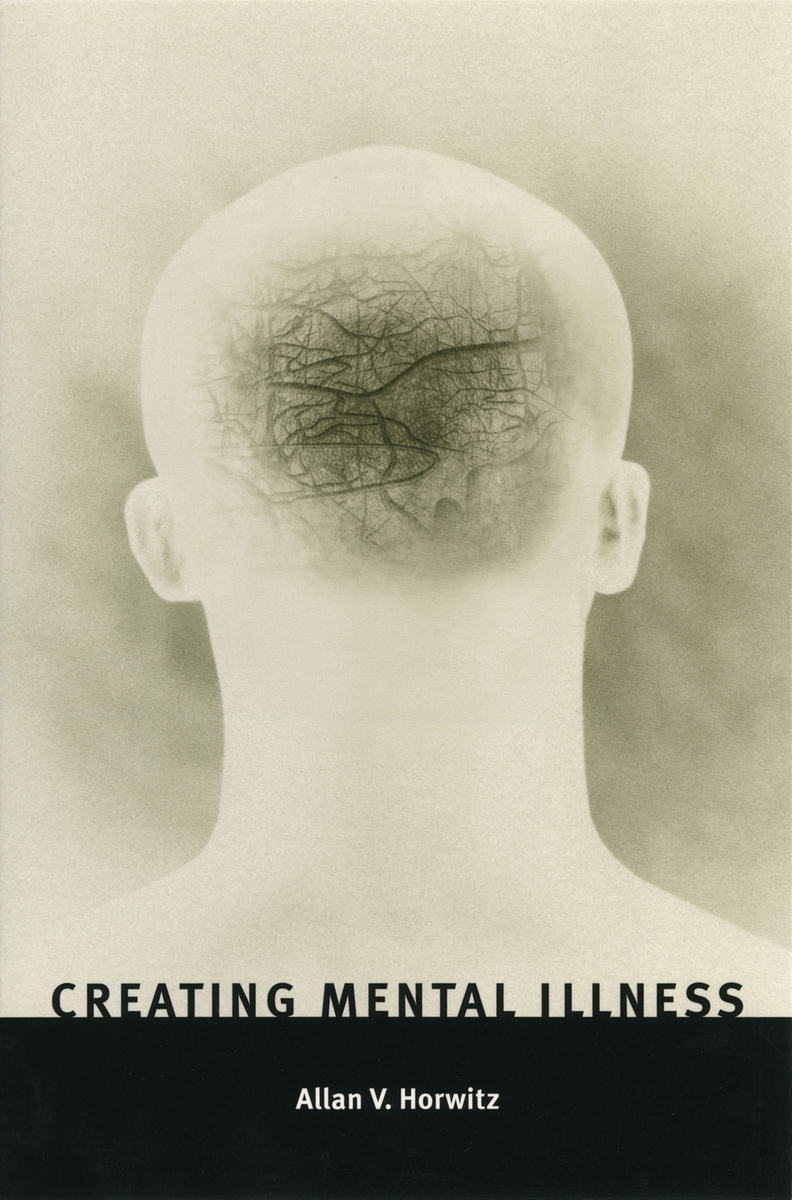
Creating Mental Illness
University of Chicago Press, 2001
Cloth: 978-0-226-35381-4 | Paper: 978-0-226-35382-1 | Electronic: 978-0-226-76589-1
DOI: 10.7208/chicago/9780226765891.001.0001
Cloth: 978-0-226-35381-4 | Paper: 978-0-226-35382-1 | Electronic: 978-0-226-76589-1
DOI: 10.7208/chicago/9780226765891.001.0001
AVAILABLE FROM
University of Chicago Press (cloth, paper, ebook)DeGruyter Multi-User Ebook Program
EBSCO eBooks (formerly NetLibrary)
ABOUT THIS BOOKAUTHOR BIOGRAPHYREVIEWSTABLE OF CONTENTS
ABOUT THIS BOOK
In this surprising book, Allan V. Horwitz argues that our current conceptions of mental illness as a disease fit only a small number of serious psychological conditions and that most conditions currently regarded as mental illness are cultural constructions, normal reactions to stressful social circumstances, or simply forms of deviant behavior.
"Thought-provoking and important. . .Drawing on and consolidating the ideas of a range of authors, Horwitz challenges the existing use of the term mental illness and the psychiatric ideas and practices on which this usage is based. . . . Horwitz enters this controversial territory with confidence, conviction, and clarity."—Joan Busfield, American Journal of Sociology
"Horwitz properly identifies the financial incentives that urge therapists and drug companies to proliferate psychiatric diagnostic categories. He correctly identifies the stranglehold that psychiatric diagnosis has on research funding in mental health. Above all, he provides a sorely needed counterpoint to the most strident advocates of disease-model psychiatry."—Mark Sullivan, Journal of the American Medical Association
"Horwitz makes at least two major contributions to our understanding of mental disorders. First, he eloquently draws on evidence from the biological and social sciences to create a balanced, integrative approach to the study of mental disorders. Second, in accomplishing the first contribution, he provides a fascinating history of the study and treatment of mental disorders. . . from early asylum work to the rise of modern biological psychiatry."—Debra Umberson, Quarterly Review of Biology
AUTHOR BIOGRAPHY
Allan V. Horwitz is a professor in the Department of Sociology and Institute for Health, Health Care Policy, and Aging Research at Rutgers University.
REVIEWS
“[Horwitz] properly identifies the financial incentives that urge therapists and drug companies to proliferate psychiatric diagnostic categories. He correctly identifies the stranglehold that psychiatric diagnosis has on research funding in mental health. Above all, he provides a sorely needed counterpoint to the most strident advocates of disease-model psychiatry.”
"This is a must-read book. . . . The content is superb. It is filled with insights into the social, historical, and economic forces responsible for the overmedicalization of human unhappiness and distress."
— George Graham, Metapsychology"A cogent and thought-provoking book. It deserves to be read widely and thoroughly, and not only by the already converted. In an ideal world it would be compulsory reading for mental health professionals in training."
— Nick Haslam, Transcultural Psychiatry“Horwitz analyzes the social history of the dynamic, diagnostic, and social constructionist frameworks with enormous historical detail. He crafts fascinating arguments regarding how each framework was conceptualized, sold, measured, and the social impact that it left in its wake. . . . A fascinating, meticulously researched social history that will appeal to a wide range of academic audiences.”
“Horwitz makes at least two major contributions to our understanding of mental disorders. First, he eloquently draws on evidence from the biological and social sciences to create a balanced, integrative approach to the study of mental disorders. Second, in accomplishing the first contribution, he provides fascinating history of the study and treatment of mental disorders . . . from early asylum work to the rise of modern biological psychiatry.”
“A fascinating and scholarly critique of our classification of mental disorders.”
TABLE OF CONTENTS
Preface
Introduction: The Proliferation of Mental Illnesses
One: A Concept of Mental Disorder
Two: The Expansion of Mental Illnesses in Dynamic Psychiatry
Three: The Emergence of Diagnostic Psychiatry
Four: The Extension of Mental Illnesses into the Community
Five: The Structuring of Mental Disorders
Six: The Biological Foundations of Diagnostic Psychiatry
Seven: Social Causes of Distress
Eight: Diagnostic Psychiatry and Therapy
Conclusion: Mental Illnesses as Social Constructions
Notes
References
Index