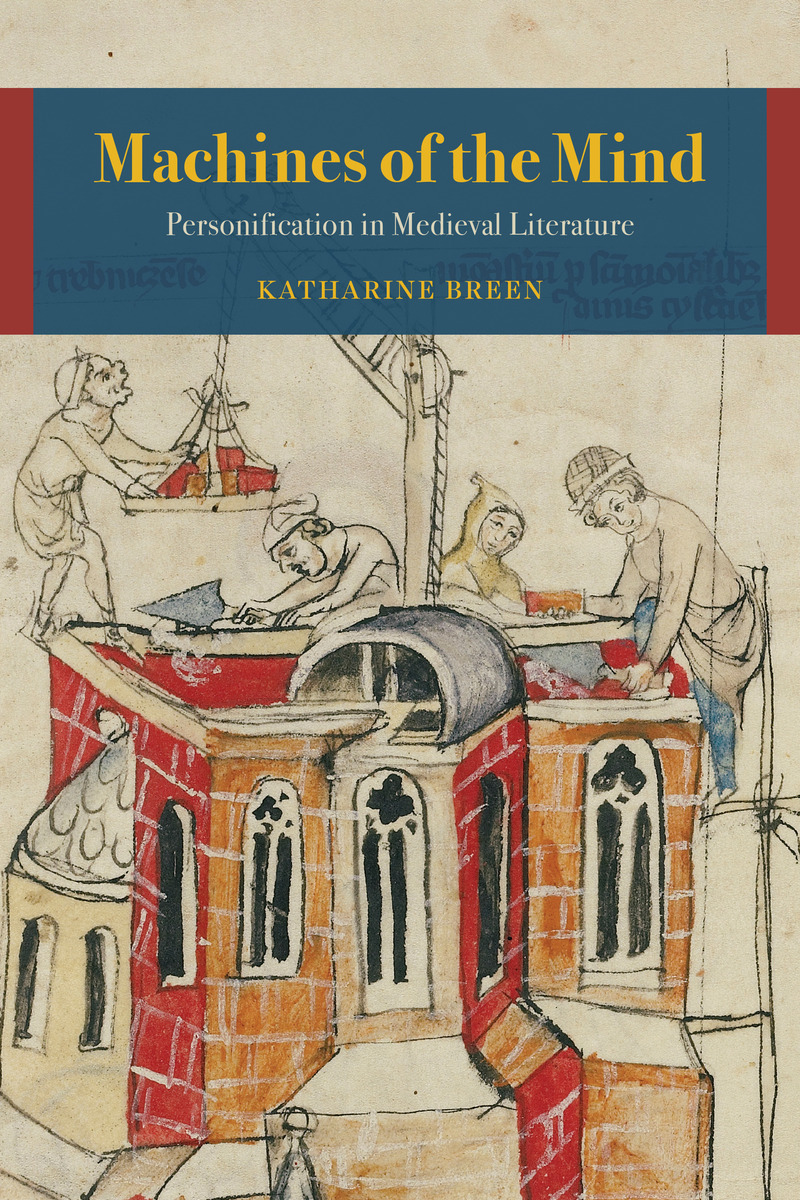
Machines of the Mind
Personification in Medieval Literature
by Katharine Breen
University of Chicago Press, 2021
Cloth: 978-0-226-77645-3 | Paper: 978-0-226-77659-0 | Electronic: 978-0-226-77662-0
DOI: 10.7208/chicago/9780226776620.001.0001
ABOUT THIS BOOKAUTHOR BIOGRAPHYREVIEWSTABLE OF CONTENTS
ABOUT THIS BOOK
In Machines of the Mind, Katharine Breen proposes that medieval personifications should be understood neither as failed novelistic characters nor as instruments of heavy-handed didacticism. She argues that personifications are instead powerful tools for thought that help us to remember and manipulate complex ideas, testing them against existing moral and political paradigms. Specifically, different types of medieval personification should be seen as corresponding to positions in the rich and nuanced medieval debate over universals. Breen identifies three different types of personification—Platonic, Aristotelian, and Prudentian—that gave medieval writers a surprisingly varied spectrum with which to paint their characters.
Through a series of new readings of major authors and works, from Plato to Piers Plowman, Breen illuminates how medieval personifications embody the full range of positions between philosophical realism and nominalism, varying according to the convictions of individual authors and the purposes of individual works. Recalling Gregory the Great’s reference to machinae mentis (machines of the mind), Breen demonstrates that medieval writers applied personification with utility and subtlety, employing methods of personification as tools that serve different functions. Machines of the Mind offers insight for medievalists working at the crossroads of religion, philosophy, and literature, as well as for scholars interested in literary character-building and gendered relationships among characters, readers, and texts beyond the Middle Ages.
AUTHOR BIOGRAPHY
Katharine Breen is associate professor of English at Northwestern University. She is the author of Imagining an English Reading Public, 1150-1400, and her essays and articles have appeared in such publications as Representations, Journal of Church History, Chaucer Review, Review of English Studies, Speculum, and New Medieval Literatures, among others. She is a coeditor of the Yearbook of Langland Studies.
REVIEWS
“Machines of the Mind persuades its readers to think more systematically about the types and uses of personification. Breen clears away some forty years of confusion about medieval philosophical positions on realism and so-called nominalism, clearly differentiating them from the postmodern nominalism of twentieth-century high theory and imaginatively reconsidering their implications for literary representation. Her schema will allow future scholars to differentiate Platonic, Neoplatonic, moderate realist, and nominalist strategies for personification while also recognizing that many medieval works may employ multiple types at once. This book will remain a reference point for many years to come.”
— Fiona Somerset, author of Feeling like Saints: Lollard Writings after Wyclif
"Machines of the Mind is one of the most thorough and insightful texts on personification available. . . . Breen is a meticulous writer, and the book is successful in its aims. Taking on a large wealth of information and literature in stride, Breen writes out a detailed history. . . . Audiences who have a critical background in personification will find this book to be invaluable to their studies."
— Comitatus
" Breen’s Machines of the Mind traces the formal and historical development of three traditions of personification that, as she argues throughout the book, are available to medieval authors: Prudentian, Platonic, and Aristotelian. She describes how each type of personification functions as a pliable and complex 'engine of thought' that allows writers and readers to think through difficult questions."
— Qui Parle
"Machines of the Mind: Personification in Medieval Literature is a powerful and original intervention in medieval allegory studies and, more broadly, literary history and theory. This is a book that will reshape our thinking about the interaction between poetics and philosophy in antiquity and the Middle Ages."
— Rita Copeland, Speculum: A Journal of Medieval Studies
"Machines of the Mind more than succeeds in its goals of creating a much needed taxonomy of personification that also redefines it as a spur to cognition, personal reform, and political reflection."
— Studies in the Age of Chaucer
TABLE OF CONTENTS
Introduction - Katharine Breen
DOI: 10.7208/chicago/9780226776620.003.0001
[personification;allegory;realism;nominalism;Plato;Aristotle;Prudentius;Gregory the Great]
The introduction treats personifications as what the medieval theologian Gregory the Great calls “machines of the mind.” Much as builders’ hoists amplify force through mechanical advantage, allowing their users to lift loads that far exceed their strength, personifications enable their users to focus on and manipulate ideas that would otherwise be out of reach. Disrupting the critical debate that sees allegory as either inherently philosophically realist or inherently philosophically nominalist, the introduction recognizes that different kinds of personifications perform different kinds of work. While the most familiar Platonic personifications are resplendent and authoritative, and often explicitly the product of visionary experience, moderately realist Aristotelian personifications are extracted from sense perceptions of empirical objects and characterized by a wealth of verisimilar detail. Prudentian personifications take after their Platonic counterparts in being both numinous and philosophically realist, while resembling their Aristotelian counterparts in being self-conscious human creations. Readers reform or recreate Prudentian personifications as they read and are in turn reformed by them, remade first as virtuous readers and ultimately as personifications of virtue. (pages 1 - 32)
This chapter is available at:
https://academic.oup.com/chica...
1. Consecratus Manu: Men Forming Gods Forming Men - Katharine Breen
DOI: 10.7208/chicago/9780226776620.003.0002
[personification;prosopopoeia;rhetoric;religion;deification;Cicero;Quintilian;Rhetorica ad Herennium;On the Nature of the Gods;On the Laws]
Chapter 1 challenges the widely held critical distinction between naïve religious personifications on the one hand and self-aware rhetorical personifications on the other. Tracing the origins of medieval personification to the late classical period, it finds that religious texts such as Cicero’s On the Nature of the Gods present the deified virtues as both fully numinous and, without contradiction, the product of human intellectual craftsmanship. Conversely, rhetorical handbooks such as the Rhetorica ad Herennium and Quintilian’s Institutes of Oratory present ancestors and localities as paradigmatic examples of personification, treating prosopopoeia not only as asite for rhetorical invention but also as a form of religious invocation. Both kinds of personification come into being through a process of consecration or deification, contrasted with the characteristically Platonic process of divine illumination and the characteristically Aristotelian process of abstraction from sense perception. Formed by human agency, they are also formative in the way that experiences are formative, guiding their followers in the practice of virtue. As they do so, these formative personifications disrupt the categories and chronologies of recent accounts of personification allegory. (pages 35 - 68)
This chapter is available at:
https://academic.oup.com/chica...
2. How to Fight Like a Girl: Christianizing Personification in the Psychomachia - Katharine Breen
DOI: 10.7208/chicago/9780226776620.003.0003
[personification;virtue;vice;Christian;pagan;feminine;masculine;transgender;Prudentius;Psychomachia]
Chapter 2 turns from theory to practice, arguing that Prudentius’s Psychomachia seeks to reform the personifications of the classical world for Christian ends. It demonstrates that Prudentius’s Vices are none other than the deified abstractions of classical religion, and that his Virtues destroy them not once but twice: first as moral categories, then as a pagan form of personification vanquished by its Christian counterpart. Despite the violence of these confrontations, however, Prudentius’s model of formative personification adapts rather than dismantles that of Cicero and Quintilian. His feminine Virtues are simultaneously supernatural beings battling against wicked spirits and self-conscious human creations. Indeed, their bodies revert to those of male persons as soon as they slacken in their fight against vice, indicating that for Prudentius virtue is a process of self-personification, even self-deification, through religious practice. Prudentius invites his normatively masculine readers to reform or recreate the poem’s personifications as they read and in turn to be reformed by them, remade first as virtuous readers and ultimately as transgender personifications of virtue. (pages 69 - 108)
This chapter is available at:
https://academic.oup.com/chica...
3. Ex Uno Omnia: Plato’s Forms and Daemons - Katharine Breen
DOI: 10.7208/chicago/9780226776620.003.0004
[personification;allegory;forms;daemons;Plato;Neoplatonism;Augustine;Cicero;Calcidius;Apuleius]
Chapter 3 examines the different varieties of Neoplatonism available in the Middle Ages and their correspondingly different implications for personification allegory. It demonstrates that the category of Neoplatonic personification includes not only the tradition’s most thoroughly awe-inspiring and numinous personifications but also some that are notably irreverent and unreliable. Many of the most elevated Neoplatonic personifications are associated with an Augustinian epistemology in which humans gain knowledge of the forms through divine illumination; they tend to be transcendentally beautiful allegorical goddesses, often brides or daughters of God. Neoplatonic personifications associated with a Ciceronian understanding of the forms, in contrast, tend to be philosophical rather than mystical, associated with debate and dialectic rather than awe-inspiring visions. Other Neoplatonic personifications do not refer to the forms at all but rather to daemons, figures intermediate between humans and the supreme deity in the Neoplatonic hierarchy of being. Like their namesakes, daemonic personifications tend to have intimate, tutelary relationships with their human charges. They can be flawed and even ridiculous, and are often enmeshed in the classical pantheon in ways that pose interpretive challenges for Christian writers. (pages 111 - 149)
This chapter is available at:
https://academic.oup.com/chica...
4. Hello, Nurse! The Boethian Daemon - Katharine Breen
DOI: 10.7208/chicago/9780226776620.003.0005
[personification;daemon;Boethius;Consolation of Philosophy;Neoplatonism;commentary;William of Conches;William of Aragon;Nicholas Trevet]
Examining Boethius’ Consolation of Philosophy both within its original late classical context and through the medieval commentary tradition, chapter 4 argues that Lady Philosophy inherits her basic mode of being from classical daemons, and thus is neither transcendent nor fully authoritative. Philosophy’s intermediate status is encoded in her femininity, which allows her to nurse the young and care for the sick but limits her influence over full-fledged philosophers. Neither in the Consolation itself nor in the medieval commentaries does Philosophy lead the way to transcendence. In Boethius’ prosimetrum, the prisoner finally seeks God through humble prayer rather than Neoplatonic ascent, redefining philosophy as a fundamentally worldly discipline concerned with moral probity and political justice. Medieval commentators likewise cordon off the highest reaches of philosophy as ill-suited for personification, leaving Philosophy as the mistress of a diminished and downward-looking discipline, suitable for beginners and those who look away from the heights to devote themselves to the public good. Understood in these terms, Philosophy embodies a specific, limited point of view, explicitly subordinate to that of Boethius as author. (pages 150 - 200)
This chapter is available at:
https://academic.oup.com/chica...
5. E Pluribus Unum: Abstracting Universals from Particulars - Katharine Breen
DOI: 10.7208/chicago/9780226776620.003.0006
[personification;universals;moderate realism;nominalism;Aristotle;Thomas Aquinas;John Duns Scotus;William of Ockham;William Langland;Guillaume de Deguileville]
Chapter 5 investigates the relatively unexplored category of Aristotelian personification. In his critique of Plato’s account of the forms, Aristotle argues that humans derive universals such as man and horse from their observations of empirical men and horses. According to the medieval Aristotelians known as moderate realists, these universals are abstracted from sense perceptions and exist in the human mind as “beings of reason.” The personifications that correspond to beings of reason are ontologically dependent on the individuals from which they are abstracted, emerging from and sometimes even rejoining them in the manner of Liar in Langland’s Piers Plowman. Nominalist personifications likewise trace their roots to Aristotle but tend to be puzzles or enigmas. Like Guillaume de Deguileville’s Penance, who carries a broom in her mouth to signify the tongue’s cleansing power in confession, they tend to be described in terms that are worldly but not verisimilar. Penance does not resemble penance but is instead a machine for generating the concept of penance in the minds of would-be penitents. Strictly speaking, a nominalist personification does not represent a universal but instead prompts its audience to conceptualize it. (pages 203 - 233)
This chapter is available at:
https://academic.oup.com/chica...
6. Dreaming of Aristotle in the Songe d’Enfer and Winner and Waster - Katharine Breen
DOI: 10.7208/chicago/9780226776620.003.0007
[personification;universals;moderate realism;Aristotle;Raoul de Houdenc;Songe d'Enfer;Winner and Waster;gender;dream vision]
Chapter 6 examines moderately realist Aristotelian personification in two vernacular dream visions: Raoul de Houdenc’s Songe d’Enfer and the anonymous Winner and Waster. The dream structure lends itself to Aristotelian personification because it makes no claims about the independent existence of universals or the personifications who represent them outside of the human mind. Instead, the poets present their personifications as means of coming to grips with their contemporary world. In the Songe d’Enfer, personified vices such as Throwdown and Grasping grow in strength and stature as people abandon idealized feudal values in favor of the values of the tavern and the marketplace, suggesting that they represent Aristotelian universals abstracted from the qualities of empirical human beings. The titular personifications of Winner and Waster, in turn, make a dizzying multiplicity of economic actors available to ethical and political analysis. The preponderance of masculine personifications in these poems contrasts with the predominantly feminine personifications of earlier allegorical traditions. This preference suggests that the authors understood themselves to be producing a new variety of personification defined by its ability to represent the male-dominated social, economic, and political world rather than by its distance from it. (pages 234 - 273)
This chapter is available at:
https://academic.oup.com/chica...
7. A Good Body Is Hard to Find: Putting Personification through Its Paces in Piers Plowman - Katharine Breen
DOI: 10.7208/chicago/9780226776620.003.0008
[personification;William Langland;Piers Plowman;Prudentius;Boethius;Holy Church;Hunger;Anima;Eld]
While the book’s first six chapters seek to isolate different varieties of personification for the sake of analytical clarity, the final chapter recognizes that during the later Middle Ages hybrid metaphysical systems were the rule rather than the exception. These systems generally describe the intellection of “higher” cognitive objects in terms of divine illumination and that of “lower” objects in terms of Aristotelian abstraction. They give rise to allegorical works in which numinous and worldly personifications appear either side by side or sequentially. The chapter examines Piers Plowman as an instance of this mixed allegory, arguing that it includes instances of Prudentian, Neoplatonic, and Aristotelian personification. Indeed, the widely acknowledged shift in the gender of Langland’s personifications over the course of the poem reflects a larger shift from characteristically feminine Neoplatonic personifications to characteristically masculine Aristotelian ones. More broadly, Langland’s willingness to experiment with different varieties of personification offers a fitting riposte to critics who insist that personification is either inherently realist or inherently nominalist, as he builds, rebuilds, and tinkers with his personifications as machines of the mind designed to answer specific questions or solve specific problems. (pages 274 - 316)
This chapter is available at:
https://academic.oup.com/chica...