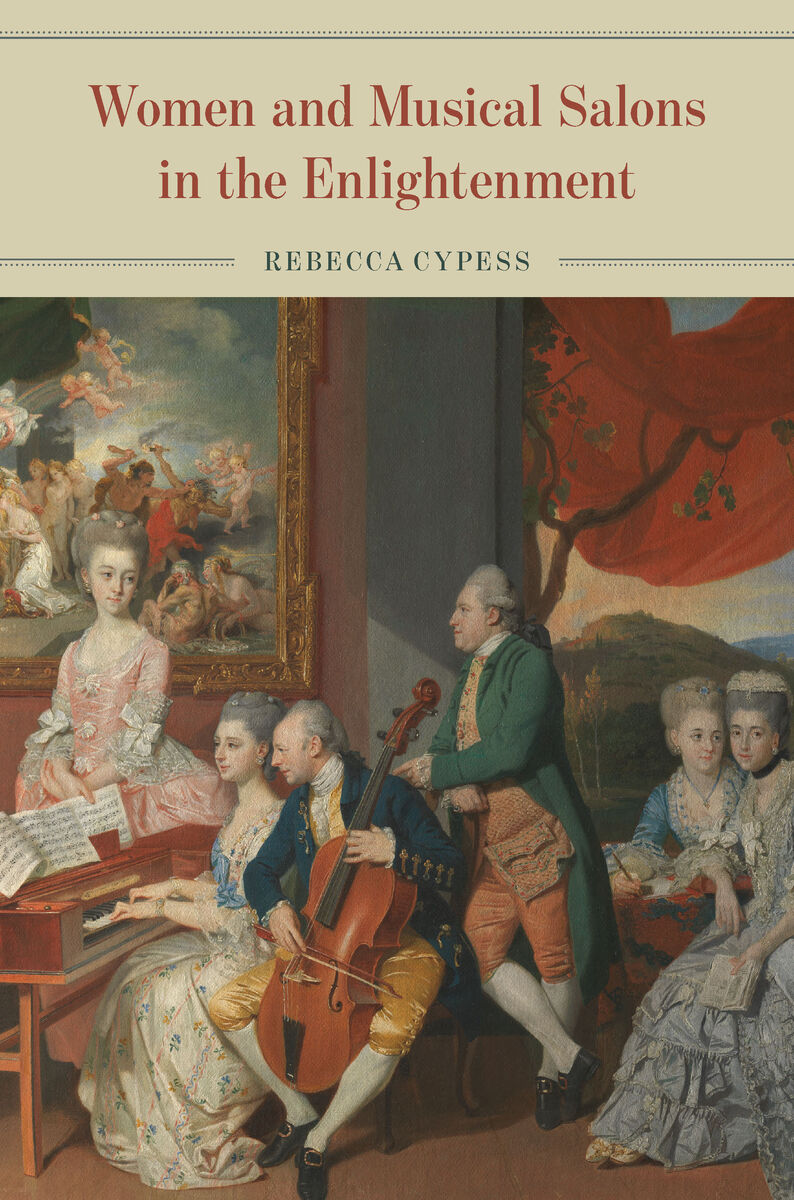
Women and Musical Salons in the Enlightenment
by Rebecca Cypess
University of Chicago Press, 2022
Cloth: 978-0-226-81791-0 | Electronic: 978-0-226-81792-7
DOI: 10.7208/chicago/9780226817927.001.0001
ABOUT THIS BOOKAUTHOR BIOGRAPHYREVIEWSTABLE OF CONTENTS
ABOUT THIS BOOK
A study of musical salons in Europe and North America between 1760 and 1800 and the salon hostesses who shaped their musical worlds.
In eighteenth-century Europe and America, musical salons—and the women who hosted and made music in them—played a crucial role in shaping their cultural environments. Musical salons served as a testing ground for new styles, genres, and aesthetic ideals, and they acted as a mediating force, bringing together professional musicians and their audiences of patrons, listeners, and performers. For the salonnière, the musical salon offered a space between the public and private spheres that allowed her to exercise cultural agency.
In this book, musicologist and historical keyboardist Rebecca Cypess offers a broad overview of musical salons between 1760 and 1800, placing the figure of the salonnière at its center. Cypess then presents a series of in-depth case studies that meet the salonnière on her own terms. Women such as Anne-Louise Brillon de Jouy in Paris, Marianna Martines in Vienna, Sara Levy in Berlin, Angelica Kauffman in Rome, and Elizabeth Graeme in Philadelphia come to life in multidimensional ways. Crucially, Cypess uses performance as a tool for research, and her interpretations draw on her experience with the instruments and performance practices used in eighteenth-century salons. In this accessible, interdisciplinary book, Cypess explores women’s agency and authorship, reason and sentiment, and the roles of performing, collecting, listening, and conversing in the formation of eighteenth-century musical life.
AUTHOR BIOGRAPHY
Rebecca Cypess is associate dean for academic affairs and associate professor of music at the Mason Gross School of the Arts, Rutgers University. She is the author of Curious and Modern Inventions: Instrumental Music as Discovery in Galileo’s Italy, also published by the University of Chicago Press.
REVIEWS
“Women and Musical Salons in the Enlightenment is a fascinating, imaginative, and richly detailed study of musical salon culture in the late eighteenth century. As Cypess argues, while salon culture in general has been extensively explored, musical salons have not. The women at the salons’ centers have often been treated as accessories to the male ‘geniuses’ they have supported, their own musical productions and activities ignored. But Cypess takes a fundamentally new approach, attempting to reimagine and recreate the lived musical experiences of those social spaces. This is an important and compelling book, executed with verve and authority, carefully considered and argued, and richly presented.”
— Annette Richards, Cornell University
“Traditional narratives in musical historiography have tended to cast (male) genius-composers as protagonists, often overlooking the variety of influential roles played by women. This book is a much needed and timely corrective. With elegant prose that moves seamlessly from theoretical perspectives to music analysis to the author’s reflection on her own performance experience, Women and Musical Salons in the Enlightenment is encyclopedic in its mastery of the relevant literature from musicology and other disciplines. Accessible and engaging to diverse readerships, this book will certainly interest scholars from a variety of fields.”
— Edward Klorman, McGill University
"Few music books can be considered revelatory, but Cypess's volume earns that accolade because it exposes vital activity in 18th-century Europe (and America) that has been all but ignored by most musicians... Although the book classes as music, it will be perfectly accessible to readers beyond the music discipline. Fascinating and compelling... Essential."
— Choice
"Rebecca Cypess’s second monograph. . . represents a remarkable achievement, or rather, several remarkable achievements – as an account of an elusive musical history, a feat of musical performance studies, a model of feminist historiography, and a courageous challenge to methodological limits."
— Ad Parnassum
"Cypess’s own virtuosity as a musician and scholar is itself amply displayed in this elegantly written and insightful study. Her interpretations are meticulous and rely on detailed study of a wealth of primary sources as well as her own experiences as a very accomplished keyboardist. . . [An] outstanding monograph."
— Austrian History Yearbook
"The strength of the book lies in Cypess’s engagement with recent scholarship. . . Cypess’s
exploration of music history from a social and cultural perspective opens the door to new ways of thinking about the past. Cypess’s analysis of the established historical narrative only adds to the enjoyment of the book. This book is recommended to anyone interested in a fresh perspective on the history of classical music."
— Quarter Notes
"Musical salons in the late 18th century, which were mostly held in private homes and hosted by accomplished women, have often been treated as “fringe events” in music histories. Rebecca Cypess, however, has put them front and center in her engaging new book. . . . The five case studies in the book provide a fascinating cross-section, and I highly recommend it for anyone interested in exploring the topic. Perhaps it will even encourage performers to delve further into the musical repertory and make new connections."
— Early Music America
"This broadly conceived and exceptionally detailed work is a collection of interdependent essays that consider the musical salon during the Enlightenment period, specifically 1760–1800, as a space for music making and as praxis for understanding music making in the West. . . . [Cypress's] essays unpack the salon’s role in the formation of the Enlightenment sense of selfhood, assess the intersections of gender and social status at play in these complex spaces, and track the salon’s transference to the colonial US at a time of profound cultural formation."
— Notes
"Cypess provides a history and philosophy of salons and then presents five representative salonniéres: Madame Brillon, Marianna Martines, Sara Levy, Angelica Kauffman, and Elizabeth Graeme. . . As Cypess ascertains, salons were liminal spaces of female agency in which they could influence cultural taste. . . . This book provides a great deal of new ideas about performance, authorship, and life for women in 18th century Europe."
— Music Reference Services Quarterly
"A comprehensive study of the involvement of women in mid-to-late-eighteenth-century European and American salons. Cypess’s work is a resounding success in its detailed descriptions of the salons, the instrumentation and music performed, and the various roles women served in these establishments. . . . Cypess’s research is outstanding and fills a notable void in the literature, rendering this book of great value to scholars of several disciplines. The work is meticulously and artfully written and will be a great asset to any library."
— College Music Symposium
"There has been a fair amount of work over the last twenty-five years on eighteenth-century salons and on the questions they raise about how, and how far, Enlightened ideals of sovereign individuality and agency extended into the lives of women. Rebecca Cypess’s new book distinguishes itself in several respects within this well-populated field. This is the first book-length treatment of specifically musical salons led by women, and it makes use of extensive audio examples, recorded by the author and her associates and carefully interwoven with its cultural analyses. . . . The five case-study chapters, each dedicated to a different salonnière, are little jewels, full of deft cultural allusions; fascinating, and at times poignant biographical detail; and quietly original musical insights."
— Journal of Modern History
TABLE OF CONTENTS
Introduction - Rebecca Cypess
DOI: 10.7208/chicago/9780226817927.003.0001
[musical salons;women;Enlightenment;salonnière;public sphere;private sphere]
While musical salons of the eighteenth centuryhave made occasional appearances inscholarly literature, they have not yet been addressed from a holistic perspective and on their own terms. The introduction surveys the field of musical salons, exploring the historiography and terminology of the institution as well as its gender and social dynamics and its role in the thought and experience of the Enlightenment. The role of thesalonnièrewas crucial to the musical salon.Associated with music-making among their many other avenues of “accomplishment,” women used the musical salon as a site of cultural agency. Because of their situation within the home, salons formed an appropriate site for the exercising of female agency. Yet the proceedings of the musical salon invariably spilled out into the public sphere in one way or another. (pages 1 - 23)
This chapter is available at:
https://academic.oup.com/chica...
1. Musical Salons as Liminal Spaces: Salonnières as Agents of Musical Culture - Rebecca Cypess
DOI: 10.7208/chicago/9780226817927.003.0002
[musical salons;public sphere;private sphere;women composers;salonniere]
This chapter builds on recent work that locates salons in a liminal space between the public and private spheres. With respect to musical salons in particular, this liminality was essential for enabling women to act as agents of musical culture. As Antoine Lilti has argued, the salon’s situation as part of the home rendered it an acceptable site of female agency. The domestic associations of women’s music-making enhanced this ethos. Musical salon hostesses navigated the line between the salon and the public sphere in a variety of ways. Through patronage of professional performers and composers, networks of travel and epistolary exchange, collecting of scores and instruments, and activities as performers, composers, and sometimes publishers of their work, musical salonnières played a key role in the shaping of a modern musical culture. (pages 24 - 61)
This chapter is available at:
https://academic.oup.com/chica...
2. Sensuality, Sociability, and Sympathy: Musical Salon Practices as Enactments of Enlightenment - Rebecca Cypess
DOI: 10.7208/chicago/9780226817927.003.0003
[musical salons;performance practice;keyboard duos;sympathy;moral sentiment;play]
This chapter offers a reconsideration of salon music based both on historical evidence and on the author’s experience as a performer who has engaged with the performance practices used in eighteenth-century salons. Rather than thinking about salon music in terms of compositional style, as some writers have fruitfully done in the past, this chapter asks what may be learned by placing performance at the center of the story. This approach indeed offers new perspectives: the chapter links the reciprocity and ludic qualities of salon performance to the sociability of games that were played there, and it shows how both music and salon games were meant, simultaneously, to entertain salon participants and, equally important, to foster a sense of sympathy (what today would be called “empathy”) in them. Sympathy was understood during the late eighteenth century as the key to the formation of “moral sentiment,” itself the basis of moral societies. Thus, far from being divorced from the intellectual projects of the Enlightenment, the sensual experiences of music and other salon practices helped lay the groundwork for the cultivation of an enlightened self. (pages 62 - 102)
This chapter is available at:
https://academic.oup.com/chica...
3. Ephemerae and Authorship in the Salon of Madame Brillon - Rebecca Cypess
DOI: 10.7208/chicago/9780226817927.003.0004
[Brillon de Jouy, Anne-Louise Boyvin d'Hardancourt;Benjamin Franklin;ephemerality;women composers;square piano;Romance;keyboard duos]
This chapter is set in the Parisian salon of Anne-Louise Boyvin d’Hardancourt Brillon de Jouy (1744–1824), a salon hostess, amateur keyboardist, and composer whose network of musical connections extended across Europe and to North America. A composer as well as a dedicatee of published music by professional musicians, Brillon nevertheless valued the lived experiences of music in her salon above all, and this chapter seeks to understand these experiences through the medium of a square piano nearly identical to the one that she owned. The author posits that Brillon adopted a “poetics of the ephemeral,” which found its way into the public sphere through her interactions with professional composers such as Luigi Boccherini. The chapter considers Brillon’s interest in ephemeral qualities of music such as timbre and texture alongside some of the music dedicated to her—in particular, Boccherini’s opus 5 sonatas for violin and keyboard. This juxtaposition opens the way to a reconsideration of women’s authorship in eighteenth-century salons. (pages 103 - 149)
This chapter is available at:
https://academic.oup.com/chica...
4. Composition, Collaboration, and the Cultivation of Skill in the Salon of Marianna Martines - Rebecca Cypess
DOI: 10.7208/chicago/9780226817927.003.0005
[Martines, Marianna;Metastasio, Pietro;women composers;public sphere;Accademia filarmonica;cantata]
This chapter shows how the Viennese salonnière, keyboardist, singer, and composer Marianna Martines (1744–1812) fashioned her image as an internationally recognized composer, while mitigating her presence in the public sphere through the institution of the salon. Martines, like others in Vienna, did not shy away from casting herself as hardworking and devoted to serious study. While other women composers drew public criticism, Martines largely succeeded in avoiding such attacks by staying out of the fully public eye. Examining some of her Italian cantatas in light of contemporary descriptions of what made her style of composition and performance distinctive, this chapter argues that her salon was defined by her collaboration with her mentor, Pietro Metastasio, who lived with the Martines family for decades, who guided Martines’s education and career, and whose poetry she set. This collaborative approach continued to define her salon after Metastasio’s death. (pages 150 - 199)
This chapter is available at:
https://academic.oup.com/chica...
5. The Cultural Work of Collecting and Performing in the Salon of Sara Levy - Rebecca Cypess
DOI: 10.7208/chicago/9780226817927.003.0006
[Levy, Sara;Jews;Haskalah;Enlightenment;collecting;performing;performance studies;antisemitism;anti-Judaism]
Long dominated by the musical King Frederick the Great, the city of Berlin after the Seven Years’ War saw the rise of a network of salons hosted by elite Jewish women. This chapter turns to one of these salons with a distinctively musical character. Sara Levy (1761–1854) was a virtuosic keyboardist closely linked to the Bach family who hosted a salon starting in the 1780s. Her collection of scores of music by the Bach family as well as local Prussian composers from previous generations reflects her strong interest in the musical past, while her patronage of contemporary composers shows how she shaped musical culture in her own day. Levy was also an active patron of the Jewish Enlightenment (Haskalah), and she would have been aware of the debates—conducted both in German and in Hebrew—about whether Jews had the ability to be musical at all. This chapter offers a new interpretation of Levy’s music-historicist inclinations, arguing that, in collecting these scores, stamping them with her name, and, most importantly, playing them in her salon in the company of both Jews and Christians, Levy asserted the place of enlightened Jews in German musical history. (pages 200 - 232)
This chapter is available at:
https://academic.oup.com/chica...
6. Musical Improvisation and Poetic Painting in the Salon of Angelica Kauffman - Rebecca Cypess
DOI: 10.7208/chicago/9780226817927.003.0007
[Kauffman, Angelica;Bandettini, Teresa;Fantastici, Fortunata Sulgher;Morelli, Maria Maddalena;improvisation;improvvisatrice;Rome;Corilla Olimpica]
This chapter considers the artistic salon that the famous painter Angelica Kauffman (1741–1807) held in her home in Rome in the 1780s, following her extended sojourn in London. Although Kauffman specialized in painting (with a special emphasis on history painting, unusual for a woman), music was her other talent and love from an early age. Many of her paintings feature music—a self-portrait depicting her struggle over the choice of these two arts is especially revealing, and she made music in her salon. Kauffman also hosted musical performances by two of the leading improvisers of sung poetry in Rome: Teresa Bandettini and Fortunata Sulgher Fantastici. Drawing on accounts of these singers as well as their model, Corilla Olimpica, and weaving that evidence together with a little-known manuscript of musical accompaniments for improvised poetry, this chapter offers new reconstructions of the art of sung improvisations in late eighteenth-century Rome. Both Kauffman and the improvvisatrici consciously adopted the personae of muses and of classical poets, since these personae presented a means of framing women’s creative expression. Ultimately, this chapter argues that Kauffman fashioned her salon as a place where the fleeting sounds of women’s poetry gained a permanent presence through painted art. (pages 233 - 278)
This chapter is available at:
https://academic.oup.com/chica...
7. Reading Musically in the Salon of Elizabeth Graeme - Rebecca Cypess
DOI: 10.7208/chicago/9780226817927.003.0008
[Graeme, Elizabeth;Fergusson, Elizabeth Graeme;Hopkinson, Francis;colonial America;Philadelphia;women poets]
This chapter considers both music and poetry in the salon of Elizabeth Graeme (1737–1801) in Philadelphia. Influenced by the so-called Litchfield Group of writers in England, and drawing on their neoclassical inspiration, John Milton, Graeme developed a poetic style that was modeled on musical imagery and musical sociability. But for Graeme, music was more than just a poetic symbol—it was a living art in which she was trained and participated. Her salon likely featured performances by the amateur musician, inventor, writer, and statesman Francis Hopkinsonand his musical mentor, the professional Scottish violinist James Bremner. Graeme participated in the practice of writing new poetry for popular Scottish airs, and it was through such an air that Hopkinson and others in Graeme’s circle memorialized Bremner after his death in 1780. This chapter reveals new evidence about Graeme’s understanding of music as a spiritual practice through a close reading of the contents of one of her manuscripts containing her original paraphrases of the biblical book of Psalms. In this manuscript, she copied essays, letters, and sermons that attest to her deep interest in the power of music to bind together a community of faith. (pages 279 - 324)
This chapter is available at:
https://academic.oup.com/chica...
Conclusion - Rebecca Cypess
DOI: 10.7208/chicago/9780226817927.003.0009
[musical salons;inequality;sociability]
The conclusion explores problems in the study of musical salons and suggests new pathways for research. (pages 325 - 328)
This chapter is available at:
https://academic.oup.com/chica...