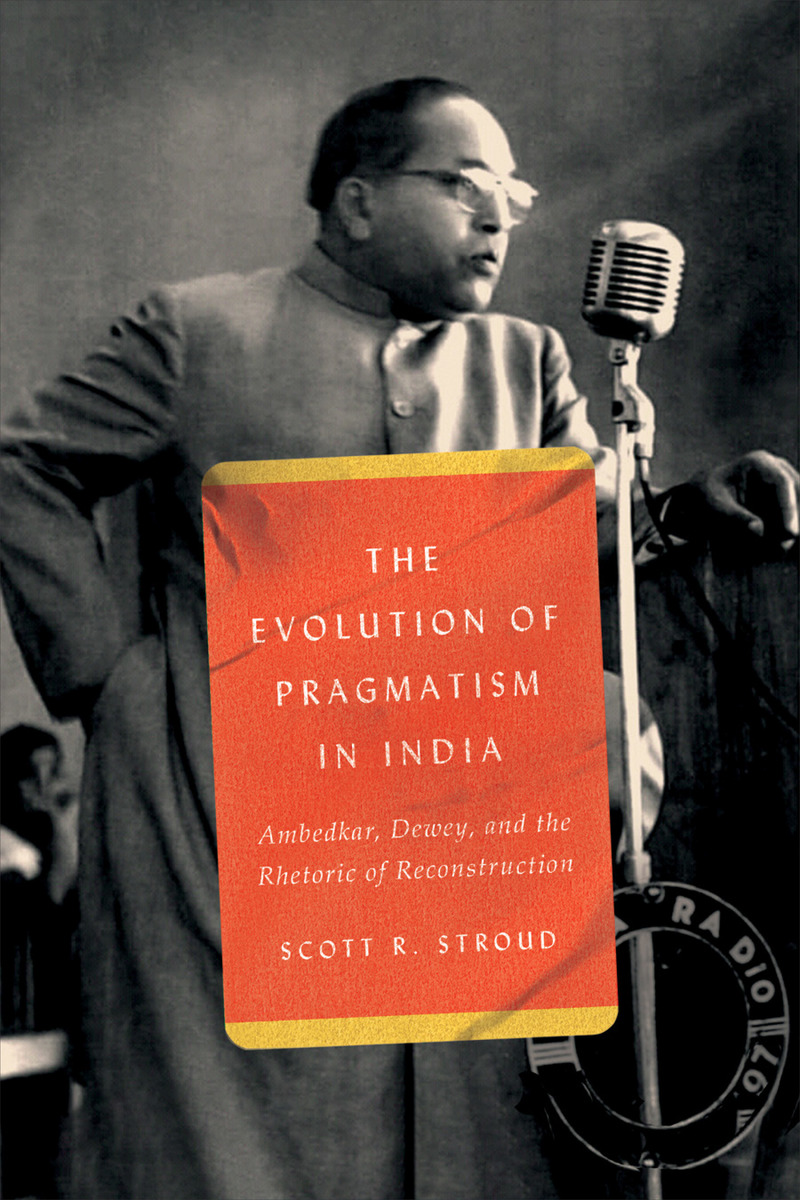
The Evolution of Pragmatism in India
Ambedkar, Dewey, and the Rhetoric of Reconstruction
by Scott R. Stroud
University of Chicago Press, 2023
Cloth: 978-0-226-82388-1 | Paper: 978-0-226-82432-1 | Electronic: 978-0-226-82389-8
DOI: 10.7208/chicago/9780226823898.001.0001
ABOUT THIS BOOKAUTHOR BIOGRAPHYREVIEWSTABLE OF CONTENTS
ABOUT THIS BOOK
"A magnificent study" (New York Review of Books) of how the Indian reformer Bhimrao Ambedkar reimagined John Dewey’s pragmatism.
In The Evolution of Pragmatism in India, Scott R. Stroud delivers a comprehensive exploration of the influence of John Dewey’s pragmatism on Bhimrao Ambedkar, architect of the Republic of India’s constitution. Stroud traces Ambedkar’s development in Dewey’s Columbia University classes in 1913–1916 through his final years in 1950s India when he rewrote the story of Buddhism. Stroud examines pragmatism’s influence not only on the philosophical ideas underpinning Ambedkar’s fight against caste oppression but also how his persuasive techniques drew on pragmatism’s commitment to reconstruction and meliorism. At the same time, Stroud is careful to point out the ways that Ambedkar pushed back against Dewey’s paradigm and developed his own approach to challenges in India. The result is a nuanced study of one of the most important figures in Indian history.
AUTHOR BIOGRAPHY
Scott R. Stroud is associate professor of communication studies at the University of Texas at Austin. He is the author of John Dewey and the Artful Life and Kant and the Promise of Rhetoric.
REVIEWS
“Ambedkar was one of the greatest legal and political thinkers of the twentieth century, but his thought is barely known in the United States. With wide-ranging research and insightful philosophical probing, Stroud shows that Ambedkar, using Dewey’s works as a fulcrum, created a distinctive form of Buddhist pragmatism, committed to meliorist social dialogue, non-anger, and the flexible pursuit of social democracy. A major achievement.”
— Martha C. Nussbaum, University of Chicago
“In this meticulously researched book, Stroud positions Ambedkar’s engagement with Dewey’s thought as a defining moment in the global history of American pragmatism. The Evolution of Pragmatism in India is a major contribution to Ambedkar studies, which enlarges our methodological repertoire for approaching this foundational thinker of caste inequality.”
— Anupama Rao, Columbia University
"Stroud’s in-depth exploration of the influence of Dewey’s pragmatism on Ambedkar’s thought not only allows us to comprehend the positions that Ambedkar took but also, equally, to appreciate the compromises he made in his policy engagement for Dalit empowerment from 1919 to 1956."
— Sukhadeo Thorat, Jawaharlal Nehru University, Indian Institute of Dalit Studies
“In this carefully researched and skillfully presented work, Stroud examines Ambedkar’s adoption of a revivified Buddhism and Dewey’s pragmatism as tools for his struggle against the Hindu caste system. By expanding our understanding of the global potentials of pragmatism, Stroud has made a major contribution to East-West scholarship.”
— Larry A. Hickman, Center for Dewey Studies
"Ambedkar’s intellectual inheritance has been delved into like seldom before. . . . The significance of the text must be considerable within both Ambedkarite scholarship and in other disciplines which seek to look into the various issues of social conflict/cohesion and understand them in terms of socio-political operations of force."
— Journal of Comparative Literature and Aesthetics
“A work of scholarship that shows the global relevance of pragmatism in the 20th Century introduces the fascinating philosophy of Ambedkar to a non-Indian audience, and provides an entry for further scholarship on this profound thinker and activist. . . . Stroud’s book is groundbreaking.”
— Transactions of the Charles S. Peirce Society
"The book is indeed very persuasive that to fully understand Ambedkar, one must understand his relationship with Dewey. . . . it is hard to imagine a more careful and compelling exploration."
— LSE Review of Books
"A magnificent study of Ambedkar’s complex engagement with Dewey’s ideas, which he reworked to address India’s specific political and social conditions."
— New York Review of Books
"The story of pragmatism is often framed as a distinctly American one, with minor forays and moments of appreciation in Europe and elsewhere. The Evolution of Pragmatism in India helps to revise and reframe that hoary narrative. Stroud, associate professor of communication at the University of Texas at Austin, offers an illuminating exploration of an under-examined figure in pragmatism’s variegated history."
— Philosophy in Review
"A book of philosophy and of intellectual history. . . The Evolution of Pragmatism in India will be the definitive account of Ambedkar and Dewey for a very long time."
— Journal of Buddhist Philosophy
"The most anticipated scholarly treatment of Ambedkar’s philosophy, among the half dozen or so books that have been published in . . . years."
— Pragmatism Today
"By embedding Dr. B.R. Ambedkar’s brilliant, scathing, and context-specific rhetorical strategies within a broader universe of humanistic debate, [Stroud] seeks to bring anticaste views to bear on expansive and pluriversal conceptualizations of knowledge, society, government and the use of force. . . . Stroud’s greatest contribution to the Ambedkarite discourse might well be a timely resuscitation of Ambedkar’s intellectual nimbleness, freethinking, and doggedly nonideological assessments of problems."
— South Asia Multidisciplinary Academic Journal
"Stroud’s work is rigorously researched and exceptionally executed. When it comes to archival and argumentative integrity, Stroud exceeds expectations. His book offers a sophisticated balance of meticulous detail with impressive scope. What I appreciate most, however, is the relevance of his work for contemporary exigencies in rhetorical studies. I am always grateful when scholarship transcends its raw materials in a specific historic or geographic context and yields rich conceptual utility for other situations."
— Rhetoric & Public Affairs
"In tracing the uptake of Dewey’s philosophy into Bhimrao Ambedkar’s lifelong, high-stakes negotiation against India’s caste system and, eventually, his work as a chief architect of India’s Constitution, Stroud provides his readers what, to my mind, is the greatest revelation about–and possibly the biggest argument for the efficacy of–American pragmatism yet this century, one that will serve as a key text for thinking through pragmatism’s evolving commitments from a rhetorical vantage."
— Rhetoric Society Quarterly
TABLE OF CONTENTS
Introduction / Exploring the Evolution of Pragmatism in India
DOI: 10.7208/chicago/9780226823898.003.0001
[Bhimrao Ambedkar;John Dewey;rhetoric;influence;pragmatism]
This chapter explores the mysteries surrounding Bhimrao Ambedkar’s relationship to John Dewey and his pragmatism. It is well known that Ambedkar held his teacher, Dewey, in high regard. What exactly he thought about in terms of his courses with Dewey is not known. This chapter establishes the parameters for the study of the Ambedkar-Dewey relationship, noting the importance of both philosophical and rhetorical methodologies in studying Ambedkar’s use of Dewey’s ideas, texts, and positions. This chapter also clarifies the nature of influence and resistance in Ambedkar’s engagement with Dewey’s pragmatist thought.
One / Ambedkar and Dewey at Columbia University
DOI: 10.7208/chicago/9780226823898.003.0002
[Bhimrao Ambedkar;John Dewey;caste;Columbia University;pragmatism]
This chapter explores Ambedkar’s encounter with John Dewey at Columbia University. Using a range of lecture notes, student notes, and other materials, this chapter recreates the main themes that Ambedkar heard in Dewey’s courses and explores their impacts on his thought once Ambedkar is back in India. The importance of the individual-community dialectic, as well as the value of force, is impressed on Ambedkar during his education in New York. Dewey’s reading of force as energy and force as violence is shown to leave Ambedkar desiring a type of force that accommodates his pursuit of anti-caste reform in the Indian context, thereby grounding much of his later advocacy and activism against caste.
Two / The Genesis of Ambedkar’s Reconstructive Rhetoric
DOI: 10.7208/chicago/9780226823898.003.0003
[Bhimrao Ambedkar;John Dewey;reconstruction;reconstructive rhetoric;education;reform]
Ambedkar’s education and interests were very broad. This chapter connects his experiences at Columbia University with those generated in London. By examining an often-overlooked early work of Ambedkar’s, we can see the creative and appropriative use of Dewey’s pragmatism in crafting Ambedkar’s own theories of democracy and reform. In Ambedkar’s early review of Bertrand Russell’s book on social reconstruction, we can discern the Indian reformer’s use of Dewey’s typology of force to resist readings of Russell that would undo reform efforts through a passive non-resistance. This chapter situates Ambedkar’s developing philosophy of pragmatism as a contrast to accounts such as Gandhi’s and Tolstoy’s that undermine effectiveness. Also of note, however, is Ambedkar’s early resistance to uses of force that violently foreclose the achievement of community with others, including those labeled as one’s enemies or opponents. Ambedkar’s philosophy places reform and rhetorical activity hand in hand, as a creative new method to educate and reform individuals and institutions.
Three / Reconstructive Rhetoric, Appropriation, and the Strategic Use of Reference
DOI: 10.7208/chicago/9780226823898.003.0004
[Bhimrao Ambedkar;John Dewey;reconstruction;rhetoric;echoing;appropriation;pragmatism]
This chapter explores the rhetorical or argumentative methods employed by Ambedkar in his early anti-caste activism. It charts his advocacy to the Southborough Committee, a group charged with collecting information on how to extend voting rights in Indian political spheres. Exploring and cataloguing all of Ambedkar’s appropriative engagements with Dewey’s texts in this 1919 testimony, this chapter demonstrates the reconstructive and rhetorical method of Ambedkar’s pragmatist approach. It surveys the rhetorical uses of quotational practices and illustrates that Ambedkar’s use of “echoing” serves an important persuasive function, one that fits into his concerns with effective but non-coercive uses of force in political reform efforts. The chapter concludes with some general reflections on what Ambedkar’s meliorism and reconstructive rhetoric entails.
Four / Pragmatism, Reflection, and the Annihilation of Caste
DOI: 10.7208/chicago/9780226823898.003.0005
[Bhimrao Ambedkar;John Dewey;Annihilation of Caste;echoing;rhetoric;reconstructive rhetoric;pragmatism]
This chapter engages Ambedkar’s reconstructive rhetorical method in his “Annihilation of Caste” text in the 1930s. Underlying this undelivered speech and its arguments, however, is Ambedkar’s extensive activity as a reader of John Dewey’s books. This chapter begins by exploring Ambedkar as active reader, or one who selectively annotates Dewey’s works as he thinks through them. Charting Ambedkar’s engagement with important books authored by Dewey, this chapter demonstrates certain patterns that interested the Indian reformer. Dewey’s accounts of democracy as habit, reconstruction as integral to the pragmatist spirit, and the resistance to fully transcendent ideals or structures for society all emerge as prominent. Charting Ambedkar’s reworking of his pragmatism in his “Annihilation of Caste” text, this chapter illustrates how Ambedkar engaged caste oppression using the ideas of democracy as a way of life and as relying on experience itself as fully educative. Ambedkar was committed to the idea that the graded hierarchy enshrined in the caste system truncates democracy and precludes deeply unified senses of community. This chapter comprehensively extracts Ambedkar’s echoing of Deweyan texts and passages in his planned address, thereby showing the sustained engagement with and appropriation of pragmatist ideas and methods in his own synthetic thought.
Five / Education, Force, and the Will to Convert
DOI: 10.7208/chicago/9780226823898.003.0006
[Bhimrao Ambedkar;John Dewey;pragmatism;conversion;Dalit;personality;rhetoric;reform;caste;Buddhism]
This chapter explores Ambedkar’s commitment to rhetoric and communication as vital means of reform and political change. Focusing on his conversion appeals to his Dalit followers, this chapter examines his speeches in the 1930s until his death to explore how he encourages the reflective morality that he saw as so valuable in Dewey’s pragmatism. He also creatively appropriates the ideal of personality from Dewey’s early writing, a period that Dewey had left behind when Ambedkar encountered him at Columbia University, to argue against the caste system. Ambedkar’s reconstructive rhetoric thereby becomes more than a method of arguing for reform; it also connects with common pragmatist notions of the psychology of labels and concepts to reveal a path to gain respect from self and others through conversion. Reflective morality for Ambedkar becomes a process of reflecting on the troubling aspects of one’s existing habits, the renunciation of problematic habits, and the conversion to a religious orientation that entails more useful habits. Given the influence of the concept of personality on his developing thought, Ambedkar insists that this process is both one of individual and systemic improvements. This chapter concludes by examining the importance of Ambedkar’s own conversion to Buddhism in 1956.
Conclusion / The Vision of Ambedkar’s Navayana Pragmatism
DOI: 10.7208/chicago/9780226823898.003.0007
[Bhimrao Ambedkar;Navayana pragmatism;Buddhism;Marxism;Communism;social democracy;liberty;equality;fraternity]
The conclusion explores the general parameters of Ambedkar’s philosophy as a form of pragmatism. Ambedkar is a vital figure for the anti-caste movement, but he also intended his philosophy of democracy and Buddhism to be a global path toward better communities. This chapter explores the commitments of his Navayana pragmatism, a philosophy that begins with the psychology of individuals as integrally social as well as organic. Habit and custom assume central roles in this approach, as well as the various directions of meliorative influence they entail. The whole person or personality emerges out of the individual-community dialectic, and this chapter shows that communicative habits are vital for how this personality is enabled or constrained in group experience. Ambedkar’s semi-transcendent ideal of social democracy is shown to be a complex balancing of the values of liberty, equality, and fraternity. This ideal influences his reinterpretation of Buddhism in the 1950s, as well as the positioning of that religious orientation against dominant readings of Marx’s communism. Ambedkar’s Navayana pragmatism, integrally connected to his Navayana Buddhism, thereby becomes a major contribution of his thought to philosophy in general and to the global evolution of pragmatism in particular.