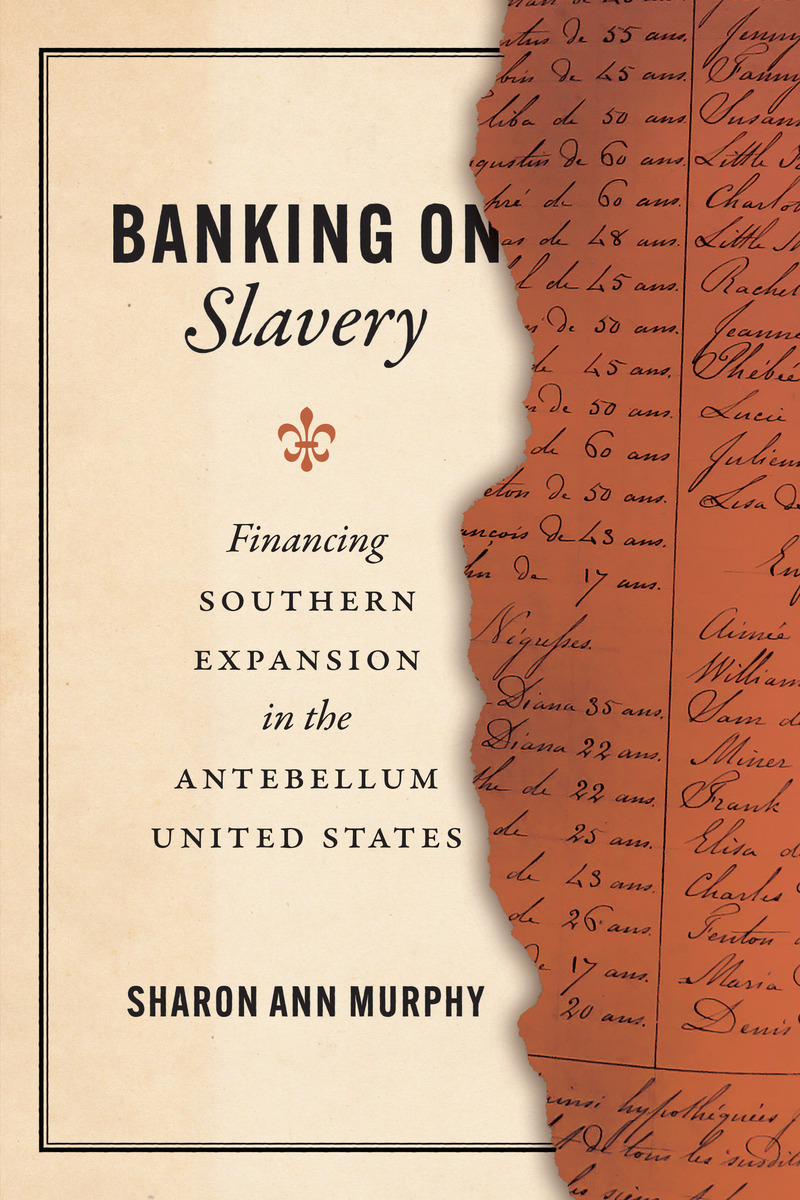
REVIEWS
"Murphy’s meticulously researched and clearly written study examines the role of banks in what she terms the concomitant 'financialization' of human property and the southwestern expansion of plantation economies in the mid-19th-century South. . . . The lives of enslaved persons caught in the web of the capitalist marketplace haunt the pages of Murphy's excellent work."
— Choice
“A tremendous accomplishment. We cannot fully understand the history of banking in the United States without reckoning with Murphy’s important findings. Banking on Slavery sets the stage for new understandings of the history of capitalism and its relation to slavery.”
— Claire Priest, author of Credit Nation: Property Laws and Institutions in Early America
"In a pathbreaking account of the way Americans financed slavery, Murphy connects the vast sweep of that tragedy to the banking that made it possible. Detail by dollar detail, she exposes the structures that transmuted enslaved people into assets and collateral, building white wealth all the while. A powerful--and chilling--book."
— Christine Desan, author of Making Money: Coin, Currency, and the Coming of Capitalism
"More surprising has been the lack of historical analysis of the banking firms and financial practices that underwrote the expansion of slavery in the antebellum United States. In her groundbreaking new book, Banking on Slavery, historian Sharon Ann Murphy corrects this glaring omission."
— Sean Vanatta, Wharton Initiative on Financial Policy and Regulation
"This book is well worth reading for scholars of banking history, slavery, and antebellum institutions generally. The author has clearly done her homework in various archives, and the details associated with individual cases are often fascinating."
— EH.net
"Banking on Slavery fills an important need in our historical understanding. . . .This is one of the very few book-length studies of how banks in the South financed the expansion of slavery into the Old Southwest. Deeply researched and well-grounded in both primary sources and sound secondary scholarship, this excellent book is most welcome and should be read by anyone interested in the history of American slavery."
— Emerging Civil War
"Banking on Slavery evinces deep research in the surviving records of financial institutions, as well as in the documents produced by litigation over them and manuscript sources. Murphy also does yeoman’s work in highlighting the silences forced upon the people ensnared in these transactions, naming them wherever possible. . . The resulting work is exacting in its detail, precise in its accounting, and devastating in its depiction of the ties between slavery and finance in the antebellum South and will reward careful readers with a significantly deeper understanding of the evolution of American slavery."
— H-Early-America
"Sharon Ann Murphy’s richly detailed book, Banking on Slavery: Financing Southern Expansion in the Antebellum United States, deepens our understanding on how slaveholders used banks to finance the development of the frontier South through a detailed analysis of debt contracts, legal cases, and banking policies. Murphy has provided scholars of U.S. slavery and of U.S. financial history with essential details on how banks achieved the financialization of enslaved people, how these banking practices contributed to the growth of the Southern economy, and where Southern frontier banks fit in the context of the nineteenth-century U.S. financial system. And, furthermore, the author adds to the literature on the history of capitalism by clearly showing that, while banking had a lasting affect on slavery, slavery did not have a lasting impact on U.S. commercial banking."
— Business History Review
"Amid a growing body of literature on slavery and American capitalism, Sharon Ann Murphy’s Banking on Slavery proves that there is still room for scholars to grapple with the question of how slavery shaped American economic development. The well-researched, engaging book sheds new light on the connections between the development of commercial banking
and the extension of the plantation economy into the southern frontier."
— Journal of the Civil War Era
"Until now, we have not understood in precise detail how southern banks made possible the spread and growth of slavery in the United States. Sharon Ann Murphy, a master at explaining and analyzing the nitty-gritty of how financial institutions and practices worked, has completed yet another act of scholarly service by hunting down the extant records of obscure banking transactions. . . . Readers will gain new insight into the histories of southern life, slavery, and the nineteenth-century economy. These are unsettling rewards."
— Journal of Southern History
TABLE OF CONTENTS
Introduction: Banking in the Nation’s Largest Slave Market - Sharon Ann Murphy
DOI: 10.7208/chicago/9780226824604.003.0001
[New Orleans;slave auction;slavery;antebellum;Mississippi River valley;frontier South;commercial banking;cotton plantations;sugar plantations]
This introduction begins with a walking tour of downtown New Orleans. The slave auction was the physical embodiment of the South’s full embrace and celebration of slavery as the engine behind its antebellum economic prosperity. It was an essential part of the massive movement of people—both enslaved and free—into the fertile lands from Georgia to the Mississippi River valley in the aftermath of the War of 1812. Yet the question of how slaveholders financed the settlement of the frontier South remains an understudied topic. It was expensive to move people great distances, to improve the land, and to create the critical infrastructure necessary to survive and thrive on the frontier. Thus, the slave auctions of New Orleans were interspersed with that city’s banks. The New Orleans banking infrastructure represented both the pinnacle of commercial banking in the frontier South, as well as the height of the involvement of banking with the financialization of slavery. The conquest of the Deep South with the growth of large-scale cotton and sugar plantations paralleled the separate maturation of a commercial-banking industry in the United States during the first half of the nineteenth century. (pages 1 - 14)
This chapter is available at:
https://academic.oup.com/chica...
1: The Limits of Early Bank Financing of Slavery - Sharon Ann Murphy
DOI: 10.7208/chicago/9780226824604.003.0002
[commercial banks;Bank of the United States;bank charters;discount loans;commercial business paper;foreclosure;fieri facias;debtors;slaveholders;human property]
This chapter focuses on the limited ability of early commercial banks to meet the rapidly growing financial needs of slaveholders. During the 1810s, most banks in both the North and the South—including the Bank of the United States—remained committed to short-term discount loans on commercial business paper. These loans were often renewable, and an individual could potentially accumulate significate debts across multiple loans. Southern banks were able to claim enslaved people as part of fieri facias foreclosure proceedings which allowed the sheriff to seize and sell the property of delinquent debtors. In lieu of foreclosure, banks increasingly permitted debtors to secure these renewable short-term loans with mortgages on specific land and human property. And there was growing pressure from southern planters—particularly on the frontier—for banking services that could accommodate longer-term loans, for larger dollar amounts, directly secured by land and human property. Yet while slaveholders sought greater flexibility to tap into the wealth stored in their human property, bankers needed to balance these demands against the requirements of their bank charters and the accepted norms and practices of the financial community. (pages 19 - 43)
This chapter is available at:
https://academic.oup.com/chica...
2: Adapting Slave Financing to the Needs of the Frontier South during the Nation’s First Boom and Bust - Sharon Ann Murphy
DOI: 10.7208/chicago/9780226824604.003.0003
[War of 1812;Panic of 1819;enslaved people;financialization;commercial banks;discounting;mortgage loans;collateral;foreclosure;endorsers]
This chapter examines the shifting attitudes of banks towards the financialization of enslaved people during the post-War of 1812 boom and the ensuing Panic of 1819. Many southern banks—particularly those operating on the frontier—began pushing the boundaries of both their charter limitations and accepted banking practices to take advantage of the financial opportunities presented by the booming postwar economy. Banks were increasingly willing to secure existing commercial debts in a mortgage contract with enslaved lives as the collateral. Banks also began creatively interpreting the discounting privileges written into their charters, initiating mortgage loans directly secured by land or human property, with the courts supporting these interpretations. Some banks even began lending money for the initial purchase of human property, accepting those same lives as collateral for the loan. In pushing these boundaries, banks had to navigate several new challenges, especially as the Panic of 1819 forced many debts into foreclosure. Banks had to balance selling the property of delinquent debtors or their endorsers at a loss, taking possession of land and people until market conditions improved, or renegotiating mortgage terms; all these options threatened a bank’s immediate liquidity and its continued existence. (pages 44 - 74)
This chapter is available at:
https://academic.oup.com/chica...
3: Old South Banks and Frontier Finance - Sharon Ann Murphy
DOI: 10.7208/chicago/9780226824604.003.0004
[old South;frontier South;domestic slave trade;human property;slave narratives;mortgages;immovable property;wives;widows;slaveholders]
This chapter examines how banks of the old South were drawn into financing slavery’s expansion as their existing customers moved West and South. Access to credit was also critical for the numerous domestic slave traders transporting enslaved individuals from the old South to the frontier. Despite their conservative charters, some banks sought innovative ways to include land and human property in their loan portfolios. In slave narratives of the period, debt, bankruptcy, and the sale of enslaved men and women were common themes. As a result, in southern courtrooms throughout the 1820s and 1830s, creditors and debtors battled over the priority of claims on mortgaged property, the legal requirements for recording mortgages and trust deeds on property classified as immovable (which could actually be physically relocated), and questions of fraudulent property conveyances. These jurisdictional fights became particularly fraught when one of the parties involved was the wife, widow, or minor children of the debtor. Yet the willingness of some traditional banks of the old South to accommodate the expansion of slavery still fell far short of the needs of frontier slaveholders. (pages 79 - 108)
This chapter is available at:
https://academic.oup.com/chica...
4: Pushing Financial Boundaries with Traditional Banks - Sharon Ann Murphy
DOI: 10.7208/chicago/9780226824604.003.0005
[Mississippi;Alabama;Georgia;joint banking-improvement companies;internal improvements;cotton plantations;sugar plantations;collateral]
This chapter examines the conduct of frontier banks incorporated with conservative charters similar to banks in the old South and the North, which assumed that lending should be based on short-term commercial paper and that long-term lending secured by property should be the exception rather than the rule. Throughout the 1820s, frontier banks creatively adapted traditional banking practices—often in open defiance of their charter provisions—to meet the growing credit needs of slaveholders, particularly those expanding into Mississippi, Alabama, and Louisiana. And rather than reining in these banks, legislatures slowly adapted charter regulations to reflect the reality on the ground. These banks enabled the development of the expansive cotton and sugar plantations from Georgia to Louisiana that would form the core of the South’s economy by mid-century. Frontier state legislatures likewise experimented with joint banking-improvement companies to finance internal-improvement projects to meet the infrastructure desires of the growing region. Yet this embrace of enslaved lives as collateral necessarily involved an imperfect adaptation of existing bank forms, and was always in tension with accepted banking practices. The traditional banking model thus still fell short of meeting the financial needs of a rapidly developing slave economy. (pages 109 - 138)
This chapter is available at:
https://academic.oup.com/chica...
5: Reimagining Banking for a Slave Economy - Sharon Ann Murphy
DOI: 10.7208/chicago/9780226824604.003.0006
[plantation banks;property bank;sugar plantations;leverage;Louisiana;financialization;bonds;Second Bank of the United States;market value;assets]
This chapter examines the creation of plantation banks during the 1830s, marking the pinnacle of the financialization of slavery. In particular, the capital-intensive nature of Louisiana sugar plantations required large, long-term loans that fell outside the scope of even the most permissive frontier banks. Plantation banks were a type of property bank that explicitly drew on the land and human capital of the region, allowing slaveholders to leverage their stored wealth in enslaved people. Like a home equity loan, slaveholders could borrow against the market value of enslaved bodies in anticipation of repaying the debt either from future profits or the appreciation in value of the enslaved life itself, all while still enjoying the full advantage of their profitable labor, natural increase, and appreciating market value. Even more, enslaved people became abstract, fungible assets as part of bond instruments that could be bought and sold on the world’s most modern financial exchanges. Similarly, the Second Bank of the United States was increasingly willing to engage in large-scale lending on the southern frontier. This experiment with plantation banks then expanded into Mississippi, Arkansas, and Florida, before the Panic of 1837 wiped out most of these institutions. (pages 139 - 170)
This chapter is available at:
https://academic.oup.com/chica...
6: Foreclosing (or Not) on Delinquent Slaveholders - Sharon Ann Murphy
DOI: 10.7208/chicago/9780226824604.003.0007
[Panic of 1837;Panic of 1839;debt defaults;foreclosure;refinancing;leniency;safety net;slaveholders]
This chapter examines the aftermath of the Panics of 1837 and 1839. In the face of widespread debt defaults, banks had to choose between short-term leniency toward debtors (which might endanger the bank’s solvency), and the hassle, expense, and risk of seizing and selling property in a depressed market. Banks sometimes were obligated to foreclose on debtors. Yet having invested so heavily in plantations and enslaved lives during the 1830s, most banks chose to prop up the system of slavery whenever possible, rather than oversee its systematic collapse. Banks repeatedly refinanced mortgages that were significantly overdue and/or were figuratively underwater (meaning that the debt due surpassed the value of the property itself), and deliberately helped slaveholding families to maintain possession of their plantations. Rather than upholding their fiduciary responsibility to protect the interests of bank shareholders, bondholders, and noteholders, these banks instead jeopardized their balance sheets and placed their own survival at risk to protect the slaveholding aristocracy on the frontier. By serving as a financial safety net for slaveholders during the depression, frontier banks helped lay the foundations of the southern economic boom during the 1850s. (pages 173 - 207)
This chapter is available at:
https://academic.oup.com/chica...
7: Escaping Debt: Bankruptcy, Fraud, and Going to Texas - Sharon Ann Murphy
DOI: 10.7208/chicago/9780226824604.003.0008
[bankruptcy;fraud;Texas;debtors;foreclosure;wives;widows;human property]
This chapter examines both the legal and illegal means by which delinquent debtors tried to evade foreclosure. Debtors could try to invalidate the original contract in court, or place themselves at the mercy of their creditors through state bankruptcy proceedings. In 1841, Congress passed a new federal bankruptcy law which was designed as a uniform procedure to provide relief to a wide array of debtors. The highly controversial law satisfied few people and was repealed by March 1843. Examples of fraudulent evasions included the illegitimate sale of mortgaged property, questionable ownership claims by wives and widows, and the nondisclosure of assets in bankruptcy filings. Both bankruptcy proceedings and fraud disputes could tie up foreclosure in court for years—sometimes decades. Even if the creditor ultimately prevailed, the delay usually left the property in the hands of the debtor until the final ruling, during which time they continued to benefit from the enslaved labor. The most brazen means of evading foreclosure was to flee from creditors with the human property in question. When the independent Republic of Texas existed along the southern border from 1836 to 1846, absconding debtors could literally hide in plain sight with their human property. (pages 208 - 243)
This chapter is available at:
https://academic.oup.com/chica...
8: When Banks Fail - Sharon Ann Murphy
DOI: 10.7208/chicago/9780226824604.003.0009
[failure;Second Bank of the United States;liquidation;foreclosure;plantation banks;bonds;enslaved people;mortgages]
This chapter addresses the repercussions of widespread bank failures for both the debtors and the enslaved men, women, and children who had been offered as loan collateral. The willingness of banks to embrace long-term mortgages on land and human property, and their leniency toward many delinquent slaveholders during the depression itself, ultimately resulted in the failure of a large percentage of banks—particularly in the frontier South. One of the biggest banking casualties was the former Second Bank of the United States, which still operated in the region with a Pennsylvania state charter. As banks called for the repayment of all outstanding loans, slaveholding debtors faced the seizure and sale of their land and human property. Additionally, banks needed to liquidate any enslaved people they owned as a result of previous foreclosures. And all of these liquidations often occurred as market prices were collapsing. These mass seizures and sales could disrupt and displace a significant portion of the enslaved population in the affected regions. Beyond trying to orchestrate an efficient dismantling of their banking systems, several states also had to contend with fulfilling their obligations to pay back state bonds that had been sold in support of their plantation banks. (pages 244 - 274)
This chapter is available at:
https://academic.oup.com/chica...
9: From Commercial Banking to Private Finance - Sharon Ann Murphy
DOI: 10.7208/chicago/9780226824604.003.0010
[anti-banking;plantations;financialization;private banks;free banking;slaveholders;mercantile firms]
This chapter examines the relationship between banks and slavery during the 1840s and 1850s. Whereas innovative banking institutions had been essential to the expansion of the slave South during the 1820s and 1830s, southerners after the panics no longer viewed this relationship as necessary. By helping to absorb the worst consequences of the panics, the banking sector had facilitated slaveholders in weathering the depression and ultimately paved the way for the South to emerge as a global economic powerhouse by mid-century. Yet banks also received much of the blame for the hard times. As the frontier of the 1830s became more settled, legislatures aggressively pushed back against bank financing of slavery, forcing slaveholders to pursue other methods of financial support. The more mature plantation system of the late 1840s instead relied for its financing on the few remaining banks, private (unchartered) banks, and mercantile firms that were expanding into plantation finance. By the 1850s, several frontier states began to reconsider their strict anti-banking policies. Yet in returning to bank finance, they explicitly rejected the financialization of slavery by banking institutions, reverting instead to the much more conservative free-banking model that was then growing in popularity. (pages 275 - 313)
This chapter is available at:
https://academic.oup.com/chica...
Epilogue: Banks, Debt, Emancipation, Reparations, and Memory - Sharon Ann Murphy
DOI: 10.7208/chicago/9780226824604.003.0011
[banks;debt;emancipation;reparations;memory;slavery;financialization;frontier South;education]
This epilogue considers the long-term implications of the financialization of enslaved people. In the immediate aftermath of emancipation, numerous court cases revolved around the question of whether the debtor or creditor should bear the pecuniary loss of emancipation. The few banks to survive the war found themselves caught up in these debates. They could argue that they should not share the burden of emancipation, since they were technically not slaveholders (at least not usually)—just the financial intermediaries facilitating the economic life of the region. But, in fact, banks had been an integral part of the system of slavery, particularly during the critical decades of the 1820s through the 1840s, when large cotton and sugar plantations were developing in the frontier South. What consequences, if any, should those surviving banks suffer as a result of their historical involvement with slavery? The epilogue then pivots to the present, and the responsibility of descendant institutions for the actions of their predecessors. Finally, it considers the role of memory in how we grapple with America’s slaveholding past more broadly. Beyond monetary reparations, what can and should we be doing to educate citizens better about the system of slavery and its continued impact? (pages 314 - 328)
This chapter is available at:
https://academic.oup.com/chica...