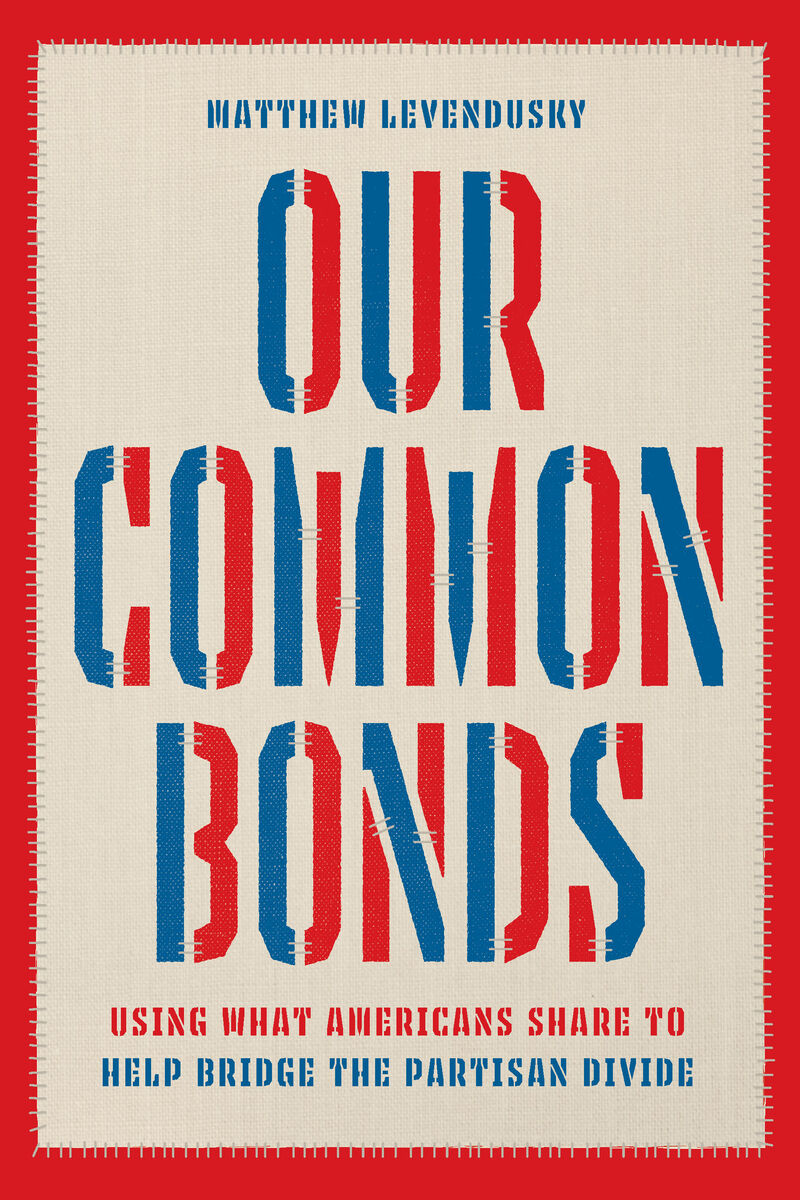
Our Common Bonds
Using What Americans Share to Help Bridge the Partisan Divide
University of Chicago Press, 2023
Cloth: 978-0-226-82468-0 | Paper: 978-0-226-82470-3 | Electronic: 978-0-226-82469-7
DOI: 10.7208/chicago/9780226824697.001.0001
Cloth: 978-0-226-82468-0 | Paper: 978-0-226-82470-3 | Electronic: 978-0-226-82469-7
DOI: 10.7208/chicago/9780226824697.001.0001
AVAILABLE FROM
University of Chicago Press (cloth, paper, ebook)DeGruyter Multi-User Ebook Program
Google Play
OverDrive
ABOUT THIS BOOKAUTHOR BIOGRAPHYREVIEWSTABLE OF CONTENTS
ABOUT THIS BOOK
A compelling exploration of concrete strategies to reduce partisan animosity by building on what Democrats and Republicans have in common.One of the defining features of twenty-first-century American politics is the rise of affective polarization: Americans increasingly not only disagree with those from the other party but distrust and dislike them as well. This has toxic downstream consequences for both politics and social relationships. Is there any solution?
Our Common Bonds shows that—although there is no silver bullet that will eradicate partisan animosity—there are concrete interventions that can reduce it. Matthew Levendusky argues that partisan animosity stems in part from partisans’ misperceptions of one another. Democrats and Republicans think they have nothing in common, but this is not true. Drawing on survey and experimental evidence, the book shows that it is possible to help partisans reframe the lens through which they evaluate the out-party by priming commonalities—specifically, shared identities outside of politics, cross-party friendships, and common issue positions and values identified through civil cross-party dialogue. Doing so lessons partisan animosity, and it can even reduce ideological polarization. The book discusses what these findings mean for real-world efforts to bridge the partisan divide.
AUTHOR BIOGRAPHY
Matthew Levendusky is professor of political science at the University of Pennsylvania, where he also holds the Stephen and Mary Baran Chair in the Institutions of Democracy at the Annenberg Public Policy Center. His books include The Partisan Sort and How Partisan Media Polarize America. He is also the coauthor of We Need to Talk and Democracy Amid Crises.REVIEWS
"This book will stimulate great classroom discussions. Highly recommended."
— Choice"Levendusky focuses on partisan divisions, but his methods and data are different from those of [other] authors. Rather than focusing on ideology or issue attitudes, his concern is affective polarization, or the growing hostility and mistrust Americans feel for the other party and its supporters—a trend that he, like many observers, sees as corrosive of democratic norms...Levendusky’s methodological approach is that taken by leading studies on the field, but the book is still written in an accessible manner so that concerned citizens outside academia may find it informative."
— Perspectives on Politics“Twenty-first-century American politics has been defined by polarization. In two prior seminal books, Levendusky offered crucial insights into how ideological sorting and partisan media have shaped the ways in which citizens have polarized. This book is yet another foundational contribution, revealing what strategies can counteract dangerously high levels of affective polarization. The book greatly advances what we know about citizen reasoning, partisanship, and identity more generally. It is required reading for all who want to understand and improve American democracy. In short, Levendusky has yet again provided an agenda-setting book.”
— James N. Druckman, Northwestern UniversityTABLE OF CONTENTS
1: Is Overcoming Division a Fantasy? - Matthew Levendusky
2: How Can We Mitigate Partisan Animosity? - Matthew Levendusky
3: Can Our Shared Identities Bridge the Partisan Divide? - Matthew Levendusky, Matthew Levendusky
4: Why Can’t We Be Friends: Can Cross-Party Friendships Mitigate Affective Polarization? - Matthew Levendusky, Matthew Levendusky
5: Does Cross-Party Dialogue Reduce Partisan Animus? - Matthew Levendusky
6: Are There Downstream Consequences to Reducing Affective Polarization? - Matthew Levendusky, Matthew Levendusky
7: What Does This All Mean? - Matthew Levendusky