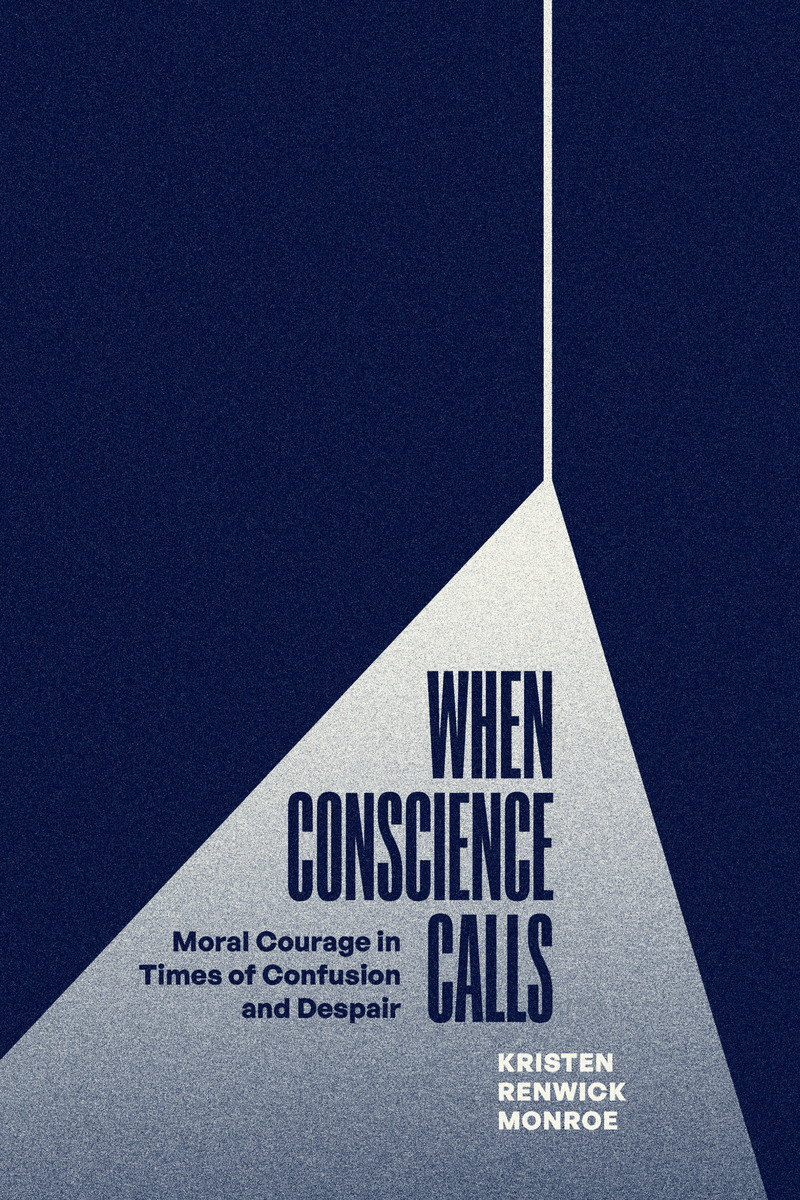
TABLE OF CONTENTS
Introduction: What Is Moral Courage? - Kristen Renwick Monroe
DOI: 10.7208/chicago/9780226829081.003.0001
[empirical analysis;confusion;despair;politics of hate]
Two closely-related concerns drove the writing of this book. The first is straightforward and scholarly. What is moral courage? What does it look like in today’s world? What drives it? Why should we care about it? The second is darker, more existential and intensely personal, triggered by the election of a president I found unfit, by both experience and character. Horrified, in shock at the ugliness of political life as practiced by Trump supporters—and some of his opponents—I became deeply troubled about the nation’s future, fearing democracy was threatened worldwide. Alarmed, I searched vainly for an appropriate response to the despair and heartache this engendered in me. As a scholar, I knew the literature on moral courage needed a stronger and more nuanced empirical analysis. As a teacher, I realized many students were as lost and disoriented as I. As a human being, I hoped that sharing my vulnerability at a more personal level might help others in their search for strength and an appropriate ethical response in times of confusion and despair. This book thus weaves personal thoughts into the more objective, scholarly analysis, in the hope that both can inform the reader. (pages 1 - 6)
This chapter is available at:
https://academic.oup.com/chica...
1. Moral Courage: What We Know and What We Need to Know - Kristen Renwick Monroe
DOI: 10.7208/chicago/9780226829081.003.0002
[moral relativism;fanaticism;conceptualization of moral courage]
The literature on moral courage assumes moral courage emanates from the actor’s core values and that the actor is aware of but disregards potential risks and costs. Moral courage differs from physical courage in requiring some theory of agency and a knowledge of human behavior. It involves caring for specific ideals, causes, or individuals and thus involves clear, deep, constitutive attachments. It links closely to liberal democratic values, forcing us to ask: how can we objectively distinguish my act of fanaticism from your act of moral courage? Moral courage can be one single act (saving a drowning person) or persistent acts (hiding Jews during the Holocaust), with critical differences existing between moral courage that is immediate and spontaneous as opposed to deliberative. Most discussions of moral courage assume it emanates from the actor’s core values. Broadening the fields reviewed to include social psychology reveals moral values can give rise to immoral outcomes, as when it is deemed good to obey authorities but the authorities themselves are evil. Finally, analysts generally define moral courage -- correctly but vaguely -- as people doing the right thing. While accurate, this conceptualization lacks specificity. This book is designed to fill in this gap. (pages 9 - 27)
This chapter is available at:
https://academic.oup.com/chica...
2. Stories of Moral Courage: Data and Research Methodology - Kristen Renwick Monroe
DOI: 10.7208/chicago/9780226829081.003.0003
[empirical analysis;narrative-interpretative methodology;interview methods]
Most discussions of moral courage emanate either from the theoretical and abstract works of philosophers andpolitical theorists or from the controlled laboratory experiments of social psychologists. Ours is a more empirically-based analysis, one in which we conducted interviews with people, living in contemporary society,who havetaken acts that seemed morally courageous according to the general conceptualizations found in the literature summarized in Chapter 1. The interviews included nearly 100 individuals. For reasons of space, we can print full interviews with only a few individuals; the ones we chose were selected both because their demographics reflect the members of the broader sample and because their conversations articulate so well the main substantive themes we found in the broader sample. These individuals and the narrative-interpretive method of analysis are described in this chapter. (pages 28 - 38)
This chapter is available at:
https://academic.oup.com/chica...
3. “We’re Going to Do What’s Right. We May Pay a Price for It, but That’s Fine”: Steve Zimmer on Protecting Undocumented Students - Kristen Renwick Monroe
DOI: 10.7208/chicago/9780226829081.003.0004
[immigrants;economic inequality;xenophobia]
Head of the Los Angeles Unified School District in 2017, Steve Zimmer helped pass an ordinance barring immigration officials from entering LA schools to capture and arrest undocumented students. Steve’s own family history resonated in the students he supervised, with Steve arguing we are a nation of immigrants. Drawing on his sense of white privilege, plus the anti-Semitism he himself experienced, Steve deemed it an honor to be able to use his undeserved privilege to dismantle instruments of institutional/systemic racism, thus standing with vulnerable groups facing oppression and hate. His story reveals empathy's critical role in moral courage, with Steve arguing that school workers might not be his parents but they are someone’s parents and hence worthy of the same treatment we accord our own family members. Concerns with increasingly xenophobic anti-immigrant sentiment triggered Steve’s political involvement with immigrant rights. He cautions against following demagogues who use economic failure as a pretext to gain power by telling us that all we have to do is build walls to keep other people out. Instead, we must find the courage to develop real solutions for economic inequity, thus creating an economy that truly works for all, those in the working class included. (pages 41 - 48)
This chapter is available at:
https://academic.oup.com/chica...
4. “No One, Not Even the President, Is Above the Law”: Erwin Chemerinsky on Suing President Trump - Kristen Renwick Monroe
DOI: 10.7208/chicago/9780226829081.003.0005
[lawsuit;emoluments clause;rule of law]
Dean of the Law School at the University of California at Irvine when Donald Trump became President in 2017, Erwin Chemerinsky joined other constitutional scholars and sued Trump for violations of the U.S. Constitution’s emoluments clause. Also called the foreign emoluments clause, the emoluments clause (Article I, Section 9, Paragraph 8) states:“No Title of Nobility shall be granted by the United States: And no Person holding any Office of Profit or Trust under them, shall, without the Consent of the Congress, accept of any present, Emolument, Office, or Title, of any kind whatever, from any King, Prince, or foreign State.” Article II, Section1, Paragraph 7 contains a domestic emoluments clause prohibiting the president from receiving any “emolument” from state or federal government beyond his compensation for his services as chief executive. These clauses were designed to ensure the country's leaders would not be influenced through gifts, a common European practice when the Constitution was written. Chemerinsky et al. argued that Trump’s use of his hotels and other business dealings violated this clause. In January 2021, the Supreme Court dismissed the cases. This was but one instance of Chemerinsky taking brave stands for justice. (pages 49 - 53)
This chapter is available at:
https://academic.oup.com/chica...
5. “If We Organize, We Can Change the World”: Heather Booth on Social Activism - Kristen Renwick Monroe
DOI: 10.7208/chicago/9780226829081.003.0006
[moral muscle;abortion rights;civil rights]
Heather Booth was a college student at the University of Chicago when she participated in the 1964 Freedom Summer whenhundreds of college students traveled to Mississippi to help register voters. Heather’s parents' values had shaped her own commitment and decision to join the project, but they were very frightened for her safety, quite rightly, as it turned out. (Three students were brutally murdered, as were several members of the family with whom Heather stayed.) It broke Heather’s heart to hurt her parents, whom she loved dearly, but she knew the abysmal situation for Blacks in Mississippi might be improved by her acts. Back in Chicago, Heather later founded the JANE movement, which helped provide safe abortions for women in the days when abortions were illegal. After college, Heather continued her social-political activism, working with various progressive organizations to expand voting and housing rights and equality for all groups in the United States. Heather’s story highlights the importance of moral muscle, showing how one small act of moral courage can build one’s empathy and ability to take other, bolder acts, and illustrates the importance of organizing to promote the common good. (pages 54 - 74)
This chapter is available at:
https://academic.oup.com/chica...
6. “I Am Going to Do This. I Am Going to Do This to the End”: Kay Monroe on Caring for the Elderly - Kristen Renwick Monroe
DOI: 10.7208/chicago/9780226829081.003.0007
[isolation;elder care;the quietness of moral courage]
Moral courage need not roar; it can be quietand undramatic but nonetheless powerful. With a serious heart condition of her own, Kay risked her own health and gave up a job she loved to care for her mother for thirteen years, watching helplessly as her mother battled Lewy-Body disease. Kay’s story captures the sense of being stuck, stuck inside the house, inside your head, inside a relationship with someone who slowly moves farther away from you, ultimately leaving you alone, financially drained, and emotionally bereft. Yet Kay never questioned her choice. Driven by love, duty, and compassion, Kay found there was no choice. She knew she could die of a heart condition, but she was not walking away from her mother. Kay’s story will resonate with anyone who has cared for and losta loved one. It highlights the tragedy of old age in an America that has not yet found a good way to deal with elders and reveals the heroism of a very private kind of moral courage. (pages 75 - 95)
This chapter is available at:
https://academic.oup.com/chica...
7. “The Courage You Have . . . It’s Not Something You Consciously Think About”: Amal on Anti-Muslim Bullying - Kristen Renwick Monroe
DOI: 10.7208/chicago/9780226829081.003.0008
[religious bigotry;Muslim prejudice;tsunami;moral muscle]
Amal was a high school girl in Southern California when she first encountered anti-Muslim sentiment. Friends tried to convert her, telling her she would burn in hell if she refused to convert to Christianity, and school administrators set aside her election as student body president because she was Muslim. Amal refused to strike back, taking the high ground and showing remarkable forbearance, especially for someone so young. Her experience withstanding religious bullying strengthened her, providing her with the fortitude and judgment to survivethe 2004 tsunami, one of the largest natural disasters in recorded history. Killingat least 225,000 peopleacross a dozen countries, the tsunami caught Amal underwater in Thailand. It destroyed Amal’s hotel and left her – literally – without the clothes on her back, only a swimming suit. Seeing then how people worked together to help each other, Amal took all these experiences and dedicated her life to helping people in need. Amal’s story reveals the strength in refusing to retaliate and conveys how even small acts of moral courage shape character and change people, opening them to new possibilities. (pages 96 - 107)
This chapter is available at:
https://academic.oup.com/chica...
8. “It Would Be a Violation of the Public Trust to Not Do All I Could to Stop the Wrongdoing”: Loretta Lynch on Speaking Truth to Power during the Enron Crisis - Kristen Renwick Monroe
DOI: 10.7208/chicago/9780226829081.003.0009
[political corruption;family values and support;rule of law]
Loretta Lynch drew our attention because of her work as Commissioner of the California Public Utilities Commission and President from 2000-2002. During this time, Lynch oversaw the PUC through a manufactured energy crisis that involved her fighting against gouging and manipulation by energy sellers in what became known as the Enron crisis. An early critic of energy deregulation and a strong advocate of keeping rates reasonable, Lynch antagonized powerful politicians by refusing to “get along by going along.” Hers is an insider’s look at how public officials are often forced to take unpopular stands that leave them open to charges of disloyalty if they wish to keep their integrity and uphold the law, themes that surfaced later during the Trump administration and the public hearings investigating the insurrection of January 6, 2021. Lynch reveals the importance of family, as both the source of values and support during times when she was being tested and pressured by powerful men in both California and Washington. Her story underlines the importance of the impartial rule of law and of maintaining a good character, even in the face of tremendous political pressure to “go along” and “play the game like everyone else.” (pages 108 - 127)
This chapter is available at:
https://academic.oup.com/chica...
9. “Nothing Else . . . Would Enable Me to Look in the Mirror the Next Day”: Vikram Tej on Fighting Caste in India - Kristen Renwick Monroe
DOI: 10.7208/chicago/9780226829081.003.0010
[caste;moral compass;parenting]
A career civil servant, Vikram Tej sued the Indian government for caste discrimination. Not against himself but against others. Doing so risked his job but he told the interviewer – his granddaughter –parenting involves more than just putting food on the table. It’s about raising strong children who understand that fighting for good will bring a happier life. “Even if you don't have all the material wealth in the world if you're a good person, you'll always be one of the happiest people in the world for following your moral compass.” A modest man, Tej requested a pseudonym, insisting he wanted no praise simply for doing what he should do. Indeed, Tej refused to describe defending lower castes as heroic. “It makes me seem like a hero, and it makes them seem like poor victims, and they are not. They're just like anyone else, and they are human.” Valuing community more than money, position or fame, Tej’s moral courage means helping other people without considering how it affects you. The ultimate goal in life is to be able to look yourself in the mirror, knowing you’re living your life following good moral values. (pages 128 - 132)
This chapter is available at:
https://academic.oup.com/chica...
10. When Nobody’s Watching - Kristen Renwick Monroe
DOI: 10.7208/chicago/9780226829081.003.0011
[spontaneous acts;moral muscle;core values;identity]
Moral courage consists of acts emanating spontaneously from the core values of fairness, justice, and a concern for the well-being of others, values held so deeply they eventually come to constitute the actor’s character or identity. Moral courage rarely originates in agonistic choice and is usually taken in full recognition of the potential risks, costs, and consequences of acting. The people who engage in moral courage are not superhuman. Indeed, they are not necessarily people judged high on agency. They are normal human beings, driven by their own need to do what they deem right in order to help others and to be able to live with themselves later. Further analysis revealed the morally courageous as humble, empathic people with a strong sense of connectedness to others. Their core values often originate in family, as does the support they crave during tough times. They are people for whom duty and conscience form the very core of their being. Not doing the right thing and pursuing winning at all costs are not options for the morally courageous, for whom each small act of moral courage strengthened their moral muscle and their ability to act courageously later. (pages 135 - 173)
This chapter is available at:
https://academic.oup.com/chica...
Conclusion: Learning from the Lives of Others - Kristen Renwick Monroe
DOI: 10.7208/chicago/9780226829081.003.0012
[universal moral absolutes;moral relativism;hope]
What broader questions emerge from analyzing moral courage? Are there universal moral values? Or is moral courage – like other ethical behavior – relative, thus depriving us of objective tools to distinguish fanaticism from moral courage? Does empirical evidence justify believing in universal values? And if context shapes basic values so much that we lack moral absolutes, what does that suggest for establishing courts and laws designed to administer justice for crimes against humanity? Equally important, does studying moral courage help us personally when we are overwhelmed by confusion and despair? Must we have hope to carry on? No. Hope can facilitate, initiate, and drive moral courage but hope is not necessary for moral courage to exist. We can operate ethically without hope. We can behave morally simply because that is what we must do to remain human. Any of us, no matter how disoriented, lost, or uncertain, can dig deep within ourselves to imagine new scenarios, new ways of viewing the world. We can stand firm and assert moral values in the face of oppression, cruelty, and hatred, taking strength from our own most basic humane values anytime we need to rediscover our own moral compass. (pages 174 - 204)
This chapter is available at:
https://academic.oup.com/chica...