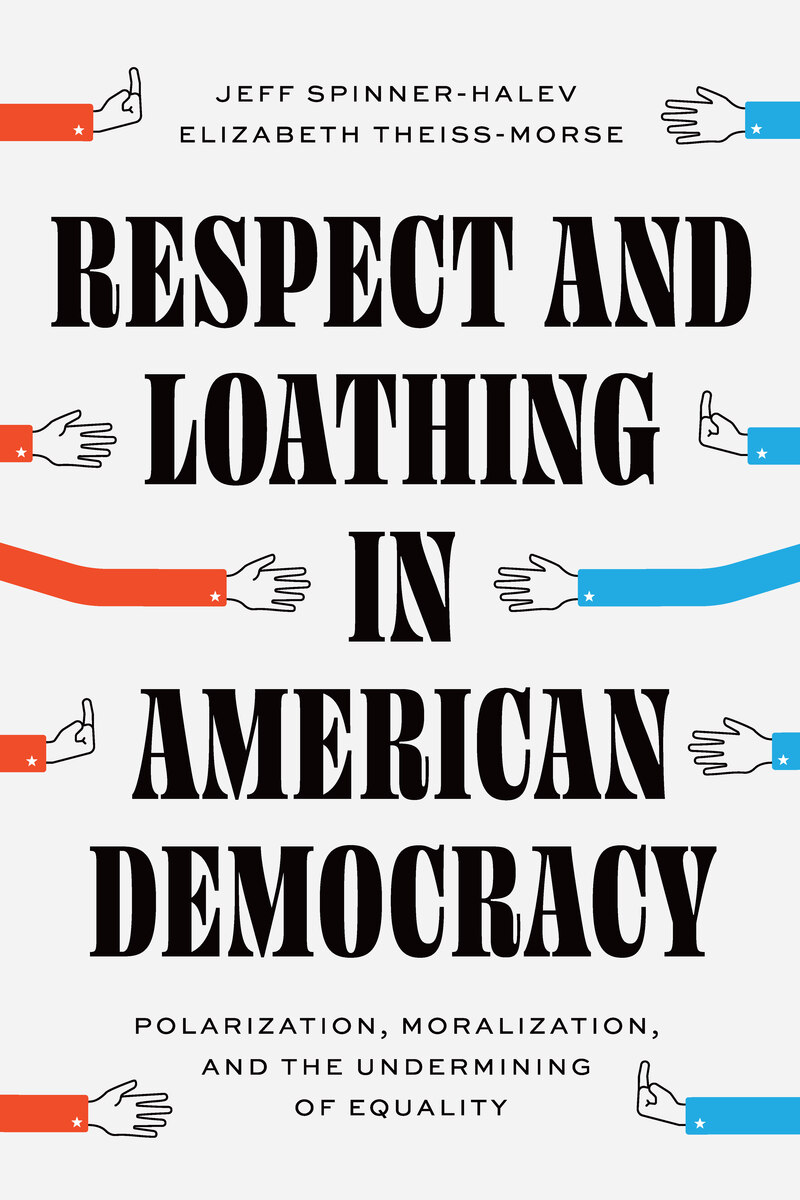
Respect and Loathing in American Democracy
Polarization, Moralization, and the Undermining of Equality
by Jeff Spinner-Halev and Elizabeth Theiss-Morse
University of Chicago Press, 2024
Cloth: 978-0-226-83171-8 | Paper: 978-0-226-83173-2 | Electronic: 978-0-226-83172-5
DOI: 10.7208/chicago/9780226831725.001.0001
ABOUT THIS BOOKAUTHOR BIOGRAPHYREVIEWSTABLE OF CONTENTS
ABOUT THIS BOOK
A deep examination of why respect is in short supply in politics today and why it matters.
Respect is in trouble in the United States. Many Americans believe respecting others is a necessary virtue, yet many struggle to respect opposing partisans. Surprisingly, it is liberal citizens, who hold respect as central to their view of democratic equality, who often have difficulty granting respect to others. Drawing on evidence from national surveys, focus groups, survey experiments, and the views of political theorists, Jeff Spinner-Halev and Elizabeth Theiss-Morse explain why this is and why respect is vital to—and yet so lacking in—contemporary US politics.
Respect and Loathing in American Democracy argues that liberals and conservatives are less divided than many believe, but alienate one another because they moralize different issues. Liberals moralize social justice, conservatives champion national solidarity, and this worldview divide keeps them at odds.
Respect is both far-reaching and vital, yet it is much harder to grant than many recognize, partly because of the unseen tension between respect, social justice, and national solidarity. Respect and Loathing in American Democracy proposes a path forward that, while challenging, is far from impossible for citizens to traverse.
AUTHOR BIOGRAPHY
Jeff Spinner-Halev is the Kenan Eminent Professor of Political Ethics at the University of North Carolina at Chapel Hill. Elizabeth Theiss-Morse is the Willa Cather Professor of Political Science at the University of Nebraska, Lincoln.
REVIEWS
“Respect and Loathing in American Democracy breaks much new ground. It brings normative insight to bear on fresh data to illuminate a problem at the core of democracy in our time: why people have such a hard time respecting those on the other side of our polarized partisan divide. An important book.”
— Stephen Macedo | Princeton University
“Spinner-Halev and Theiss-Morse take their own road to assessing what ails American politics. Whereas there are numerous books and articles on racism/identity, nationalism, and white working-class politics, Respect and Loathing in American Democracy tells a novel story that is thoughtful, rich in evidence, and engaging."
— Matthew Wright | University of British Columbia
"This work nicely blends political theory and the empirical study of behavior to construct an important examination of democracy in the US today."
— Choice
"In their new and theoretically innovative book, Spinner-Halev and Theiss-Morse argue that the nation’s politics suffers from a lack of respect among political opponents…Respect and Loathing blends political philosophy and empirical social science. For that reason alone, the book is a model for other political scientists and scholars of any discipline interested in how normative philosophical inquiry can inform empirical analysis, and vice versa…a rich and thoughtful discussion of what respect truly means."
— Political Science Quarterly
"The book is both powerful and timely, and it demands our close attention."
— Oxford Political Review
TABLE OF CONTENTS
1. Democratic Equality and the Importance of Respect - Jeff Spinner-Halev, Elizabeth Theiss-Morse
DOI: 10.7208/chicago/9780226831725.003.0001
[recognition respect;civic respect;toleration;social justice;egalitarian political theory;relational equality;structural injustice]
Respect is in trouble in American democracy. While toleration has been studied extensively, respect has not. Political theorists mistakenly take respect for granted and political scientists simply ignore it. This chapter introduces the liberal respect paradox, which means that many liberal citizens deeply believe in respect yet have a hard time granting respect to opposing partisans. Two conceptualizations of respect lay the groundwork for the book: recognition respect (following Stephen Darwall) and civic respect (which redefines the under-theorized idea of mutual respect). The unnoticed tension between respect and social justice that permeates egalitarian political theory is the basis of the liberal respect paradox. (pages 3 - 23)
This chapter is available at:
https://academic.oup.com/chica...
2. Is It Possible to Respect Opposing Partisans? - Jeff Spinner-Halev, Elizabeth Theiss-Morse
DOI: 10.7208/chicago/9780226831725.003.0002
[recognition respect;equality;partisan polarization]
Fundamental to democratic equality is the acceptance that all people have intrinsic worth as moral agents. The acceptance of recognition respect is the focus of this chapter. Both focus group and survey data show that liberal citizens have a more varied understanding of equality and are more likely to believe in the centrality of respect than conservative citizens. One would expect, then, that Democrats would be more willing to give recognition respect to opposing partisans than Republicans, but they actually have a harder time granting this respect. This liberal respect paradox cannot be explained away by Democrats’ disdain for Donald Trump and instead suggests a deep struggle among liberals between a belief in democratic equality and recognition respect. (pages 24 - 50)
This chapter is available at:
https://academic.oup.com/chica...
3. The Failed Aspirations of Civic Respect - Jeff Spinner-Halev, Elizabeth Theiss-Morse
DOI: 10.7208/chicago/9780226831725.003.0003
[civic respect;pluralism;political stereotyping]
This chapter improves on theorists’ idea of mutual respect, which is rarely defined well, through the idea of civic respect. Civic respect involves people trying to understand why fellow citizens think differently than they do. First, civic respect means listening (at least sometimes) to those with different political and social views in either or both impersonal and interpersonal ways. Second, civic respect means not engaging in political stereotyping. Political stereotyping leads people to make many mistakes about opposing partisans’ beliefs. Third, civic respect means not assuming that citizens who vote for the opposing candidate do so because they are poorly informed, ignorant, or misled. Being willing to grant civic respect demands a belief in pluralism. This chapter explains why many Americans say they believe in civic respect but have a hard time practicing it. The dynamics surrounding civic respect point to the struggle many Americans have with genuine pluralism. (pages 51 - 76)
This chapter is available at:
https://academic.oup.com/chica...
4. The Social Justice Worldview and Moralization - Jeff Spinner-Halev, Elizabeth Theiss-Morse
DOI: 10.7208/chicago/9780226831725.003.0004
[social justice;moralization;worldviews;structural injustice;racism;egalitarian political theory]
Many egalitarian theorists and liberal citizens believe in the centrality of egalitarianism in their view of what constitutes a just world. Justice is not only about how individuals treat one another; it is also about addressing the injustices embedded in societal institutions. These beliefs make up the social justice worldview, which encompasses beliefs about the need to dismantle individual and structural injustices and the moralization of these beliefs. The more strongly Democrats hold this moralized social justice worldview, the less respect they grant to Republicans. Because many Democrats believe Republicans are racist, sexist, and homophobic, they cannot respect Republicans’ fostering of a socially unjust world. Data show that many Republicans are not opposed to the social justice worldview, but they do not moralize these beliefs as much as Democrats do. Republicans believe the eradication of social injustices is about individuals behaving better and not the dismantling of social structures, which is a view Democrats find difficult to respect. (pages 79 - 101)
This chapter is available at:
https://academic.oup.com/chica...
5. The National Solidarity Worldview and Moralization
DOI: 10.7208/chicago/9780226831725.003.0005
[national solidarity;patriotism;national identity;liberty;immigration]
Whereas many liberals hold strongly to a moralized social justice worldview, many conservatives hold strongly and moralize a national solidarity worldview. In this worldview, a good society is one that fosters a united citizenry who strongly identify with their nation. Americans are united around loyalty, the valuing of citizenship, and a belief in liberty. Republicans hold this national solidarity worldview more strongly than Democrats (although Democrats support it) and are much more likely than Democrats to moralize it. Many Republicans think that Democrats’ insistence on dividing Americans by race and sexual identity and criticizing U.S. history in their quest for social justice serves to weaken the nation. Many Republicans find it difficult to respect Democrats who they think are set on weakening America through their social justice agenda, their support for more open immigration, and their lack of understanding that a strong nation protects individual liberty. Data show that Democrats are more supportive of the national solidarity worldview than Republicans believe, but they are less likely to moralize this worldview.
6. Collective Responsibility and Judging Others - Jeff Spinner-Halev, Elizabeth Theiss-Morse
DOI: 10.7208/chicago/9780226831725.003.0006
[structural injustice;social justice;national solidarity;freedom;collective responsibility]
Many liberal citizens think that people have both a personal and a collective responsibility to end structural injustice, an argument that is woven through the work of several egalitarian political theorists. While many Republicans view justice as a matter of individual behavior, they believe people have a personal and a collective responsibility when it comes to people being loyal citizens who keep the nation strong. Individuals who strongly believe in collective responsibility judge others harshly, which helps explain the liberal respect paradox. Liberals believe both that respect is a cardinal virtue of democratic citizenship and that citizens have a collective responsibility to work against structural injustice, but these two strongly held beliefs clash. Many conservative citizens also experience tension between respect and their view of collective responsibility, but the tension is not as deep since their view of respect is less intensely held than it is for liberals. (pages 125 - 148)
This chapter is available at:
https://academic.oup.com/chica...
7. Respect versus Justice? - Jeff Spinner-Halev, Elizabeth Theiss-Morse
DOI: 10.7208/chicago/9780226831725.003.0007
[egalitarian political theory;substantive equality;basic equality;relational equality;procedural democracy;pluralism;egalitarian pluralism]
Substantive egalitarianism embraces an egalitarian ethos, the idea that equality and equity should dominate in our social relations and in state policy; it leads many liberal citizens to the idea that we all have a collective responsibility to fight against structural injustice. Many non-liberals do not share this ethos, while some liberal citizens question the focus on collective responsibility, recognizing how challenging an idea it is. This chapter argues that egalitarian political theory has a troubled relationship with pluralism and explains why many theorists need to prioritize respect or justice. The chapter also defends pluralism over its rival, monism, and proposes an alternative to an egalitarian ethos, an egalitarian pluralist ethos. Still, there are bounds to civic respect—a disregard for procedural democracy—that limit when it ought to be granted. Political theorists should care about our empirical findings, not simply dismiss them. It is inadequate to simply say that if citizens cannot grant respect to one another, the problem is not with ideas about justice or democratic theory but with the people. (pages 151 - 172)
This chapter is available at:
https://academic.oup.com/chica...
8. Struggling toward Respect - Jeff Spinner-Halev, Elizabeth Theiss-Morse
DOI: 10.7208/chicago/9780226831725.003.0008
[civic respect;recognition respect;democracy;second-best strategies]
What is lost in democracy when there is little recognition respect and when civic respect is not practiced? The strategy of some of the focus group participants to toss civic respect aside to retain recognition respect is a second-best strategy, but only for interpersonal relations. Even if one cannot listen to opposing views in person, one still has a civic obligation to understand the views of others, which can be done in impersonal ways. The importance of recognition respect is unqualified, however, and its loss undermines democracy. As many of the liberal focus group participants suggested, respect is a core value of democracy. This book invites the question: if respect is hard to grant but so important to democracy, what can be done to get more citizens to be more respectful? Simply appealing to the democratic conscience within citizens will not get us very far. This chapter offers a few suggestions on how to increase respect, though there is no silver bullet. (pages 173 - 186)
This chapter is available at:
https://academic.oup.com/chica...