ABOUT THIS BOOK
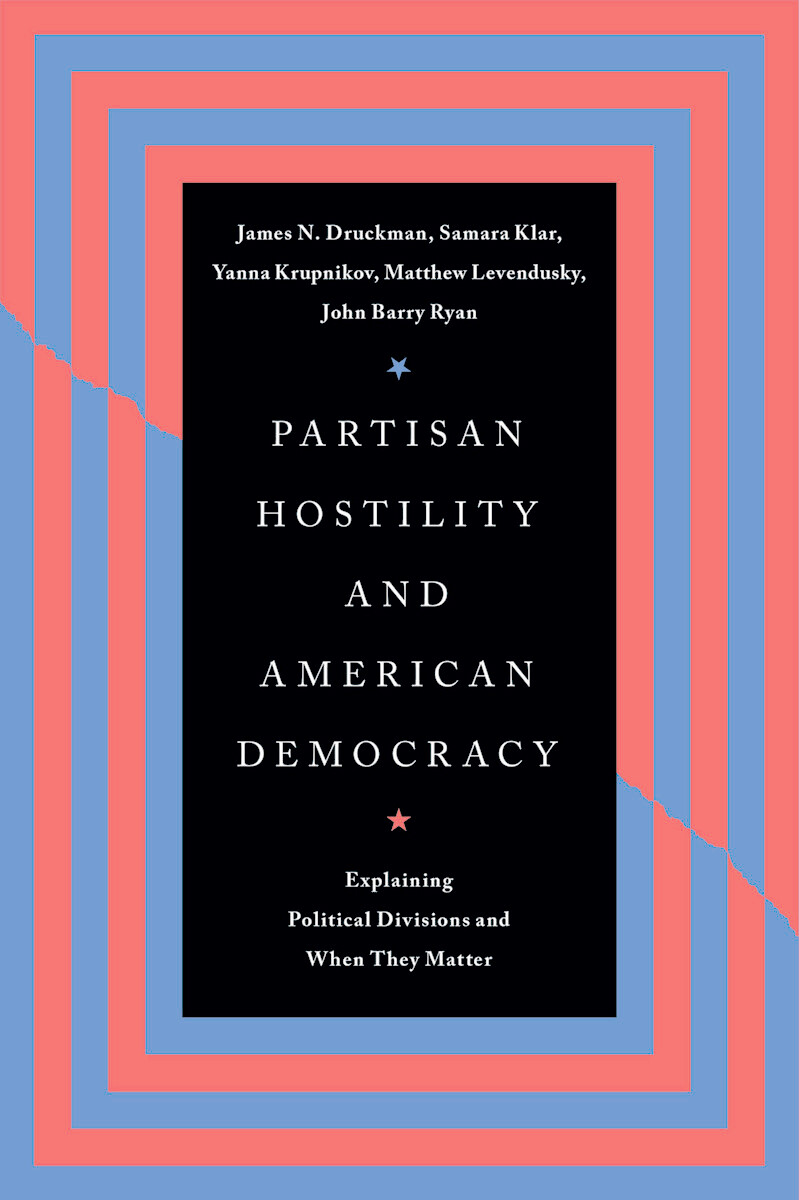
An unflinching examination of the effects and boundaries of partisan animosity.
For generations, experts argued that American politics needed cohesive parties to function effectively. Now many fear that strong partisan views, particularly hostility to the opposing party, are damaging democracy. Is partisanship as dangerous as we fear it is?
To provide an answer, this book offers a nuanced evaluation of when and how partisan animosity matters in today’s highly charged, dynamic political environment, drawing on panel data from some of the most tumultuous years in recent American history, 2019 through 2021. The authors show that partisanship powerfully shapes political behaviors, but its effects are conditional, not constant. Instead, it is most powerful when politicians send clear signals and when an issue is unlikely to bring direct personal consequences. In the absence of these conditions, other factors often dominate decision-making.
The authors argue that while partisan hostility has degraded US politics—for example, politicizing previously non-political issues and undermining compromise—it is not in itself an existential threat. As their research shows, the future of American democracy depends on how politicians, more than ordinary voters, behave.
REVIEWS
"This interesting and timely book empirically assesses the dangers presented to American democracy by partisan hostility or animosity and ideological polarization."
— Choice
“Partisan Hostility and American Democracy is essential reading for those who fear that partisan hostility has pernicious consequences for mass-elite linkages as well as for the functioning (and ongoing degradation) of American democracy...The authors present a rigorous theoretical and empirical analysis of how (and when) partisanship—and more particularly animus towards political opponents—affects contemporary American partisans’ beliefs and behaviors. This is an extremely insightful, provocative, and important book.”
— Perspectives on Politics
"Partisan Hostility and American Democracy explores the degree to which hostility affects political beliefs and behaviors, promoting the view that while partisan animosity is unlikely to directly lead to democratic breakdown or collapse, it does have deleterious effects on democracy that could contribute to erosion over time."
— Journal of Economic Literature
“The growing divide between Democrats and Republicans has sparked hundreds of academic papers and books documenting the damaging effects of affective polarization on both the quality of governance and the social fabric of political life in the United States. In this abundance of literature, Partisan Hostility and American Democracy stands out. The authors provide a comprehensive and, more importantly, nuanced account of how the rise in partisan hostility—identity-driven divisions between the political parties—shapes Americans’ perceptions of the political world, including their support for public figures and policies, political compromise, as well as democratic norms and practices.”
— Political Science Quarterly
"Partisan Hostility and American Democracy [cites] studies on affective polarization showing that the gap between the positive feelings toward one’s own party and the negative feelings for the other party has grown in the past 20 years."
— Perspectives on Political Science
“Timely and rich, this is the best book yet written on partisan animosity in the United States. Harnessing impressive data, the authors convincingly show the powerful role of elected officials in magnifying tensions in the citizenry.”
— Sean J. Westwood | Dartmouth College
“Although there's been extensive documentation of the existence of partisan animosity and affective polarization, there's been little research attempting to understand whether this behavior affects democratic governance. Through extensive data collection and rigorous research design, the authors show that partisan animosity won't lead to immediate democratic collapse but instead can lead to long-term erosion of norms.”
— Neil Malhotra | Stanford University
TABLE OF CONTENTS
1. Partisan Hostility in America - James N. Druckman, Samara Klar, Yanna Krupnikov, Matthew Levendusky, John Barry Byan
DOI: 10.7208/chicago/9780226833668.003.0001
[affective polarization;partisan animosity;democratic backsliding;democratic erosion;democratic stability]
This chapter introduces the book’s core puzzle: how much does political animosity—the tendency of Democrats and Republicans to dislike and distrust one another—shape Americans’ political behavior? While many previous studies have focused on the apolitical effects of animosity (i.e., its effects on factors like dating and marriage, economic activity, and so forth), less is known about how it affects our democracy: does partisan hostility actually pose a threat to our system of government, and if so, how? This chapter sets the stage for what is to come by laying out book’s argument. Partisan animosity does matter politically, but its effect is highly conditional—when those conditions are met, animosity shapes how citizens behave, but not otherwise. This suggests a nuanced assessment about the overall effects of animosity: while it matters politically, it is also incorrect to argue that it has led to a complete breakdown of our politics. While there are threats to democratic stability, they come much more from elites than from ordinary voters. (pages 1 - 23)
This chapter is available at:
https://academic.oup.com/chica...
2. Animosity in American Politics - James N. Druckman, Samara Klar, Yanna Krupnikov, Matthew Levendusky, John Barry Byan
DOI: 10.7208/chicago/9780226833668.003.0002
[partisanship;running tally;rational choice;instrumental approach;social identity;motivated reasoning;out-party animus;partisan animosity;party cues]
This chapter lays out the main theoretical contribution of our work. We review established views on how individuals process information in a political context and we emphasize the different motivations that guide decision-making. We dig into what it means to be a partisan and how party identification might guide political preferences. To identify as a partisan comprises both positive feelings about one’s own and also negative feelings about other parties. Negative feelings—or animosity—toward the out-party tend to guide political behavior to a much larger degree than does in-party love. We theorize the conditions under which out-party animosity shapes how people think about politics and policies. We argue that when political leaders take clear positions on policies, partisans with high out-party animosity should follow their lead. In these cases, Democrats and Republican with high out-party animosity should be diverse in their views, while those with low out-party animosity should be closer together. When political leaders do not take clear positions, however, we believe there should be very little divergence—or even none at all—between Democrats’ and Republicans’ policy views, regardless of their out-party animus. (pages 24 - 38)
This chapter is available at:
https://academic.oup.com/chica...
3. Analyzing the Impact of Partisan Animosity - James N. Druckman, Samara Klar, Yanna Krupnikov, Matthew Levendusky, John Barry Byan
DOI: 10.7208/chicago/9780226833668.003.0003
[affective polarization;feeling thermometers;trait ratings;dataset;social distance;COVID-19]
This chapter describes the survey data we collect and details each of the variables to carry out the tests that appear throughout the remainder of the book. Our unique dataset begins in the summer of 2019 and continues as we re-interview a large panel of adults at multiple times over the two-year period that followed. Throughout that time a variety of important issues and events occurred in American politics—including high-profile policy debates, important events in the Black Lives Matter movement, the rise of previously unknown political figures, and the COVID-19 pandemic and policies that surround it. In chapter 3, we present the measurements we need in order examine how out-party animus interacts with party cues to guide preferences and opinion and to test our predictions that animosity effects decline or evaporates when the decisions are personally consequential. (pages 39 - 61)
This chapter is available at:
https://academic.oup.com/chica...
4. How Animosity Can Fuel Issue Polarization - James N. Druckman, Samara Klar, Yanna Krupnikov, Matthew Levendusky, John Barry Byan
DOI: 10.7208/chicago/9780226833668.003.0004
[ideological polarization;party cues;political animosity;elite polarization;minimum wage;Obamacare;undocumented immigrants;Green New Deal;assault weapons ban;defund the police]
This chapter examines the relationship between partisan animosity and issue polarization. Building on our theoretic expectations, we consider three types of issues. The first are issues where elite polarization is symmetric; this means ordinary people receive clear cues about issue positions from both parties. The second are issues where neither party’s elites have polarized, leaving people with no cues from either party. The third are issues where the polarization is asymmetric, meaning that people receive clear cues from one party, but mixed signals from the other. We find when polarization is symmetric, people who are higher in animus are more likely to follow party cues which leads to more ideological polarization. Conversely, in issues without clear cues from both parties, we see almost no relationship between animus and issue attitudes. Contrary to our predictions, for issues on which elite polarization is asymmetric, we do not see similarly asymmetric ideological polarization among the public. Overall, our findings suggest a relationship between animosity and cue-taking, which then leads to ideological divisions. The possibility that animosity drives ideological polarization through a nuanced cue-taking mechanism, in turn, can clarify why increases in animosity may not translate into increases in mass ideological polarization. (pages 62 - 73)
This chapter is available at:
https://academic.oup.com/chica...
5. A Political Virus: How Partisan Animus Polarized Voters’ Responses to the COVID-19 Pandemic - James N. Druckman, Samara Klar, Yanna Krupnikov, Matthew Levendusky, John Barry Byan
DOI: 10.7208/chicago/9780226833668.003.0005
[COVID-19;partisan animosity;preventative behavior;vaccine;Democrat;Republican;safety;pandemic]
This chapter examines how partisan animosity shaped Americans’ responses to the COVID-19 pandemic. The study’s design offers us unique leverage on this question: because we collected our measure of partisan animosity in July 2019 (before COVID emerged), we can be confident that it was not influenced by how elites behaved during the pandemic, thereby avoiding any potential reverse causality. Because the parties’ elites took clear and distinct positions on how to best respond to the virus, the pandemic provides an excellent test case for our theory. We show that as animosity increased, Democrats and Republicans increasingly took divergent approaches to the pandemic. High-animus Democrats engaged in more preventative behaviors, were more likely to wear masks and get vaccinated, perceived various in-person activities to be less safe, and favored more policies to limit the spread of the virus. In contrast, high-animus Republicans took the opposite stances. We also show, consistent with our proposed mechanism, that for those for whom the virus was especially consequential, these animus-driven gaps shrunk markedly. While normally animus drives partisans apart, when the stakes are high, its influence wanes. (pages 74 - 95)
This chapter is available at:
https://academic.oup.com/chica...
6. Animus and Evaluations of Political Leaders - James N. Druckman, Samara Klar, Yanna Krupnikov, Matthew Levendusky, John Barry Byan
DOI: 10.7208/chicago/9780226833668.003.0006
[affective polarization;approval ratings;leadership evaluations;Donald Trump;Joe Biden;Covid-19;state and local politics]
This chapter considers the role of partisan animosity in shaping the way people evaluate political leaders. We consider leaders who are ostensibly neutral and those who are more closely linked to their political parties. We also once again turn to Covid-19 to analyze how personal consequences affect the relationship between animosity and evaluations of apolitical scientific figures. We first find that people with higher levels of political animosity are more likely to politicize figures who are ostensibly neutral. Second, we find that animosity is more likely to drive evaluations of leaders who are more politicized (e.g. Presidents Biden and Trump) than those who are less politicized (e.g. state and local leaders). Building on this idea, we see that as leaders become more politicized over time, the partisan gap in evaluation increases. In particular, we find that as scientists and institutions become more politicized over the course of the Covid-19 pandemic, political animus becomes more likely to drive the evaluations of these figures. Finally, we find that among people who viewed Covid-19 as personally consequential, the partisan gap in approval of political leaders associated with the pandemic decreased.Our results suggest a conditional role for political animus in leadership evaluations. (pages 96 - 121)
This chapter is available at:
https://academic.oup.com/chica...
7. Partisan Animus and Political Compromise - James N. Druckman, Samara Klar, Yanna Krupnikov, Matthew Levendusky, John Barry Byan
DOI: 10.7208/chicago/9780226833668.003.0007
[compromise;polarization;respect;civility;legislative process;animus]
As abstract concepts, the American public broadly believes the political process should involve compromise and mutual respect. At the same time, previous research suggests Americans want the other party to compromise and want the other party to treat them with respect; they have much less desire for their party to give up anything in a deal or to treat politicians from the other party with respect. In this chapter, we replicate those previous findings -- both with new questions and replicating an earlier experiment by other authors. However, we find that conditional support for compromise and respect is concentrated among those highest in out-party animus. Further, partisan cues are required for the relationship between animus and support for compromise to emerge. Animosity plays no role in support for compromise in which both parties make equal concessions, but only high animus respondents prefer a compromise in which the out-party givesup more. At the same time, while all partisans prefer an even split to their side making larger concessions, high animus respondents are the most likely to oppose such a deal. In sum, while the public is largely supportive of compromise and respect, the high animus minority prioritizes political victories. (pages 122 - 137)
This chapter is available at:
https://academic.oup.com/chica...
8. A Democratic Paradox: Opposing the Practices and Norms That Uphold a Popular Democracy -With Jon Kingzette
DOI: 10.7208/chicago/9780226833668.003.0008
[democratic norms;anti-democratic practices;partisan violence;partisan animosity;checks and balances]
This chapter examines how partisan animosity shapes Americans' support or opposition for undemocratic practices (e.g., blocking Supreme Court nominees from the other party, gerrymandering), support or opposition for democratic norms (e.g., checks and balances, respect for institutions), and support for illegal actions and partisan violence in the pursuit of political goals. We find that, generally, partisans do not strongly support undemocratic practices, they support democratic norms, and they oppose partisan violence. Animosity has, at most, modest effects on attitudes about undemocratic practices and democratic norms, and no effect on partisan violence. Scholars and pundits need to be careful not to exaggerate the effects of animosity on democratic backsliding. That said, the results do suggest animosity can, at least somewhat, contribute to hampering democratic functioning. Whether it leads to a dire threat to democracy depends on the extent to which elites exploit the leeway they gain from high animus voters who accept democratic violations. (pages 138 - 157)
This chapter is available at:
https://academic.oup.com/chica...
9. The Challenges of Partisan Hostility for American Democracy - James N. Druckman, Samara Klar, Yanna Krupnikov, Matthew Levendusky, John Barry Byan
DOI: 10.7208/chicago/9780226833668.003.0009
[partisan animosity;partisan hostility;democracy;democratic backsliding;democratic erosion;political parties;politicization]
This chapter discusses the implications of our findings for American democracy. It highlights four major points. First, it is essential to differentiate challenges to democratic functioning from levers of democratic collapse. The book’s results show that partisan animosity can generate substantial challenges for functioning but its relationship to attitudes or behaviors that lead to collapse are much less clear (or do not exist). Second, animosity matters only when the parties provide clear signals on where they stand. This is not the case on many less politicized, polarizing topics. Third, animosity becomes much less relevant when it comes to decisions that have clear personal consequences since in these cases, individuals put aside partisan considerations and focus on their direct well-being. Alternatively, when a topic becomes politicized, animosity becomes more relevant even if the topic is not obviously political (e.g., evaluations of scientific experts, advice). Fourth, those high in animosity differ substantially from those low in animosity—in terms of their engagement in politics and their attitudes.The more power those high in animus have to shape politics, the more challenges to democratic functioning arise. (pages 158 - 178)
This chapter is available at:
https://academic.oup.com/chica...