ABOUT THIS BOOK
A sobering portrait of the United States’ divided racial politics.
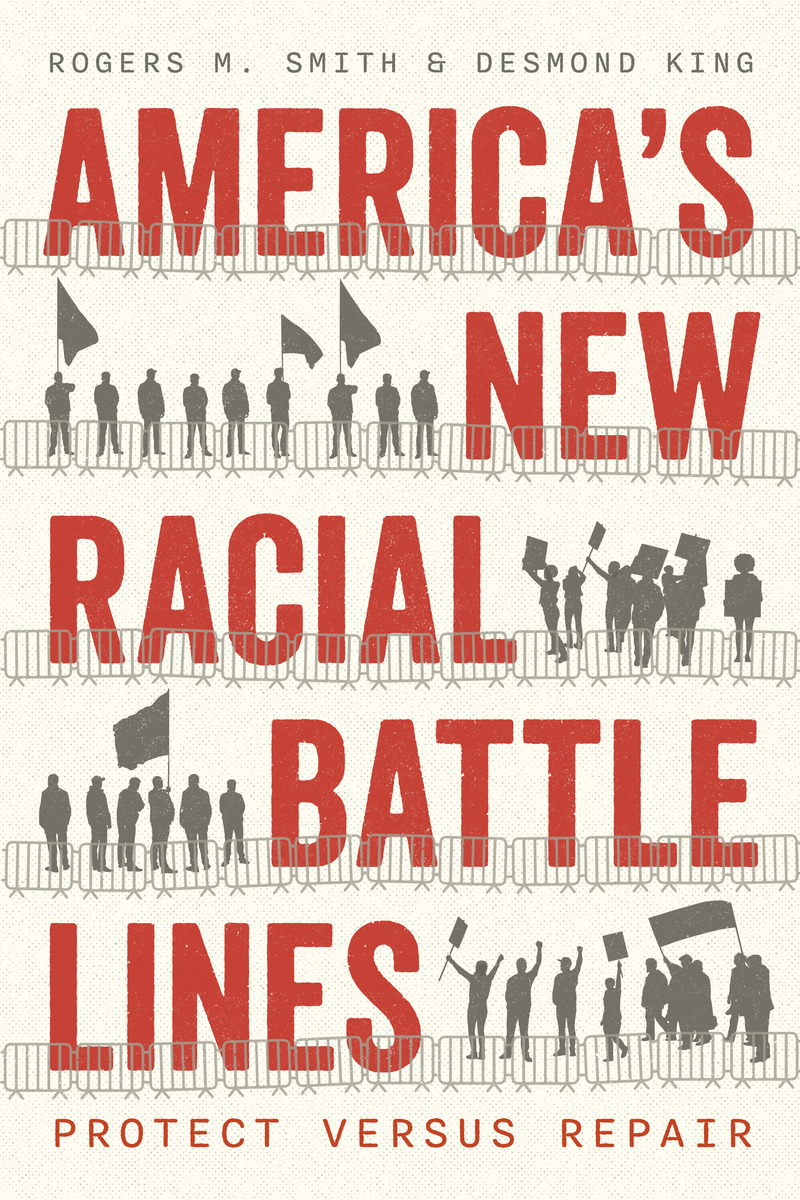
For nearly two decades, Rogers M. Smith and Desmond King have charted the shifting racial policy alliances that have shaped American politics across different eras. In America’s New Racial Battle Lines, they show that US racial policy debates are undergoing fundamental change. Disputes over colorblind versus race-conscious policies have given way to new lines of conflict. Today’s conservatives promise to protect traditionalist, predominantly white, Christian Americans against what they call the “radical” Left. Meanwhile, today’s progressives seek not just to integrate American institutions but to more fully transform and “repair” pervasive systemic racism.
Drawing on interviews with activists, surveys, social network analyses, and comprehensive reviews of federal, state, and local policies and advocacy groups, Smith and King map the memberships and goals of two rival racial policy alliances and delineate the contrasting stories each side tells. They also show that these increasingly polarized racial policy alliances are substantially funded on both the Left and Right.
Placing today’s conflicts in theoretical and historical perspectives, Smith and King analyze where these intensifying clashes may take the nation in the years ahead. They highlight the great potential for mounting violence, as well as the remaining possibilities for finding common ground.
TABLE OF CONTENTS
Chapter 1. America’s New Racial Battle Lines - Rogers M. Smith, Desmond King
DOI: 10.7208/chicago/9780226834030.003.0001
[racial orders;Protect policies;Repair policies;historical institutionalism;traditionalist Americans;systemic racism;reparations]
An overview of the book's central findings and arguments. The chapter describes the"racial orders," historical institutionalist theoretical framework the book employs, and the three eras of conflicting racial orders the nationdisplayed through 2010: slavery versus anti-slavery, segregation v. anti-segregation, color-blind v. race-conscious policies. It contends America is entering a 4th era of racial politics, pittingconservative Protectpolicies meant to aid traditionalist Americans against progressive Repairpolicies seeking to overcome systemicracism, often through "reparations," newly conceived as initiatives aimed at institutional transformations, not simply as cash payments. Both these polarizedracial policy alliances have gained control of some governing institutions, making them "racial institutional orders", though conservative positions remain more powerful. Both racial policy alliances contain extensive numbers of new groups as well as older ones who have converted to the new policy agendas, and both have substantial funding. (pages 3 - 32)
This chapter is available at:
https://academic.oup.com/chica...
Chapter 2. Racial Orders as Institutional Orders: Race, Class, and Intersectionality - Rogers M. Smith, Desmond King
DOI: 10.7208/chicago/9780226834030.003.0002
[historical institutionalism;biological determinism;white hegemony;racial policy regimes;racial capitalism;cultural determinism;capitalism;social network;intersectional;racial institutional orders]
Recent transformations in American racial politics have prompted renewed explorations of theoretical frameworks for understanding race-related disputes. This chapter explicatesthe book's historical institutionalist approach, focused on "racial institutional orders," by connecting it with other institutionalist frameworks and elaborating the concepts of "policy alliances" and "policy regimes." It uses social network analyses of website interconnections to illustrate the existence of "racial policy alliances." It also contrasts the "racial orders" framework with four alternatives—conservative theories of biological or cultural racial determinism; capitalist-focused accounts; white hegemony accounts; and intersectional accounts, all sometimes also termed "racial capitalism" accounts. It contends the racial orders framework is useful for organizing empirical evidence to assess the strengths and limitations of alternative accounts. (pages 33 - 66)
This chapter is available at:
https://academic.oup.com/chica...
Chapter 3. The Rise of the Protect Policy Alliance: New Actors, New Money, Resurgent Causes - Rogers M. Smith, Desmond King
DOI: 10.7208/chicago/9780226834030.003.0003
[Critical Race Theory;America First;Christian nationalism;woke;Diversity, Equity, Inclusion;Donald Trump;Nicholas Fuentes;militia;dark money]
In the early 1970s, American conservatives began building a network of think tanks, lobbying and litigation groups, and activist organizations that stressed conservative economic policies. Nowmany of those groups instead emphasize Protectpolicies like bans on Critical Race Theory, immigration curbs, attacks on Diversity, Equity, and Inclusion (DEI) initiatives,"woke" threats to conservative speech, and more.They are joined by numerous newer groups, many bearing the "America First"and "MAGA" labels popularized by Donald Trump. This chapter provides an overview of the older and newer Protect Alliance groups, with particular attention to Christian nationalists; armed and often violent militia groups; and prominent, though often "dark money," funding sources. (pages 69 - 96)
This chapter is available at:
https://academic.oup.com/chica...
Chapter 4. The Conservatives’ Story: Who and What to Protect - Rogers M. Smith, Desmond King
DOI: 10.7208/chicago/9780226834030.003.0004
[National Conservatives;Freedom Conservatives;Critical Race Theory;Christopher Rufo;Charles Kesler;Ward Connerly;Black Panthers;globalists;nationalism;natural rights individualism]
Conservative intellectuals tell distinct but overlapping stories on why it is imperative today to protect traditionalist Americans against a more militantly radical Left. Most contendthat the nation went astray when it did not emphatically shift to color-blind policies after ending Jim Crow Segregation. Permitting race-conscious policies allowed proponents of the radical Left views of the 1960s Black Panthers, Angela Davis, and others to shape the rise of a Diversity, Equity, and Inclusion industry, Critical Race Theory, and the Black Lives Matter movement. These have radicalized civil rights goals. Some conservatives trace these ideas back to the rejection of natural rights individualism in the Progressive era. Conservative politicians, led by Donald Trump, blame modern liberal Democrats and globalist elites for fostering these ideas instead of an ardent nationalism.Differences persistbetween new Trump-style "National Conservatives" and primarily older, more libertarian "Freedom Conservatives" butthey agree on most points of their Protect racial policy agenda. In addition to published sources, the chapter draws on interviews with leading conservative thinkers including Christopher Rufo, Ward Connerly, Charles Kesler, and others. (pages 97 - 123)
This chapter is available at:
https://academic.oup.com/chica...
Chapter 5. The Protect Alliance at Work: Policies and Reforms - Rogers M. Smith, Desmond King
DOI: 10.7208/chicago/9780226834030.003.0005
[affirmative action;MAGA;protestors;voting rights;immigration;education;GOP legislatures;housing integration;police reforms;monuments]
The Trump administration went even further than Donald Trump's campaign rhetoric in implementing a wide range of Protect racial policy regimes. Trump appointees adopted innumerable measures toend or limitaffirmative action, restrictimmigration, curb housing integration initiatives, oppose race-conscious police reforms, reduce voting rights protections for minorities, resist changes in public monuments, and combat Diversity, Equity, and Inclusioninitiatives in many venues. After Trump's defeat, MAGA Republicans expanded these efforts at the local, state, and national levels, with many GOP governors and state legislaturesbanning "divisive concepts" in public education systems, imposing new restrictions on civil rights protestors, and restricting voting access. (pages 124 - 150)
This chapter is available at:
https://academic.oup.com/chica...
Chapter 6. The Rise of the New Repair Groups - Rogers M. Smith, Desmond King
DOI: 10.7208/chicago/9780226834030.003.0006
[Black Lives Matter;racial equity;H.R. 40;George Floyd;Barack Obama;reparations;abolition;municipal reparations;violent Left groups]
In the early 21st century, civil rights initiatives seemed stalled despite the election of Barack Obama as the nation's first Black president. But international calls for reparations were rising,and from2013 on,police killings of Black Americans sparked the Black Lives Matter movement and racial protests that peaked in 2020 after the police murderof George Floyd. Reinforced by journalistic and academic writings, older civil rightsgroups were reenergized and many new groups formed, some focused on"racial equity," some on "reparations," some on "abolition," but all favoring wide-ranging initiativesto "repair" American institutions seen as embodying systemic racism. The chapter uses signatories in support of H.R. 40, the bill calling for a national reparations study commission, to map the wide range of older and new civil rights groups supporting such positions. It also documentssupport from universities and religious groups,municipal and state reparations initiatives, and others,and it maps the new funding environment for racial justice causes, as well as the small number of violent Left groups. (pages 153 - 197)
This chapter is available at:
https://academic.oup.com/chica...
Chapter 7. The Repair Story and Transformative Visions - Rogers M. Smith, Desmond King
DOI: 10.7208/chicago/9780226834030.003.0007
[Movement for Black Lives;N'COBRA;ADOS;California Reparations Task Force;NAARC;William Darity;white supremacy;Diversity, Equity, and Inclusion]
While Protect conservatives see America's new racial battle lines as drawn primarily by modern liberals, Repair advocates see them as rooted in century-old struggles of people of color against European imperialism and white supremacy. They see mostDiversity, Equity, and Inclusion initiatives as desirable but inadequate to bring needed systemic changes, and sometimes as coopting support for neoliberal policies. The chapter canvasses the policy agendas proposed by the Movement for Black Lives, ADOS, NAARC, N'COBRA, economist William Darity,and the California Task Force to Study and Develop Reparations Proposals for African Americans, among others. Despite important differences over what counts as "reparations" and whether only descendants of enslaved Americans should receive them, the programs call for many of the same systemic political, educational, and cultural changes, and economic redistributive measures. Despite some anti-capitalist rhetoric, none call directly for the full overthrow of capitalism, and some see their measures as strengthening the American nation. (pages 198 - 220)
This chapter is available at:
https://academic.oup.com/chica...
Chapter 8. Today’s Repair Alliance: Current Initiatives across Policy Regimes - Rogers M. Smith, Desmond King
DOI: 10.7208/chicago/9780226834030.003.0008
[housing reparations;public education;expanded voting rights;Police Civilian Review Boards;The 1619 Project;Confederate monuments;civil rights museums;public health initiatives;immigrant rights;universal basic income]
While the agendas of many of today's Repair racial justice groups are genuinely radical, many of their more immediate policy goals are being pursued, especially at the municipal and state levels. Evanston, Illinois and other cities are funding housing assistance to Black residents as a form of reparations. Many cities are adopting Police Civilian Review Boards, often in response to Black Lives Matter demands. Efforts to restrict teaching about racial issues in schools are being resisted, sometimes by adopting The 1619 Project's curricular materials or similar resources. Numerous monuments to Confederates have been taken down and new civil rights monuments and museums are being established. Many cities and counties have declared racism to be a "public health crisis" and adopted new public health and environmental initiatives. Many have sought to expand voting rights and rights of immigrants, against Protect conservative efforts to restrict them. Some cities are adopting Universal Basic Income programs. Repair advocates can be found in support of all these actions. (pages 221 - 250)
This chapter is available at:
https://academic.oup.com/chica...
Chapter 9. Lessons for and from Theories of Racial Politics - Rogers M. Smith, Desmond King
DOI: 10.7208/chicago/9780226834030.003.0009
[racial policy;white supremacist;capitalism;institutional orders;political coalitions;intersectional]
The evidence of earlier chapters shows that thesimplified accounts of racial politics sometimes advanced in popular discourse are not sustainable. More nuanced versions of the three progressive perspectives discussed in Chapter Two, however, cannot be dismissed.Capitalist-focused accounts must reckon with the reality that there are capitalists on both sides of the Protect v. Repair racial policy disputes. Yet it is true that even the most radical Repair advocates have offered more anti-capitalist slogans than programs, and that many of their proposals might well strengthen capitalism. White hegemony theorists often neglect the anti-white supremacist traditions, practices, and politics that have shaped American experience along with racially hierarchical ones. Yet it is true that America's racial inequalities remain persistent in America, with no clear path toward their reduction. Intersectional theories rightlycontend that racial systems must be understood as interlocked with other systems of power and privilege; but it is not clear how far they provide guidance on political strategies or substantive programs for overcoming the injustices of those systems. The institutional orders approach adopted in this book appearspromising for structuring empirical investigations that may help address many of the unresolved issues. (pages 253 - 268)
This chapter is available at:
https://academic.oup.com/chica...
Chapter 10. Views from the Battleground: Paths and Prospects for America’s New Racial Politics - Rogers M. Smith, Desmond King
DOI: 10.7208/chicago/9780226834030.003.0010
[multicultural conservatism;working class;racial violence;progressive alliance;intersectional;nationalism;reparations;China]
Considering both international and domestic factors, the chapter lays out a range of possible futures for the conflicts between America's new Protect versus Repair racial policy alliances. Theinternational environment is marked by resurgent right-wing nationalisms, which reinforce Protect proponents; heightened transnational racial equity and reparations advocacy, which aids Repair advocates; and the China/U.S. relationship, which may cut either way. Domestically, polls indicate deep divisions but little support for radical Repair positions. While a scenario of little change is possible, most likely is predominant success for "multicultural conservatism," a stance that embraces all racial and ethnic groups as long as they support conservative policies. Progressives may, however, gain success by offering joint race/class initiatives, despite tensions between the two. Less likely but not impossible is greater power for white extremist conservative policies, or for a working class-centered Left coalition focused solely on sharedeconomic interests. A broad intersectional progressive alliance is conceivable but not likely, while escalating racial violence appears all too possible. It is also possible, however, that Americans, who still agree on much, will yet find more constructive ways forward on racial policy issues. (pages 269 - 304)
This chapter is available at:
https://academic.oup.com/chica...