ABOUT THIS BOOK
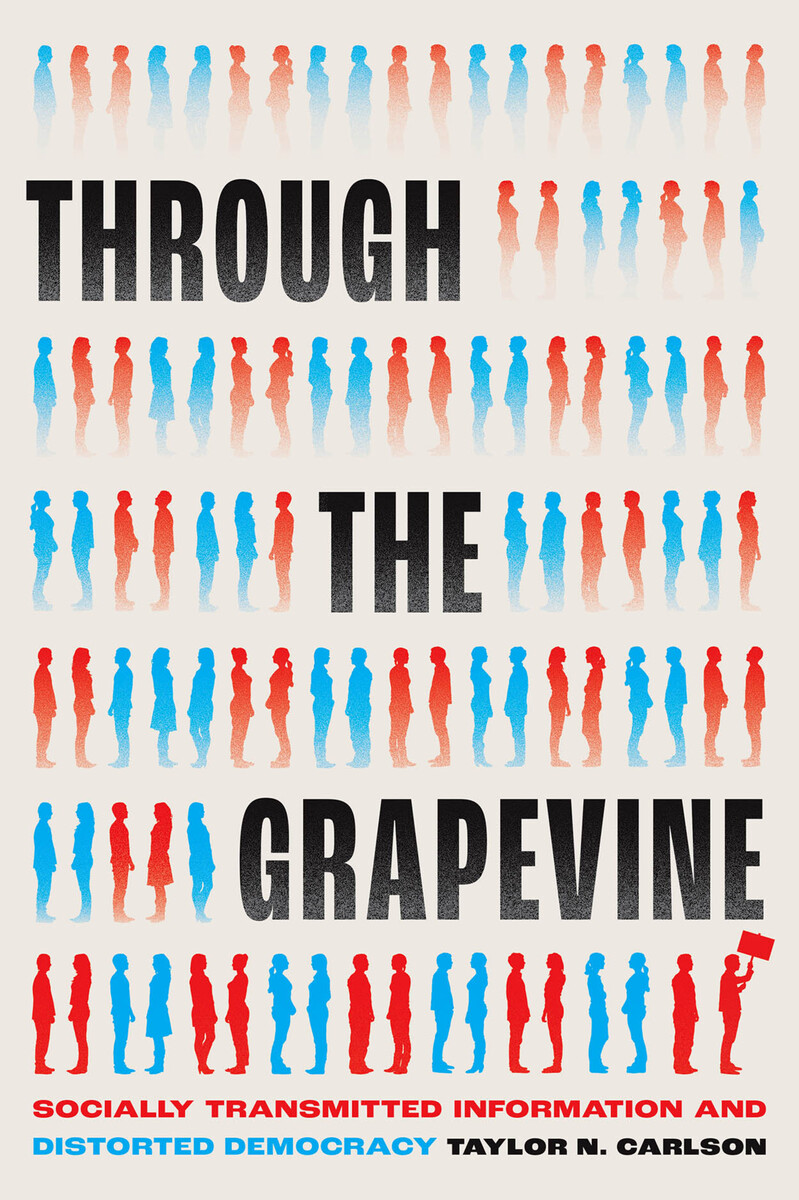
An enlightening examination of what it means when Americans rely on family and friends to stay on top of politics.
Accurate information is at the heart of democratic functioning. For decades, researchers interested in how information is disseminated have focused on mass media, but the reality is that many Americans today do not learn about politics from direct engagement with the news. Rather, about one-third of Americans learn chiefly from information shared by their peers in conversation or on social media. How does this socially transmitted information differ from that communicated by traditional media? What are the consequences for political attitudes and behavior?
Drawing on evidence from experiments, surveys, and social media, Taylor N. Carlson finds that, as information flows first from the media then person to person, it becomes sparse, more biased, less accurate, and more mobilizing. The result is what Carlson calls distorted democracy. Although socially transmitted information does not necessarily render democracy dysfunctional, Through the Grapevine shows how it contributes to a public that is at once underinformed, polarized, and engaged.
REVIEWS
“If you study American politics or political behavior, you should absolutely read Taylor Carlson’s recent book about information, interpersonal communication, and democratic functioning in the United States…Carlson’s major move and contribution lie with her focus on the content of the information moving between the actively informed and the casually informed parts of the public, and on the consequences that these changes have on public opinion and action…Carlson’s work is impressive, rigorous, and convincing.”
— Perspectives on Politics
“Through the Grapevine is an impressive blend of work on political communication and social networks that will interest scholars in both research areas. The book’s theoretical and empirical breadth is a real strength. The central argument about how social transmission changes media effects can be usefully applied to both in-person and digital communication…Carlson’s book should motivate more research at the intersection of political communication and social networks. It makes an important contribution in showing that socially transmitted information is fundamentally different from the news that inspires it. How different? It depends who you talk to."
— Public Opinion Quarterly
"Many citizens learn about politics through conversations with their friends and family. Such engagement can come with a steep cost. In this terrific and meticulously researched book, Carlson argues that interpersonal conversations about politics may do more harm than good. As citizens discuss what they read or hear in media reports, the actual information transmitted through conversation degrades and becomes more partisan in character, more negative in tone, and less accurate in nature."
— Adam J. Berinsky | Massachusetts Institute of Technology
“Through the Grapevine is one of the most important books written on public opinion formation in some time. Carlson convincingly argues that as an engaged public discusses politics via word-of-mouth, they distort it, make it less accurate, and more polarizing. This turns decades of conventional wisdom about the role that informed news consumers play in a democracy on its head and sheds light on how most Americans form their political opinions.”
— Kevin Arceneaux | author of "Changing Minds or Changing Channels?"
TABLE OF CONTENTS
1. How Political Conversations Change the Information Environment - Taylor N. Carlson
DOI: 10.7208/chicago/9780226834160.003.0001
[socially transmitted information;two-step flow;distorted democracy;polarization;misinformation;engagement;media;political discussion]
This chapter introduces the importance of studying socially transmitted information to better understand political communication and behavior.The chapter highlights some examples in which information communicated via word-of-mouth (online and offline) has affected political outcomes, such as the spread of misinformation. The chapter carefully situates the argument within the political communication literature, demonstrating how it builds upon the two-step flow to reorient our focus to the information that flows between people.The central argument is that as information flows from mass media to the actively informed to the casually informed, it becomes sparse, biased, less accurate, and mobilizing. This results in distorted democracy, where a nontrivial portion of the public is underinformed, polarized, but engaged.The chapter concludes with a road map summarizing the rest of the book. (pages 1 - 16)
This chapter is available at:
https://academic.oup.com/chica...
2. Distorted Democracy - Taylor N. Carlson
DOI: 10.7208/chicago/9780226834160.003.0002
[socially transmitted information;two-step flow;distorted democracy;misinformation;polarization;engagement;media;political discussion;actively informed;casually informed]
Chapter 2 presents the theory of distorted democracy, which suggests that as information diffuses from mass media to the actively informed to the casually informed, it becomes sparse, biased, less accurate, and mobilizing, which in turn fuels a context in which part of the public is underinformed, polarized, but engaged.The chapter highlights key theoretical and empirical shortcomings from previous research on the two-step flow, emphasizing the need to carefully examine the content of the information that is communicated throughout the two-step flow.The chapter draws on research across the social sciences to explain why information should change and how it could subsequently affect political attitudes and behavior. (pages 17 - 37)
This chapter is available at:
https://academic.oup.com/chica...
3. Conceptual and Empirical Measurement - Taylor N. Carlson
DOI: 10.7208/chicago/9780226834160.003.0003
[socially transmitted information;two-step flow;distorted democracy;political discussion;actively informed;casually informed;opinion leaders;telephone game experiment]
Chapter 3 unpacks the conceptual and empirical measurement strategies employed in this book. The chapter begins by describing what it means to be actively informed and casually informed, and differentiates them from similar constructs discussed in previous research. The actively informed directly seek out news from mass media; the casually informed are only indirectly exposed to the news through other people.The chapter uses nationally representative survey data to uncover the characteristics that distinguish the actively informed from the casually informed, importantly noting that the actively informed are stronger partisans. This data also shows that the casually informed primarily rely on people with whom they have stronger social connections in both face-to-face and social media contexts. Chapter 3 also provides an overview of the data collection used in the book, focusing on the strengths and limitations of the telephone game experiment. (pages 38 - 62)
This chapter is available at:
https://academic.oup.com/chica...
4. Distortion - Taylor N. Carlson
DOI: 10.7208/chicago/9780226834160.003.0004
[socially transmitted information;information distortion;text analysis;Twitter;partisan bias;misinformation;confirmation bias;motivated reasoning]
As the first empirical chapter of the book, Chapter 4 examines how information becomes distorted through social transmission. The chapter begins by discussing cognitive biases that could explain why information becomes sparse, biased, less accurate, and mobilizing. The chapter then presents evidence from eight telephone game experiments, where participants read news articles and wrote messages about them to other people. Analyzing the text of these messages, compared to the original news articles, reveals that information does indeed become more sparse, less accurate, more biased in favor of the participants’ preferences, and more mobilizing. However, some of the distortions are relatively rare, which highlights the nuanced normative implications of the findings. The chapter concludes by demonstrating that similar information distortion patterns appear in an analysis of Twitter data from the January 6, 2021 insurrection at the Capitol. (pages 63 - 90)
This chapter is available at:
https://academic.oup.com/chica...
5. Underinformed - Taylor N. Carlson
DOI: 10.7208/chicago/9780226834160.003.0005
[socially transmitted information;misinformation;learning;telephone game experiment;political knowledge;underinformed]
Chapter 5 tests whether the casually informed are underinformed, the first component of distorted democracy.Using a telephone game experiment, the chapter opens by demonstrating that when people receive information from a more knowledgeable co-partisan, they learn just as much information as they would have had they read a full news article, but if the informant does not meet these criteria, they show no evidence of learning at all. The chapter continues to investigate misinformation, using a matching analysis of survey data to demonstrate that the casually informed are typically—but not always—more likely to believe misinformation than are the actively informed. Additional survey data suggests that people who are misinformed are more likely to recall learning from social sources. Evidence from two experiments also suggest that socially transmitted information, especially from co-partisans, can increase misinformation.The chapter concludes with a discussion of the implications of these results. (pages 91 - 113)
This chapter is available at:
https://academic.oup.com/chica...
6. Polarized - Taylor N. Carlson
DOI: 10.7208/chicago/9780226834160.003.0006
[socially transmitted information;polarization;telephone game experiment;partisan sorting;echo chambers]
Chapter 6 examines whether socially transmitted information can polarize the casually informed, the second component of distorted democracy. Drawing on evidence from two telephone game experiments—one on environmental policy and one on immigration policy, the chapter reveals that socially transmitted information from co-partisans causes an increase in partisan sorting of policy preferences and more extreme policy preferences in some cases, relative to receiving no information at all. This suggests that the casually informed can become more polarized when exposed to information from their co-partisan peers. However, socially transmitted information did not influence affective polarization. Chapter 6 concludes with a detailed discussion of the nuanced interpretations of the results, as well as how these findings speak to the polarization literature. (pages 114 - 138)
This chapter is available at:
https://academic.oup.com/chica...
7. Engaged - Taylor N. Carlson
DOI: 10.7208/chicago/9780226834160.003.0007
[socially transmitted information;political engagement;telephone game experiment;social influence;donating;protesting;contacting legislators]
Chapter 7 tests the third arm of distorted democracy: political engagement. The chapter explains why socially transmitted information could mobilize people to action and then tests this argument with three approaches. First, using the telephone game experiments from Chapter 6, results suggest that exposure to socially transmitted information from a co-partisan can marginally increase the likelihood that someone reports they would contact their legislator about the issue at hand and donate to relevant interest groups. Second, nationally representative survey data suggests that the more someone reported increasing the amount of socially transmitted information they received during the 2022 election cycle, the more likely they were to report that they contacted a legislator and attended a protest. Third, the chapter unpacks several cases to highlight situations in which people were mobilized to action based in part upon socially transmitted information.Chapter 7 concludes with a discussion of the implications. (pages 139 - 157)
This chapter is available at:
https://academic.oup.com/chica...
8. Distorted or Dysfunctional? - Taylor N. Carlson
DOI: 10.7208/chicago/9780226834160.003.0008
[socially transmitted information;distorted democracy;democratic values;dysfunctional democracy;political communication;media effects;social networks;political discussion;social media]
As the concluding chapter, Chapter 8 wrestles with the question of whether socially transmitted information renders American democracy entirely dysfunctional or simply distorted from what some might consider ideal. The chapter summarizes the key points from the book, discusses both narrow and broad extensions that should be tackled by future research, and explains how research in other corners of the discipline could engage with the argument from this book. The chapter includes two empirical demonstrations of extensions, one highlighting that social transmission can distort frames used in campaign messaging, the other highlighting that socially transmitted information could be linked to perceptions of election integrity and democratic values.The chapter concludes by noting that socially transmitted information may contribute to a distorted democracy, but not an entirely dysfunctional one. (pages 158 - 178)
This chapter is available at:
https://academic.oup.com/chica...