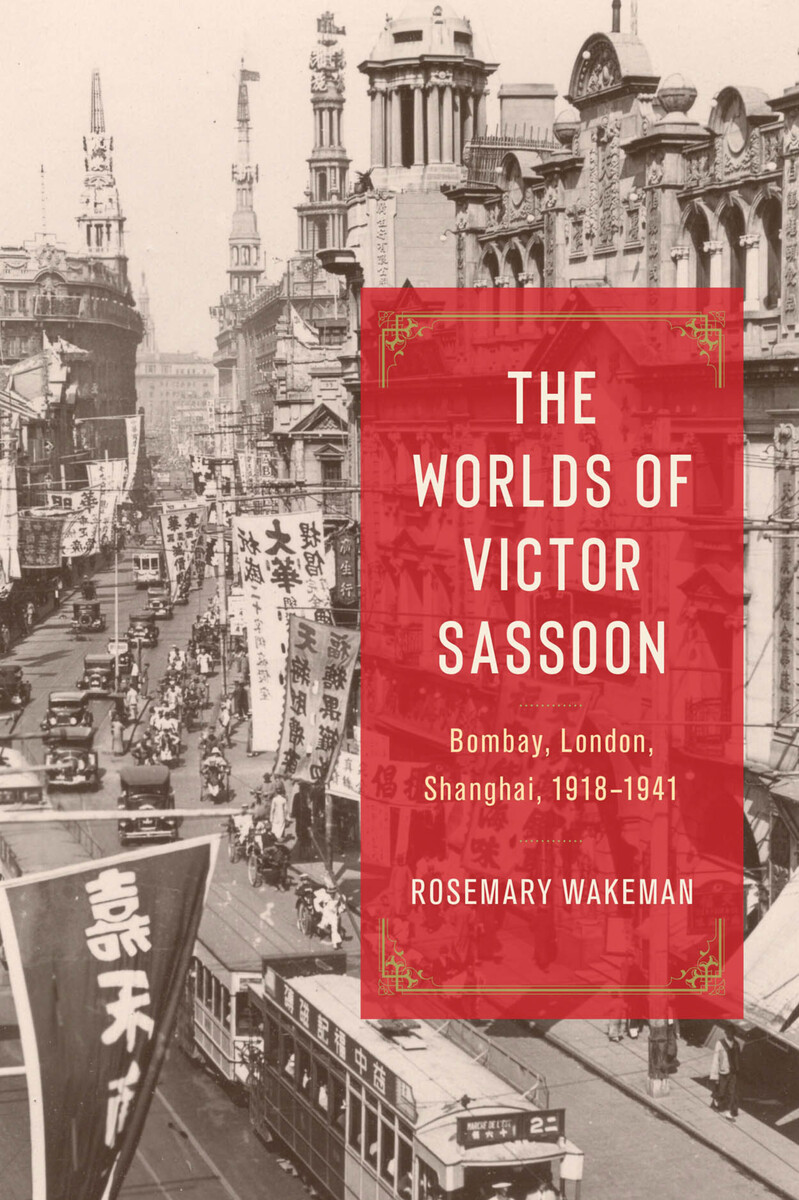
The Worlds of Victor Sassoon
Bombay, London, Shanghai, 1918–1941
by Rosemary Wakeman
University of Chicago Press, 2024
Cloth: 978-0-226-83418-4 | Electronic: 978-0-226-83419-1
DOI: 10.7208/chicago/9780226834191.001.0001
ABOUT THIS BOOKAUTHOR BIOGRAPHYREVIEWSTABLE OF CONTENTS
ABOUT THIS BOOK
An interpretative history of global urbanity in the 1920s and 1930s, from the vantage point of Bombay, London, and Shanghai, that follows the life of business tycoon Victor Sassoon.
In this book, historian Rosemary Wakeman brings to life the frenzied, crowded streets, markets, ports, and banks of Bombay, London, and Shanghai. In the early twentieth century, these cities were at the forefront of the sweeping changes taking the world by storm as it entered an era of globalized commerce and the unprecedented circulation of goods, people, and ideas. Wakeman explores these cities and the world they helped transform through the life of Victor Sassoon, who in 1924 gained control of his powerful family’s trading and banking empire. She tracks his movements between these three cities as he grows his family’s fortune and transforms its holdings into a global juggernaut. Using his life as its point of entry, The Worlds of Victor Sassoon paints a broad portrait not just of wealth, cosmopolitanism, and leisure but also of the discrimination, exploitation, and violence wreaked by a world increasingly driven by the demands of capital.
AUTHOR BIOGRAPHY
Rosemary Wakeman is professor of history at Fordham University. She is the author of A Modern History of European Cities: 1815 to the Present as well as The Heroic City: Paris, 1945–1958 and Practicing Utopia: An Intellectual History of the New Town Movement, the latter two also published by the University of Chicago Press
REVIEWS
“Wakeman is a historian at the top of her game. From the career of the international businessman Victor Sassoon between the world wars, she spins a tale of three cities and the myriad networks of trade, finance, and society that connected them. Mixing urban history, business history, and biography, this book is at once a story of empire and wealth as well as one of migration, poverty, strikes, and war. If you are looking for an imaginative take on global urban history, this is a wonderful place to start.”
— Simon Gunn, author of Automobility and the City in Twentieth-Century Britain and Japan
“Following the life of Victor Sassoon, this engaging and accessible book successfully argues that the interwar period in the first decade of the twentieth century was when large cities around the world became intricately connected through the circulation of global capital.”
— Toby Lincoln, author of An Urban History of China
“Wakeman brings imperial economic history to life, interweaving brilliant cultural analysis with lively stories of men, money, and markets. The result is a tour de force of global urban history during the interwar period.”
— Lynn Hollen Lees, author of Planting Empire, Cultivating Subjects
"In The Worlds of Victor Sassoon, Rosemary Wakeman explores the urban spaces and economies of Bombay, London, and Shanghai in the 1920s and 1930s. This elegantly written work depicts a world where globalization, seething political ferment, and technological change created instability and strife – and handsome profits for a lucky few."
— History Today
"A thoughtful study that seeks to deepen understandings of the history of globalization and its impact on modern life."
— Choice
"Meticulously researched, fluidly written, and cogently argued, The Worlds of Victor Sassoon sets a new standard for future works of global urban history by foregrounding the deep entanglement of a rapidly globalizing urban landscape during the interwar years. Through the globe-trotting stories of Victor Sassoon, a product of the British Empire, the book highlights the complex interplay of global capitalism, colonialism, nationalism, and social tensions in these global cities."
— Journal of Imperial and Commonwealth History
"Historian Rosemary Wakeman brings to life the frenzied, crowded streets, markets, ports, and banks of Bombay,
London, and Shanghai."
— China Rhyming
TABLE OF CONTENTS
Introduction - Rosemary Wakeman
DOI: 10.7208/chicago/9780226834191.003.0001
[urban history;globalization;twentieth century]
The introduction introduces readers to the framework of the book, the themes and analyses to be examined. It centers on a discussion of the urban history of Bombay, London and Shanghai, as well as on global history, and interpretations of globalization, capitalism, and the urban realm in the 1920s and 1930s. (pages 1 - 17)
This chapter is available at:
https://academic.oup.com/chica...
One. The Fortunes of Empire - Rosemary Wakeman
DOI: 10.7208/chicago/9780226834191.003.0002
[Victor Sassoon;merchant capitalism;global commerce]
Chapter One offers a brief historical description of the Sassoon family and the merchant capitalism that tied the three cities together in the nineteenth and early twentieth centuries. It concentrates on the emergence of global banking and finance within the context of the British Empire. The early history of Bombay, London, and Shanghai is introduced. The chapter recounts the Sassoon family role in the trade in opium and cotton textiles, and in the expansion of maritime commercial networks across Southeast Asia and the Far East. It describes Victor Sassoon’s early years in London and his training to take over the family business. (pages 18 - 37)
This chapter is available at:
https://academic.oup.com/chica...
Two. Bombay, Wonder of the World - Rosemary Wakeman
DOI: 10.7208/chicago/9780226834191.003.0003
[Bombay;cosmopolitanism;urbanization]
Chapter Two introduces British Bombay in the years after the First World War. Its textile industry and global trade in cotton are examined along with the elite circle of millowners, Victor Sassoon among them, that controlled the city. The chapter argues that Bombay was a freewheeling cosmopolitan hub, especially for South Asia. It had a big city feel, a modern sensibility, and a mix of global wealth and influence. The chapter recounts the intensity of Bombay’s Jazz Age public life and the rise of a new salaried middle class attached to global commerce. The city’s expansion and real estate development are discussed in relation to debates about westernization and the call for swadeshi (self-sufficiency and an Indian national culture). (pages 38 - 62)
This chapter is available at:
https://academic.oup.com/chica...
Three. Bombay, Global Helm - Rosemary Wakeman
DOI: 10.7208/chicago/9780226834191.003.0004
[cotton industry;migration;global capitalism]
Chapter Three examines Bombay’s role from the perspective of its cotton industry and global commerce. It discusses the role of labor migrants and dockworkers in the city’s geography of connectivity, and how the city’s built environment symbolized its global reach. The chapter argues that the city’s merchant financiers worked both within and against colonialism. They became venture capitalists, investing in new technologies (including telecommunications and aviation) and amassing power and wealth across Southeast Asia and the Far East. The declining capacity of Bombay’s cotton industry on the world stage is recounted through Victor Sassoon’s battles over colonial customs duties and currency policy as well as the strikes at the Sassoon textile mills. (pages 63 - 95)
This chapter is available at:
https://academic.oup.com/chica...
Four. London, Magnet of the World - Rosemary Wakeman
DOI: 10.7208/chicago/9780226834191.003.0005
[British Empire;migration;mass culture]
Chapter Four describes London as the capital of the British Empire and the city’s profusion of peoples as the “magnet of the world.” The imperial might of London is described via the opening of India House and the British Empire Exhibition, the influence of Indian migrants and the India League in the capital, and the increase in global tourism. The media industry played off mass culture and the popular obsession with High Society. The chapter examines the “society racket” and the cult of celebrity, the rise of a new middle class, and the social inequalities that made protests and strikes a routine of daily life. (pages 96 - 115)
This chapter is available at:
https://academic.oup.com/chica...
Five. London, Capital of Finance - Rosemary Wakeman
DOI: 10.7208/chicago/9780226834191.003.0006
[global finance;Art Deco;real estate]
Chapter Five focuses on the City of London as the heart of global finance, its banks and markets in gold and silver. Victor Sassoon’s banks and financial ventures are used as an example of global capitalism at work. The innovative industries that made London a global powerhouse were evident in both the city center and suburbs as Art Deco headquarters for multinational corporations. Real estate speculation was rampant. London’s Docklands are discussed as a global gateway for trade and migration. The chapter recounts the decline of British influence over global commerce and the efforts by British business to shore up colonial connections and the commercial struggles with India that ensued. (pages 116 - 143)
This chapter is available at:
https://academic.oup.com/chica...
Six. Enigmatic Shanghai - Rosemary Wakeman
DOI: 10.7208/chicago/9780226834191.003.0007
[global commerce;mass culture;social inequality]
Chapter Six depicts Victor Sassoon’s move to Shanghai amid political and social turmoil. It describes the city as China’s industrial and commercial dynamo and the weight of western, primarily British, interests in expanding the reach of global capitalism. It describes silver as the core of the Chinese monetary system and the impact of financial speculation on the city. The chapter examines the cosmopolitan glamour of Jazz Age Shanghai and its entertainment industries. The rise of a new middle class is set against the slums and poverty of the working poor. The social inequalities reverberated in violent protests and revolutionaries with their own brand of global cosmopolitanism. The chapter ends with a description of Hong Kong as a center of global commerce under the British as well as a migratory gateway for the Far East. (pages 144 - 168)
This chapter is available at:
https://academic.oup.com/chica...
Seven. Global Shanghai
DOI: 10.7208/chicago/9780226834191.003.0008
[foreign concessions;real estate;global finance]
Chapter Seven focuses on the foreign concessions and British International Settlement in Shanghai. It describes the Bund as the space of global finance and considers the importance of Chinese business elites to the city’s global influence. Victor Sassoon’s real estate empire and his celebrity influence highlight the extent of global financial networks. Shanghai as a global migratory hub and refugee sanctuary is recounted through its Russian, Jewish, and Japanese populations. The chapter describes the conflicts over foreign concessions amid the city’s expansion, the fall of Shanghai and its occupation by Japan, and the end of Victor Sassoon’s reign.
Epilogue - Rosemary Wakeman
DOI: 10.7208/chicago/9780226834191.003.0009
[Second World War;globalization;urban history]
The epilogue recounts Victor Sassoon's reaction to the demise of his financial and real estate empire in Shanghai and the outbreak of the Second World War. It examines the evolution of global capitalism under the impact of political and social crises in the 1920s and 1930s, and discusses how these influences shaped the urban worlds of Bombay, London, and Shanghai. (pages 193 - 200)
This chapter is available at:
https://academic.oup.com/chica...