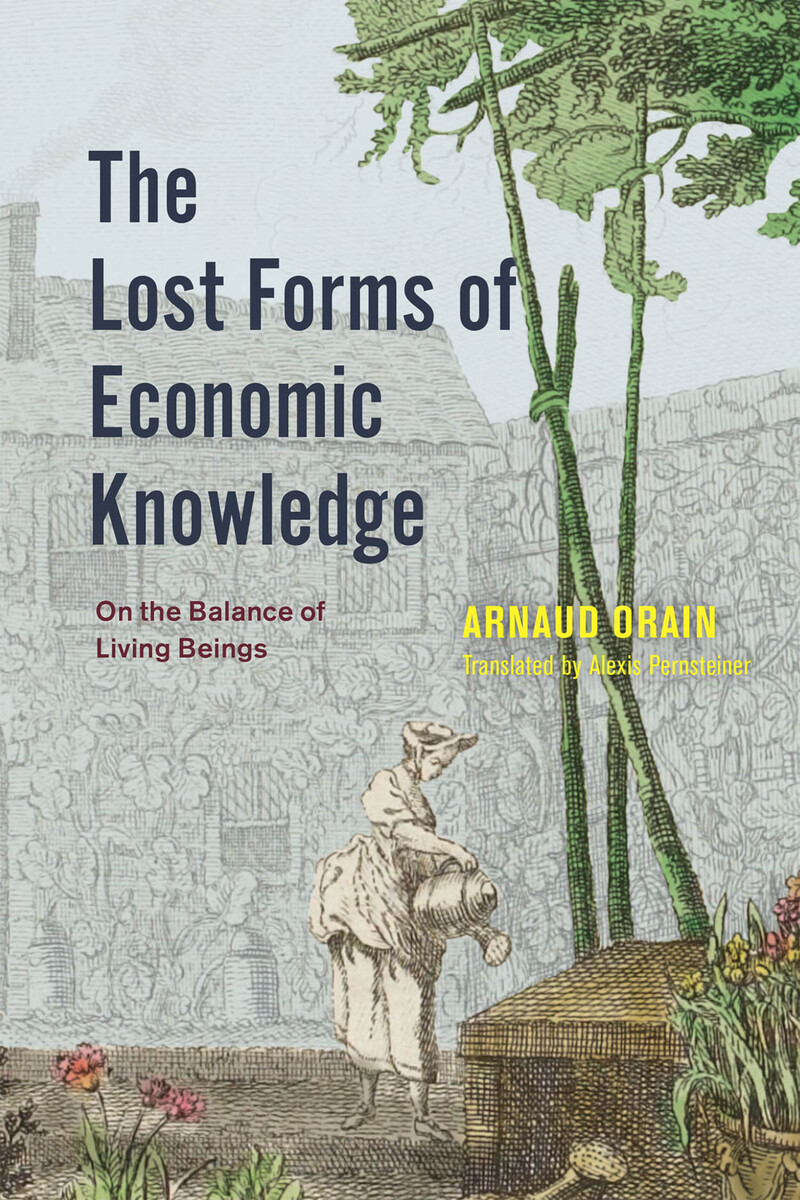
Cloth: 978-0-226-84251-6 | Paper: 978-0-226-85275-1 | Electronic: 978-0-226-84252-3
DOI: 10.7208/chicago/9780226842523.001.0001
ABOUT THIS BOOK
Traces the early history of economic knowledge developed by thinkers between the sixteenth and eighteenth centuries.
Starting with the sixteenth century, The Lost Forms of Economic Knowledge investigates the origins and prehistory of economic thought before the emergence of political economy as an autonomous discipline in the late eighteenth century. In this book, the celebrated French historian Arnaud Orain argues that these “lost forms” of economic knowledge represent an important alternative to our modern system of numerical abstraction and market manipulation.
As Orain shows, older approaches to the economy defined it as a relationship between humans and their specific environment. These earlier mindsets sought to advance vernacular knowledge by turning to a variety of figures—naturalists, artisans, farmers, and merchants—to learn how to take advantage of the environment without depleting it. The goal of these inquiries was not to maximize profit but to determine how to allow humans to satisfy basic needs and live in harmony with nature. Now, at a time in which natural resources are fast depleting, Orain argues that we could do worse than consider the alternative approaches to “economics” that lie in our past, and that might still be available in the future.
AUTHOR BIOGRAPHY
Arnaud Orain, an economist and historian, is directeur d’études at the Centre des Recherches Historiques at the École des Hautes Études en Sciences Sociales in Paris. He is the author of The Politics of Utopia, also published by the University of Chicago Press, and Neoliberalism Is Over. Alexis Pernsteiner is a French translator and language coach based in Marseille.
REVIEWS
“With immense learning and sensitive ethical imagination, Orain shows readers how the eighteenth-century contribution to present-day economics is not, inevitably, ecologically irresponsible productivism.”
— Paul Cheney, University of ChicagoTABLE OF CONTENTS
Introduction
1: The Tinkerer and the Observer
2: Science: A Description of the World and Local Truths
3: A Dialogical and Democratic Economic Science
4: The Oeconomy of Nature and the Science of Oeconomy
5: Oeconomic Physics: The French Case until the Revolution
6: Oeconomic Physics: An Applied Science
Conclusion. The Age of Possibility in the Twenty-first Century: The Crisis of Modern Science
Acknowledgments
Notes
References
Index of Names
Subject Index