Cloth: 978-0-226-84306-3 | Electronic: 978-0-226-84307-0
DOI: 10.7208/chicago/9780226843070.001.0001
ABOUT THIS BOOK
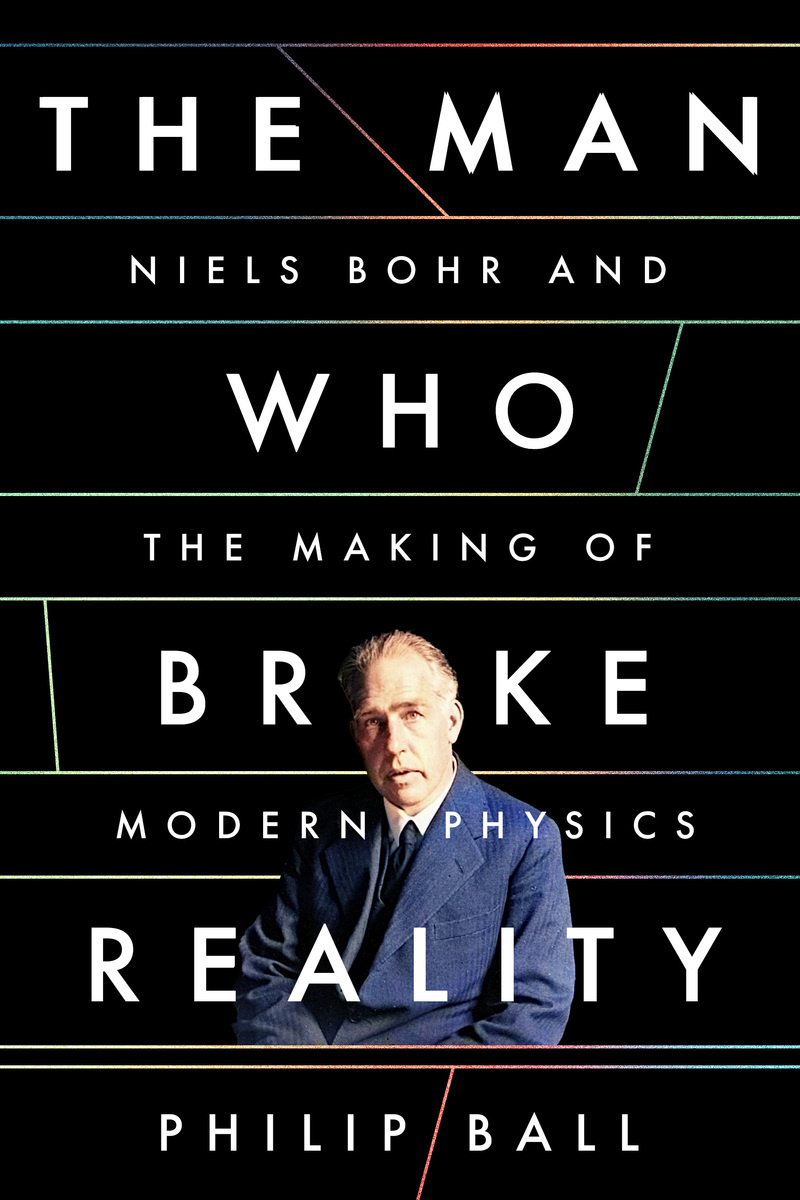
From the brilliant Philip Ball, a thrilling biography of Nobel Prize–winning Danish physicist Niels Bohr, the most radical quantum mechanician of all.
In the first half of the twentieth century, the tremendous energy locked up in the nucleus of an atom was discovered and then liberated, bringing both the promise of utopia and the threat of apocalypse. The dawn of the nuclear age is often associated with Albert Einstein, whose iconic equation E = mc2 revealed the staggering energy available from radioactive transformation, or with J. Robert Oppenheimer, who led the project at Los Alamos to build the first nuclear bombs. But the person who arguably did more than any other to shape the Promethean era in which we now live was the Danish physicist Niels Bohr.
In The Man Who Broke Reality, renowned science communicator Philip Ball reveals that it was Bohr who first explained the physics of the nuclear atom, and it was his model of the atom’s dense nucleus that enabled scientists to understand how it could be split apart. Ball also shows how Bohr was the central figure in the development of quantum mechanics, the theory of matter and energy that destabilized centuries of thinking not just about the microscopic nature of the world but about physical reality itself.
Bohr’s story is the story of modern physics and its transformative impact on the world. But The Man Who Broke Reality is not merely an intellectual drama. It chronicles a heroic life lived in turbulent times, across two world wars, the Manhattan Project, and the arms race of the Cold War. And it establishes Bohr as one of the most profound, inventive, and iconoclastic thinkers of the twentieth century.
AUTHOR BIOGRAPHY
Philip Ball is a freelance writer and broadcaster whose many books on the interactions of the sciences, the arts, and the wider culture include Bright Earth, Curiosity, Patterns in Nature, How to Grow a Human, The Modern Myths, The Elements, The Book of Minds, and How Life Works, all also published by the University of Chicago Press. His book Critical Mass won the 2005 Aventis Prize for Science Books, and his most recent work is Alchemy. Ball is also the 2022 recipient of the Royal Society’s Wilkins-Bernal-Medawar Medal for contributions to the history, philosophy, or social roles of science. He trained as a chemist at the University of Oxford and as a physicist at the University of Bristol, and he was an editor at Nature for more than twenty years. He lives in London.
REVIEWS
Best Books of 2026: Environment, Science and Technology
— Financial Times"Ball tackles the life and work a giant of modern physics, Danish Nobel laureate Niels Bohr. Sometimes overshadowed in popular culture by the standard figures of the atomic age—Oppenheimer and Einstein among them—Bohr steps into the blinding light, thanks to Ball’s adroit pen. After all, before humankind could succeed in splitting the atom, it first needed a model of the nucleus at its core. Constructing that model was but one of Bohr’s seminal contributions. He also seeded the field of quantum mechanics, which continues to blow apart our understanding of how physics operates in the universe."
— Bob Grant, Nautilus"In his gripping biography Ball ensures we feel the intense pull of Bohr’s genius. . . . The Man Who Broke Reality reminds us that science is a very human adventure, and that great humans make great things happen."
— Luca Turin, The Guardian, "Book of the Day""The Man Who Broke Reality is comprehensive, authoritative and shrewd, and, like all of Ball’s books, as entertaining as it is enlightening."
— John Banville, Financial Times"Excellent. . . . Ball’s biography has reclaimed not only the life and times of Bohr but also that of many half-forgotten figures who made major contributions to our knowledge over a century ago. It reclaims those scientists, Jewish and non-Jewish, who lived in an epoch of dictators and authoritarian politicians and tried to find a way through the morass of moral dilemmas. A perceptive and absorbing book about an underpublicized subject—and an accessible read."
— Colin Shindler, The Jerusalem Post"Drawing on extensive historical research, Ball reconstructs the conversations, collaborations, disagreements, and personal relationships through which much of modern physics took shape. Along the way, he explores Bohr’s distinctive approach to science, his influence on generations of physicists, and his efforts to grapple with the political and social implications of the atomic age."
— Trevor Owens, American Institute of Physics' Ex Libris Universum"Charting his dramatic life and revolutionary science, a compelling new biography of Niels Bohr, one of the twentieth century's 'most inventive and iconoclastic thinkers,' and a scientist whose insights continue to shape our understanding of the universe and our place within it."
— The Bookseller“A true tour de force. A fresh, authoritative, meticulously researched, and utterly engaging examination of arguably the deepest thinker of the twentieth century.”
— Jim Al-Khalili, New York Times–best-selling author of “On Time,” “The Joy of Science,” and “The World According to Physics”“An exploration of the limits of scientific knowledge, as embodied in the life of one of the great figures of modern physics. With characteristic insight, Ball shows us how the quantum mysteries of the twentieth century gave rise to some of the most profound debates about the nature of human attempts to understand the universe on its most fundamental scales.”
— Matthew Stanley, author of "Einstein’s War: How Relativity Triumphed amid the Vicious Nationalism of World War I"“A terrific writer.”
— Adam Rutherford, The Guardian, on Ball's "How Life Works"“Distinguished.”
— The New York Times Book Review, on Ball’s “The Modern Myths”“His prose is a pleasure to read.”
— The Wall Street Journal, on Ball's "Beyond Weird"“Ball is lucid and interesting on every topic he touches.”
— The New Yorker, on Ball’s “Invisible”“One of the most engaging contemporary science writers.”
— Financial Times, on Ball’s “Invisible”TABLE OF CONTENTS
Introduction: Architect of the Atomic Age
1 The Special One: Growing Up in Copenhagen
2 The Smallest Matter: The Mysteries of the Atom
3 Quantum Jumps: Bohr’s Atom
4 Building on the Past: The Institute
5 The View from Copenhagen: Turning the Quantum into a Theory
6 Tables and Waves: Quantum Mechanics
7 Both This and That: Complementarity
8 Entangled: Arguments with Einstein
9 Light and Life: Biology, Society, Philosophy
10 Into the Core: Anatomising the Nucleus
11 Fission: The Dawn of Atomic Energy
12 A Dangerous Occupation: Copenhagen Under the Nazis
13 A Great God: Bohr and the Arms Race
14 The Statesman of Physics: Bohr in the World
Epilogue: A Kind of Science
Acknowledgements
Bibliography
Sources
Notes
Index