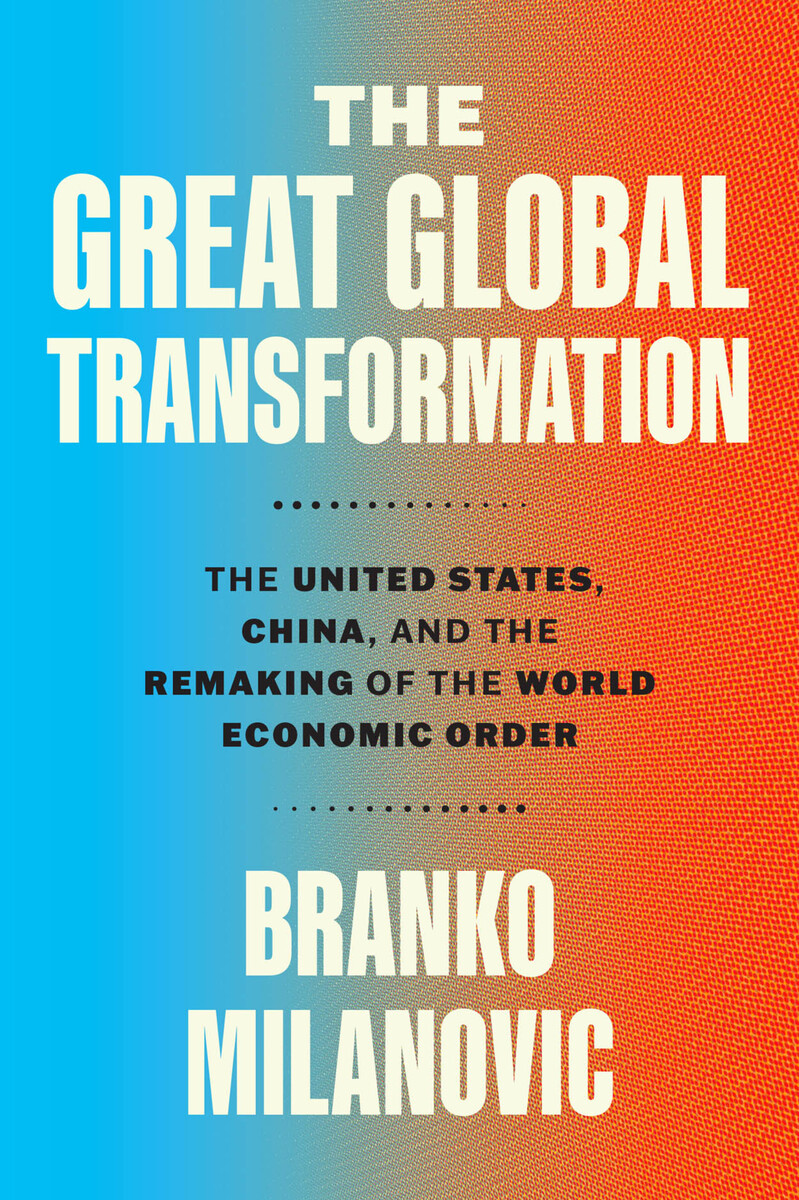
Cloth: 978-0-226-84641-5 | Paper: 978-0-226-86284-2 | Electronic: 978-0-226-84642-2
DOI: 10.7208/chicago/9780226846422.001.0001
ABOUT THIS BOOK
From the essential chronicler of the world economy, a portrait of the Great Powers in transition.The world’s two great economic powers are on opposite trajectories. In the United States, decades of neoliberal policies produced a small class of rich elites and gutted the middle class. In China, the same global forces have created a massive new upper class. The result is the greatest reshuffling of global incomes since the Industrial Revolution—a dramatic shakeup of each country’s political order. As the two powers retreat from one another, the implications for their futures, and for the world economy, are uncertain.
In The Great Global Transformation, acclaimed economist Branko Milanovic draws on original research to chart how these seismic shifts will shape the next century of the global economy. As both the US and China retreat into protectionism, Milanovic shows how a new and multipolar world order will follow—and how rising nationalism will have dramatically different effects on the two countries. And he shows us the fight ahead: as plutocracy returns, global war threatens, and a new system silently shapes our nations, driving populist discontent to the breaking point.
A worthy successor to Capitalism, Alone and his other landmark works, Milanovic’s new book announces the arrival of a new era he terms “national market liberalism,” in which liberalism survives in domestic economies, but not necessarily in the social arena. The Great Global Transformation is Milanovic’s indispensable account of the new twenty-first century now underway.
AUTHOR BIOGRAPHY
Branko Milanovic is research professor and a senior scholar at the Stone Center on Socio-Economic Inequality, City University of New York, as well as visiting professor at the International Inequalities Institute at the London School of Economics and Political Science. He is the author of numerous books, including Visions of Inequality; Capitalism, Alone; and Global Inequality.REVIEWS
“Around the world, politicians from Donald Trump to Xi Jinping are attempting to respond to a deep hostility in their respective countries toward those who have benefited most from globalization. Milanović’s provocative book offers one of the best explanations for why this revolt lies behind the rise of illiberalism and the return of nationalism.”
— Jacobin, Books Jacobin Loved in 2025“Milanovic does a masterful job of weaving together the currents giving rise to today's international economic order.”
— Barry Eichengreen, Foreign Affairs“For Milanovic, greed is the iron cage of our times, and our future is bleak. . . . His body of research, as a whole, has firmly established the importance of tackling inequality from a critical, world historical perspective. The Great Global Transformation provides a useful and accessible summary of his work.”
— Roberto Patricio Korzeniewicz, Nature“In his fine new book The Great Global Transformation, the former World Bank economist Branko Milanovic describes how our political and economic order is now coming to an end. China and the global south now account for more of the world economy than the US, Japan, Europe, and the many others put together that he terms the “capitalist core”; at the same time, capitalism is being redefined. The elites who prospered under the regimes shaped by Reagan and Thatcher are now redefining their nations into narrower, meaner, harsher societies, ditching the old commitments to multiculturalism and equality for women. They are forcing upon the rest of us capitalism without secure contracts, unions, or even the HR department.”
— Aditya Chakrabortty, The Guardian“Milanovic draws parallels in political trends across multiple countries and points out that what seems like flip-flopping or policy reversals by Xi and others may be 'course corrections' towards a long-term goal. He notes that U.S. nostalgia for post-war dominance is an exception, not the norm. Merchants who sell or source internationally may find Milanovic’s insights fresh and useful as they navigate growth.”
— Practical E-Commerce“Milanovic postulates an implicit premise: democratic systems cannot survive being stretched across larger swathes of the global income distribution without experiencing severe political stress. . . . his findings are incredibly striking and powerful. To my mind the facts he marshals must now stand as the basic parameters of any political and historical attempt to explain the ‘backlash’ against neoliberalism and the global economic system that defined the period between 1979 and 2016.”
— Nicholas Mulder, Weltinnenpolitik“I don’t know by what miracle he managed to make it pose for so long, given the spasms and crises that are shaking it, but Branko Milanović’s portrait of our world is very well done. . . . often remarkable. It is striking, in particular, how closely Washington’s latest moves. . . mirror its analysis of the political phenomenon represented by Donald Trump.”
— Andrea Capussela, Andrea's Substack“Milanović is an extraordinary thinker who frequently writes some of the most compelling accounts of globalization’s fallout that exists, mapping with devastating precision who won and who lost from the great opening of the world economy. Milanović is known, also importantly, for understanding the political convulsions that followed as a consequence: Brexit, Trump, the collapse of centrist parties across Europe. His latest book, The Great Global Transformation, extends this analysis into what comes next. . . . The book is, in many ways, his attempt to name the era we’ve already entered but haven’t yet been able to start speaking coherently about. And it’s excellent at that.”
— Sinéad O’Sullivan, But This Time It's Different“An excellent guide to the new global order.”
— Philip Cunliffe, Compact“Milanovic sees today's global economy through a distinctly Marxist lens, and that's precisely what makes this book so compelling. Whether you agree or not, his framework is sharp, provocative, and impossible to ignore in a world where markets and nations are increasingly entangled.”
— NEORATMTABLE OF CONTENTS
Preface
Introduction
1. The Rise of Asia
2. Convergence and Conflict
3. The Elites
4. National Market Liberalism
5. Nationalism, Greed and Property
Bibliography
Acknowledgements
Notes
Index