ABOUT THIS BOOK
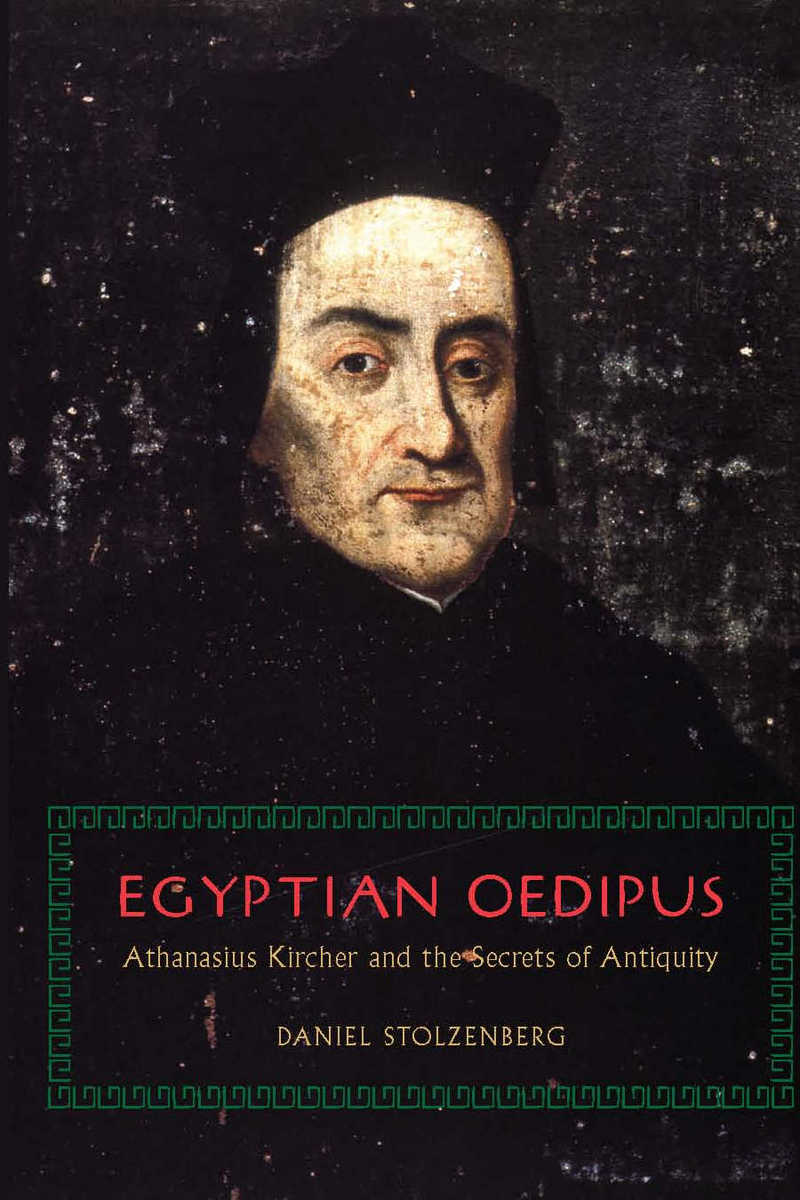
A contemporary of Descartes and Newton, Athanasius Kircher, S. J. (1601/2–80), was one of Europe’s most inventive and versatile scholars in the baroque era. He published more than thirty works in fields as diverse as astronomy, magnetism, cryptology, numerology, geology, and music. But Kircher is most famous—or infamous—for his quixotic attempt to decipher the Egyptian hieroglyphs and reconstruct the ancient traditions they encoded. In 1655, after more than two decades of toil, Kircher published his solution to the hieroglyphs, Oedipus Aegyptiacus, a work that has been called “one of the most learned monstrosities of all times.” Here Daniel Stolzenberg presents a new interpretation of Kircher’s hieroglyphic studies, placing them in the context of seventeenth-century scholarship on paganism and Oriental languages.
Situating Kircher in the social world of baroque Rome, with its scholars, artists, patrons, and censors, Stolzenberg shows how Kircher’s study of ancient paganism depended on the circulation of texts, artifacts, and people between Christian and Islamic civilizations. Along with other participants in the rise of Oriental studies, Kircher aimed to revolutionize the study of the past by mastering Near Eastern languages and recovering ancient manuscripts hidden away in the legendary libraries of Cairo and Damascus. The spectacular flaws of his scholarship have fostered an image of Kircher as an eccentric anachronism, a throwback to the Renaissance hermetic tradition. Stolzenberg argues against this view, showing how Kircher embodied essential tensions of a pivotal phase in European intellectual history, when pre-Enlightenment scholars pioneered modern empirical methods of studying the past while still working within traditional frameworks, such as biblical history and beliefs about magic and esoteric wisdom.
REVIEWS
“Extraordinary: Kircher, the figure of fun, emerges from Stolzenberg’s impressive analysis as a serious scholar . . . The roots of Kircher’s brilliant failure as a scholar lay in his effort to pursue two incompatible paths at the same time. The mystical antiquarian could not be true to both his selves: he was a living oxymoron. It is the measure of Stolzenberg’s achievement that he makes us feel the passion and understand the arguments that led Kircher to try.”
— Anthony Grafton, London Review of Books
“Thoroughly researched and informative.”
— Alastair Hamilton, Times Literary Supplement
"Not only an important addition to this literature, but also deserves to be read by anyone interested in the encyclopedic and antiquarian scholarship which characterized much of the early seventeenth century republic of letters."
— British Journal for the History of Science
"Stolzenberg has succeeded admirably in showing us that Kircher's work on ancient Egypt must be taken seriously in order to understand him and his times."
— Renaissance Quarterly
“A fine study of Kircher’s Egyptological writings and the world of scholarship in the second half of the seventeenth century. Recommended.”
— R . Fritze, Athens State University, Choice
“If you don't already know about Athanasius Kircher, you should take a long trip through his extraordinary and weird fields of research: a Jesuit priest who tinkered with everything from early cinematic projectors to talking statues, and wrote about impossibly tall skyscrapers inspired by the Tower of Babel and developed his own unique twist on a volcanic theory of a Hollow Earth. If Gizmodo had been founded in the seventeenth century, Kircher would have been its editor in chief. Stolzenberg's book is an excellent biography of the man and his ideas.”
— Gizmodo's Notable Books of 2013
"A landmark study. . . . There is much that is new in this insightful and scrupulously researched book, whose most notable contributions would appear to be the restoration of Kircher's place in the intellectual and antiquarian culture of his own day, with due consideration of the subsequent reception, and rejection, of his work during the following century. Especially notable is Stolzenberg's characterization Kircher's Egyptological project as the product of 'an encounter between two early modern intellectual traditions: erudition (antiquarian research and philology) and occult philosophy (the Renaissance Neoplatonic tradition, based on a lineage of esoteric wisdom attributed to extremely ancient wise men).'"
— Brian A. Curran, Pennsylvania State University, Early Science and Medicine
“Daniel Stolzenberg’s beautifully conceived, meticulously researched, and eminently readable study of Athanasius Kircher is bound to become an indispensable reference for anybody interested in the momentous seventeenth-century transition from traditional occult philosophy and its belief in an ancient oriental wisdom to modern perspectives grounded in critical philological and historiographical methods.”
— Wouter J. Hanegraaff, University of Amsterdam
“Daniel Stolzenberg has a sure grasp of Athanasius Kircher’s infinite output, intricate thought, and complicated times. An informed and sensitive treatment of a truly baroque character.”
— Ingrid D. Rowland, University of Notre Dame
“In Egyptian Oedipus, Daniel Stolzenberg not only provides the first serious study of Athanasius Kircher’s investigations into the history and culture of ancient Egypt, but he also furnishes a perceptive critical evaluation of Kircher’s scholarship and persona, warts and all. Stolzenberg goes beyond Kircher’s programmatic statements to unveil his actual scholarly practices. In doing so, Stolzenberg has produced an exemplary case study of a polymath at work and has provided us with a more nuanced understanding of Kircher’s influence.”
— Mordechai Feingold, California Institute of Technology
“In this lively and erudite book, Daniel Stolzenberg sets himself the daunting task of making Athanasius Kircher legible to a modern reader. How, he asks, can we understand a writer like Kircher without making him a figure either of comedy or of awe? The answer he gives is a tour-de-force reading of Kircher’s central claim to fame in the seventeenth century, his work on hieroglyphics. Along the way, we learn much about the fate and function of occult philosophy in the period, the operations of the early modern republic of letters, and the place of Rome and early modern Catholicism more generally in the intellectual landscape of early modern Europe.”
— Jonathan Sheehan, University of California, Berkeley
TABLE OF CONTENTS
A Note on Quotations and Translations
List of Abbreviations
Oedipus in Exile - Daniel Stolzenberg
DOI: 10.7208/chicago/9780226924151.003.0001
[Athanasius Kircher, Jesuit priest, Malta, Catholic Knights, Landgrave Frederick, Hesse-Darmstadt, Lutheranism, Catholicism, Pope Urban VIII]
This book begins with the Jesuit priest Athanasius Kircher's stay in Malta, a European outpost between Sicily and North Africa governed by the Catholic Knights of St. John of Jerusalem. Kircher arrived at the end of May in the retinue of a young German prince, Landgrave Frederick of Hesse-Darmstadt, who, following negotiations with Rome, had converted from Lutheranism to Catholicism. In reward, Pope Urban VIII promised Frederick the Grand Cross of the Order of St. John and the lucrative office of coadjutor of the Grand Priory of Germany. This required Frederick to take up temporary residence on the island, and Kircher, a fellow German, was sent along to serve as the landgrave's confessor and teach mathematics at Malta's Jesuit college. It was a poor match; Kircher's talents and ambitions were scholarly rather than pastoral, while Frederick was a rowdy youth and Malta a cultural backwater. (pages 1 - 35)
This chapter is available at:
https://academic.oup.com/chica...
Esoteric Antiquarianism - Daniel Stolzenberg
DOI: 10.7208/chicago/9780226924151.003.0002
[scholarly grandiosity, hieroglyphic doctrine, ancient significance, Rosetta Stone, hieroglyphic inscriptions, Latin prose]
This chapter explores the scale of Egyptian Oedipus and how it impressed people of an age accustomed to scholarly grandiosity. To the modern reader, however, it is the book's substance that most astonishes. Egyptian Oedipus promises a complete “restoration of the hieroglyphic doctrine,” all the lost secrets of religion and science that ancient Egyptians supposedly encoded on their monuments. The massive final volume gathers almost every hieroglyphic inscription known to Europeans at that time, as well as other ancient artifacts, including mummies, sarcophagi, Canopic jars, sphinxes, idols, lamps, and amulets, found in Rome, other Christian cities, Istanbul, and Egypt. Kircher glosses each object with a learned explanation of its ancient significance. Without a Rosetta Stone, he translates the hieroglyphic inscriptions, character by character, into Latin prose. (pages 36 - 70)
This chapter is available at:
https://academic.oup.com/chica...
How to Get Ahead in the Republic of Letters - Daniel Stolzenberg
DOI: 10.7208/chicago/9780226924151.003.0003
[great antiquary, Peiresc, Arabic manuscripts, hieroglyphic studies, Oriental philology, antiquarianism]
This chapter focuses on the Jesuit priest Kircher, the great antiquary Peiresc, and the story of their relationship, which revolved around a series of Arabic manuscripts. It sheds light on Kircher's hieroglyphic studies by situating them in the erudite world of Oriental philology and antiquarianism that Peiresc personified. When Peiresc heard the description of an Arabic manuscript about Egypt and the hieroglyphs, he immediately began to cultivate a relationship with its owner and, before long, had taken Kircher under his wing and helped launch his career. Decades later, when Kircher published his hieroglyphic studies, he professed himself Peiresc's loyal disciple. Had he lived to receive the homage, Peiresc might have felt more than a little ambivalent. Before he died, he came to harbor significant reservations about Kircher's scholarship, and Egyptian Oedipus surely would have confirmed his fears about his protege's lack of rigor and penchant for unsubstantiated speculation. (pages 71 - 103)
This chapter is available at:
https://academic.oup.com/chica...
Oedipus in Rome - Daniel Stolzenberg
DOI: 10.7208/chicago/9780226924151.003.0004
[hieroglyphic studies, Coptic-Arabic lexicon, powerful patrons, center of scholarship, Rome, Oriental studies]
This chapter covers Kircher's return to Rome from Malta in 1638. Kircher was eager to return to the unfinished edition of the Coptic-Arabic lexicon and his ever-expanding hieroglyphic studies, and as he brought both projects to completion in the following years, he encountered numerous obstacles. He overcame these obstacles only with the assistance of new and powerful patrons, and by harnessing the exceptional resources that made Rome a vital center of scholarship, especially in the fields of antiquarian and Oriental studies. Kircher's investigations of Egypt and the hieroglyphs, culminating in the monumental Egyptian Oedipus, were products of a network of institutions, collections, and individuals centered in Rome and extending throughout Europe and the world. (pages 104 - 128)
This chapter is available at:
https://academic.oup.com/chica...
Ancient Theology and the Antiquarian - Daniel Stolzenberg
DOI: 10.7208/chicago/9780226924151.003.0005
[doctrinal components, hieroglyphic studies, historical component, occult philosophy, Hilfswissenschaft, auxiliary science]
This chapter focuses on the historical and doctrinal components of Kircher's hieroglyphic studies. Kircher insisted emphatically on the truth of the historical component of his investigation, which was crucial for his claim to have accurately translated the hieroglyphs. By contrast, his treatment of the doctrinal component was primarily descriptive. Believing that knowledge to be found in the testaments of occult philosophy, Kircher needed familiarity with the Hermetic Corpus, the Chaldean Oracles, and the Kabbalah, just as he needed expertise in paleography and Oriental languages. To use the terminology of nineteenth-century scholarship, one might say that he treated occult philosophy as a Hilfswissenschaft—an auxiliary science, like numismatics or archeology, which the scholar of antiquity must master in order to make correct sense of his sources and bring the past to light. (pages 129 - 150)
This chapter is available at:
https://academic.oup.com/chica...
The Discovery of Oriental Antiquity - Daniel Stolzenberg
DOI: 10.7208/chicago/9780226924151.003.0006
[Near Eastern texts, Arabic literature, Oriental sources, Kabbalah, antiquarian imperative, historical data pool, skeptical imperative, critical philology]
This chapter examines Kircher's study of Near Eastern texts, focusing on two cases. In his study of Arabic literature about Egypt and Hermes Trismegistus, Kircher carried out significant, original investigations of Oriental sources. In his treatise on the Kabbalah, on the other hand, he exaggerated his firsthand study of Jewish authors and concealed his reliance on Latin secondary sources. Since Egyptian Oedipus was, to a large extent, cobbled together from the texts of unacknowledged early modern authors, a careful examination of its sources is needed to appreciate the mixture of original and derivative learning that Kircher set indiscriminately before his reader. In his scholarship, the antiquarian imperative to expand the historical data pool trumped the skeptical imperative of critical philology. (pages 151 - 179)
This chapter is available at:
https://academic.oup.com/chica...
Erudition and Censorship - Daniel Stolzenberg
DOI: 10.7208/chicago/9780226924151.003.0007
[magical practices, esoteric wisdom, Jesuit censors, orthodoxy, natural philosophy, astronomical work, heterodox subject matter]
This chapter looks at how the Jesuit censors responded to Kircher's exposition of magical practices and esoteric wisdom, and how Kircher responded to them. It offers a different kind of case study than previous investigations of Jesuit censorship, which have concentrated on the Society's efforts to enforce orthodoxy in the realm of natural philosophy, including Kircher's controversial astronomical work. Because of constraints on free expression, interpreting early modern texts about heterodox subject matter is inherently difficult. In the case of Egyptian Oedipus we are lucky to have an uncommon trove of archival material—Jesuit censorship reports, the surviving manuscript of half of Egyptian Oedipus, and unpublished correspondence—which allows a detailed reconstruction of how censorship shaped Kircher's text, providing insight into how to interpret the published work. (pages 180 - 197)
This chapter is available at:
https://academic.oup.com/chica...
Symbolic Wisdom in an Age of Criticism - Daniel Stolzenberg
DOI: 10.7208/chicago/9780226924151.003.0008
[translating hieroglyphs, philological criticism, hieroglyphic symbolism, symbolic images, Neoplatonic theory, nondiscursive language, hermeneutic practice, arbitrariness]
This chapter first examines Kircher's method of translating hieroglyphs and then turns to his efforts to defend their reliability against philological criticism. In contrast to the many studies of Kircher's theory of hieroglyphic symbolism, little attention has been paid to the mechanics by which he produced the translations printed in Egyptian Oedipus and Obeliscus Pamphilius. These were based on the idea that symbolic images could only be understood in relationship to texts, combined with the Neoplatonic theory that the hieroglyphs were a “nondiscursive” language, which communicated without grammar or syntax. The hermeneutic practice that Kircher derived from these principles allowed him to produce translations that were not unmethodical, but which were inherently liable to charges of arbitrariness. (pages 198 - 225)
This chapter is available at:
https://academic.oup.com/chica...
Oedipus at Large - Daniel Stolzenberg
DOI: 10.7208/chicago/9780226924151.003.0009
[Kircher's hieroglyphic studies, Yverdon Encyclopedia, eccentric, Corpus Hermeticum, hieroglyphic inscriptions]
This chapter attempts to explain the surprising endurance of Kircher's hieroglyphic studies among scholars who deemed them fundamentally flawed. One cannot say that Kircher's work was unsuccessful as it was read, cited, and commented on by other scholars with considerable frequency for more than a century. As the Yverdon Encyclopedia observed, despite Kircher's reputation as an eccentric, copies of Egyptian Oedipus were still “expensive and sought-after” more than a hundred years after its publication. The deficiencies of Kircher's hieroglyphic studies had not gone unnoticed, however. Many early modern critics particularly lambasted the two defects that most stand out to the modern reader: Kircher's reliance on discredited sources such as the Corpus Hermeticum; and the fantastic quality of his interpretations of hieroglyphic inscriptions. (pages 226 - 253)
This chapter is available at:
https://academic.oup.com/chica...
The Twilight of Tradition and the Clear Light of History - Daniel Stolzenberg
DOI: 10.7208/chicago/9780226924151.003.0010
[nineteenth-century writers, reliable knowledge, credible evidence, tradition, occult philosophy, empirical historical research, historical scholarship, symbolic wisdom, ancient Egypt]
This book concludes by describing how nineteenth-century writers commonly described reliable knowledge of the past based on credible evidence as the “clear light of history,” which they contrasted with various phrases such as “the mist of tradition,” “mythological fiction and poetry,” the “faint gleam of tradition and fable,” “the dimness of legendary fable and myth,” the “impenetrable veil of tradition, mystery, and silence,” or simply “tradition.” It has argued that the fusion of occult philosophy and empirical historical research found in Kircher's hieroglyphic studies was not anomalous. The opposition between “history” and “tradition,” which came so naturally to the nineteenth century, was foreign to the seventeenth. Kircher trusted that the progress of historical scholarship would illuminate, not vaporize, the symbolic wisdom of ancient Egypt. (pages 254 - 259)
This chapter is available at:
https://academic.oup.com/chica...
Acknowledgments
Bibliography
Index