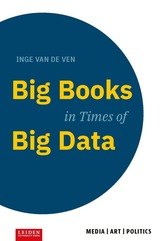
front cover of Big Books in Times of Big Data
Big Books in Times of Big Data
Inge Van de Ven
Leiden University Press, 2019
Big Books in Times of Big Data examines recent trends of size and scale in the novel in terms of the shift from the bound book to the newer materialities of the digital. Using a wide-ranging international archive of hefty tomes by authors such as Mark Z. Danielewski, Roberto Bolaño, Elena Ferrante, and Karl Ove Knausgård, George R.R. Martin, Jonathan Franzen, and William T. Vollmann, Van de Ven reflects on the place of big book-bound literature in a media genealogy which includes film and television but also online databases, social media, selfies, and Global Information Systems. This study makes a case for the cultural agency of the big book—as a material object and a discursive phenomenon, entangled in complex ways with questions of canonicity, mediality, gender, and power. Van de Ven takes us into a contested bookish terrain beyond the 1,000-page mark, where issues of scale and readerly comprehension clash with authorial aggrandizement and the pleasures of ‘binging’ and serial consumption.
[more]


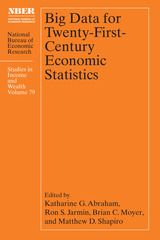
front cover of Big Data for Twenty-First-Century Economic Statistics
Big Data for Twenty-First-Century Economic Statistics
Edited by Katharine G. Abraham, Ron S. Jarmin, Brian C. Moyer, and Matthew D. Shapiro
University of Chicago Press, 2022
The papers in this volume analyze the deployment of Big Data to solve both existing and novel challenges in economic measurement. 

The existing infrastructure for the production of key economic statistics relies heavily on data collected through sample surveys and periodic censuses, together with administrative records generated in connection with tax administration. The increasing difficulty of obtaining survey and census responses threatens the viability of existing data collection approaches. The growing availability of new sources of Big Data—such as scanner data on purchases, credit card transaction records, payroll information, and prices of various goods scraped from the websites of online sellers—has changed the data landscape. These new sources of data hold the promise of allowing the statistical agencies to produce more accurate, more disaggregated, and more timely economic data to meet the needs of policymakers and other data users. This volume documents progress made toward that goal and the challenges to be overcome to realize the full potential of Big Data in the production of economic statistics. It describes the deployment of Big Data to solve both existing and novel challenges in economic measurement, and it will be of interest to statistical agency staff, academic researchers, and serious users of economic statistics.
[more]


Send via email Share on Facebook Share on Twitter