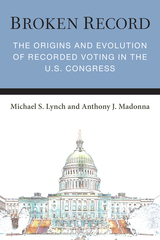
front cover of Broken Record
Broken Record
The Origins and Evolution of Recorded Voting in the U.S. Congress
Michael S. Lynch & Anthony J. Madonna
University of Michigan Press, 2025
Since the 1920s, the roll call voting record has influenced American politics. Using recorded votes, candidates attack electoral opponents, interest groups attempt to drum up financial or electoral support for their preferred candidates, scholars test theories of legislative behavior, and the media characterizes the ideological leanings of Congress. Despite this, there has not been a systematic attempt to document the changing usage of the roll call record. Michael S. Lynch and Anthony J. Madonna have undertaken a massive, multiyear data collection effort that culminated in four new datasets covering from 1905 to the contemporary period. Using data on approximately 120,000 amendments, 60,000 roll call votes, 2,000 important enactments, and 8,000 special rules from 1905 to 2015, the authors demonstrate how the roll call recording system has evolved. 

Consistent with the Founders’ skepticism of the impact of recorded voting in Congress, Broken Record shows that the contemporary roll call voting record includes far more meaningless position-taking and procedural roll call votes than it did during earlier congresses. The book argues that the removal of practical barriers to roll calls, internal changes to legislative procedures, and increased electoral competitiveness have led to more roll call votes on proposals sponsored by more extreme members. In addition to policy making being more difficult, increased roll call voting has played a substantial role in artificially increasing observed levels of polarization. This book argues that solving polarization requires a more nuanced set of solutions than simply replacing legislators; it will require increased public education about how Congress operates and specific procedural reforms.
[more]


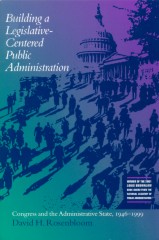
front cover of Building a Legislative-Centered Public Administration
Building a Legislative-Centered Public Administration
Congress and the Administrative State, 1946-1999
David Rosenbloom
University of Alabama Press, 2002

2001 Louis Brownlow Award from the National Academy of Public Administration

Reimagining public administration through the lens of constitutional governance and legislative intent.

Before 1946 the congressional role in public administration had been limited to authorization, funding, and review of federal administrative operations, which had grown rapidly as a result of the New Deal and the Second World War. But in passing the Administrative Procedure Act and the Legislative Reorganization Act that pivotal year, Congress self-consciously created for itself a comprehensive role in public administration. Reluctant to delegate legislative authority to federal agencies, Congress decided to treat the agencies as extensions of itself and established a framework for comprehensive regulation of the agencies' procedures. Additionally, Congress reorganized itself so it could provide continuous supervision of federal agencies.

Rosenbloom shows how these 1946 changes in the congressional role in public administration laid the groundwork for future major legislative acts, including the Freedom of Information Act (1966), Privacy Act (1974), Government in the Sunshine Act (1976), Paperwork Reduction Acts (1980, 1995), Chief Financial Officers Act (1990), and Small Business Regulatory Fairness Enforcement Act (1996). Each of these acts, and many others, has contributed to the legislative-centered public administration that Congress has formed over the past 50 years.

This first book-length study of the subject provides a comprehensive explanation of the institutional interests, values, and logic behind the contemporary role of Congress in federal administration and attempts to move the public administration field beyond condemning legislative "micromanagement" to understanding why Congress values it.

[more]


Send via email Share on Facebook Share on Twitter