
 A SCHOLARLY BOOK REPOSITORY
7 start with B start with B

The proclamation of Belarusian independence on March 25, 1918, and the rival establishment of the Soviet Belarusian state on January 1, 1919, created two distinct and mutually exclusive national myths, which continue to define contemporary Belarusian society. This book examines the processes that resulted in this dual resolution in the context of World War I and the subsequent Russian Revolutions.
Based on original archival material, Lizaveta Kasmach scrutinizes the development of competing concepts of Belarusian nationhood in the context of rivaling national aspirations and imperial policies. The analysis convincingly demonstrates the divisions within the nationalist movement, both politically between the moderates and socialists, and geographically between German-occupied territory with Vilna as a center versus Russian-controlled territory around Minsk. Besides the case study of Belarusian nation-building efforts, the book is a contribution to the study of the First World War in East Central Europe, approaching the war and its aftermath as a mobilizational moment in the region.


The modern Middle East was forged in the crucible of the First World War, but few know the full story of how war actually came to the region. As Sean McMeekin reveals in this startling reinterpretation of the war, it was neither the British nor the French but rather a small clique of Germans and Turks who thrust the Islamic world into the conflict for their own political, economic, and military ends.
The Berlin-Baghdad Express tells the fascinating story of how Germany exploited Ottoman pan-Islamism in order to destroy the British Empire, then the largest Islamic power in the world. Meanwhile the Young Turks harnessed themselves to German military might to avenge Turkey’s hereditary enemy, Russia. Told from the perspective of the key decision-makers on the Turco-German side, many of the most consequential events of World War I—Turkey’s entry into the war, Gallipoli, the Armenian massacres, the Arab revolt, and the Russian Revolution—are illuminated as never before.
Drawing on a wealth of new sources, McMeekin forces us to re-examine Western interference in the Middle East and its lamentable results. It is an epic tragicomedy of unintended consequences, as Turkish nationalists give Russia the war it desperately wants, jihad begets an Islamic insurrection in Mecca, German sabotage plots upend the Tsar delivering Turkey from Russia’s yoke, and German Zionism midwifes the Balfour Declaration. All along, the story is interwoven with the drama surrounding German efforts to complete the Berlin to Baghdad railway, the weapon designed to win the war and assure German hegemony over the Middle East.
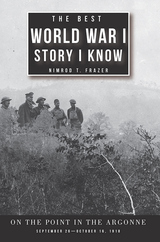
The Best World War I Story I Know: On the Point in the Argonne is the breath-taking story of three US Army divisions tasked with capturing the Côte de Châtillon during the Meuse-Argonne offensive in autumn 1918. Readers will first follow in the footsteps of Missouri-Kansas Guard troops who were repulsed in the opening days of the battle; their courage in the face of heavy fire was not enough to overcome poor leadership.
They were replaced by the 1st Division, the “best of the Regular Army.” This fine unit became physically and mentally exhausted after suffering horrendous casualties. Unable to fight on, “The Big Red One” was exchanged at the base of Côte de Châtillon, with the 42nd, the Rainbow Division. It too struggled to gain ground on the heavily-contested hill until General Douglas MacArthur’s determined 84th Brigade of “Alabama cotton pickers and Iowa corn growers” forced their way past the Germans. The Côte was finally in American hands and the war all but over.


An expansive narrative of World War I’s Eastern Front challenges longstanding analytical frameworks, offering a novel and far-reaching explanation for the emergence of new nation-states from the wreckage of Europe’s land empires.
In August 1914, Germany, Austria, and Russia sent millions of soldiers hurtling toward one another across the volatile borderlands of Central Europe. The early battles produced appalling casualties but no decisive triumphs; the Great War’s Eastern Front would remain a cauldron of death and destruction for years. And unlike in western Europe, the killing would not end in 1918. With the collapse of the three empires, the front dissolved into a series of overlapping civil, international, and revolutionary wars that would continue for several years more.
The connections among prewar, wartime, and postwar events in Central Europe are so strong, argues Jesse Kauffman, that we should analyze the conflict there in new chronological terms: starting with the Russian Revolution in1905 and continuing until at least the 1921 Treaty of Riga. In particular, The Blood-Dimmed Tide shows that the emergence of sovereign nation-states in postwar Central Europe was neither the inevitable triumph of long-thwarted national ambitions nor a wholly contingent, unforeseeable outcome of the war. Rather, modern states emerged from a conscious decision taken by all the belligerents to encourage the nationalist aspirations of imperial subjects in their enemies’ territories.
Indeed, the repercussions of Central Europe’s long Great War can be felt all the way to today’s conflict in Ukraine. It might be time to retire Eric Hobsbawm’s famous notion of the “short twentieth century”—1914 to 1991—and to consider instead that the twentieth century has not yet drawn to a close.
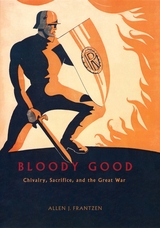
Here for the first time, Allen J. Frantzen traces these chivalric ideals from the Great War back to their origins in the Middle Ages and shows how they resulted in highly influential models of behavior for men in combat. Drawing on a wide selection of literature and images from the medieval period, along with photographs, memorials, postcards, war posters, and film from both sides of the front, Frantzen shows how such media shaped a chivalric ideal of male sacrifice based on the Passion of Jesus Christ. He demonstrates, for instance, how the wounded body of Christ became the inspiration for heroic male suffering in battle. For some men, the Crucifixion inspired a culture of revenge, one in which Christ's bleeding wounds were venerated as badges of valor and honor. For others, Christ's sacrifice inspired action more in line with his teachings—a daring stay of hands or reason not to visit death upon one's enemies.
Lavishly illustrated and eloquently written, Bloody Good will be must reading for anyone interested in World War I and the influence of Christian ideas on modern life.
READERS
Browse our collection.
PUBLISHERS
See BiblioVault's publisher services.
STUDENT SERVICES
Files for college accessibility offices.
RECENTLY PUBLISHED




UChicago Accessibility Resources
home | accessibility | search | about | contact us
BiblioVault ® 2001 - 2025
The University of Chicago Press