
 A SCHOLARLY BOOK REPOSITORY
2474 start with C start with C
Jessica Yood traces the century-long origins of a writing-centered idea of the American university and tracks the resurgence of this idea today. Drawing on archival and classroom evidence from public colleges and universities and written in a lively autoethnographic voice, Yood names “genres of the commons”: intimate, informal writing activities that create peer-to-peer knowledge networks. She shows how these unique genres create collectivity—an academic commons—and calls on scholars to invest in composition as a course cultivating reflective, emergent, shared knowledge. Yood departs from movements that divest from the first-year composition classroom and details how an increasingly diverse student population composes complex, evolving cultural literacies that forge social bonds and forward innovation and intellectual and civic engagement.
The Composition Commons reclaims the commons as critical idea and writing classroom activities as essential practices for remaking higher education in the United States.

With Computer Game Worlds, Claus Pias sets out to answer these questions. Tracing computer games from their earliest forms to the unstoppable commercial and cultural phenomena they have become today, Pias then provides a careful epistemological reconstruction of the process of playing games, both at computers and by computers themselves. The book makes a valuable theoretical contribution to the ongoing discussion about computer games.

A deconstruction of gender through the voices of Siri, HAL 9000, and other computers that talk
Although computer-based personal assistants like Siri are increasingly ubiquitous, few users stop to ask what it means that some assistants are gendered female, others male. Why is Star Trek’s computer coded as female, while HAL 9000 in 2001: A Space Odyssey is heard as male? By examining how gender is built into these devices, author Liz W. Faber explores contentious questions around gender: its fundamental constructedness, the rigidity of the gender binary, and culturally situated attitudes on male and female embodiment.
Faber begins by considering talking spaceships like those in Star Trek, the film Dark Star, and the TV series Quark, revealing the ideologies that underlie space-age progress. She then moves on to an intrepid decade-by-decade investigation of computer voices, tracing the evolution from the masculine voices of the ’70s and ’80s to the feminine ones of the ’90s and ’00s. Faber ends her account in the present, with incisive looks at the film Her and Siri herself.
Going beyond current scholarship on robots and AI to focus on voice-interactive computers, The Computer’s Voice breaks new ground in questions surrounding media, technology, and gender. It makes important contributions to conversations around the gender gap and the increasing acceptance of transgender people.

Critical and iconoclastic, Comrade or Brother? traces the history of the British Labour Movement from its beginnings at the onset of industrialisation through its development within a capitalist society, up to the end of the twentieth-century. Written by a leading activist in the labour movement, the book redresses the balance in much labour history writing. It examines the place of women and the influence of racism and sexism as well as providing a critical analysis of the rival ideologies which played a role in the uneven development of the labour movement.

William Benton Whisenhunt draws on the largely untapped archive of Williams’s papers to provide a first-ever biography of the dedicated radical writer. Williams spent nearly ten years living and traveling in the USSR, where he observed the Soviet system and reported on it with unusual nuance in numerous books, articles, and speeches. Whisenhunt follows Williams from his early life as a lumberyard worker and preacher through his participation in the Revolution and his long career as a radical writer. Able to see socialism as flawed, Williams’s nonetheless defended it as an alternative to capitalism with such vigor that correspondents often addressed him as Comrade Rhys.
Astute and richly detailed, Comrade Rhys reveals the life and work of an overlooked radical thinker.
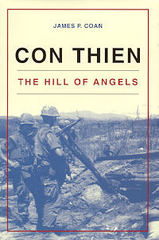
Holding the Hill of Angels: A Marine’s Fight for Survival at the DMZ.
Throughout much of 1967, a remote United States Marine firebase only two miles from the demilitarized zone (DMZ) captured the attention of the world’s media. That artillery-scarred outpost was the linchpin of the so-called McNamara Line intended to deter incursions into South Vietnam by the North Vietnamese Army. As such, the fighting along this territory was particularly intense and bloody, and the body count rose daily.
Con Thien combines James P. Coan’s personal experiences with information taken from archives, interviews with battle participants, and official documents to construct a powerful story of the daily life and combat on the red clay bulls-eye known as "The Hill of Angels." As a tank platoon leader in Alpha Company, 3d Tank Battalion, 3d Marine Division, Coan was stationed at Con Thien for eight months during his 1967-68 service in Vietnam and witnessed much of the carnage.
Con Thien was heavily bombarded by enemy artillery with impunity because it was located in politically sensitive territory and the U.S. government would not permit direct armed response from Marine tanks. Coan, like many other soldiers, began to feel as though the government was as much the enemy as the NVA, yet he continued to fight for his country with all that he had. In his riveting memoir, Coan depicts the hardships of life in the DMZ and the ineffectiveness of much of the U.S. military effort in Vietnam.
Based on extensive archival research conducted at six American universities and using the specific cases of institutional mission, regional accreditation, and federal funding, this study demonstrates that administrators and faculty have introduced, reformed, maintained, threatened, or eliminated composition as part of negotiations related to nondisciplinary institutional exigencies. Viewing composition from this perspective, author Ryan Skinnell raises new questions about why composition exists in the university, how it exists, and how teachers and scholars might productively reconceive first-year composition in light of its institutional functions.
The book considers the rhetorical, political, organizational, institutional, and promotional options conceding composition opened up for institutions of higher education and considers what the first-year course and the discipline might look like with composition’s transience reimagined not as a barrier but as a consummate institutional value.
Americans have long acknowledged a deep connection between evangelical religion and democracy in the early days of the republic. This is a widely accepted narrative that is maintained as a matter of fact and tradition—and in spite of evangelicalism’s more authoritarian and reactionary aspects.
In Conceived in Doubt, Amanda Porterfield challenges this standard interpretation of evangelicalism’s relation to democracy and describes the intertwined relationship between religion and partisan politics that emerged in the formative era of the early republic. In the 1790s, religious doubt became common in the young republic as the culture shifted from mere skepticism toward darker expressions of suspicion and fear. But by the end of that decade, Porterfield shows, economic instability, disruption of traditional forms of community, rampant ambition, and greed for land worked to undermine heady optimism about American political and religious independence. Evangelicals managed and manipulated doubt, reaching out to disenfranchised citizens as well as to those seeking political influence, blaming religious skeptics for immorality and social distress, and demanding affirmation of biblical authority as the foundation of the new American national identity.
As the fledgling nation took shape, evangelicals organized aggressively, exploiting the fissures of partisan politics by offering a coherent hierarchy in which God was king and governance righteous. By laying out this narrative, Porterfield demolishes the idea that evangelical growth in the early republic was the cheerful product of enthusiasm for democracy, and she creates for us a very different narrative of influence and ideals in the young republic.
While the basic facts of Japanese-American incarceration are well known, John Howard’s extensive research gives voice to those whose stories have been forgotten or ignored. He highlights the roles of women, first-generation immigrants, and those who forcefully resisted their incarceration by speaking out against dangerous working conditions and white racism. In addition to this overlooked history of dissent, Howard also exposes the government’s aggressive campaign to Americanize the inmates and even convert them to Christianity. After the war ended, this movement culminated in the dispersal of the prisoners across the nation in a calculated effort to break up ethnic enclaves.
Howard’s re-creation of life in the camps is powerful, provocative, and disturbing. Concentration Camps on the Home Front rewrites a notorious chapter in American history—a shameful story that nonetheless speaks to the strength of human resilience in the face of even the most grievous injustices.
As John Philip Reid goes on to make clear, "liberty" did not mean to the eighteenth-century mind what it means today. In the twentieth century, we take for granted certain rights—such as freedom of speech and freedom of the press—with which the state is forbidden to interfere. To the revolutionary generation, liberty was preserved by curbing its excesses. The concept of liberty taught not what the individual was free to do but what the rule of law permitted. Ultimately, liberty was law—the rule of law and the legalism of custom. The British constitution was the charter of liberty because it provided for the rule of law.
Drawing on an impressive command of the original materials, Reid traces the eighteenth-century notion of liberty to its source in the English common law. He goes on to show how previously problematic arguments involving the related concepts of licentiousness, slavery, arbitrary power, and property can also be fit into the common-law tradition. Throughout, he focuses on what liberty meant to the people who commented on and attempted to influence public affairs on both sides of the Atlantic. He shows the depth of pride in liberty—English liberty—that pervaded the age, and he also shows the extent—unmatched in any other era or among any other people—to which liberty both guided and motivated political and constitutional action.

John Phillip Reid goes on to argue that it was generally the application, not the definition, of these rights that was disputed. The sole—and critical—exception concerned the right of representation. American perceptions of the responsibility of representatives to their constituents, the necessity of equal representation, and the constitutional function of consent had diverged gradually, but significantly, from British tradition. Drawing on his mastery of eighteenth-century legal thought, Reid explores the origins and shifting meanings of representation, consent, arbitrary rule, and constitution. He demonstrates that the controversy which led to the American Revolution had more to do with jurisprudential and constitutional principles than with democracy and equality. This book will interest legal historians, Constitutional scholars, and political theorists.

Conceptual Harmonies develops an original account of G. W. F. Hegel’s perplexing Science of Logic from a simple insight: philosophical and mathematical thought have shaped each other since classical times. Situating Science of Logic within the rise of modern mathematics, Redding stresses Hegel’s attention to Pythagorean ratios, Platonic reason, and Aristotle’s geometrically inspired logic. He then explores how later traditions shaped Hegel’s world, through both Leibniz and new forms of algebraic geometry. This enlightening reading recovers an overlooked stream in Hegel’s philosophy that remains, Redding argues, important for contemporary conceptions of logic.
The essays in this book focus primarily on performance art and photography. From war and environmental pollution to racism and sexual assault, Stiles analyzes the consequences of trauma as seen in the works of artists like Marina Abramovic, Pope.L, and Chris Burden. Assembling rich intellectual explorations on everything from Paleolithic paintings to the Bible’s patriarchal legacies to documentary images of nuclear explosions, Concerning Consequences explores how art can provide a distinctive means of understanding trauma and promote individual and collective healing.

The 1,400-year-old schism between Sunnis and Shi’is is currently reflected in the destructive struggle for hegemony between Saudi Arabia and Iran—with no apparent end in sight. But how did this conflict begin, and why is it now the focus of so much attention?
Charting the history of Islam from the death of the Prophet Muhammad to the present day, John McHugo describes the conflicts that raged over the succession to the Prophet, how Sunnism and Shi’ism evolved as different sects during the Abbasid caliphate, and how the rivalry between the Sunni Ottomans and Shi’i Safavids ensured that the split would continue into the modern age. In recent decades, this centuries-old divide has acquired a new toxicity that has resulted in violence across the Arab world and other Muslim countries.
Definitive, insightful, and accessible, A Concise History of Sunnis and Shi'is is an essential guide to understanding the genesis, development, and manipulation of the schism that for far too many people has come to define Islam and the Muslim world.
In their Concise History of Woman Suffrage, Mari Jo Buhle and Paul Buhle have revitalized this classic text by carefully selecting from among its best material. The eighty-two chosen documents, now including interpretative introductory material by the editors, give researchers easy access to material that the original work's arrangement often caused readers to ignore or to overlook.
The volume contains the work of many reform agitators, among them Angelina Grimké, Lucy Stone, Carrie Chapman Catt, Charlotte Perkins Gilman, Anna Howard Shaw, Jane Addams, Sojourner Truth, and Victoria Woodhull, as well as Elizabeth Cady Stanton, Susan B. Anthony, Matilda Joslyn Gage, and Ida Husted Harper.
Braund presents the only annotated edition of Bernard Romans's rare and valuable 18th-century account of his observations in the southeastern United States.
Bernard Romans's A Concise Natural History of East and West Florida, William Bartram's Travels, and James Adair's History of the American Indian are the three most significant accounts of the southeastern United States published during the late 18th century. This new edition of Romans's Concise Natural History, edited by historian Kathryn Braund, provides the first fully annotated edition of this early and rare description of both the European settled areas and the adjoining Indian lands in what are now the states of Florida, Georgia, Alabama, Mississippi, and Louisiana.
Romans's purpose in producing his Concise Natural History was twofold: to aid navigators and shippers by detailing the sailing passages of the region and to promote trade and settlement in the region. To those ends, he provided detailed scientific observations on the natural history of the area, a summary of the region's political history, and an assessment of the potential for economic growth in the Floridas based on the area's natural resources.
A trained surveyor and cartographer and a self-taught naturalist, Romans supplied detailed descriptions of the region's topography and environment, including information about the climate and weather patterns, plants, animals, and diseases. He provided information about the state of scientific inquiry in the South and touched on many of the most important intellectual arguments of the day, such as the origin of the races, the practice of slavery, and the benefits and drawbacks of monopoly on trade.
In addition, Concise Natural History can be placed firmly in the genre of colonial promotional literature. Romans's book was an enthusiastic guide aimed at those seeking to establish modest holdings in the region:
"What a field is open here! . . . No country ever had such inexhaustible resources; no empire had ever half so many advantages combining in its behalf!" Romans explained how settlers should travel to the area, what they would need in terms of provisions and tools, and what it would cost to have their land surveyed. In addition to providing an abundance of practical advice, Romans also offered information about the history of earlier settlements, including the earliest and most complete account of New Smyrna near St. Augustine.
Romans also presented unique information about the various Indian tribes he encountered. In fact, historians agree that among the most useful portions of the book are Romans's descriptions of the largest Indian tribes in the 18th-century Southeast: the Creeks, Choctaws, and Chickasaws. Romans's account of the diet of the Creeks and Choctaws is one of the most complete available. And his description of the location of Choctaw village sites is one of the best sources for this information.
Focusing on the Congressional Black Caucus (CBC), Katherine Tate studies the ways in which the nation’s most prominent group of Black legislators has developed politically. Organized in 1971, the CBC set out to increase the influence of Black legislators. Indeed, over the past four decades, they have made progress toward the goal of becoming recognized players within Congress. And yet, Tate argues, their incorporation is transforming their policy preferences. Since the Clinton Administration, CBC members—the majority of whom are Democrats—have been less willing to oppose openly congressional party leaders and both Republican and Democratic presidents. Tate documents this transformation with a statistical analysis of Black roll-call votes, using the important Poole-Rosenthal scores from 1977 to 2010. While growing partisanship has affected Congress as a whole, not just minority caucuses, Tate warns that incorporation may mute the independent voice of Black political leaders.
During the height of the civil rights movement, Blacks were among the most liberal Americans. Since the 1970s, however, increasing representation in national, state, and local government has brought about a more centrist outlook among Black political leaders.
Focusing on the Congressional Black Caucus (CBC), Katherine Tate studies the ways in which the nation’s most prominent group of Black legislators has developed politically. Organized in 1971, the CBC set out to increase the influence of Black legislators. Indeed, over the past four decades, they have made progress toward the goal of becoming recognized players within Congress. And yet, Tate argues, their incorporation is transforming their policy preferences. Since the Clinton Administration, CBC members—the majority of whom are Democrats—have been less willing to oppose openly congressional party leaders and both Republican and Democratic presidents. Tate documents this transformation with a statistical analysis of Black roll-call votes, using the important Poole-Rosenthal scores from 1977 to 2010. While growing partisanship has affected Congress as a whole, not just minority caucuses, Tate warns that incorporation may mute the independent voice of Black political leaders.
Concrete has been used in arches, vaults, and domes dating as far back as the Roman Empire. Today, it is everywhere—in our roads, bridges, sidewalks, walls, and architecture. For each person on the planet, nearly three tons of concrete are produced every year. Used almost universally in modern construction, concrete has become a polarizing material that provokes intense loathing in some and fervent passion in others.
Focusing on concrete’s effects on culture rather than its technical properties, Concrete and Culture examines the ways concrete has changed our understanding of nature, of time, and even of material. Adrian Forty concentrates not only on architects’ responses to concrete, but also takes into account the role concrete has played in politics, literature, cinema, labor-relations, and arguments about sustainability. Covering Europe, North and South America, and the Far East, Forty examines the degree that concrete has been responsible for modernist uniformity and the debates engendered by it. The first book to reflect on the global consequences of concrete, Concrete and Culture offers a new way to look at our environment over the past century.
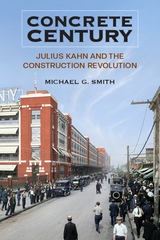
Drawing upon Kahn’s personal correspondence, architectural drawings, company records, and contemporary news and journal articles, Michael G. Smith reveals how this man—whose family had immigrated to the US to escape antisemitism in Germany—played an important role in the rise of concrete. Concrete not only turned the tide against widespread destruction of buildings by fire, it also paved the way for our modern economy. Concrete Century will delight readers intrigued by architecture and construction technology alike with the true origin story of modern concrete buildings.
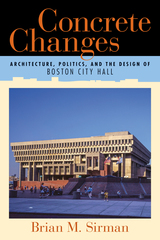
And yet Boston City Hall frequently ranks among the country's ugliest buildings. Concrete Changes seeks to answer a common question for contemporary viewers: How did this happen? In a lively narrative filled with big personalities and newspaper accounts, Brian M. Sirman argues that this structure is more than a symbol of Boston's modernization; it acted as a catalyst for political, social, and economic change.
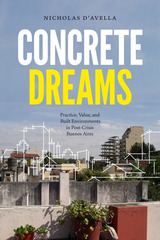
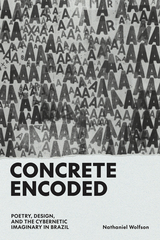
A study of concrete art and poetry, its implications, and influence in Brazil.
Concrete art and poetry burst onto Brazil’s cultural stage in the 1950s, while the country was embarking on a dizzying period of modernization. Bringing together key poets and visual artists alongside less recognized figures, Nathaniel Wolfson shows that concretism was hardly socially inert, as pundits have suggested. Rather, it presciently grappled with an emerging information age that would soon reorganize human relations globally.
Concrete Encoded describes a nascent cybernetic imaginary. Concretism has long been considered Brazil’s most global aesthetic movement. Wolfson traces new circles of international theorists and practitioners involved in critical technological thought. Wolfson argues that concrete poetry is the quintessential literary genre of the early information age. He shows that Brazilian poets, artists, and designers contested the military dictatorship’s technological authoritarianism and information-gathering operations. Vigorous experimentalists, their attention to form and semantics unveiled both the creative and nefarious possibilities of algorithmic writing. A highly original work, Concrete Encoded reckons with aesthetic responses from Brazil to an advancing capitalist and digital era.
Struggles over critical urban technologies during and after Morocco’s French Protectorate reveal a fundamental conflict over the nature of decolonization in the country.
Concrete Futures is a history of concrete that complicates our view of the building material, revealing it as a site of contestation over resources and authority in twentieth-century Morocco. Beginning with the French protectorate period between 1912 and 1956 and continuing into the post-independence era, Daniel Williford uses debates surrounding concrete building technologies as a conduit through which to explore struggles over colonization, modernization, and decolonization. The half-finished cinder block buildings found in cities all over Morocco, he shows, are a product of the system that colonial engineers and officials developed to deal with labor disputes, contests over knowledge, and anticolonial unrest.
By exploring concrete and its uses, Williford discloses how conflicts between experts, workers, and residents over construction and urban renewal—from the introduction of reinforced concrete to strategies of slum clearance—shaped the meaning and the trajectory of decolonization in Morocco.

Offers an insightful new way to understand the construction and consequences of the US interstate highway system, expanding and revising the common story.
In Concrete Leviathan, historian Teal Arcadi denaturalizes the interstate highway system, interrogating the ideologies, fiscal mechanisms, and legal tools that led to the construction of a vast and permanent physical infrastructure—and then made it all but impossible to change course. Arcadi argues that the US interstate highway system was built by an unaccountable regime of law and political economy that systematically created and insulated structures of governance. The power of these administrative and physical structures has been such that even when people have mobilized to oppose or try to change them, their protests have tended only to reveal the extent and power of the infrastructural state.
At the same time, Concrete Leviathan shows how resistance to this infrastructure’s inequities generated new democratic ideas and practices, pointing toward more participatory structures of government and more equitable models of state building.
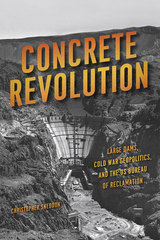
Founded in 1902, the Bureau became enmeshed in the US State Department’s push for geopolitical power following World War II, a response to the Soviet Union’s increasing global sway. By offering technical and water resource management advice to the world’s underdeveloped regions, the Bureau found that it could not only provide them with economic assistance and the United States with investment opportunities, but also forge alliances and shore up a country’s global standing in the face of burgeoning communist influence. Drawing on a number of international case studies—from the Bureau’s early forays into overseas development and the launch of its Foreign Activities Office in 1950 to the Blue Nile investigation in Ethiopia—Concrete Revolution offers insights into this historic damming boom, with vital implications for the present. If, Sneddon argues, we can understand dams as both technical and political objects rather than instruments of impartial science, we can better participate in current debates about large dams and river basin planning.
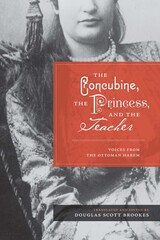
In the Western imagination, the Middle Eastern harem was a place of sex, debauchery, slavery, miscegenation, power, riches, and sheer abandon. But for the women and children who actually inhabited this realm of the imperial palace, the reality was vastly different. In this collection of translated memoirs, three women who lived in the Ottoman imperial harem in Istanbul between 1876 and 1924 offer a fascinating glimpse "behind the veil" into the lives of Muslim palace women of the late nineteenth and early twentieth centuries.
The memoirists are Filizten, concubine to Sultan Murad V; Princess Ayse, daughter of Sultan Abdulhamid II; and Safiye, a schoolteacher who instructed the grandchildren and harem ladies of Sultan Mehmed V. Their recollections of the Ottoman harem reveal the rigid protocol and hierarchy that governed the lives of the imperial family and concubines, as well as the hundreds of slave women and black eunuchs in service to them. The memoirists show that, far from being a place of debauchery, the harem was a family home in which polite and refined behavior prevailed. Douglas Brookes explains the social structure of the nineteenth-century Ottoman palace harem in his introduction.
These three memoirs, written across a half century and by women of differing social classes, offer a fuller and richer portrait of the Ottoman imperial harem than has ever before been available in English.
African Studies Association Women’s Caucus’s Aidoo-Snyder Book Prize winner
A Choice Outstanding Academic Title
The monumental palace of Kano, Nigeria, was built circa 1500 and is today inhabited by more than one thousand persons. Historically, its secluded interior housed hundreds of concubines whose role in the politics, economics, and culture of Kano city-state has been largely overlooked. In this pioneering work, Heidi J. Nast demonstrates how human-geographical methods can tell us much about a site like the palace, a place bereft of archaeological work or relevant primary sources.
Drawing on extensive ethnographic work and mapping data, Concubines and Power presents new evidence that palace concubines controlled the production of indigo-dyed cloth centuries before men did. The women were also key players in the assessment and collection of the state's earliest grain taxes, forming a complex and powerful administrative hierarchy that used the taxes for palace community needs. In addition, royal concubines served as representatives of their places of origin, their freeborn children providing the king with additional human capital to cement territorial alliances through marriage.
Social forces undoubtedly shaped and changed concubinage for hundreds of years, but Nast shows how the women’s reach extended far beyond the palace walls to the formation of the state itself.
In A Conditional Embrace, Kristyl D. Tift seeks to understand how Black queer women theater and film artists depict their own survival in heterosexist temporalities and spaces. Using the framework of lovin’ on—a theory inspired by Black feminist thought, performance theory, and queer theory—Tift closely reads the works of a selection of artists to investigate the “conditional embrace” of Black queer art in society. Her intersectional and intertextual methodology considers the text and body as part and parcel of performance work, allowing her to examine the multiple and complex intersections of identity at play in works meant to be read and performed. Tift puts the work of more visible artists such as Dee Rees, Sharon Bridgforth, and Staceyann Chin in direct conversation with lesser-known contributors to Black queer feminist performance such as Shirlene Holmes and Donnetta Lavinia Grays, analyzing not only their plays, installations, and poetry but also interviews, personal essays, performances, and more. Centering the works of artists situated, by birth or migration, in the Southern US and the Caribbean, A Conditional Embrace explores how artists at the margins of art and society represent Black queer women’s survival through processes of self-making, community-building, and homemaking.
Contributors. Elizabeth Alexander, Jennifer DeVere Brody, Daphne A. Brooks, Linh U. Hua, Janet Neary, Marlon B. Ross, Robyn Wiegman
In The Confederacy Charles P. Roland is faithful to both the larger career and the internal complexity. Paying careful attention to President Davis' struggle against dividing forces within, the author skillfully narrates the attempt of the Confederacy to wage total war against superior forces. All the poignant events and conditions are here: the formation of the government, the upper South's final commitment to the cause, the doomed attempts to combat the Northern blockade at home and Northern diplomacy overseas, an agrarian economy's heroic defiance of an industrial enemy, the desperate measures by which the Davis government tried to sustain the Confederacy, and, at last, the dissolution and flight of the administration in 1865.
With accuracy, sensitivity, and balance, Mr. Roland develops the epic themes of his story against a background of vivid historical detail and re-creates the Confederacy with a tragic splendor—the prime quality of its surviving image among Southerners.
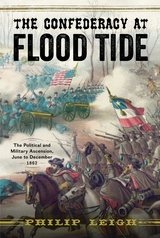
The first six months of 1862 provided a string of Federal victories in the West at Mill Springs, Fort Donelson, Pea Ridge, Island Number 10, and Shiloh. In May, New Orleans fell, and Union General George McClellan’s army was so close to the Confederate capital of Richmond, Virginia, that the troops could set their watches by the city’s church bells. But then the unexpected happened. In June, Robert E. Lee’s Army of Northern Virginia pushed McClellan’s much larger army back to the James River. In Europe, Confederate diplomats sought international recognition for the Confederate States of America, which was made even more attractive now that a shortage of cotton made the powerful textile interests anxious to end the war. Further tipping the balance, in July, the Confederacy secretly ordered two of the latest ironclad ships from England’s famous Laird Shipyard—the same yard that built the commerce raider Alabama. These steam-powered ironclads would be far superior to anything in the Federal navy.
While the “high tide” of the Confederacy is often identifed as Pickett’s Charge during the Battle of Gettysburg in July 1863, the most opportune time for the Confederacy vanished seven months earlier, coinciding with President Abraham Lincoln’s Emancipation Proclamation on January 1, 1863 and the failure of the secessionist states to be recognized as a sovereign nation. As Philip Leigh explains in his engrossing new book, The Confederacy at Flood Tide: The Political and Military Ascension, June to December 1862, on every battlefront and in the governmental halls of Europe, the Confederate effort reached its furthest extent during the second half of 1862. But with the president’s proclamation, battlefield reverses, Europe's decision to reject Confederate diplomatic overtures, and Britian's decision to halt the sale of the ironclads, the opportunity for Confederate success ended. The Confederacy would recede, and the great battles of 1863 and 1864 only marked the Southerners’ tenacity and stubborn belief in a lost cause.
The Confederacy’s Fighting Chaplain is the remarkable story of the Irishman who brought the Bible and his own resourcefulness and daring to both the battlefield and the diplomatic field—a story that has been largely ignored for more than 130 years. The biography of John B. Bannon also chronicles the forgotten Southerners—the Irish immigrants of the Confederacy—whose colorful and crucial role in the Civil War has been seriously neglected.
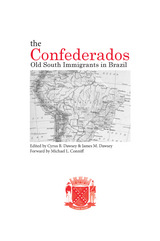
The story of exiles from the Confederate South who fled to Brazil after the US Civil War. The collection includes a previously unpublished narrative by an original settler
In the wake of the American Civil War, thousands of disillusioned Southerners sought refuge far from Reconstruction’s reach—many found it in Brazil. The Confederados is a compelling exploration of this little-known migration, tracing the journey of Confederate exiles who forged new lives in the sugarcane fields of São Paulo. Through vivid personal narratives, scholarly essays, and rare archival insights, this volume uncovers the cultural, agricultural, and religious legacy these settlers left behind.
From the harrowing voyage of Sarah Bellona Smith Ferguson to the enduring traditions of the Campo chapel, the book reveals how these Americans shaped—and were shaped by—their Brazilian surroundings. It examines their impact on education, Protestantism, and farming, and how their descendants maintain a distinct identity more than a century later.
Richly illustrated and deeply researched, The Confederados is essential reading for anyone interested in Southern history, diaspora studies, or the global echoes of the Civil War. This is not just a story of exile—it’s a testament to resilience, adaptation, and the enduring ties between two nations.

Another Confederate cavalry raid impends. You hear the snort of an impatient horse, the leathery squeaking of saddles, the low-voiced commands of officers, the muffled cluck of guns cocked in preparation—then the sudden rush of motion, the din of another attack.
This classic story seeks to illuminate a little-known theater of the Civil War—the cavalry battles of the Trans-Mississippi West, a region that included Missouri, Arkansas, Texas, the Indian Territory, and part of Louisiana. Stephen B. Oates traces the successes and defeats of the cavalry; its brief reinvigoration under John S. "Rip" Ford, who fought and won the last battle of the war at Palmetto Ranch; and finally, the disintegration of this once-proud fighting force.
Confederate Cities, edited by Andrew L. Slap and Frank Towers, shifts the focus from the agrarian economy that undergirded the South to the cities that served as its political and administrative hubs. The contributors use the lens of the city to examine now-familiar Civil War–era themes, including the scope of the war, secession, gender, emancipation, and war’s destruction. This more integrative approach dramatically revises our understanding of slavery’s relationship to capitalist economics and cultural modernity. By enabling a more holistic reading of the South, the book speaks to contemporary Civil War scholars and students alike—not least in providing fresh perspectives on a well-studied war.
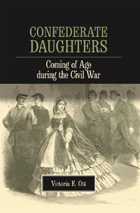
Confederate Daughters: Coming of Age during the Civil War explores gender, age, and Confederate identity by examining the lives of teenage daughters of Southern slaveholding, secessionist families. These young women clung tenaciously to the gender ideals that upheld marriage and motherhood as the fulfillment of female duty and to the racial order of the slaveholding South, an institution that defined their status and afforded them material privileges. Author Victoria E. Ott discusses how the loyalty of young Southern women to the fledgling nation, born out of a conservative movement to preserve the status quo, brought them into new areas of work, new types of civic activism, and new rituals of courtship during the Civil War.
Social norms for daughters of the elite, their preparation for their roles as Southern women, and their material and emotional connections to the slaveholding class changed drastically during the Civil War. When differences between the North and South proved irreconcilable, Southern daughters demonstrated extraordinary agency in seeking to protect their futures as wives, mothers, and slaveholders.
From a position of young womanhood and privilege, they threw their support behind the movement to create a Confederate identity, which was in turn shaped by their participation in the secession movement and the war effort. Their political engagement is evident from their knowledge of military battles, and was expressed through their clothing, social activities, relationships with peers, and interactions with Union soldiers.
Confederate Daughters also reveals how these young women, in an effort to sustain their families throughout the war, adjusted to new domestic duties, confronting the loss of slaves and other financial hardships by seeking paid work outside their homes.
Drawing on their personal and published recollections of the war, slavery, and the Old South, Ott argues that young women created a unique female identity different from that of older Southern women, the Confederate bellehood. This transformative female identity was an important aspect of the Lost Cause mythology—the version of the conflict that focused on Southern nationalism—and bridged the cultural gap between the antebellum and postbellum periods.
Augmented by twelve illustrations, this book offers a generational understanding of the transitional nature of wartime and its effects on women’s self-perceptions. Confederate Daughters identifies the experiences of these teenage daughters as making a significant contribution to the new woman in the New South.
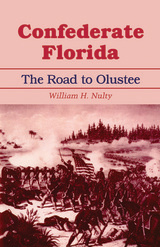
At the end of 1863 the Federal forces in the Department of the South were tied up in siege operations against Charleston and Savannah, operations that showed little progress or promise. The commander of the Department, Major General Quincy A. Gillmore, led an expedition into Florida to recruit blacks, cut off commissary supplies headed for other parts of the Confederacy, and disrupt the railroad system within Florida. Expedition forces landed at Jacksonville on February 7, 1864.
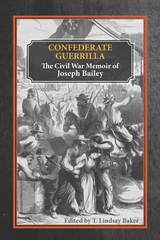
Joseph M. Bailey’s memoir, Confederate Guerrilla, provides a unique perspective on the fighting that took place behind Union lines in Federal-occupied northwest Arkansas during and after the Civil War. This story—now published for the first time—will appeal to modern readers interested in the grassroots history of the Trans-Mississippi war. Bailey participated in the Battle of Pea Ridge and the siege of Port Hudson, eventually escaping to northwest Arkansas where he fought as a guerrilla against Federal troops and civilian unionists. After Federal forces gained control of the area, Bailey rejoined the Confederate army and continued in regular service in northeast Texas until the end of the war.
Historians will find the descriptions of military campaigns and the observations on guerrilla war especially valuable. According to Bailey, Southern guerrillas were motivated less by a sense of loyalty to either the Confederate or Union side than by a determination to protect their families and neighbors from the “Mountain Federals.” This partisan war waged between the rebel guerrillas and Southern Unionists was essentially a “struggle for supremacy and revenge.”
Comprehensive annotations are provided by editor T. Lindsay Baker to illuminate the clarity and reliability of Bailey’s late-life memoir.
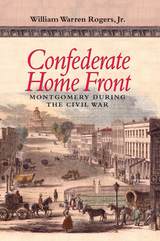
Drawing from a wealth of historic documents and personal papers, William Warren Rogers, Jr., provides a fascinating and detailed political, economic, social, and commercial history of Montgomery from 1860 to 1865. His account begins with an examination of daily life in the city before the war began-how slaves outnumbered whites, how an unvarnished frontier atmosphere prevailed on the streets despite citizens' claims to refinement, how lush crops of corn and cotton grew in fields right up to the city limits, and how class divisions were distinct and immovable.
Rogers arranges his material topically, covering the events that led to the decision for secession and Montgomery's heady days as the Confederacy's first capital; the industrialization of the city's war effort as it became a hub of activity and served as a military post; the city's business patterns and administration as it attempted to promote the Confederacy and defend itself from federal forces; and the plight of the small group of Unionists who inhabited Montgomery through the war. Rogers concludes with chapters examining the situation in Montgomery as the Confederacy unraveled and the city fell to Union troops.
The Montgomery experience offers a microcosm of life on the Confederate home front and demonstrates that citizens generally experienced the same hopes, deprivations, and tragedies that other Southerners did at this time. Rogers's well-written, comprehensive history of the wartime city makes an original contribution to Civil War homefront and community studies that should appeal to general readers and scholars alike.
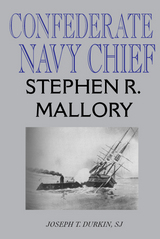
The book tells of Stephen R. Mallory's support of naval inventions, strategy, and ideas. It also sheds light on the the successes and failures of Jefferson Davis. Durkin gives a well-balanced biography of Mallory and his life in the Confederate navy.

Originally published in 1984, The Confederate Navy in Europe is the first full account of the European activities of the Confederate navy during the American Civil War, including information on the Southerners who procured naval vessels in Great Britain and France, the construction of the ships, and the legal and political impact on the European governments that assisted in the Confederate cause.
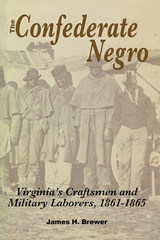
A superb work in the social history of American industry
A Gettysburg College "Top 200 Civil War Books" selection
Mayflower Award Winner for 1970
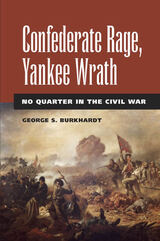
Author George S. Burkhardt details a fascinating case that the Confederates followed a consistent pattern of murder against the black soldiers who served in Northern armies after Lincoln’s 1863 Emancipation Proclamation. He shows subsequent retaliation by black soldiers and further escalation by the Confederates, including the execution of some captured white Federal soldiers, those proscribed as cavalry raiders, foragers, or house-burners, and even some captured in traditional battles.
Further disproving the notion of Confederates as victims who were merely trying to defend their homes, Burkhardt explores the motivations behind the soldiers’ actions and shows the Confederates’ rage at the sight of former slaves—still considered property, not men—fighting them as equals on the battlefield.
Burkhardt’s narrative approach recovers important dimensions of the war that until now have not been fully explored by historians, effectively describing the systemic pattern that pushed the conflict toward a black flag, take-no-prisoners struggle.
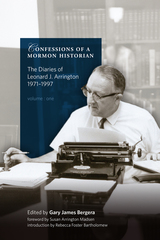
Leonard Arrington (1917–99) was born an Idaho chicken rancher whose early interests seemed not to extend much beyond the American west. Throughout his life, he tended to project a folksy persona, although nothing was farther from the truth.
He was, in fact, an intellectually oriented, academically driven young man, determined to explore the historical, economic, cultural, and religious issues of his time. After distinguishing himself at the University of North Carolina (Chapel Hill) and serving in the army during World War II in North Africa and Italy, Arrington accepted a professorship at Utah State University. In 1972 he was called as the LDS Church Historian—an office he held for ten years until, following a stormy tenure full of controversy over whether the “New Mormon History” he championed was appropriate for the church, he was quietly released and transferred, along with the entire Church History Division, to Brigham Young University. It was hoped that this would remove the impression in people’s minds that his writings were church-approved.
His personal diaries reveal a man who was firmly committed to his church, as well as to rigorous historical scholarship. His eye for detail made him an important observer of “church headquarters culture.”
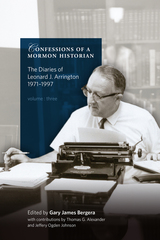
Leonard Arrington (1917–99) was born an Idaho chicken rancher whose early interests seemed not to extend much beyond the American west. Throughout his life, he tended to project a folksy persona, although nothing was farther from the truth.
He was, in fact, an intellectually oriented, academically driven young man, determined to explore the historical, economic, cultural, and religious issues of his time. After distinguishing himself at the University of North Carolina (Chapel Hill) and serving in the army during World War II in North Africa and Italy, Arrington accepted a professorship at Utah State University. In 1972 he was called as the LDS Church Historian—an office he held for ten years until, following a stormy tenure full of controversy over whether the “New Mormon History” he championed was appropriate for the church, he was quietly released and transferred, along with the entire Church History Division, to Brigham Young University. It was hoped that this would remove the impression in people’s minds that his writings were church-approved.
His personal diaries reveal a man who was firmly committed to his church, as well as to rigorous historical scholarship. His eye for detail made him an important observer of “church headquarters culture.”
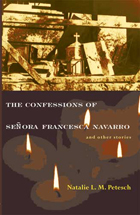
“Memory, of course, is sometimes like a bucking horse, sometimes a runaway one, and one must control the reins until finally it stops, snorting with exhausted relief,” writes Natalie L. M. Petesch in her haunting new collection, The Confessions of Señora Francesca Navarro and Other Stories.
Petesch immerses readers in the lives of people caught up in the 1936–39 Spanish Civil War, which left more than five hundred thousand dead. She captures the hand-to-mouth existence on the streets of Madrid of two war orphans; an old soldier’s memories of a fallen militiawoman; the dilemma of Franco’s laundress as she seeks to duplicate a stolen religious icon she finds in his home; and a man’s struggle to find his bride among thousands of Republican refugees waiting for ships to evacuate them before Franco’s Fascists arrive to kill them.
In the title novella, an elderly woman describes to her granddaughter how the families of Franco’s officers fighting against Republican militiamen endured hunger, filth, and danger in an underground fortress. Petesch conveys the humiliating details of war through the sensibility of a cultured woman who recalls only too vividly latrines made of laundry tubs, the smell of unwashed humans, and the stench of death.
Brilliant in its imaginative power and heartbreaking in its access to the bottomless well of human tears, The Confessions of Señora Francesca Navarro and Other Stories is the work of a mature artist able to convey a particular world so vividly that we know these people as our own.


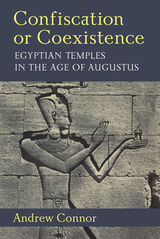
The interpretative consensus developed after the publication of a handful of key documents—P.Tebt. 2.302 especially, alongside BGU 4.1198 and 1200, and P.Berl.Leihg. 1.5. Connor offers a fundamentally revised interpretation of these texts, building from a fresh examination of the papyri themselves. The book frames the interpretation in a wider discussion of Roman interactions with Egyptian religion, including material from inside and outside Egypt, and locates the development of an interpretative consensus in early 20th-century scholarship within the wider context of empire and colonization at the time. In doing so, Connor explores these papyri through their historical, intellectual, and linguistic contexts, alongside a number of other important texts bearing on the relationship between the temples and the Roman state.
Americans have witnessed inconsistent and seemingly dramatic turnabouts in legislators' attitudes toward trade, with strong bipartisan support for free trade and the Uruguay Round in one instant and heated debate over participation in the World Trade Organization the next. Martha L. Gibson systematically traces the competing forces that interject conflict into an overall consensus on the value of a liberalized trade policy.
Cutting through the tangled web of congressional politics, Gibson shows why it is impossible to understand trade legislation without first understanding how electoral politics and the institutional rules of Congress distort legislators' interests, incentives, and policy goals. Gibson's book clearly shows that trade legislation is not made in a vacuum but is just one in a series of simultaneous games with competing goals in which legislators engage to satisfy the conflicting demands of constituents.
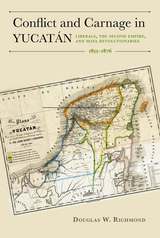
Synthesizing an extensive and heterogeneous range of sources, Douglas W. Richmond covers three tumultuous political upheavals of this period. First, Mexico’s fledgling republic attempted to impose a liberal ideology at odds with traditional Maya culture on Yucatán; then, the French-backed regime of Emperor Maximilian began to reform Yucatán; and, finally, the republican forces of Benito Juárez restored the liberal hegemony. Many issues spurred resistance to these liberal governments. Instillation of free trade policies, the suppression of civil rights, and persecution of the Roman Catholic Church mobilized white opposition to liberal governors. The Mayas fought the seizure of their communal properties. A long-standing desire for regional autonomy united virtually all Yucatecans. Richmond advances the thought-provoking argument that Yucatán both fared better under Maximilian’s Second Empire than under the liberal republic and would have thrived more had the Second Empire not collapsed.
The most violent and bloody manifestation of these broad conflicts was the Caste War (Guerra de Castas), the longest sustained peasant revolt in Latin American history. Where other scholars have advocated the simplistic position that the war was a Maya uprising designed to reestablish a mythical past civilization, Richmond’s sophisticated recounting of political developments from 1855 to 1876 restores nuance and complexity to this pivotal time in Yucatecan history.
Richmond’s Conflict and Carnage in Yucatán is a welcome addition to scholarship about Mexico and Yucatán as well as about state consolidation, empire, and regionalism.
---J. N. Hillgarth, Professor Emeritus, University of Toronto
"By focusing on the diversified activities of the talented mid-thirteenth-century archbishop of Toledo, Lucy Pick brilliantly illuminates the complex relations between the Christian conquerors of Spain and the conquered Muslim and Jewish populations. Students of medieval Spain, of the medieval Roman Catholic Church, of medieval Muslims and Islam, and of medieval Jews and Judaism will benefit from this excellent study."
---Robert Chazan, New York University.
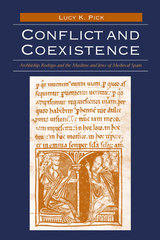
In Conflict and Coexistence, Lucy Pick sets out to explain how Christians, Muslims, and Jews lived alongside one another in medieval Spain. By examining the life and works of Rodrigo Jiménez de Rada, the Archbishop of Toledo (1209-47), Pick explains that the perceived threat of the non-Christian presence was managed through the subordination of Muslims and Jews.
Rodrigo stood at the center of a transformative period of history in the Iberian peninsula. During his long and varied career as archbishop, he acted as scholar, warrior, builder, and political leader. The wave of victories he helped initiate were instrumental in turning back the tide of Muslim attacks on Christian Spain and restarting the process of Christian territorial conquest. However, Toledo was still a multiethnic city in which Christians lived side by side with Jews and Muslims. As archbishop, he was faced with the considerable challenge of maintaining peace and prosperity in a city where religious passions and intolerance were a constant threat to stability.
This work seeks to examine Rodrigo's relations with the Muslims and Jews of his community both as he idealized them on paper and as he worked through them in real life. Though Rodrigo wrote an anti-Jewish polemic, and set out to conquer Muslim-held lands, he also used scholarly patronage and literary creation to combat internal and external, Christian and non-Christian threats alike. His intended and actual consequences of these varied techniques were to allow Christians, Muslims, and Jews to live together under Christian authority. Rodrigo was bound by practical necessity to find a means of accommodating these groups that was both effective and theologically satisfactory. Throughout this influential work, Pick examines the various aspects of Rodrigo's life and career that led to his policies and the consequences that his work and beliefs brought about in medieval Spain.
This book will be of interest to anyone who studies the history, religion, and literature of medieval Spain, to those interested in the transmission of learning from the Muslim to the Christian world, and to those who study intellectual life and development in medieval Europe.
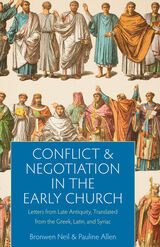
Conflict and Negotiation in the Early Church focuses on the period 500 to 700 CE, one of the least documented periods in the history of the church, but also one of the most formative, whose conflicts resonate still in contemporary Christian communities, especially in the Middle East.
To uncover the hidden history of this period and its theological controversies, Neil and Allen have tapped a little known written source, the letters that were exchanged by bishops, emperors and other civic leaders of the sixth and seventh centuries. This was an era of crisis for the Byzantine empire, at war first with Persia, and then with the Arab forces united under the new faith of Islam. Official letters were used by the churches of Rome and Constantinople to pursue and defend their claims to universal and local authority, a constant source of conflict. As well as the east-west struggle, Christological disagreements with the Syrian church demanded increasing attention from the episcopal and imperial rulers in Constantinople, even as Rome set itself adrift and looked to the West for new allies.
From this troubled period, 1500 letters survive in Greek, Latin, and Syriac. With translations of a number of these, many rendered into English for the first time, Conflict and Negotiation in the Early Church examines the ways in which diplomatic relations between churches were developed, and in some cases hindered or even permanently ruptured, through letter-exchange at the end of Late Antiquity.
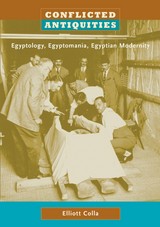
Colla draws on medieval and modern Arabic poetry, novels, and travel accounts; British and French travel writing; the history of archaeology; and the history of European and Egyptian museums and exhibits. The struggle over the ownership of Pharaonic Egypt did not simply pit Egyptian nationalists against European colonial administrators. Egyptian elites found arguments about the appreciation and preservation of ancient objects useful for exerting new forms of control over rural populations and for mobilizing new political parties. Finally, just as the political and expressive culture of Pharaonism proved critical to the formation of new concepts of nationalist identity, it also fueled Islamist opposition to the Egyptian state.
Milton calls attention to fabrications of our post-truth era but goes further to deeply explore the ways members of the Peruvian military see their past, how they actively commemorate and curate it in the present, and why they do so. Her nuanced approach upends frameworks of memory studies that reduce military and ex-military to a predictable role of outright denial.
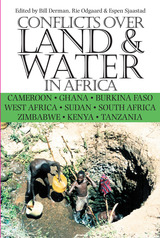
This is an examination of the broader context for the re-emergence of land reform and resource conflicts in Africa. Efforts to change the race based systems of land ownership and land tenure in Namibia, South Africa, and Zimbabwe have pushed land issues to the forefront of social and economic discourses in Africa. This collection examines the broader context for the re-emergence of land reform and resource conflicts.
The case studies examine the links between identity maintenance, tenurial changes, state intervention, and forms and modes of conflict. The authors emphasize the need for a deeper understanding of local histories, cultures, and motivations if efforts to attain a more just distribution of resources are to succeed. The book contributes to a field that has been developing rapidly in the decade since the publication of Melissa Leach and Robin Mearns' collection The Lie of the Land and Mahmood Mamdani's Citizen and Subject. Those two books started a wide ranging discussion of the political reasons for failed development in Africa, as well as the environmental and natural resource dimensions of that failure.
A Confluence of Transatlantic Network demonstrates how portions of interconnected trust-based kinship, business, and ideational transatlantic networks evolved over roughly a century and a half and eventually converged to engender, promote, and facilitate the migration of southern elites to Brazil in the post–Civil War era. Placing that migration in the context of the Atlantic world sharpens our understanding of the transborder dynamic of such mainstream nineteenth-century historical currents as international commerce, liberalism, Protestantism, and Freemasonry. The manifestation of these transatlantic forces as found in Brazil at midcentury provided disaffected Confederates with a propitious environment in which to try to re-create a cherished lifestyle.

The contributors to this volume explore connections between religious affiliation, race, gender, ethnicity, epidemiology, and attitudes towards health and medicine in Missouri from the nineteenth century to the present day. They ask what role religious belief systems play in healthcare outcomes and offer important arguments for building a dialogue between faith communities and medical caregivers. Centering on Missouri as a site for religious transformation and diversity, this volume documents how religious perspectives shape contemporary America.
Initial chapters outline the religious history of Missouri, relaying the history of medicine in the region before and after Missouri statehood. Subsequent essays document Missouri’s religious diversity by contemplating Native American, Asian American, and African American religious experiences in Missouri, intentionally recovering and respectfully contextualizing understudied events and forgotten individuals. The volume’s remaining essays consider religious responses to the Cholera, Influenza, and Covid-19 epidemics and show how Native American, Euro-American, and African American Missourians have transformed U.S. history and healthcare. Collectively, the essays in this book demonstrate that religious freedom, medical knowledge, and transnational encounters are woven into the historical fabric of the region.
Featuring essays by experts in Religious Studies and Health Sciences, this volume will be of interest to scholars of religion, sociology, public health, and medicine, as well as readers more generally interested in the history and culture of Missouri.
This work offers a groundbreaking account of how Chicana/o activists have engaged in sustained efforts to reclaim Indigenous identity through political struggle, cultural expression, and transnational solidarity.
Author José Luis Serrano Nájera takes an in-depth look at the history of Chicana/o indigeneity, starting with the Chicana/o Movement of the 1960s and 1970s and through twenty-first century transnational activism and solidarity movements. Serrano Nájera reveals how claims to indigeneity were rooted in reciprocal relationships with Indigenous communities and driven by a shared commitment to decolonization. Through chapters on visual and performing arts, ceremony, education, and grassroots organizing, this book challenges reductive narratives of cultural appropriation and instead foregrounds the complex and historically grounded nature of Chicana/o indigeneity.
Drawing on extensive archival research, Serrano Nájera demonstrates how Chicana/o indigeneity has contributed to broader Indigenous rights movements, including efforts that culminated in the 2007 United Nations Declaration on the Rights of Indigenous Peoples. This work highlights the intercontinental dimensions of Chicana/o activism and offers a vital source for scholars and students in Chicana/o studies, Indigenous studies, ethnic studies, history, and political science. Confronting Colonial Legacies is a compelling call to rethink the politics of identity, sovereignty, and solidarity across the Americas.
In Confronting Communism, Victor S. Kaufman examines how the United States and Great Britain were able to overcome serious disagreements over their respective approaches toward Communist China. Providing new insight into the workings of alliance politics, specifically the politics of the Anglo- American alliance, the book covers the period from 1948—a year before China became an area of contention between London and Washington—through twenty years of division to the gradual resolution of Anglo-American divergences over the People's Republic of China beginning in the mid-1960s. It ends in 1972, the year of President Richard Nixon's historic visit to the People's Republic, and also the year that Kaufman sees as bringing an end to the Anglo-American differences over China.
Kaufman traces the intricate and subtle pressures each ally faced in determining how to approach Beijing. The British aspect is of particular interest because Britain viewed itself as being within "three circles": Western Europe, the Atlantic alliance, and the Commonwealth. Important as well to British policy with respect to China was the concern about being dragged into another Korean-style conflict. The impact of decisions on these "circles," as well as the fear of another war, appeared time and again in Britain's decision making.
Kaufman shows how the alliance avoided division over China largely because Britain did the majority of the compromising. Reliant upon the United States militarily and financially, most U.K. officials made concessions to their Washington counterparts. Readers of Confronting Communism will come away with a better understanding of alliance politics. They will learn that such decision making, for both Great Britain and the United States, was a highly complex process, one that posed serious challenges to the Anglo-American alliance. Despite those challenges, accord between London and Washington prevailed.
Confronting Historical Paradigms argues that confrontation with major paradigms of world history has marked the fields of African and Latin American history during the last quarter-century, and that the process has dramatically restructured historical and theoretical understanding of peasantries, labor, and the capitalist world system. Moreover, it maintains, the intellectual reverberations within and across the African and Latin American fields constitute a challenging and underappreciated counterpoint to laments that contemporary historical knowledge has suffered a splintering so extreme that it undermines larger dialogue and meaning.
The authors, in their substantive essays, synthesize, order, and evaluate the significance of the enormous resonating literatures that have come to exist for Africa and Latin America on the themes of the capitalist world system, labor, and peasantries. They historicize these literatures by analyzing an entire cycle of critical dialogue and confrontation with historical paradigms and the professional upheavals that accompanied them. They review the initial confrontations with frameworks of historical knowledge that erupted in the 1960s and the early 1970s; the emergence of new “dissident” paradigms; the outpouring of subsequent scholarship on peasants, labor, and capitalism that began to unravel the newly proposed paradigms by the 1980s and 1990s; and the outlines of the new interpretive frameworks that tended to displace both the “traditional” and “early dissident” paradigms. They also suggest possible outlines of a new cycle of “Third World” confrontations with paradigm, anchored in themes such as gender and ethnicity.
Confronting Historical Paradigms employs a historicized awareness of intellectual networks, conversations, and history–theory dialogues. The result is a critical analysis and synthetic presentation of substantive advances that have preoccupied scholarship on Africa and Latin America in recent decades and a powerful challenge to notions that “new” fields of history have ended up destroying intellectual coherence and community.
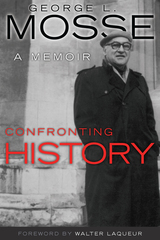
Confronting History describes Mosse's opulent childhood in Weimar Berlin; his exile in Paris and England, including boarding school and study at Cambridge University; his second exile in the U.S. at Haverford, Harvard, Iowa, and Wisconsin; and his extended stays in London and Jerusalem. Mosse discusses being a Jew and his attachment to Israel and Zionism, and he addresses his gayness, his coming out, and his growing scholarly interest in issues of sexuality. This touching memoir—told with the clarity, passion, and verve that entranced thousands of Mosse's students—is guided in part by his belief that "what man is, only history tells" and, most of all, by the importance of finding one's self through the pursuit of truth and through an honest and unflinching analysis of one's place in the context of the times.

Confronting Leviathan describes Mozambique’s attempt to construct a socialist society in one African country on the back of an anti-colonial struggle for national independence. In explaining the failure of this effort the authors suggest reasons why the socialist vision of the ruling party, Frelimo, lacked resonance with Mozambican society. They also document in detail South Africa’s attempts to destabilize the country, even to the extent of sponsoring the Renamo insurgents. The dynamics of that insurgency and its roots in Mozambican society are examined as well as the process of negotiation that brought it to a close. Finally the authors analyze the more recent attempt to construct a liberal capitalist society in Mozambique. From their findings it appears that this may prove no easier than the construction of socialism.
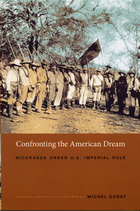
Gobat focuses primarily on the reactions of the elites to Americanization, because the power and identity of these Nicaraguans were the most significantly affected by U.S. imperial rule. He describes their adoption of aspects of “the American way of life” in the mid–nineteenth century as strategic rather than wholesale. Chronicling the U.S. occupation of 1912–33, he argues that the anti-American turn of Nicaragua’s most Americanized oligarchs stemmed largely from the efforts of U.S. bankers, marines, and missionaries to spread their own version of the American dream. In part, the oligarchs’ reversal reflected their anguish over the 1920s rise of Protestantism, the “modern woman,” and other “vices of modernity” emanating from the United States. But it also responded to the unintended ways that U.S. modernization efforts enabled peasants to weaken landlord power. Gobat demonstrates that the U.S. occupation so profoundly affected Nicaragua that it helped engender the Sandino Rebellion of 1927–33, the Somoza dictatorship of 1936–79, and the Sandinista Revolution of 1979–90.
The first author to address the impact of geopolitics on the courts’ representation of Nazi euthanasia, Bryant argues that international power relationships wreaked havoc on the prosecutions.
Drawing on primary sources, this provocative investigation of the Nazi campaign against the mentally ill and the postwar quest for justice will interest general readers and provide critical information for scholars of Holocaust studies, legal history, and human rights. Support for this publication was generously provided by the Eugene M. Kayden Fund at the University of Colorado.
Mosse considers a broad range of topics, from Nazi book burnings to Americans’ search for unifying national symbols during the Great Depression, exploring how the development of particular modes of art, architecture, and mass movements served nationalist agendas by dictating who was included in the image of the nation. These essays retain their significance today in their examination of the cultural and social implications of contemporary nationalism. A new critical introduction by Shulamit Volkov, professor emerita of history at Tel Aviv University, situates Mosse’s analysis within its historiographical context.
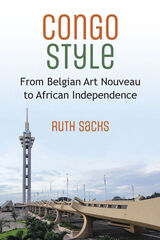
Congo Style presents a postcolonial approach to discussing the visual culture of two now-notorious regimes: King Leopold II’s Congo Colony and the state sites of Mobutu Sese Seko’s totalitarian Zaïre. Readers are brought into the living remains of sites once made up of ambitious modernist architecture and art in Kinshasa, Democratic Republic of the Congo. From the total artworks of Art Nouveau to the aggrandizing sites of post-independence Kinshasa, Congo Style investigates the experiential qualities of man-made environments intended to entertain, delight, seduce, and impress.
In her study of visual culture, Ruth Sacks sets out to reinstate the compelling wonder of nationalist architecture from Kinshasa’s post-independence era, such as the Tower of the Exchange (1974), Gécamines Tower (1977), and the artworks and exhibitions that accompanied them. While exploring post-independence nation-building, this book examines how the underlying ideology of Belgian Art Nouveau, a celebrated movement in Belgium, led to the dominating early colonial settler buildings of the ABC Hotels (circa 1908–13). Congo Style combines Sacks’s practice as a visual artist and her academic scholarship to provide an original study of early colonial and independence-era modernist sites in their African context.
In Congo’s Dancers, Lesley Nicole Braun uses the prism of the Congolese danseuse to examine the politics of control and the ways in which notions of visibility, virtue, and socio-economic opportunity are interlinked in this urban African context. The work of the danseuse highlights the fact that public visibility is necessary to build the social networks required for economic independence, even as this visibility invites social opprobrium for women. The concert dancer therefore exemplifies many of the challenges that women face in Kinshasa as they navigate the public sphere, and she illustrates the gendered differences of local patronage politics that shape public morality. As an ethnographer, Braun had unusual access to the world she documents, having been invited to participate as a concert dancer herself.
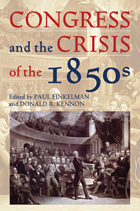
During the long decade from 1848 to 1861 America was like a train speeding down the track, without an engineer or brakes. The new territories acquired from Mexico had vastly increased the size of the nation, but debate over their status—and more importantly the status of slavery within them—paralyzed the nation. Southerners gained access to the territories and a draconian fugitive slave law in the Compromise of 1850, but this only exacerbated sectional tensions. Virtually all northerners, even those who supported the law because they believed that it would preserve the union, despised being turned into slave catchers. In 1854, in the Kansas-Nebraska Act, Congress repealed the ban on slavery in the remaining unorganized territories. In 1857, in the Dred Scott case, the Supreme Court held that all bans on slavery in the territories were unconstitutional. Meanwhile, northern whites, free blacks, and fugitive slaves resisted the enforcement of the 1850 fugitive slave law. In Congress members carried weapons and Representative Preston Brooks assaulted Senator Charles Sumner with a cane, nearly killing him. This was the decade of the 1850s and these were the issues Congress grappled with.
This volume of new essays examines many of these issues, helping us better understand the failure of political leadership in the decade that led to the Civil War.
Contributors
Spencer R. Crew
Paul Finkelman
Matthew Glassman
Amy S. Greenberg
Martin J. Hershock
Michael F. Holt
Brooks D. Simpson
Jenny Wahl
The authors examine in detail how the Republican Party slowly withdrew its support for a meaningful civil rights agenda, as well as how Democrats and Republicans worked together to keep civil rights off the legislative agenda at various points. In doing so, Jenkins and Peck show how legal institutions can be used both to liberate and protect oppressed minorities and to assert the power of the white majority against those same minority groups.
Congress in Reverse is the first book to attempt to answer these questions. Jordan M. Ragusa and Nathaniel A. Birkhead examine when and why existing statutes are successfully “undone,” arguing that repeals are most common when the parties are united on the issue—which was not the case when it came to Obamacare for the Republican Party—and the majority party wins control of Congress after a long stint in the minority. By shifting focus from the making of laws to their un-making, Congress in Reverse opens up a new arena for studying legislative activity in Congress.
A landmark publication of public reports that reveal the founding of the Confederate government
Past publications of the proceedings of the Confederate Congress have focused on the public sessions of the Regular Confederate States Congress that met in Richmond, Virginia from February 1862 to March 1865. Omitted were the formative early sessions of the Montgomery, Alabama and Richmond, Virginia Provisional Congresses of 1861 and 1862. In Congress of States, David Carlson reveals these critical early meetings.
To illuminate this pivot point in American and Southern history, Carlson has drawn on detailed and often verbatim minutes reported in Richmond, Montgomery, Charleston, New Orleans, Savannah, and Augusta newspapers, assembling here a unique set of transcriptions that reveal the birth of the Confederate government.
Congress of States provides an introduction to the Provisional Confederate Congress and the purpose of this work relative to the Southern Historical Society’s landmark 1923 publication “Proceedings of the Confederate Congress,” which detailed the 1862–1865 Regular Confederate Congress. He also includes a chronology outlining the major events of the secession crisis, annotated minutes for the Provisional Confederate Congress’s five sessions, appendices featuring the leadership and committees of the Provisional Congress, and fascinating examples of the proposed Confederate emblem and flags debated by the delegates.
A key set of primary sources that scholars, historians, librarians, and political scientists will value for years to come, Congress of States will also be essential reading for the general reader interested in American and Southern history, the Antebellum South, and the Civil War.
Ronald Reagan's election in 1980 brought with it a major shift in the composition of the U.S. Congress for the first time in several decades. The subsequent introduction of an enormous amount of new legislation sparked debate among many political observers that a new coalition was being built in American politics and that a significant change in the issues on the agenda before Congress heralded a Republican realignment.
Barbara Sinclair's study is a major contribution to our understanding of realignment politics in the House of Representatives. It also provides important insight into the changes in American political life in the late twentieth century.
Congressional Realignment poses three basic, related questions: What are the sources of agenda change? What determines congressional voting alignments and alignment change? Under what conditions are the barriers to major policy change overcome? Sinclair's answers are impressive both in their scholarship and in the depth and intelligence of her insights.
Why did white pine help spark the American Revolution? How did balsam aid the development of germ theory? What does hemlock have to do with making leather? In Conifers of the New England–Acadian Forest, microbiologist Steve Keating explores how conifers influenced the course of human history, writing in a style that is both scientific and accessible.
Keating’s study focuses on one of the most forested and wild ecoregions in North America, which extends into New York, New England, and Canada and includes Acadia National Park. Here, spruces, firs, and cedars of the northern boreal forest mix with hemlocks and pines of more temperate climates. This combination helps create the appearance, aroma, and ecology of the region, and the trees’ unique botanical traits have been ingeniously utilized by numerous peoples including the Iroquois, French explorers, beer brewers, and shipbuilders. Keating concludes with identification guides for the conifers and where they can be found in Acadia National Park.
Conjoined Twins in Black and White provides contemporary readers with the twins’ autobiographies, the first two “show histories” to be republished since their original appearance, a previously unpublished novella, and a nineteenth-century medical examination, each of which attempts to define these women and reveal the issues of race, gender, and the body prompted by the twins themselves. The McKoys, born slaves, were kidnapped and taken to Britain, where they worked as entertainers until they were reunited with their mother in an emotional chance encounter. The Hiltons, cast away by their horrified mother at birth, worked the carnival circuit as vaudeville performers until the WWII economy forced them to the burlesque stage. The hardships, along with the triumphs, experienced by these very different sister sets lend insight into our fascination with conjoined twins.
Bollywood movies have been long known for their colorful song-and-dance numbers and knack for combining drama, comedy, action-adventure, and music. But when India entered the global marketplace in the early 1990s, its film industry transformed radically. Production and distribution of films became regulated, advertising and marketing created a largely middle-class audience, and films began to fit into genres like science fiction and horror. In this bold study of what she names New Bollywood, Sangita Gopal contends that the key to understanding these changes is to analyze films’ evolving treatment of romantic relationships.
Reflecting the structure of the ring shout—the counterclockwise song, dance, drum, and story in African American history and culture—Conjuring Freedom offers three new concepts to cultural studies in order to describe the practices, techniques, and implications of the troop’s performance: (1) Black Communal Conservatories, borrowing from Robert Farris Thompson’s “invisible academies” to describe the structural but spontaneous quality of black music-making, (2) Listening Hermeneutics, which accounts for the generative and material affects of sound on meaning-making, and (3) Sonic Politics, which points to the political implications of music’s use in contemporary representations of race and history.
READERS
Browse our collection.
PUBLISHERS
See BiblioVault's publisher services.
STUDENT SERVICES
Files for college accessibility offices.
RECENTLY PUBLISHED



UChicago Accessibility Resources
home | accessibility | search | about | contact us
BiblioVault ® 2001 - 2026
The University of Chicago Press