
 A SCHOLARLY BOOK REPOSITORY
A royal education.
Xenophon (ca. 430 to ca. 354 BC) was a wealthy Athenian and friend of Socrates. He left Athens in 401 and joined an expedition including ten thousand Greeks led by the Persian governor Cyrus against the Persian king. After the defeat of Cyrus, it fell to Xenophon to lead the Greeks from the gates of Babylon back to the coast through inhospitable lands. Later he wrote the famous vivid account of this “March Up-Country” (Anabasis); but meanwhile he entered service under the Spartans against the Persian king, married happily, and joined the staff of the Spartan king, Agesilaus. But Athens was at war with Sparta in 394 and so exiled Xenophon. The Spartans gave him an estate near Elis where he lived for years writing and hunting and educating his sons. Reconciled to Sparta, Athens restored Xenophon to honor, but he preferred to retire to Corinth.
Xenophon’s Anabasis is a true story of remarkable adventures. Hellenica, a history of Greek affairs from 411 to 362, begins as a continuation of Thucydides’ account. There are four works on Socrates (collected in LCL 168). In Memorabilia Xenophon adds to Plato’s picture of Socrates from a different viewpoint. The Apology is an interesting complement to Plato’s account of Socrates’ defense at his trial. Xenophon’s Symposium portrays a dinner party at which Socrates speaks of love; and Oeconomicus has him giving advice on household management and married life. Cyropaedia, a historical romance on the education of Cyrus (the Elder), reflects Xenophon’s ideas about rulers and government; the Loeb edition is in two volumes.
We also have his Hiero, a dialogue on government; Agesilaus, in praise of that king; Constitution of Lacedaemon (on the Spartan system); Ways and Means (on the finances of Athens); Manual for a Cavalry Commander; a good manual of Horsemanship; and a lively Hunting with Hounds. The Constitution of the Athenians, though clearly not by Xenophon, is an interesting document on politics at Athens. These eight books are collected in the last of the seven volumes of the Loeb Classical Library edition of Xenophon.
A royal education.
Xenophon (ca. 430 to ca. 354 BC) was a wealthy Athenian and friend of Socrates. He left Athens in 401 and joined an expedition including ten thousand Greeks led by the Persian governor Cyrus against the Persian king. After the defeat of Cyrus, it fell to Xenophon to lead the Greeks from the gates of Babylon back to the coast through inhospitable lands. Later he wrote the famous vivid account of this “March Up-Country” (Anabasis); but meanwhile he entered service under the Spartans against the Persian king, married happily, and joined the staff of the Spartan king, Agesilaus. But Athens was at war with Sparta in 394 and so exiled Xenophon. The Spartans gave him an estate near Elis where he lived for years writing and hunting and educating his sons. Reconciled to Sparta, Athens restored Xenophon to honor, but he preferred to retire to Corinth.
Xenophon’s Anabasis is a true story of remarkable adventures. Hellenica, a history of Greek affairs from 411 to 362, begins as a continuation of Thucydides’ account. There are four works on Socrates (collected in LCL 168). In Memorabilia Xenophon adds to Plato’s picture of Socrates from a different viewpoint. The Apology is an interesting complement to Plato’s account of Socrates’ defense at his trial. Xenophon’s Symposium portrays a dinner party at which Socrates speaks of love; and Oeconomicus has him giving advice on household management and married life. Cyropaedia, a historical romance on the education of Cyrus (the Elder), reflects Xenophon’s ideas about rulers and government; the Loeb edition is in two volumes.
We also have his Hiero, a dialogue on government; Agesilaus, in praise of that king; Constitution of Lacedaemon (on the Spartan system); Ways and Means (on the finances of Athens); Manual for a Cavalry Commander; a good manual of Horsemanship; and a lively Hunting with Hounds. The Constitution of the Athenians, though clearly not by Xenophon, is an interesting document on politics at Athens. These eight books are collected in the last of the seven volumes of the Loeb Classical Library edition of Xenophon.

The edited volume Cyrus the Great: Life and Lore re-contextualizes Cyrus’s foundational act and epoch in light of recent scholarship, while examining his later reception in antiquity and beyond. Among the many themes addressed in the volume are: the complex dossier of Elamo-Persian acculturation; the Mesopotamian antecedents of Cyrus’s edict and religious policy; Cyrus’s Baupolitik at Pasargadae, and the idiosyncratic genesis of Persian imperial art; the Babylonian exile, the Bible, and the First Return; Cyrus’s exalted but conflicted image in the later Greco-Roman world; his reception and programmatic function in genealogical constructs of the Hellenistic and Arsacid periods; and finally Cyrus’s conspicuous and enigmatic evanescence in the Sasanian and Muslim traditions.
The sum of these wide-ranging contributions assembled in one volume, as well as a new critical edition and English translation of the Cyrus Cylinder, allow for a more adequate evaluation of Cyrus’s impact on his own age, as well as his imprint on posterity.


Morganová explains the various forms of action art, from the “actions” and “happenings” of the 1960s; to the actions of land art that encompass stones, trees, water, or fire; to recent displays of body art; to the actions of the latest generation of artists, who are using the principles of action art in contemporary postconceptual and participative art. Along the way, she introduces the most prominent Czech artists of each specific niche, including Milan Knížák, Zorka Ságlová, Ivan Kafka, Petr Štembera, Karel Miler, Jirí Kovanda, and Katerina Šedá, and demonstrates not only the changes in the art forms themselves but also the shifting roles of artists and spectators after World War II.
With over one hundred illustrations, Czech Action Art introduces this heretofore overlooked but fascinating art form to a global readership.

Lee Bidgood offers a fascinating study of the Czech bluegrass phenomenon that merges intimate immersion in the music with on-the-ground fieldwork informed by his life as a working musician. Drawing on his own close personal and professional interactions, Bidgood charts how Czech bluegrass put down roots and looks at its performance as a uniquely Czech musical practice. He also reflects on “Americanist” musical projects and the ways Czech musicians use them to construct personal and social identities. Bidgood sees these acts of construction as a response to the Czech Republic’s postsocialist environment but also to US cultural prominence within our global mediascape.

Fifty-four weeks later, what Vaculík turns out to have written is a unique mixture of diary, dream journal, and outright fiction—an inverted roman à clef in which the author, his family, his mistresses, and the real leaders of the Czech underground play major roles. Undisputedly the most debated novel among the Prague dissident community of the 1980s, it is a work that Vaculík himself described as an amalgam of “hard-boiled documentary” and “magic fiction,” while Václav Havel called it “a truly profound and perceptive account. . . . A great novel about modern life and the crisis of contemporary humanity.”
A Czech Dreambook has been hailed as the most important work of Czech literature in the past forty years. And yet it has never before been available in English. Flawlessly translated by Gerald Turner, Vaculík’s masterpiece is a brilliant exercise in style, dry humor, and irony—an important portrait of the lives and longings of the dissidents and post-Communist elites.
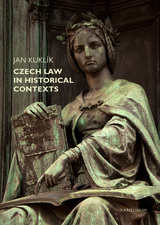
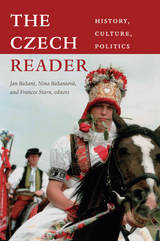

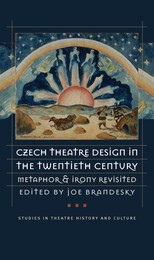
Essays by Vera Ptacková, Dennis Christilles, Delbert Unruh, and, Marie Zdenková their full texts restored and reedited for this volume since their initial publication in exhibit catalogs, provide historical and linguistic insights into contemporary Czech scenography as well as comparisons to the major art movements affecting the designers. Brandesky’s informative introductory essay contextualizes the shifting tenets of Czech theatre design. Also included are biographies of the designers, a bibliography, and thirty black-and-white photographs.
The accompanying CD provides access to the vibrant and sophisticated images of the Czech theatrical world: 138 richly colorful paintings and drawings of costumes, models, and set designs and in situ photos of exhibited designs plus 27 color and black-and-white photos of the designers. The CD also includes the full text of the book with links to all the art and to the designers’ biographies. Book and CD together showcase the Czech Republic as a center of international stage design.
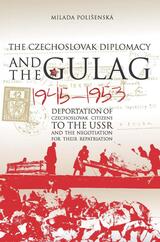

While millions of Soviet slaves awaited liberation from the Nazi troops, millions of German concentration camp victims put their last bit of hope in the Red Army.
An in-depth look into the Soviet persecution of Jewish refugees, this book offers twenty-one different interviews with Czechoslovak Jewish refugees who found themselves in Soviet labor and prison camps between 1939 and 1941. They represent around two thousand Czechoslovak Jews who escaped persecution from German and Hungarian occupational forces and Slovak fascists by fleeing to the East. The Soviets sentenced most of them to long stints of forced labor in the Gulags for illegal immigration, espionage, and other arbitrary accusations. A specific group was formed by the Jews from the Hungarian labor service who either defected to or were captured by the Soviets.
Dvořák and Hradilek chronicle four waves of escape—those from the Protectorate of Bohemia and Moravia, the Nisko concentration camp, Carpathian Ruthenia, and the aforementioned labor service. Thorough and clear, every interview coincides with supplementary documents and photographs found in the NKVD archives, sourced from Ukraine.

Established in 1918, as a new state the First Czechoslovak Republic was keen to project a distinct image. Participation in World Fairs offered the perfect opportunity-. In this comprehensive account of Czechoslovak participation in international exhibitions of the interwar period Marta Filipová looks beyond the sleek façade of the modernist pavilions to examine the intersections of architecture, art and design with commercial interests, state agendas, individual action and the public, offering a complex insight into the production and reception of national displays.
The rich collection of images – mainly photographs – provides a close look at the Czechoslovak pavilions. The design, content and context of the displays convey an idealized narrative that was created for the fairs and the myths on which the Czechoslovak nation and state were built. Heavy machinery, modern art, tourist destinations, and food and drink were presented as Czechoslovak, while many aspects of social life – particularly women or ethnic minorities – were strikingly underrepresented or absent. The book argues that the objects and ideas that the pavilion organizers put on display legitimized and validated the existence of the new state through the inclusion and exclusion of exhibits, people, and ideas.
While Marta Filipová primarily focuses on Czechoslovakia, she also offers insights into how other emerging nations projected and sustained their image during this historical period and how interwar world’s fairs accommodated them.
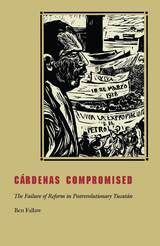
For historical, geographical, and ethnic reasons, Yucatán was the center of large-scale land reform after the Mexican Revolution. A long-standing revolutionary tradition, combined with a harsh division between a powerful white minority and a poor, Maya-speaking majority, made the region the perfect site for Cárdenas to experiment by launching an ambitious top-down project to mobilize the rural poor along ethnic and class lines. The regime encouraged rural peasants to form collectives, hacienda workers to unionize, and urban laborers to strike. It also attempted to mobilize young people and women, to challenge Yucatán’s traditional, patriarchal social structure, to reach out to Mayan communities, and to democratize the political process. Although the project ultimately failed, political dialogue over Cárdenas’s efforts continues. Rejecting both revisionist (anti-Cárdenas) and neopopulist (pro-Cárdenas) interpretations, Fallaw overturns the notion that the state allowed no room for the agency of local actors. By focusing on historical connections across class, political, and regional lines, Fallaw transforms ideas on Cardenismo that have long been accepted not only in Yucatán but throughout Mexico.
This book will appeal to scholars of Mexican history and of Latin American state formation, as well as to sociologists and political scientists interested in modern Mexico.

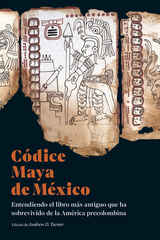
Los antiguos escribas mayas registraban profecías y observaciones astronómicas en las páginas de libros pintados. Aunque la mayoría se perdieron por el desgaste del paso del tiempo o porque fueron destruidos, se sabía que tres códices mayas prehispánicos habían sobrevivido. Sin embargo, en la década de 1960 apareció en México, en circunstancias misteriosas, un cuarto libro diferente a los demás. Después de cincuenta años de debate sobre su autenticidad, investigaciones recientes con análisis científicos e histórico-artísticos de vanguardia, determinaron que el Códice Maya de México (antes conocido como Códice Grolier) es, de hecho, el libro más antiguo del continente americano: al menos doscientos años más antiguo que los demás.
Este volumen ofrece una introducción multifacética a la creación, el descubrimiento, la interpretación y la autenticación científica del Códice Maya de México. Además, un facsímil a todo color y una guía de la iconografía página por página hacen que un amplio público pueda acceder al códice. Otros temas incluyen los usos y la importancia de los libros sagrados en Mesoamérica, el papel de la astronomía en las antiguas sociedades mayas y la continua relevancia del códice para las comunidades mayas contemporáneas.
La publicación de este volumen acompaña la exposición que se exhibirá en el J. Paul Getty Museum ubicado en el Getty Center del 18 de octubre de 2022 al 15 de enero de 2023.
An in-depth exploration of the history, authentication, and modern relevance of Códice Maya de México, the oldest surviving book of the Americas.
Ancient Maya scribes recorded prophecies and astronomical observations on the pages of painted books. Although most were lost to decay or destruction, three pre-Hispanic Maya codices were known to have survived, when, in the 1960s, a fourth book that differed from the others appeared in Mexico under mysterious circumstances. After fifty years of debate over its authenticity, recent investigations using cutting-edge scientific and art historical analyses determined that Códice Maya de México (formerly known as Grolier Codex) is in fact the oldest surviving book of the Americas, predating all others by at least two hundred years.
This volume provides a multifaceted introduction to the creation, discovery, interpretation, and scientific authentication of Códice Maya de México. In addition, a full-color facsimile and a page-by-page guide to the iconography make the codex accessible to a wide audience. Additional topics include the uses and importance of sacred books in Mesoamerica, the role of astronomy in ancient Maya societies, and the codex's continued relevance to contemporary Maya communities.
This volume is published to accompany an exhibition on view at the J. Paul Getty Museum at the Getty Center from October 18, 2022, to January 15, 2023.
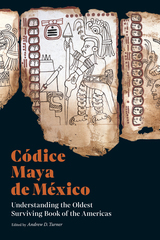
Ancient Maya scribes recorded prophecies and astronomical observations on the pages of painted books. Although most were lost to decay or destruction, three pre-Hispanic Maya codices were known to have survived, when, in the 1960s, a fourth book that differed from the others appeared in Mexico under mysterious circumstances. After fifty years of debate over its authenticity, recent investigations using cutting-edge scientific and art historical analyses determined that Códice Maya de México (formerly known as Grolier Codex) is in fact the oldest surviving book of the Americas, predating all others by at least two hundred years.
This volume provides a multifaceted introduction to the creation, discovery, interpretation, and scientific authentication of Códice Maya de México. In addition, a full-color facsimile and a page-by-page guide to the iconography make the codex accessible to a wide audience. Additional topics include the uses and importance of sacred books in Mesoamerica, the role of astronomy in ancient Maya societies, and the codex's continued relevance to contemporary Maya communities.
This volume is published to accompany an exhibition on view at the J. Paul Getty Museum at the Getty Center from October 18, 2022, to January 15, 2023.

La colección se compone de los relatos favoritos de Daniel A. Olivas, previamente publicados, junto con dos nuevos relatos, uno distópico y otro mítico, que desafían la retórica y las políticas anti-inmigración de la administración Trump. Los lectores se encontrarán con un mundo lleno tanto de lo mágico como de lo cotidiano: un hombre con doce dedos que se encuentra a sí mismo en una cita mística con una mujer; Dios, que se aparece en forma de gallina raquítica; una mujer que lucha con valentía contra su maltratador; y dioses aztecas en busca de relevancia tras la conquista española—solo por nombrar algunos de los singulares personajes que pueblan estas páginas. El libro reúne algunos de los cuentos más extraños e inolvidables de Olivas, permitiendo a los lectores experimentar su muy distintiva, y muy Chicana, ficción.
READERS
Browse our collection.
PUBLISHERS
See BiblioVault's publisher services.
STUDENT SERVICES
Files for college accessibility offices.
RECENTLY PUBLISHED






UChicago Accessibility Resources
home | accessibility | search | about | contact us
BiblioVault ® 2001 - 2025
The University of Chicago Press