
 A SCHOLARLY BOOK REPOSITORY
2474 start with C start with C
Essential to Catholic, Protestant, and even secular scholars of American religious history this is the first historiographical analysis of the work of Henry K. Rowe, James H. Nichols, Leonard J. Trinterud, H. Shelton Smith, John T. McNeill, Herbert W. Schneider, Robert T. Handy, John T. Ellis, and Jaroslav Pelikan.
Aware that every generation rewrites history, Bowden bases his investigation of major twentieth-century church historians on two questions: Why are young historians dissatisfied with earlier treatments? What leads them to believe their version is better?
Henry Warner Bowden’s extensive bibliography includes A Century of Church History: The Legacy of Philip Schaff.
In 1980, Brazil was the largest Roman Catholic country in the world, with 90 percent of its more than 120 million people numbered among the faithful. The Church hierarchy became aware, however, that the religion practiced by the majority of its members was not that promoted by the institution, a point dramatized by the rapid growth of other religious movements in Brazil—particularly Protestant sects and spirit-possession cults. In response, the Church created and assumed new roles. The Church in Brazil is a case study of the changes within the Church and their impact on Brazilian society.
In an original and illuminating discussion, Thomas Bruneau combines institutional analysis and survey data to explore the relationship between structural changes in the Church and evolving patterns of practice and belief. His discussion displays the richness and variety of devotion in Brazil—characteristics recognized by many observers—and examines the Church's potential for influencing the people's religious life.
Moving from the historical and national to the regional, Bruneau analyzes and compares changes among eight dioceses. He concludes that the Church is actively promoting a progressive social role for itself and, by backing its statements with actions, is perceived as being socially effective by both supporters and opponents.
The first study in which the national and diocesan levels of the Church are analyzed together, it is also the first to inspect systematically the Basic Christian Communities, thought by some to be the most significant grass-roots movement in the Catholic world of that time.
The Church in Iraq is both a diligent record and loving testimonial to a community that is struggling desperately to exist. Filoni guides the reader through almost two thousand years of history, telling the story of a people who trace their faith back to the Apostle Thomas. The diversity of peoples and churches is brought deftly into focus through the lens of their interactions with the papacy, but The Church in Iraq does not shy away from discussing the local political, ethnic, and theological tensions that have resulted in centuries of communion and schism. Never losing his focus on the people to whom this book is so clearly dedicated, Cardinal Filoni has produced a personal and engaging history of the relationship between Rome and the Eastern Churches. This book has much to teach its reader about the church in the near East. Perhaps its most brutal lesson is the ease with which such a depth of history and culture can be wiped away in a few short decades.
Though a commoner, Schütz Zell participated actively in public life and wrote prolifically, including letters of consolation, devotional writings, biblical meditations, catechetical instructions, a sermon, and lengthy polemical exchanges with male theologians. The complete translations of her extant publications, except for her longest, are collected here in Church Mother, offering modern readers a rare opportunity to understand the important work of women in the formation of the early Protestant church.
When Homer Hailey sparked controversy within Churches of Christ congregations over his stand on divorce and remarriage, he spoke to a movement already sundered. Historian David Edwin Harrell tells Hailey's story as a means of presenting the larger drama of faith and feuding within those churches.
A nondenominational movement of autonomous congregations, Churches of Christ have been among the fastest-growing religious bodies in the 20th century. Throughout the movement's history, church leaders debated issues ranging from missionary societies to the use of instrumental music in worship. Although some disagreements affected only the ties between congregations, others led to the creation of three distinct groups calling themselves Churches of Christ identified by their sociological and theological positions.
This book shows how the story of the Churches of Christ is reflected by Homer Hailey, a preacher, educator, and author whose life puts in perspective the personal journeys traveled by members in this century. Writing from the perspective of the non-institutional wing within the movement, Harrell avoids mainstream biases to describe the various dissenting views as fully and fairly as possible.
Combining institutional history and biography, Harrell's book is the first to bring the story of the Churches of Christ to century's end. It provides new insight into how this movement realigned itself and shows how one man's career reflected a century of spiritual growth and change for the church as a whole.
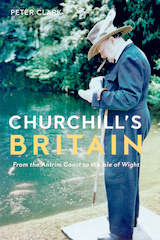
More than half a century after his death, Winston Churchill, the most significant British statesman of the twentieth century, continues to intrigue us. Peter Clark’s book, however, is not merely another Churchill biography. Churchill’s Britain takes us on a geographical journey through Churchill’s life, leading us in Churchill’s footsteps through locations in Britain and Ireland that are tied to key aspects of his biography. Some are familiar–Blenheim Palace, where he was born; Chartwell, his beloved house in the country; and the Cabinet War Rooms, where he planned the campaigns of World War II. But we also are taken to his schools, his parliamentary constituencies, locations of famous speeches, the place where he started to paint, the tobacco shop where he bought his cigars, and the graves of his family and close friends.
Clark brings us close to the statesman Churchill by visiting sites that were important to the story of his long life, from the site where his father proposed to his American mother on the Isle of Wight to his grave in a country churchyard in Oxfordshire. Designed as a gazetteer with helpful regional maps, Churchill’s Britain can be dipped into, consulted by the traveler on a Churchill tour of Britain, or read straight through—and no matter how it’s read, it will deliver fresh insights into this extraordinary man.
Winston Churchill's visit to Fulton, Missouri, on March 5, 1946, marked the first public recognition of the cold war that was to follow World War II. Churchill delivered his most famous speech, "The Sinews of Peace," which became best known by the phrase he used to describe the cold-war division of Europe, the "iron curtain."
In the United States and Britain, wartime alliances had fostered favorable feelings toward the Soviet Union. By 1946 democratic citizens on both sides of the Atlantic had begun to consider communist Russia a friend. In his speech at Fulton, Churchill exhibited breathtaking flexibility and a clear recognition of the main threat as he reminded the public that true friendship must be reserved for countries sharing a common love of liberty. The "Iron Curtain" speech defined postwar relations with the Soviet Union for citizens of Western democracies. Although it initially provoked intense controversy in the United States and Britain, criticism soon gave way to wide public agreement to oppose Soviet imperialism.
Opening with the full text of the address Churchill delivered in Fulton and concluding with Margaret Thatcher's fiftieth-anniversary address surveying the challenges facing Western democracies in this post-cold war climate, the book brings together essays that reflect on the past fifty years, recognizing Churchill's speech as a carefully conceived herald of the cold war for the Western democracies. These powerful essays offer a fresh appreciation of the speech's political, historical, diplomatic, and rhetorical significance.
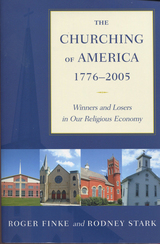
But, as Finke and Stark show, not all denominations benefited. They explain how and why the early nineteenth-century churches began their descent, while two newcomer sects, the Baptists and the Methodists, gained ground. They also analyze why the Methodists then began a long, downward slide, why the Baptists continued to succeed, how the Catholic Church met the competition of ardent Protestant missionaries, and why the Catholic commitment has declined since Vatican II. The authors also explain why ecumenical movements always fail
In short, Americans are not abandoning religion; they have been moving away from established denominations. A "church-sect process" is always under way, Finke and Stark argue, as successful churches lose their organizational vigor and are replaced by less worldly groups.
Some observers assert that the rise in churching rates indicates increased participation, not increased belief. Finke and Stark challenge this as well. They find that those groups that have gained the greatest numbers have demanded that their followers accept traditional doctrines and otherworldliness. They argue that religious organizations can thrive only when they comfort souls and demand sacrifice. When theology becomes too logical, or too secular, it loses people.
Individual chapters examine the ways thinkers throughout history, specifically Augustine, John of Salisbury, Thomas More, Machiavelli, Montaigne, Hobbes, Locke, Adam Smith, and Edmund Burke, have engaged with and been influenced by Cicero. A final chapter surveys the impact of Cicero’s ideas on political thought in the second half of the twentieth century. By tracing the long reception of these ideas, the collection demonstrates not only Cicero’s importance to both medieval and modern political theorists but also the comprehensive breadth and applicability of his philosophy.
While Cicero’s Use of Judicial Theater will be of interest primarily to professional scholars and students studying the speeches of Cicero, its wider analyses, both of Roman cultural customs and the idiosyncratic practices of the courts, will prove relevant also to social historians, as well as historians of legal procedure.
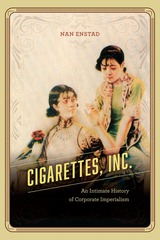
In this startling account of innovation and expansion, Enstad uncovers a corporate network rooted in Jim Crow segregation that stretched between the United States and China and beyond. Cigarettes, Inc. teems with a global cast—from Egyptian, American, and Chinese entrepreneurs to a multiracial set of farmers, merchants, factory workers, marketers, and even baseball players, jazz musicians, and sex workers. Through their stories, Cigarettes, Inc. accounts for the cigarette’s spectacular rise in popularity and in the process offers nothing less than a sweeping reinterpretation of corporate power itself.
In the summer of 1943, as World War II raged overseas, the United States also faced internal strife. Earlier that year, Detroit had erupted in a series of race riots that killed dozens and destroyed entire neighborhoods. Across the country, mayors and city councils sought to defuse racial tensions and promote nonviolent solutions to social and economic injustices. In Cincinnati, the result of those efforts was the Mayor’s Friendly Relations Committee, later renamed the Cincinnati Human Relations Commission (CHRC).
The Cincinnati Human Relations Commission: A History, 1943–2013, is a decade-by-decade chronicle of the agency: its accomplishments, challenges, and failures. The purpose of municipal human relations agencies like the CHRC was to give minority groups access to local government through internal advocacy, education, mediation, and persuasion—in clear contrast to the tactics of lawsuits, sit-ins, boycotts, and marches adopted by many external, nongovernmental organizations.
In compiling this history, Phillip J. Obermiller and Thomas E. Wagner have drawn on an extensive base of archival records, reports, speeches, and media sources. In addition, archival and contemporary interviews provide first-person insight into the events and personalities that shaped the agency and the history of civil rights in this midwestern city.
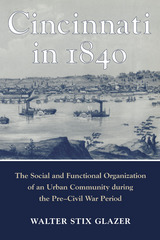
During the pre-Civil War period, Cincinnati was the fastest growing and, according to many contemporary observers, most interesting city in America. This classic study, completed in the early 1970s, focuses on the community in 1840 to explain its success but also to suggest some broader patterns in the city’s development and American urbanization.
Using local census records, city directories, tax lists, newspapers, and other contemporary sources, Walter Stix Glazer describes the demographic, social, economic, and political structure of the adult white male population in 1840 and then develops a unified model of its social and functional organizations. This analysis (based on computerized records of thousands of Cincinnatians) also documents some broader trends between 1820 and 1860: the volatility of Cincinnati’s labor force, the career patterns of its homeowners, and the leadership of a small group of successful citizens active in a broad range of voluntary associations.
This statistical analysis is complemented with sections of traditional historical narrative and biographical profiles that illustrate the general themes of the book. Glazer argues that Cincinnati’s success up to 1840 was due to a unified booster vision and a cohesive community elite that gradually broke down, as a result of ethnic and economic division, over the next twenty years. This story has broader implications in terms of the character of Jacksonian democracy and American urbanization.

“More than fifteen years ago,” Jacques Derrida writes in the prologue to this remarkable and uniquely revealing book, “a phrase came to me, as though in spite of me. . . . It imposed itself upon me with the authority, so discreet and simple it was, of a judgment: ‘cinders there are’ (il y a là cendre). . . . I had to explain myself to it, respond to it—or for it.”
In Cinders Derrida ranges across his work from the previous twenty years and discerns a recurrent cluster of arguments and images, all involving in one way or another ashes and cinders. For Derrida, cinders or ashes—at once fragile and resilient—are “the better paradigm for what I call the trace—something that erases itself totally, radically, while presenting itself.”
In a style that is both highly condensed and elliptical, Cinders offers probing reflections on the relation of language to truth, writing, the voice, and the complex connections between the living and the dead. It also contains some of his most essential elaborations of his thinking on the feminine and on the legacy of the Holocaust (both a word—from the Greek hólos, “whole,” and kaustós, “burnt”—and a historical event that invokes ashes) in contemporary poetry and philosophy. In turning from the texts of other philosophers to his own, Cinders enables readers to follow the trajectory from Derrida’s early work on the trace, the gramma, and the voice to his later writings on life, death, time, and the spectral.
Among the most accessible of this renowned philosopher’s many writings, Cinders is an evocative and haunting work of poetic self-analysis that deepens our understanding of Derrida’s critical and philosophical vision.
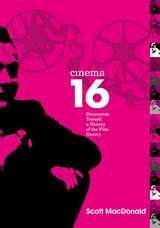
Vogel's commitment to the broadest range of cinema practice led him to develop a programming strategy, inherited from the European cine-club movement, that involved confronting audiences with such a wide range of cinematic forms that viewers left the theater considering not only the often remarkable films Vogel showed, but the place of Cinema itself in modern life.
Cinema 16: Documents Toward a History of the Film Society is the first book on Cinema 16. Scott MacDonald provides a sense of the life and work of the society, using the complete Cinema 16 program announcements, selected letters between Vogel and the filmmakers whose films he showed; selections from the program notes that accompanied Cinema 16 screenings, theoretical essays by Vogel on curating independent cinema; conversations between MacDonald and Cinema 16 members; photographs and stills; and a variety of other documents.
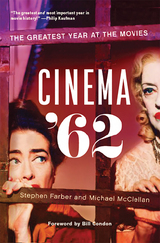
Lawrence of Arabia, The Miracle Worker, To Kill a Mockingbird, The Manchurian Candidate, Gypsy, Sweet Bird of Youth, The Longest Day, The Music Man, What Ever Happened to Baby Jane, and more.
Most conventional film histories dismiss the early 1960s as a pallid era, a downtime between the heights of the classic studio system and the rise of New Hollywood directors like Scorsese and Altman in the 1970s. It seemed to be a moment when the movie industry was floundering as the popularity of television caused a downturn in cinema attendance. Cinema ’62 challenges these assumptions by making the bold claim that 1962 was a peak year for film, with a high standard of quality that has not been equaled since.
Stephen Farber and Michael McClellan show how 1962 saw great late-period work by classic Hollywood directors like John Ford, Howard Hawks, and John Huston, as well as stars like Bette Davis, James Stewart, Katharine Hepburn, and Barbara Stanwyck. Yet it was also a seminal year for talented young directors like Sidney Lumet, Sam Peckinpah, and Stanley Kubrick, not to mention rising stars like Warren Beatty, Jane Fonda, Robert Redford, Peter O’Toole, and Omar Sharif. Above all, 1962—the year of To Kill a Mockingbird and The Manchurian Candidate—gave cinema attendees the kinds of adult, artistic, and uncompromising visions they would never see on television, including classics from Fellini, Bergman, and Kurosawa. Culminating in an analysis of the year’s Best Picture winner and top-grossing film, Lawrence of Arabia, and the factors that made that magnificent epic possible, Cinema ’62 makes a strong case that the movies peaked in the Kennedy era.

In early twentieth-century Shanghai, cinema was more than entertainment—it reshaped the city itself. As movie theaters appealed to city dwellers of all backgrounds, colonial authorities struggled to manage this new public space and introduced new safety rules, censorship, and anti-crime measures. Movie theaters unintentionally brought the unofficial way of racial segregation to an end. Moreover, imported films, though emblematic of Western modernity, paradoxically eroded the myth of Western civilizational superiority. These films revealed social ills in Euro-American societies, exposed Hollywood’s racist depictions of Chinese people, and galvanized anti-imperialist and nationalist sentiments among local audiences.
Cinema and the Cosmopolitan City adopts a “cinema off-screen” approach—stitching together urban history and film studies and foregrounding circulation, consumption, and spatial practice. Qiliang He draws on municipal archives, police records, censorship reports, trade journals, film reviews, and news stories to reconstruct the regulatory regimes imposed by the Shanghai Municipal Council and Shanghai Municipal Police, which was targeting both Bolshevism and “immoral” content. This book reveals how cinema didn’t just reflect modern life—it actively changed urban governance, fueled anticolonial feelings, and linked cosmopolitan culture with rising nationalism in China.

Following the Sandinista Revolution in 1979, young bohemian artists rushed to the newly formed Nicaraguan national film institute INCINE to contribute to "the recovery of national identity" through the creation of a national film project. Over the next eleven years, the filmmakers of INCINE produced over seventy films—documentary, fiction, and hybrids—that collectively reveal a unique vision of the Revolution drawn not from official FSLN directives, but from the filmmakers' own cinematic interpretations of the Revolution as they were living it.
This book examines the INCINE film project and assesses its achievements in recovering a Nicaraguan national identity through the creation of a national cinema. Using a wealth of firsthand documentation—the films themselves, interviews with numerous INCINE personnel, and INCINE archival records—Jonathan Buchsbaum follows the evolution of INCINE's project and situates it within the larger historical project of militant, revolutionary filmmaking in Latin America. His research also raises crucial questions about the viability of national cinemas in the face of accelerating globalization and technological changes which reverberate far beyond Nicaragua's experiment in revolutionary filmmaking.
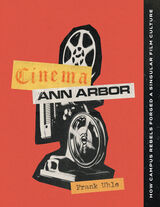
Featuring interviews with filmmaker Ken Burns, Oscar-nominated editor Jay Cassidy, producer John Sloss, and more, this masterpiece provides insights into how a Midwestern college town developed a robust underground art film community that inspired those across the country. Variety’s Owen Glieberman says, “Frank Uhle has captured the moment when cinema became, for a new generation, a kind of religion, with its own rituals and sacred texts and a spirit of exploratory mystery that has all but vanished from the culture.”
This is a must-have book for cinema and media aficionados, film archivists, and anyone interested in the cultural history of Ann Arbor.
This book was published in collaboration with Fifth Avenue Press at Ann Arbor District Library. Learn more about their publishing program here. You can also see their collection, including vintage flyers, photos, film schedules, here.
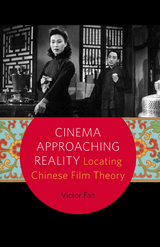
In Cinema Approaching Reality, Victor Fan brings together, for the first time, Chinese and Euro-American film theories and theorists to engage in critical debates about film in Shanghai and Hong Kong from the 1920s through 1940s. His point of departure is a term popularly employed by Chinese film critics during this period, bizhen, often translated as “lifelike” but best understood as “approaching reality.” What these Chinese theorists mean, in Fan’s reading, is that the cinematographic image is not a form of total reality, but it can allow spectators to apprehend an effect as though they had been there at the time when an event actually happened.
Fan suggests that the phrase “approaching reality” can help to renegotiate an aporia (blind spot) that influential French film critic André Bazin wrestled with: the cinematographic image is a trace of reality, yet reality is absent in the cinematographic image, and the cinema makes present this absence as it reactivates the passage of time. Fan enriches Bazinian cinematic ontology with discussions on cinematic reality in Republican China and colonial Hong Kong, putting Western theorists—from Bazin and Kracauer to Baudrillard, Agamben, and Deleuze—into dialogue with their Chinese counterparts. The result is an eye-opening exploration of the potentialities in approaching cinema anew, especially in the photographic materiality following its digital turn.
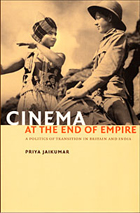
In addition to close readings of British and Indian films of the late colonial era, Jaikumar draws on a wealth of historical and archival material, including parliamentary proceedings, state-sponsored investigations into colonial filmmaking, trade journals, and intra- and intergovernmental memos regarding cinema. Her wide-ranging interpretations of British film policies, British initiatives in colonial film markets, and genres such as the Indian mythological film and the British empire melodrama reveal how popular film styles and controversial film regulations in these politically linked territories reconfigured imperial relations. With its innovative examination of the colonial film archive, this richly illustrated book presents a new way to track historical change through cinema.
A deep dive into Italian cinema under Mussolini’s regime and the filmmakers who used it as a means of antifascist resistance
Looking at Italy’s national film industry under the rule of Benito Mussolini and in the era that followed, Cinema Is the Strongest Weapon examines how cinema was harnessed as a political tool by both the reigning fascist regime and those who sought to resist it. Covering a range of canonical works alongside many of their neglected contemporaries, this book explores film’s mutable relationship to the apparatuses of state power and racial capitalism.
Exploiting realism’s aesthetic, experiential, and affective affordances, Mussolini’s biopolitical project employed cinema to advance an idealized vision of life under fascism and cultivate the basis for a homogenous racial identity. In this book, Lorenzo Fabbri crucially underscores realism’s susceptibility to manipulation from diametrically opposed political perspectives, highlighting the queer, Communist, Jewish, and feminist filmmakers who subverted Mussolini’s notion that “cinema is the regime’s strongest weapon” by developing film narratives and film forms that challenged the prevailing ethno-nationalist ideology.
Focusing on an understudied era of film history and Italian cultural production, Fabbri issues an important recontextualization of Italy’s celebrated neorealist movement and the structural ties it shares with its predecessor. Drawing incisive parallels to contemporary debates around race, whiteness, authoritarianism, and politics, he presents an urgent examination into the broader impact of visual media on culture and society.
Retail e-book files for this title are screen-reader friendly with images accompanied by short alt text and/or extended descriptions.

The "new" realism of Italian cinema after World War II represented and in many ways attempted to contain the turmoil of a society struggling to rid itself of Fascism while fighting off the threat of radical egalitarianism at the same time. In this boldly revisionist book, Vincent F. Rocchio combines Lacanian psychoanalysis with narratology and Marxist critical theory to examine the previously neglected relationship between Neorealist films and the historical spectators they address.
Rocchio builds his analysis around case studies of the films Rome: Open City, Bicycle Thieves, La Terra Trema, Bitter Rice, and Senso. Through the lens of psychoanalysis, he challenges the traditional understanding of Neorealism as a progressive cinema and instead reveals the anxieties it encodes: a society in political turmoil, an economic system in collapse, and a national cinema in ruins; while war, occupation, collaboration, and retaliation remain a part of everyday life.
These case studies demonstrate how Lacanian psychoanalysis can play a key role in analyzing the structure of cinematic discourse and its strategies of containment. As one of the first books outside of feminist film theory to bring the ideas of Lacan to theories of cinema, this book offers innovative methods that reinvigorate film analysis. Clear and detailed insights into both Italian culture and the films under investigation will make this engaging reading for anyone interested in film and cultural studies.

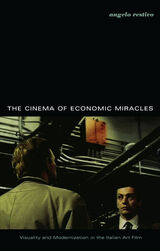
Restivo studies numerous films of the period, focusing mainly on the works of Pier Paolo Pasolini and Michelangelo Antonioni. He finds that these auteurs’ films reworked the neorealist aesthetic developed in the 1940s and 1950s, explored issues brought to the fore by the subsequent consumer boom, and presaged developments central to both critical theory and the visual arts in the 1980s and 1990s. Drawing on the theories of Lacan, Zizek, Benjamin, Foucault, Jameson, and Deleuze, he shines new light on such films as Pasolini’s Accattone and Teorema, and Antonioni’s Red Desert and Blow-Up. Restivo’s model for understanding the relationship of the 1960s Italian art film to its cultural contexts also has implications that extend to the developing national cinemas of countries such as Brazil and Taiwan.
The Cinema of Economic Miracles will interest scholars and students in all areas of film studies, especially those studying theories of the image, national cinema theory, and Italian cinema, and to those engaged in poststructuralist theory, philosophy, and comparative literature.
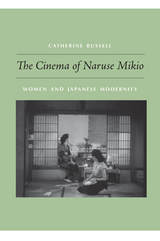
Naruse was a studio-based director, a company man renowned for bringing films in on budget and on time. During his long career, he directed movies in different styles of melodrama while displaying a remarkable continuity of tone. His films were based on a variety of Japanese literary sources and original scripts; almost all of them were set in contemporary Japan. Many were “women’s films.” They had female protagonists, and they depicted women’s passions, disappointments, routines, and living conditions. While neither Naruse or his audiences identified themselves as “feminist,” his films repeatedly foreground, if not challenge, the rigid gender norms of Japanese society. Given the complex historical and critical issues surrounding Naruse’s cinema, a comprehensive study of the director demands an innovative and interdisciplinary approach. Russell draws on the critical reception of Naruse in Japan in addition to the cultural theories of Harry Harootunian, Miriam Hansen, and Walter Benjamin. She shows that Naruse’s movies were key texts of Japanese modernity, both in the ways that they portrayed the changing roles of Japanese women in the public sphere and in their depiction of an urban, industrialized, mass-media-saturated society.

The Cinema of Sergei Parajanov is the first English-language book on the director's films and the most comprehensive study of his work. James Steffen provides a detailed overview of Parajanov's artistic career: his identity as an Armenian in Georgia and its impact on his aesthetics; his early films in Ukraine; his international breakthrough in 1964 with Shadows of Forgotten Ancestors; his challenging 1969 masterpiece, The Color of Pomegranates, which was reedited against his wishes; his unrealized projects in the 1970s; and his eventual return to international prominence in the mid-to-late 1980s with The Legend of the Surami Fortress and Ashik-Kerib. Steffen also provides a rare, behind-the-scenes view of the Soviet film censorship process and tells the dramatic story of Parajanov's conflicts with the authorities, culminating in his 1973–77 arrest and imprisonment on charges related to homosexuality.
Ultimately, the figure of Parajanov offers a fascinating case study in the complicated dynamics of power, nationality, politics, ethnicity, sexuality, and culture in the republics of the former Soviet Union.
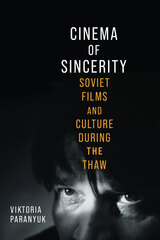
Using both theory and close readings of specific films produced in the Soviet Union during the Thaw, a period known for its relative political and cultural liberalization, Cinema of Sincerity treats sincerity as both a concept and an aesthetic strategy. Viktoria Paranyuk argues that Soviet cinema’s use of sincerity was a reworking of a trend in global cinema that sought to bridge the gap between reality and the filmed image. This period saw increased accessibility to world cinematic traditions, new voices in criticism, and, above all, the multigenerational effort in filmmaking that developed and thrived in centers outside Moscow. Paranyuk demonstrates how these changes allowed Soviet cinema to renew its visual language and use film as a space for collective self-examination.
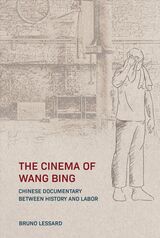
In The Cinema of Wang Bing, Bruno Lessard examines documentarian Wang Bing’s most important films. He focuses on the two obsessions at the heart of Wang’s oeuvre—the legacy of Maoist China in the present and the transformation of labor since China’s entry into the market economy—and how the crucial figures of survivor and worker are represented on screen. Bruno Lessard argues that Wang is a minjian (grassroots) intellectual whose films document the impact of Mao’s Great Leap Forward on Chinese collective memory and register the repercussions of China’s turn to neoliberalism on workers in the post-Reform era. Bringing together Chinese documentary studies and China studies, Lessard shows how Wang’s practice reflects the minjian ethos when documenting the survivors of the Great Famine and those who have not benefitted from China’s neoliberal policies—from laid-off workers to migrant workers. The films discussed include some of Wang’s most celebrated works such as West of the Tracks and Dead Souls, as well as neglected documentaries such as Coal Money and Bitter Money.
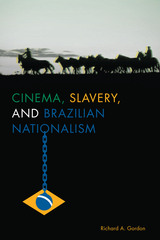
A unique contribution to film studies, Richard Gordon’s Cinema, Slavery, and Brazilian Nationalism is the first full-length book on Brazilian films about slavery. By studying Brazilian films released between 1976 and 2005, Gordon examines how the films both define the national community and influence viewer understandings of Brazilianness. Though the films he examines span decades, they all communicate their revised version of Brazilian national identity through a cinematic strategy with a dual aim: to upset ingrained ways of thinking about Brazil and to persuade those who watch the films to accept a new way of understanding their national community.
By examining patterns in this heterogeneous group of films, Gordon proposes a new way of delineating how these films attempt to communicate with and change the minds of audience members. Gordon outlines five key aspects that each film incorporates, which describe their shared formula for and role in constructing social identity. These elements include the ways in which the films attempt to create links between the past and the viewers’ present and their methods of encouraging viewers to identify with their protagonists, who are often cast as a prototype for the nation. By aligning themselves with this figure, viewers arrive at a definition of their national identity that, while Afrocentric, also promotes racial and ethnic inclusiveness. Gordon’s innovative analysis transcends the context of his work, and his conclusions can be applied to questions of national identity and film across cultures.

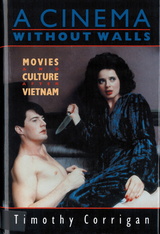
How have modern advertising techniques, the widespread use of VCRs, conglomerate takeovers of studios and film archives, cable TV, and media coverage of the Vietnam war changed the ways we watch movies? And how, in turn, have those different habits and patterns of viewing changed the ways in which films address their viewers? Drawing on a wide variety of American and European films and on many theoretical models, Timothy Corrigan investigates what he calls "a cinema without walls," taking a close look at particular films in order to see how we watch them differently in the post-Vietnam era. He examines cult audiences, narrative structure, genre films (road movies, in particular), and contemporary politics as they engage new models of film making and viewing. He thus provides a rare, serious attempt to deal with contemporary movies. Corrigan discusses filmmakers from a variety of backgrounds and cultures, including Martin Scorsese, Raoul Ruiz, Michael Cimino, Alexander Kluge, Francis Ford Coppola, Stephen Frears, and Wim Wenders. He offers detailed analyses of films such as Platoon; Full Metal Jacket; 9-1/2 Weeks; The Singing Detective; Choose Me; After Hours; Badlands; The King of Comedy; Paris, Texas; and My Beautiful Laundrette. Orchestrating this diversity, Corrigan provides a critical basis for making sense of contemporary film culture and its major achievements.

Péter Forgács, based in Budapest, is best known for his award-winning films built on home movies from the 1930s to the 1960s that document ordinary lives soon to intersect with offscreen historical events. Cinema’s Alchemist offers a sustained exploration of the imagination and skill with which Forgács reshapes such film footage, originally intended for private and personal viewing, into extraordinary films dedicated to remembering the past in ways that matter for our future.
Contributors: Whitney Davis, U of California, Berkeley; László F. Földényi, U of Theatre, Film and Television, Budapest; Marsha Kinder, U of Southern California; Tamás Korányi; Scott MacDonald, Hamilton College; Tyrus Miller, U of California, Santa Cruz; Roger Odin, U of Paris III Sorbonne–Nouvelle; Catherine Portuges, U of Massachusetts Amherst; Michael S. Roth, Wesleyan U; Kaja Silverman, U of Pennsylvania; Ernst van Alphen, Leiden U, the Netherlands; Malin Wahlberg, Stockholm U.
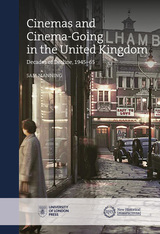
Cinema attendance fell in all regions, but the speed, nature, and extent of this decline varied widely across the United Kingdom. By presenting detailed case studies of two similarly-sized industrial cities, Belfast and Sheffield, this book adds nuance and detail to the discussion of regional variations in film exhibition and audience habits. Using a wide range of sources, such as oral testimony, box-office data, newspapers, and trade journals, Cinemas and Cinema-Going in the United Kingdom conveys the diverse and ever-changing nature of the cinema industry.
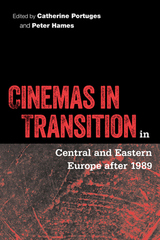
The contributors and editors of this exciting volume examine the interrelations between thematic, aesthetic, and infrastructural changes; the globalization of the international cinema marketplace; and the problems and promises arising from the privatization of national cinemas.
Cinemas in Transition in Central and Eastern Europe after 1989 also addresses the strategies employed for preserving national cinemas and cultures through an analysis of films from the Czech and Slovak republics, the former German Democratic Republic, Hungary, Poland, Romania, Ukraine, and the former Yugoslavia. The study provides a picture of Eastern European cinema at a critical juncture as well as its connections to the emergent world of transnational media.
Contributors include Barton Byg, Alexandra Foamente, Andrew Horton, Dina Iordanova, Ewa Mazierska, Bohdan Y. Nebesio, and Bogdan Stefanescu,
For over a century, cinephiles and film scholars have had to grapple with an ugly artifact that sits at the beginnings of film history. D. W. Griffith’s profoundly racist epic, The Birth of a Nation, inspired controversy and protest at its 1915 release and was defended as both a true history of Reconstruction (although it was based on fiction) and a new achievement in cinematic art. Paul McEwan examines the long and shifting history of its reception, revealing how the film became not just a cinematic landmark but also an influential force in American aesthetics and intellectual life.
In every decade since 1915, filmmakers, museums, academics, programmers, and film fans have had to figure out how to deal with this troublesome object, and their choices have profoundly influenced both film culture and the notion that films can be works of art. Some critics tried to set aside the film’s racism and concentrate on the form, while others tried to relegate that racism safely to the past. McEwan argues that from the earliest film retrospectives in the 1920s to the rise of remix culture in the present day, controversies about this film and its meaning have profoundly shaped our understandings of film, race, and art.
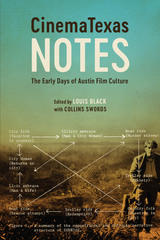
Austin’s thriving film culture, renowned for international events such as SXSW and the Austin Film Festival, extends back to the early 1970s when students in the Department of Radio-Television-Film at the University of Texas at Austin ran a film programming unit that screened movies for students and the public. Dubbed CinemaTexas, the program offered viewers a wide variety of films—old and new, mainstream, classic, and cult—at a time when finding and watching films after their first run was very difficult and prohibitively expensive. For each film, RTF graduate students wrote program notes that included production details, a sampling of critical reactions, and an original essay that placed the film and its director within context and explained the movie’s historical significance. Over time, CinemaTexas Program Notes became more ambitious and were distributed around the world, including to luminaries such as film critic Pauline Kael.
This anthology gathers a sampling of CinemaTexas Program Notes, organized into four sections: “USA Film History,” “Hollywood Auteurs,” “Cinema-Fist: Renegade Talents,” and “America’s Shadow Cinema.” Many of the note writers have become prominent film studies scholars, as well as leading figures in the film, TV, music, and video game industries. As a collection, CinemaTexas Notes strongly contradicts the notion of an effortlessly formed American film canon, showing instead how local film cultures—whether in Austin, New York, or Europe—have forwarded the development of film studies as a discipline.
The essays in this volume introduce us to the visual conventions of the Hollywood style, explaining how these first arose and how they have subsequently been challenged by alternative aesthetics. In order to frame this fascinating history, the contributors employ a series of questions about technology (how did new technology shape cinematography?), authorship (can a cinematographer develop styles and themes over the course of a career?), and classicism (how should cinematographers use new technology in light of past practice?). Taking us from the hand-cranked cameras of the silent era to the digital devices used today, the collection of original essays explores how the art of cinematography has been influenced not only by technological advances, but also by trends in the movie industry, from the rise of big-budget blockbusters to the spread of indie films.
The book also reveals the people behind the camera, profiling numerous acclaimed cinematographers from James Wong Howe to Roger Deakins. Lavishly illustrated with over 50 indelible images from landmark films, Cinematography offers a provocative behind-the-scenes look at the profession and a stirring celebration of the art form. Anyone who reads this history will come away with a fresh eye for what appears on the screen because of what happens behind it.
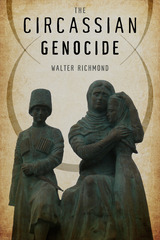
Using rare archival materials, Walter Richmond chronicles the history of the war, describes in detail the final genocidal campaign, and follows the Circassians in diaspora through five generations as they struggle to survive and return home. He places the periods of acute genocide, 1821–1822 and 1863–1864, in the larger context of centuries of tension between the two nations and updates the story to the present day as the Circassian community works to gain international recognition of the genocide as the region prepares for the 2014 Winter Olympics in Sochi, the site of the Russians’ final victory.
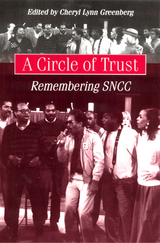
"The reminiscences and reflections voiced at the SNCC reunion remind us of the remarkable vision and courageous dedication of the civil rights movement of the 1960s. Framed by Cheryl Greenberg's eloquent and probing introduction, the SNCC veterans' comments about the triumphs and limitations of their movement represent a major contribution to the historical literature on race and power in modern America." --Raymond Arsenault, University of South Florida
On the occasion of the SNCC's 25th anniversary, more than 500 people gathered at Trinity College in Connecticut to both celebrate and critique its accomplishments. More than 40 SNCC members tell their stories and reflect on the contributions, limits and legacies of the movement in A Circle of Trust. Engaging in spirited debate with each other, with historians of the movement, and with contemporary political culture more broadly, these former and perpetual activists speak of their vision of a just society and what still remains to be done. With increasing racial tension and the continued debate over integration and separatism in America in the 1990s, the content of this conference is more relevant than ever.
Cheryl Lynn Greenberg begins with an overview of SNCC and introduces each of the chapters of oral history. Participants explore the origins of SNCC, its early adoption of nonviolent protest, its ultimate renunciation of liberal integration and embrace of militant black radicalism, its refusal to repudiate far-left organizations, and controversies over the roles of women in SNCC and society at large. The result is a thoughtful, moving, sometimes acrimonious, sometimes celebratory account of one of the most significant civil rights organizations and its successes and failures.
An essential high culture institution, the John Simon Guggenheim Memorial Foundation has both supported and molded American musical culture. Denise Von Glahn examines the Foundation and its immense influence from the organization’s prehistory and origins through the onset of World War II.
Funded by the Guggenheim mining fortune, the Foundation took early shape from the efforts of Carroll Wilson, Frank Aydelotte, and Henry Allen Moe--three Rhodes Scholars who initially struggled to envision and implement the organization’s ambitious goals. Von Glahn also examines the career of the longtime musical advisor Thomas Whitney Surette while profiling early awardees Aaron Copland, Ruth Crawford Seeger, William Grant Still, Roger Sessions, George Antheil, and Carlos Chàvez. She examines the processes behind their selection, their values and aesthetics, and their relationships with the insiders and others who championed their work.
“There was so much space.” These words epitomize ecologist Joe Truett's boyhood memories of the Angelina River valley in East Texas. Years and miles later, back home for the funeral of his grandfather, Truett began a long meditation on the world Corbett Graham had known and he himself had glimpsed, a now-vanished world where wild hogs and countless other animals rustled through the leaves, cows ate pinewoods grass instead of corn, oaks and hickories and longleaf pines were untouched by the corporate ax, and the river flowed freely. Truett's meditation resulted in this clear-sighted portrait of a place over time, its layers revealed by his love and care and curiosity.Truett celebrates his family's heritage and the unspoiled natural world of the Piney Woods without nostalgia. He recreates an older, simpler, more worthy age, but he knows that we have lost touch with it because we wanted to: he laments the loss but understands it. What makes his prose so moving and so redeeming is this precise combination of honesty and sorrow, overlaid by a quiet passion for both the natural and the human worlds.
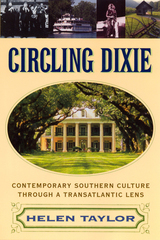
Taylor examines some of the South's most significant cultural exports in discussions that range across literature, music, film, television, theater, advertising, and tourism to focus on how and why Southern themes and icons have become so deeply embedded in British cultural life. The enduring legacy of Margaret Mitchell's Gone With the Wind can be seen today in the popularity of sequels, revisions, and reworkings of the novel. The conversation between these cultures is further explored in British responses to Alex Haley's Roots, the British theater's special affection for Tennessee Williams's plays, and the marketing of New Orleans as a preferred destination for European tourists. The transformation of Southern culture--itself a hybrid of the European, African, and American--as it circulates back across the Atlantic suggests not only new views of the history, racial politics, music and art of both Britain and the American South, but also an enhanced understanding of the dynamic flow of culture itself.
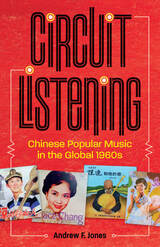
How the Chinese pop of the 1960s participated in a global musical revolution
What did Mao’s China have to do with the music of youth revolt in the 1960s? And how did the mambo, the Beatles, and Bob Dylan sound on the front lines of the Cold War in Asia? In Circuit Listening, Andrew F. Jones listens in on the 1960s beyond the West, and suggests how transistor technology, decolonization, and the Green Revolution transformed the sound of music around the globe.
Focusing on the introduction of the transistor in revolutionary China and its Cold War counterpart in Taiwan, Circuit Listening reveals the hidden parallels between music as seemingly disparate as rock and roll and Maoist anthems. It offers groundbreaking studies of Mandarin diva Grace Chang and the Taiwanese folk troubadour Chen Da, examines how revolutionary aphorisms from the Little Red Book parallel the Beatles’ “Revolution,” uncovers how U.S. military installations came to serve as a conduit for the dissemination of Anglophone pop music into East Asia, and shows how consumer electronics helped the pop idol Teresa Teng bring the Maoist era to a close, remaking the contemporary Chinese soundscape forever.
Circuit Listening provides a multifaceted history of Chinese-language popular music and media at midcentury. It profiles a number of the most famous and best loved Chinese singers and cinematic icons, and places those figures in a larger geopolitical and technological context. Circuit Listening’s original research and far-reaching ideas make for an unprecedented look at the role Chinese music played in the ’60s pop musical revolution.
Published by University of Delaware Press. Distributed worldwide by Rutgers University Press.
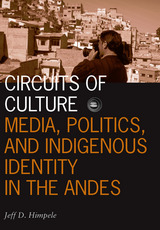
Set against the background of Bolivia’s prominent urban festival parades and the country’s recent appearance on the front lines of antiglobalization movements, Circuits of Culture is the first social analysis of Bolivian film and television, their circulation through the social and national landscape, and the emergence of the country’s indigenous video movement.
At the heart of Jeff Himpele’s examination is an ethnography of the popular television program, The Open Tribunal of the People. The indigenous and underrepresented majorities in La Paz have used the talk show to publicize their social problems and seek medical and legal assistance from the show’s hosts and the political party they launched. Himpele studies the program in order to identify the possibilities of the mass media as a site for political discourse and as a means of social action.
Charting as well the history of Bolivia’s media culture, Himpele perceptively investigates cinematic media as sites for understanding the modernization of Bolivia, its social movements, and the formation of indigenous identities, and in doing so provides a new framework for exploring the circulation of culture as a way of creating publics, political movements, and producing media.
Jeff D. Himpele is associate director for the McGraw Center for Teaching and Learning at Princeton University. He is an anthropologist and documentary filmmaker; his films include the award-winning Incidents of Travel in Chichen Itza and Taypi Kala: Six Visions of Tiwanaku.
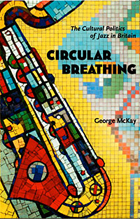
McKay explores the music in relation to issues of whiteness, blackness, and masculinity—all against a backdrop of shifting imperial identities, postcolonialism, and the Cold War. He considers objections to the music’s spread by the “anti-jazzers” alongside the ambivalence felt by many leftist musicians about playing an “all-American” musical form. At the same time, McKay highlights the extraordinary cultural mixing that has defined British jazz since the 1950s, as musicians from Britain’s former colonies—particularly from the Caribbean and South Africa—have transformed the genre. Circular Breathing is enriched by McKay’s original interviews with activists, musicians, and fans and by fascinating images, including works by the renowned English jazz photographer Val Wilmer. It is an invaluable look at not only the history of jazz but also the Left and race relations in Great Britain.
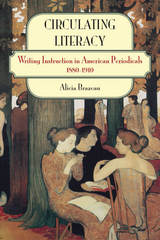
Brazeau establishes how these magazines shared a common strategy in the construction of literacy identities by connecting a specific identity with a particular set of reading and writing practices. She explores how farm journals were preoccupied with the value of literacy as a tool for shaping community; considers how the Journal and the Bazar deployed distinctly different illustrations of literacy values for women; shows how the Journal and editor Edward Bok cast women as consumers and sellers of literacy; and looks at the ways in which Bazar editors urged readers to adopt habits of reading and writing that emphasized communal relationships among women. In Circulating Literacy, Brazeau speaks to, and connects, the important topics of rural studies, gender, professionalization, and literacy sponsorship and identity, arguing for the value of the study of periodicals as literacy education tools.
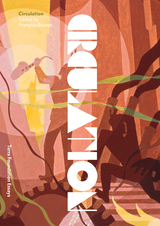
The third volume in the Terra Foundation Essays series, Circulation brings together an international and interdisciplinary team of scholars, including Thierry Gervais, Tom Gunning, J. M. Mancini, Frank Mehring, and Hélène Valance, who map the multiple planes where artistic meaning has been produced by the circulation of art from the eighteenth century to the present. The book looks at both broad historical trends and the successes and failures of particular works of art from a wide variety of artists and styles. Together, the contributions significantly expand the conceptual and methodological terrain of scholarship on American art.
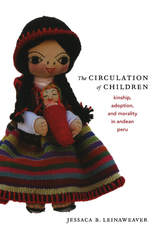
Leinaweaver provides insight into the emotional and material factors that bring together and separate indigenous Andean families in the highland city of Ayacucho. She describes how child circulation is intimately linked to survival in the city, which has had to withstand colonialism, economic isolation, and the devastating civil war unleashed by the Shining Path. Leinaweaver examines the practice from the perspective of parents who send their children to live in other households, the adults who receive them, and the children themselves. She relates child circulation to international laws and norms regarding children’s rights, adoptions, and orphans, and to Peru’s history of racial conflict and violence. Given that history, Leinaweaver maintains that it is not surprising that child circulation, a practice associated with Peru’s impoverished indigenous community, is alternately ignored, tolerated, or condemned by the state.

An investigation of how the expansion of modern medicine in Turkey transformed young boys’ experiences of circumcision.
In Turkey, circumcision is viewed as both a religious obligation and a rite of passage for young boys, as communities celebrate the ritual through gatherings, gifts, and special outfits. Yet the procedure is a potentially painful and traumatic ordeal. With the expansion of modern medicine, the social position of sünnetçi (male circumcisers) became subject to the institutional arrangements of Turkey’s evolving health care and welfare system. In the transition from traditional itinerant circumcisers to low-ranking health officers in the 1960s and hospital doctors in the 1990s, the medicalization of male circumcision has become entangled with state formation, market fetishism, and class inequalities.
Based on Oyman Başaran’s extensive ethnographic and historical research, Circumcision and Medicine in Modern Turkey is a close examination of the socioreligious practice of circumcision in twenty-five cities and their outlying towns and villages in Turkey. By analyzing the changing subjectivity of medical actors who seek to alleviate suffering in male circumcision, Başaran offers a psychoanalytically informed alternate approach to the standard sociological arguments surrounding medicalization and male circumcision.
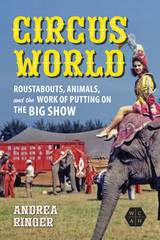
Andrea Ringer examines the industry-wide circus world--the collection of shows that traveled by rail, wagon, steamboat, and car--and the traditional and nontraditional laborers who created it. Performers and their onstage labor played an integral part in the popularity of the circus. But behind the scenes, other laborers performed the endless menial tasks that kept the show on the road. Circus operators regulated employee behavior both inside and outside the tent even as the employees themselves blurred the line between leisure and labor until, in all parts of the show, the workers could not escape their work.
Illuminating and vivid, Circus World delves into the gender, class, and even species concerns within an extinct way of life.
The lively history of this frontier fort.
History/Regional
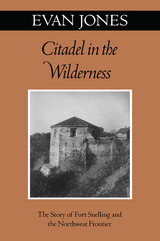
The lively history of this frontier fort, now back in print!In 1824 Colonel Josiah Snelling erected a stone fortress at the point where the Minnesota and Mississippi rivers merged, on territory secured by Lieutenant Zebulon Pike in a treaty with the Sioux chief Little Crow. Evan Jones describes the intriguing history of Fort Snelling, the Gibraltar of the West, its effect on the Native Americans of the region, and its role in the westward movement.“A story of bitter and complex rivalries. . . . With massive towers and walls capping a limestone cliff, [Fort Snelling] defied attack. But it influenced movements and events hundreds of miles away. The Sioux opposed the Chippewa, the North West Company contended with the Hudson’s Bay outfit, and Astor’s American Fur Company fought them both. . . . This book unfolds a forty-year struggle in the wilderness.” --New York Times Book Review“The author offers here a rollicking tale of high adventure and low shenanigans in and around Fort Snelling. As much the story of the Indians of the region as of the hardy Americans (famous and infamous) who walked inside this fort’s impressive walls, Citadel relays its message of courage and chicanery with a minimum of ‘undying prose’ but a maximum of straightforward and incisive storytelling.” --Library JournalEvan Jones (1915–1996) was born in Le Sueur, Minnesota. A writer of American history and cookbooks, he is the author of The Minnesota (also published in paperback by University of Minnesota Press), Trappers and Mountain Men, Epicurean Delight: The Life and Times of James Beard, and The L. L. Bean Book of New New England Cookery.ISBN 0-8166-3879-9 Paper £10.95 $14.95 256 Pages 23 black-and-white photos 5 3/8 x 8 1/2 MayFesler-Lampert Minnesota Heritage SeriesTranslation Inquiries: Penguin Putnam, Inc.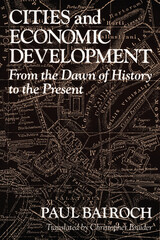
In this revised translation of De Jéricho à Mexico, Paul Bairoch seeks the answers to these questions and provides a comprehensive study of the evolution of the city and its relation to economic life. Bairoch examines the development of cities from the dawn of urbanization (Jericho) to the explosive growth of the contemporary Third World city. In particular, he defines the roles of agriculture and industrialization in the rise of cities.
"A hefty history, from the Neolithic onward. It's ambitious in scope and rich in subject, detailing urbanization and, of course, the links between cities and economies. Scholarly, accessible, and significant."—Newsday
"This book offers a path-breaking synthesis of the vast literature on the history of urbanization."—John C. Brown, Journal of Economic Literature
"One leaves this volume with the feeling of positions intelligently argued and related to the existing state of theory and knowledge. One also has the pleasure of reading a book unusually well-written. It will long both be a standard and stimulate new thought on the central issue of urban and economic growth."—Thomas A. Reiner, Annals of the American Academy of Political and Social Science


In Cities Beyond Crisis, Catalina Iannone studies the rapid evolution of Iberian urban centers in the years following the 2008 financial crisis, identifying how this event catalyzed a protracted period of unraveling and reorganization in the region. Arguing that the affects and effects of the crisis are best understood when embedded within local environments, Cities Beyond Crisis focuses on how textual, visual, and spatial interventions both drove and contested change in two racially diverse, historically marginalized neighborhoods in the capital cities of Spain and Portugal—Madrid’s Lavapiés and Lisbon’s Mouraria. Through a critical examination of the narratives shaping public perception of these spaces, whether promoting their development and consumption or challenging market-oriented trends, Iannone demonstrates how the stories that stakeholders across the ideological spectrum told about these districts illuminate enduring attachments and aspirations in each nation’s relationship to race. By approaching the study of space as a contested and contingent social product, this book takes an interdisciplinary approach, drawing from both humanistic and social science theories and practices to show how cultural production shapes and is shaped by the built environment.
Contributors. Javier Auyero, Mariana Cavalcanti, Ratão Diniz, Emilio Duhau, Sujatha Fernandes, Brodwyn Fischer, Bryan McCann, Edward Murphy, Dennis Rodgers
For Beauregard, the city is a cauldron for four haunting contradictions. First, cities are equally defined by both their wealth and their poverty. Second, cities are simultaneously environmentally destructive and yet promise sustainability. Third, cities encourage rule by political machines and oligarchies, even as they are essentially democratic and at least nominally open to all. And fourth, city life promotes tolerance among disparate groups, even as the friction among them often erupts into violence. Beauregard offers no simple solutions or proposed remedies for these contradictions; indeed, he doesn’t necessarily hold that they need to be resolved, since they are generative of city life. Without these four tensions, cities wouldn’t be cities. Rather, Beauregard argues that only by recognizing these ambiguities and contradictions can we even begin to understand our moral obligations, as well as the clearest paths toward equality, justice, and peace in urban settings.
A History of Exploration for Real and Mythical Treasures in the Americas
For half a millennium, stories of vast treasures—El Dorado, Manoa, the Seven Cities of Cibola, the Lost Dutchman Mine—have been part of the lore of the Americas. Long before the Europeans set foot in the New World, myths and rumors of fabulous wealth in distant lands, such as the kingdom of Prester John, were told and retold so often that they were assumed to be true. When Spanish explorers first made contact with the Aztec and Inca civilizations, they found cultures that were literally dripping with gold. This evidence made it easy to believe the native stories of even greater wealth just beyond the horizon. In these uncharted lands, dreamers sought their fortunes: Francisco de Coronado ranged over the North American plains in search of the elusive Quivira; Gonzalo Pizarro, brother of the Incan conqueror, and Lope Aguirre, the “Wrath of God,” were both part of ill-fated expeditions in search of El Dorado; and Leonard Clark walked out of the Amazon after World War II with gold and claimed he had found that fabled kingdom.
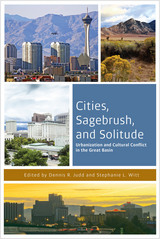
The blooming of cities in a fragile desert region poses a host of environmental challenges. The policies required to manage their impact, however, often collide with an entrenched political culture that has long resisted cooperative or governmental effort. The alchemical mixture of three ingredients--cities, aridity, and a libertarian political outlook--makes the Great Basin a compelling place to study. This book addresses a pressing question: are large cities ultimately sustainable in such a fragile environment?
Thematically and methodologically wide-ranging and innovative, this volume considers a broad spectrum of responses not only to the supposed breakdown of social cohesion but also to specific forms of deviant behavior. It draws on large numbers of writings from the period by clergymen, jurists, medical doctors, educators, social workers, and others. This literature illuminates the histories not only of urbanization and cities but also of sexuality and Christianity, crime and criminology, leisure and education, youth and women, charity and social work, and the welfare state as well as local government.
Focusing on positive instead of escapist responses to the challenges that inhered in urban society, this work can be read as part of an ongoing reassessment of the German Empire that points away from the idea that Germans were traveling an antimodernist Sonderweg, or special path, that led inevitably to National Socialism and the Third Reich. Although intended primarily for scholars and students of modern Germany, this book should speak to a variety of readers, among them anyone who cares about the history of cities, deviant behavior, or social reform.
Andrew Lees is Professor of History, Rutgers University.
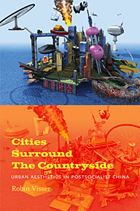
In the 1980s, writers, filmmakers, and artists began to probe the contradictions in China’s urbanization policies and rhetoric. Powerful neorealist fiction, cinema, documentaries, paintings, photographs, performances, and installations contrasted forms of glittering urban renewal with the government’s inattention to a livable urban infrastructure. Narratives and images depicting the melancholy urban subject came to illustrate ethical quandaries raised by urban life. Visser relates her analysis of this art to major transformations in urban planning under global neoliberalism, to the development of cultural studies in the Chinese academy, and to ways that specific cities, particularly Beijing and Shanghai, figure in the cultural imagination. Despite the environmental and cultural destruction caused by China’s neoliberal policies, Visser argues for the emergence of a new urban self-awareness, one that offers creative resolutions for the dilemmas of urbanism through new forms of intellectual engagement in society and nascent forms of civic governance.
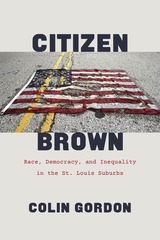
Citizen Brown uncovers half a century of private practices and public policies that resulted in bitter inequality and sustained segregation in Ferguson and beyond. Gordon shows how municipal and school district boundaries were pointedly drawn to contain or exclude African Americans and how local policies and services—especially policing, education, and urban renewal—were weaponized to maintain civic separation. He also makes it clear that the outcry that arose in Ferguson was no impulsive outburst but rather an explosion of pent-up rage against long-standing systems of segregation and inequality—of which a police force that viewed citizens not as subjects to serve and protect but as sources of revenue was only the most immediate example. Worse, Citizen Brown illustrates the fact that though the greater St. Louis area provides some extraordinarily clear examples of fraught racial dynamics, in this it is hardly alone among American cities and regions.
Interactive maps and other companion resources to Citizen Brown are available at the book website.
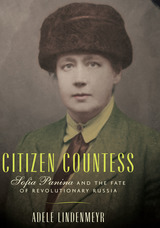
Based on Adele Lindenmeyr's detailed research in dozens of archival collections, Citizen Countess establishes Sofia Panina as an astute eyewitness to and passionate participant in the historical events that shaped her life. Her experiences shed light on the evolution of the European nobility, women's emancipation and political influence of the time, and the fate of Russian liberalism.

The condition of our public discussions about literary and cultural works has much to say about the state of our democracy. Classrooms, newspapers, magazines, Internet forums, and many other places grant citizens a place to hold public discourses—and claim a voice on national artistic matters.
Rosa A. Eberly looks at four censorship controversies where professionals asserted their authority to deny citizen critics a voice—and effectively removed discussion of literature from the public sphere. Eberly compares the outrage sparked by the publication of James Joyce's Ulysses and Henry Miller's Tropic of Cancer with the relative quiescence that greeted the much more violent and sexually explicit content of Bret Easton Ellis's American Psycho and Andrea Dworkin's Mercy. Through a close reading of letters to the editor, reviews, media coverage, and court cases, Eberly shows how literary critics and legal experts defused censorship debates—and undercut the authority of citizen critics—by shifting the focus from content to aesthetics and from social values to publicity.
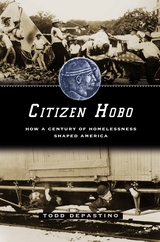
In this eye-opening work of American history, Todd DePastino tells the epic story of hobohemia's rise and fall, and crafts a stunning new interpretation of the "American century" in the process. Drawing on sources ranging from diaries, letters, and police reports to movies and memoirs, Citizen Hobo breathes life into the largely forgotten world of the road, but it also, crucially, shows how the hobo army so haunted the American body politic that it prompted the creation of an entirely new social order and political economy. DePastino shows how hoboes—with their reputation as dangers to civilization, sexual savages, and professional idlers—became a cultural and political force, influencing the creation of welfare state measures, the promotion of mass consumption, and the suburbanization of America. Citizen Hobo's sweeping retelling of American nationhood in light of enduring struggles over "home" does more than chart the change from "homelessness" to "houselessness." In its breadth and scope, the book offers nothing less than an essential new context for thinking about Americans' struggles against inequality and alienation.
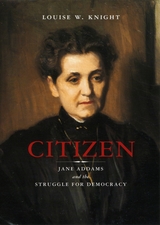
Citizen covers the first half of Addams's life, from 1860 to 1899. Knight recounts how Addams, a child of a wealthy family in rural northern Illinois, longed for a life of larger purpose. She broadened her horizons through education, reading, and travel, and, after receiving an inheritance upon her father's death, moved to Chicago in 1889 to co-found Hull House, the city's first settlement house. Citizen shows vividly what the settlement house actually was—a neighborhood center for education and social gatherings—and describes how Addams learned of the abject working conditions in American factories, the unchecked power wielded by employers, the impact of corrupt local politics on city services, and the intolerable limits placed on women by their lack of voting rights. These experiences, Knight makes clear, transformed Addams. Always a believer in democracy as an abstraction, Addams came to understand that this national ideal was also a life philosophy and a mandate for civic activism by all.
As her story unfolds, Knight astutely captures the enigmatic Addams's compassionate personality as well as her flawed human side. Written in a strong narrative voice, Citizen is an insightful portrait of the formative years of a great American leader.
“Knight’s decision to focus on Addams’s early years is a stroke of genius. We know a great deal about Jane Addams the public figure. We know relatively little about how she made the transition from the 19th century to the 20th. In Knight’s book, Jane Addams comes to life. . . . Citizen is written neither to make money nor to gain academic tenure; it is a gift, meant to enlighten and improve. Jane Addams would have understood.”—Alan Wolfe, New York Times Book Review
“My only complaint about the book is that there wasn’t more of it. . . . Knight honors Addams as an American original.”—Kathleen Dalton, Chicago Tribune
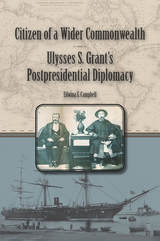
Traveling commercially and on U.S. Navy warships, Grant visited ports of call throughout the British Empire, Europe, and Asia, including Britain, France, Egypt, the Ottoman Empire, Greece, Italy, the Netherlands, Germany, Scandinavia, Russia, Spain, Portugal, Gibraltar, Ireland, India, Singapore, Hong Kong, China, and Japan. Along the way, he met with monarchs, ministers, and average citizens, creating the model for the summitry and public diplomacy practiced by future American presidents and articulating concepts of national self-determination, international organization, and the peaceful settlement of international disputes decades before Elihu Root’s advocacy of binding international arbitration and Woodrow Wilson’s proposal for the League of Nations.
Campbell reveals Grant to be a skillful envoy who brought to his travels the deep interest in foreign policy issues he had shown during his administration. Grant confirmed the United States’ commitment to Anglo-American cooperation, demonstrated America’s interest in the territorial integrity of China, affirmed American faith in universal (male) suffrage as the basis for governmental legitimacy, and asserted the importance of an international order based on equality and justice for all states and their citizens. Grant’s efforts shaped not only John Hay’s Open Door policy in 1899–1900 but also the broader American approach to twentieth-century international relations. Throughout the trip, Julia Grant proved essential to the success of her husband’s mission, and Campbell tells how the couple impressed people around the world with an enduring image of an American president and first lady.
By illuminating the significance of Grant’s often overlooked postpresidential travels, Citizen of a Wider Commonwealth establishes the eighteenth president as a key diplomat whose work strongly influenced the direction of future U.S. foreign policy and contributes substantially to the study of American international relations.
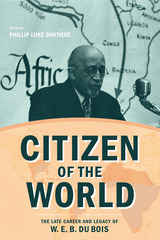
From his birth in 1868 until his death in 1963, Du Bois sought the liberation of black people in the United States and across the world through intellectual and political labor. His tireless efforts documented and demonstrated connections between freedom for African-descended people abroad and black freedom at home.
In concert with growing scholarship on his twilight years, the essays in this volume assert the fundamental importance of considering Du Bois’s later decades not as a life in decline that descended into blind ideological allegiance to socialism and communism but as the life of a productive, generative intellectual who responded rationally, imaginatively, and radically to massive mid-century changes around the world, and who remained committed to freedom’s realization until his final hour.
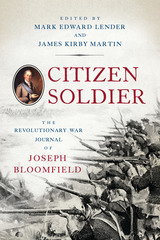
“About sunset we made a stand, when I was wounded, having a Ball with the Wad shot through my left forearm & the fuse set my coat and shirt on fire.” So wrote Major Joseph Bloomfield in his journal on September 11, 1777, describing his experiences during the hard-fought battle of Brandywine. Bloomfield was an officer in the 3rd New Jersey Regiment from 1776 to 1779. His service took him from Fort Stanwix to Fort Ticonderoga in New York, to the battle of Brandywine in Pennsylvania, and to the battle of Monmouth in his native state. He later served as governor of New Jersey from 1801 to 1812. A compassionate officer admired by his men, Bloomfield carefully recounted the hardships of military campaigns—the swings of morale, the shortage of supplies, the ever-present illnesses—and the intensity of combat. Of special interest are Bloomfield’s important notes on the culture and behavior of the Iroquois tribes known collectively as the Six Nations, which played a crucial role in revolutionary New York.
Unpublished and all but unknown when the first edition—skillfully edited by historians Mark Edward Lender and Joseph Kirby Martin—appeared, Bloomfield’s wartime journal was praised for providing both scholars and general readers with new information on the Continental soldier; the revolution’s impact on society; warfare in New York, New Jersey, and Pennsylvania; and the motives and actions of the revolutionary generation. Soldiers and civilians, Patriots and Tories, come alive in this fascinating eyewitness narrative. This new edition of Citizen Soldier: The Revolutionary War Journal of Joseph Bloomfield—the first in thirty-five years—includes a new introduction and bibliographic essay by the editors.
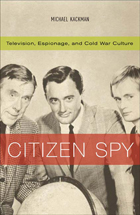
During the first decade of the Cold War, Hollywood developed such shows as I Led 3 Lives and Behind Closed Doors with the approval of federal intelligence agencies, even basing episodes on actual case files. These “documentary melodramas” were, Kackman argues, vehicles for the fledgling television industry to proclaim its loyalty to the government, and they came stocked with appeals to patriotism and anti-Communist vigilance.
As the rigid cultural logic of the Red Scare began to collapse, spy shows became more playful, self-referential, and even critical of the ideals professed in their own scripts. From parodies such as The Man from U.N.C.L.E. and Get Smart to the more complicated global and political situations of I Spy and Mission: Impossible, Kackman situates espionage television within the tumultuous culture of the civil rights and women’s movements and the war in Vietnam. Yet, even as spy shows introduced African-American and female characters, they continued to reinforce racial and sexual stereotypes.
Bringing these concerns to the political and cultural landscape of the twenty-first century, Kackman asserts that the roles of race and gender in national identity have become acutely contentious. Increasingly exclusive definitions of legitimate citizenship, heroism, and dissent have been evident through popular accounts of the Iraq war. Moving beyond a snapshot of television history, Citizen Spy provides a contemporary lens to analyze the nature—and implications—of American nationalism in practice.
Michael Kackman is assistant professor in Radio-Television-Film at the University of Texas, Austin.
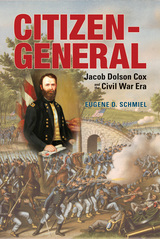
The wrenching events of the Civil War transformed not only the United States but also the men unexpectedly called on to lead their fellow citizens in this first modern example of total war. Jacob Dolson Cox, a former divinity student with no formal military training, was among those who rose to the challenge. In a conflict in which “political generals” often proved less than competent, Cox, the consummate citizen general, emerged as one of the best commanders in the Union army.
During his school days at Oberlin College, no one could have predicted that the intellectual, reserved, and bookish Cox possessed what he called in his writings the “military aptitude” to lead men effectively in war. His military career included helping secure West Virginia for the Union; jointly commanding the left wing of the Union army at the critical Battle of Antietam; breaking the Confederate supply line and thereby precipitating the fall of Atlanta; and holding the defensive line at the Battle of Franklin, a Union victory that effectively ended the Confederate threat in the West.
At a time when there were few professional schools other than West Point, the self-made man was the standard for success; true to that mode, Cox fashioned himself into a Renaissance man. In each of his vocations and avocations—general, governor, cabinet secretary, university president, law school dean, railroad president, historian, and scientist—he was recognized as a leader. Cox’s greatest fame, however, came to him as the foremost participant historian of the Civil War. His accounts of the conflict are to this day cited by serious scholars and serve as a foundation for the interpretation of many aspects of the war.
Citizens and Paupers explores this contentious history by analyzing and comparing three major programs: the Freedmen’s Bureau, the Works Progress Administration, and the present-day system of workfare that arose in the 1990s. Each of these overhauls of the welfare state created new groups of clients, new policies for aiding them, and new disputes over citizenship—conflicts that were entangled in racial politics and of urgent concern for social activists.
This combustible mix of racial tension and social reform continues to influence how we think about welfare, and Citizens and Paupers is an invaluable analysis of the roots of the debate.
Fútbol, or soccer as it is called in the United States, is the most popular sport in the world. Millions of people schedule their lives and build identities around it. The World Cup tournament, played every four years, draws an audience of more than a billion people and provides a global platform for displays of athletic prowess, nationalist rhetoric, and commercial advertising. Fútbol is ubiquitous in Latin America, yet few academic histories of the sport exist, and even fewer focus on its relevance to politics in the region. To fill that gap, this book uses amateur fútbol clubs in Chile to understand the history of civic associations, popular culture, and politics.
In Citizens and Sportsmen, Brenda Elsey argues that fútbol clubs integrated working-class men into urban politics, connected them to parties, and served as venues of political critique. In this way, they contributed to the democratization of the public sphere. Elsey shows how club members debated ideas about class, ethnic, and gender identities, and also how their belief in the uniquely democratic nature of Chile energized state institutions even as it led members to criticize those very institutions. Furthermore, she reveals how fútbol clubs created rituals, narratives, and symbols that legitimated workers' claims to political subjectivity. Her case study demonstrates that the relationship between formal and informal politics is essential to fostering civic engagement and supporting democratic practices.
and decline of the Citizens' Councils of America details the organization's
role in the massive resistance to school desegregation in the South following
the 1954 Brown vs. Board of Education decision. Included are a new preface and
updated bibliography.
"A tour de force of research and
narration. . . in highly readable style. [McMillen] . . . seems to have read
everything the historical record has to offer on the subject and to have known
exactly what to make of it. . . Himself squarely on the side of the future,
he is sensitive to the anguish that prompted the hysteria of the misguided racist. . . .
By any test, a masterful study." -- Journal of Southern History
"Takes seriously the people who
made the movement, when ridicule and caricature would have been an easier analytical
technique. Solidly researched and well written. . . an intriguing story." --
Augustus M. Burns, Social Studies
Published by Bucknell University Press. Distributed worldwide by Rutgers University Press.
Old Comedy gives Citizens on Stage its chronological backbone; the beginning and end of Aristophanes' career roughly define the period on which the book concentrates. Reading and interpreting comedy provides a model for reading Athenian politics itself. McGlew argues that the plays of Old Comedy, with their fantastic stories of common individuals triumphing over the various social and political dilemmas of democratic Athens, interpreted the relationship of private life and political activity for an Athenian audience, dramatically reaffirming the ties between citizens' personal desires and the will of the collective body. In particular, McGlew argues that comedy transforms private fantasies of personal power and pleasures--what seem most to keep the individual audience members apart--into a collective possession and touchstone of democratic citizen identity.
Citizens on Stage focuses primarily on the democratic citizen and on contemporary representations of him as a decision maker. McGlew shows that the democratic individual, sometimes idealized, sometimes despised, was a dominant concern of the literature and politics of late fifth- and early fourth-century Athens. This book will appeal to students of ancient theater and drama, Athenian politics and democracy, and the relationships between theater and politics. Social historians will also find it an invaluable resource.
James F. McGlew is Assistant Professor of Foreign Languages and Literatures and Classical Studies, Iowa State University.
Among the many questions Julia Reinhard Lupton attempts to answer under the rubric of the citizen-saint are: how did states of emergency, acts of sovereign exception, and Messianic anticipations lead to new forms of religious and political law? What styles of universality were implied by the abject state of the pure creature, at sea in a creation abandoned by its creator? And how did circumcision operate as both a marker of ethnicity and a means of conversion and civic naturalization?
Written with clarity and grace, Citizen-Saints will be of enormous interest to students of English literature, religion, and early modern culture.
Exit, like entry, has helped define citizenship over the last two centuries, yet little attention has been given to the politics of emigration. How have countries impeded or facilitated people leaving? How have they perceived and regulated those who leave? What relations do they seek to maintain with their citizens abroad and why? Citizenship and Those Who Leave reverses the immigration perspective to examine how nations define themselves not just through entry but through exit as well.
Africa, it is often said, is suffering from a crisis of citizenship. At the heart of the contemporary debates this apparent crisis has provoked lie dynamic relations between the present and the past, between political theory and political practice, and between legal categories and lived experience. Yet studies of citizenship in Africa have often tended to foreshorten historical time and privilege the present at the expense of the deeper past.
Citizenship, Belonging, and Political Community in Africa provides a critical reflection on citizenship in Africa by bringing together scholars working with very different case studies and with very different understandings of what is meant by citizenship. By bringing historians and social scientists into dialogue within the same volume, it argues that a revised reading of the past can offer powerful new perspectives on the present, in ways that might also indicate new paths for the future.
The project collects the works of up-and-coming and established scholars from around the globe. Presenting case studies from such wide-ranging countries as Sudan, Mauritius, South Africa, Côte d’Ivoire, and Ethiopia, the essays delve into the many facets of citizenship and agency as they have been expressed in the colonial and postcolonial eras. In so doing, they engage in exciting ways with the watershed book in the field, Mahmood Mamdani’s Citizen and Subject.
Contributors: Samantha Balaton-Chrimes, Frederick Cooper, Solomon M. Gofie, V. Adefemi Isumonah, Cherry Leonardi, John Lonsdale, Eghosa E.Osaghae, Ramola Ramtohul, Aidan Russell, Nicole Ulrich, Chris Vaughan, and Henri-Michel Yéré.
Attending to the hidden linkages among intimate realms and the public sphere, Sheller explores specific struggles for freedom, including women's political activism in Jamaica; the role of discourses of "manhood" in the making of free subjects, soldiers, and citizens; the fiercely ethnonationalist discourses that excluded South Asian and African indentured workers; the sexual politics of the low-bass beats and "bottoms up" moves in the dancehall; and the struggle for reproductive and LGBT rights and against homophobia in the contemporary Caribbean. Through her creative use of archival sources and emphasis on the connections between intimacy, violence, and citizenship, Sheller enriches critical theories of embodied freedom, sexual citizenship, and erotic agency in all post-slavery societies.
The stories told here capture a wide-ranging debate about the workings of the national security state and the meaning of American citizenship. Some of the participants in this debate—women like war bride Ellen Knauff and Pentagon employee Annie Lee Moss—were able to make their own experiences compelling examples of the threats posed by the national security regime. Others, such as Ruth Reynolds and Lolita Lebrón, who advocated an end to American empire in Puerto Rico, or the psychiatrist Fredric Wertham, who sought to change the very definition of national security, were less successful. Together, however, they exposed the gap between democratic ideals and government policies.
Friedman traverses immigration law and loyalty boards, popular culture and theoretical treatises, U.S. court-rooms and Puerto Rican jails, to demonstrate how Cold War repression made visible in new ways the unevenness and limitations of American citizenship. Highlighting the ways that race and gender shaped critiques and defenses of the national security regime, she offers new insight into the contradictions of Cold War political culture.

Did women have a civic identity in eighteenth-century France? In Citoyennes: Women and the Ideal of Citizenship in Eighteenth-Century France, Annie Smart contends that they did. While previous scholarship has emphasized the ideal of domestic motherhood or the image of the republican mother, Smart argues persuasively that many pre-revolutionary and revolutionary texts created another ideal for women–the ideal of civic motherhood. Smart asserts that women were portrayed as possessing civic virtue, and as promoting the values and ideals of the public sphere.
Contemporary critics have theorized that the eighteenth-century ideal of the Republic intentionally excluded women from the public sphere. According to this perspective, a discourse of “Rousseauean” domestic motherhood stripped women of an active civic identity, and limited their role to breastfeeding and childcare. Eighteenth-century France marked thus the division between a male public sphere of political action and a female private sphere of the home.
Citoyennes challenges this position and offers an alternative model of female identity. This interdisciplinary study brings together a variety of genres to demonstrate convincingly that women were portrayed as civic individuals. Using foundational texts such as Jean-Jacques Rousseau’s Emile, or on Education (1762), revolutionary gouaches of Lesueur, and vaudeville plays of Year II of the Republic (1793/1794), this study brilliantly shows that in text and image, women were represented as devoted to both the public good and their families.
In addition, Citoyennes offers an innovative interpretation of the home. Through re-examining sphere theory, this study challenges the tendency to equate the home with private concerns, and shows that the home can function as a site for both private life and civic identity.
Citoyennes breaks new ground, for it both rectifies the ideal of domestic Rousseauean motherhood, and brings a fuller understanding to how female civic identity operated in important French texts and images.
Published by University of Delaware Press. Distributed worldwide by Rutgers University Press.
“Laszlo . . . has approached the lore of citrus fruit with the élan of a master chef (the man is French, after all), mixing history, economics, biology and chemistry to produce a book that will bring a smile to readers of every taste.”—Natural History
“Altogether charming, eccentric, erudite, and definitely worth the price.”—Times Higher Education Supplement
“Stimulating. . . . Laszlo shows that the citrus fruit ‘is a treasure trove of chemicals that are highly useful to humankind’—which also happens to taste wonderful.”—Sunday Times (UK)
“Did you know there are a billion citrus trees under cultivation, or that grapefruit juice may potentiate the effects of Viagra? Citrus mines over two millennia of history to explore the spread of these fruits out of Asia, their commercialization in the United States, and enduring symbolism the world over.”—New Scientist
READERS
Browse our collection.
PUBLISHERS
See BiblioVault's publisher services.
STUDENT SERVICES
Files for college accessibility offices.
RECENTLY PUBLISHED



UChicago Accessibility Resources
home | accessibility | search | about | contact us
BiblioVault ® 2001 - 2026
The University of Chicago Press