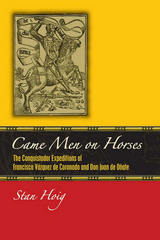
front cover of Came Men on Horses
Came Men on Horses
The Conquistador Expeditions of Francisco Vásquez de Coronado and Don Juan de Oñate
Stan Hoig
University Press of Colorado, 2013

Guided by myths of golden cities and worldly rewards, policy makers, conquistador leaders, and expeditionary aspirants alike came to the new world in the sixteenth century and left it a changed land. Came Men on Horses follows two conquistadors—Francisco Vázquez de Coronado and Don Juan de Oñate—on their journey across the southwest.

Driven by their search for gold and silver, both Coronado and Oñate committed atrocious acts of violence against the Native Americans, and fell out of favor with the Spanish monarchy. Examining the legacy of these two conquistadors Hoig attempts to balance their brutal acts and selfish motivations with the historical significance and personal sacrifice of their expeditions. Rich human details and superb story-telling make Came Men on Horses a captivating narrative scholars and general readers alike will appreciate.
[more]

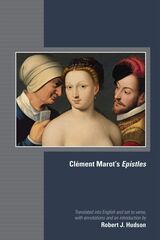
front cover of Clément Marot's Epistles
Clément Marot's Epistles
Clément Marot
Arizona Center for Medieval and Renaissance Studies, 2021
The first complete, versified English-language translation of the epistles of Renaissance poet Clément Marot.
 
Clément Marot (1496–1544), a royal poet in Renaissance France who ushered in new verse forms and renewed existing ones, stands as one of the most important literary voices of the first half of the sixteenth century. Clément Marot’s Epistles represents a first attempt to offer a sustained English-language translation and critical edition of what is widely considered his most personal, historically relevant, and crowning verse form. Aiming for integrality and poetic precision, the volume translates and sets to verse all seventy-four of Marot’s epistles, employing the same meter and rhyme scheme used by the poet in the original compositions. Likewise focused on capturing Marot’s poetic voice, thus maintaining idiomatic and literary integrity, the resulting translation is an attempt to relate the playfulness and pathos of Marot’s verse, rendering it accessible to an anglophone public.
 
Beyond the more traditional verse epistles included in the primary base text, Marot’s authorized complete works from 1538, the volume also offers translations of the introductory prose epistles penned by Marot for his Adolescence clémentine of 1532 and the 1538 edition (Lyon, Dolet), as well as the coq-à-l’âne and other versified satirical epistles, the “artificial epistle” retelling of a popular medieval romance, and more. A robust critical apparatus includes ample footnotes, an extensive introduction, illustrations, a bibliography, a chronological table, and a concordance with the principal modern French-language editions of Marot’s epistles.

The book should appeal to English-speaking historians and literary scholars alike, as well as to poetry lovers, who will appreciate a new acquaintance with this distinctive voice from poetry’s past.
 
[more]

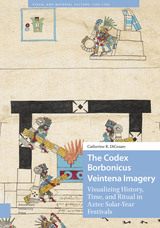
front cover of The Codex Borbonicus Veintena Imagery
The Codex Borbonicus Veintena Imagery
Visualizing History, Time, and Ritual in Aztec Solar-Year Festivals
Catherine DiCesare
Amsterdam University Press, 2024
The sixteenth-century pictorial manuscript known as the Codex Borbonicus contains a remarkable record of the eighteen Mexica (or “Aztec”) festival periods of twenty days, known as veintenas, celebrated during the 365-day solar year. Because its indigenous artists framed the Borbonicus veintenas with historical year dates, this volume situates the annually recurring rituals within the march of linear, reckoned time, in the singular year “2 Reed” (1507), during the reign of Moteuczoma II. DiCesare attends to the historical dimensions of several unusual scenes, proposing that the veintenas probably varied significantly from year to year in response to historical concerns. She considers particularly whether the Borbonicus veintenas document the confluence of solar year ceremonies with a second set of ritual feast days, governed by the 260-day cycle known as the tonalpohualli, or “count of days.” In this way, DiCesare analyzes how linear and cyclical conceptions of time intersected in Mexica ritual performance.
[more]

front cover of Cold Tyranny and the Demonic North of Early Modern England
Cold Tyranny and the Demonic North of Early Modern England
Anne Cotterill
Amsterdam University Press, 2024
The seventeenth and early eighteenth centuries were among the worst years of the Little Ice Age. This volume attends to English texts from this period to trace associations between wintry physical landscapes and an icy inner landscape of human cruelty and tyranny whose rigors promote the ultimate chill of rigor mortis. Sailors seeking a polar route to the East brought terrifying reports of northern icescapes, long popularly linked with the devil. Simultaneously, concerns about increasingly cold winters at home in Britain overlapped with increased scrutiny of kingship and the church and fear of tyranny from both. Such fears were reflected in ongoing struggles between king and Parliament during the period, leading to revolution and war. The binding power of ice and the power of northern winters to deface, kill, and bury life suggested the Fall’s human parallel to winter: cold-hearted humans as tyrannical winters who deal in death.
[more]

logo for Harvard University Press
Conquest and Agrarian Change
The Emergence of the Hacienda System on the Peruvian Coast
Robert Keith
Harvard University Press, 1976

The colonial society and economy of Latin America were based on local communities of three principal types: Spanish towns, Indian villages, and landed estates or haciendas. Of these, it was the latter that provided the economic foundations for the aristocratic social system. This book tells how and why the Spaniards who settled the Peruvian coastal valleys originally came to establish their estates. Some of the questions it attempts to answer are: Why did the hacienda system arise in the second half of the sixteenth century? Was it primarily a product of Spanish history and culture? Was it an inevitable result of the conquest? What did it owe to Indian customs and traditions? To local geography? To economic and social conditions?

Concentrating on seven major valleys of the central coast, the author investigates varying local conditions and circumstances as they appear in wills, bills of sale, contracts, and other notarial documents. The story begins with the indigenous coastal societies before the conquest and concludes with the consolidation of the hacienda system in the early seventeenth century.
[more]

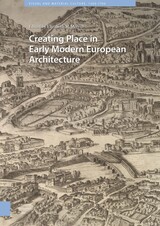
front cover of Creating Place in Early Modern European Architecture
Creating Place in Early Modern European Architecture
Elizabeth Merrill
Amsterdam University Press, 2022
The importance of place – as a unique spatial identity – has been recognized since antiquity. Ancient references to the 'genius loci', or spirit of place, evoked not only the location of a distinct atmosphere or environment, but also the protection of this location, and implicitly, its making and construction. This volume examines the concept of place as it relates to architectural production and building knowledge in early modern Europe (1400-1800). The places explored in the book's ten essays take various forms, from an individual dwelling to a cohesive urban development to an extensive political territory. Within the scope of each study, the authors draw on primary source documents and original research to demonstrate the distinctive features of a given architectural place, and how these are related to a geographic location, social circumstances, and the contributions of individual practitioners. The essays underscore the distinct techniques, practices and organizational structures by which physical places were made in the early modern period.
[more]

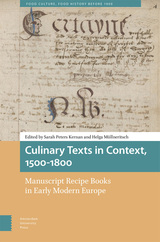
front cover of Culinary Texts in Context, 1500–1800
Culinary Texts in Context, 1500–1800
Manuscript Recipe Books in Early Modern Europe
Sarah Kernan
Amsterdam University Press, 2024
This collection represents a new and significant contribution to the study of recipe books from the early modern period (ca. 1500–1800) by situating them in a broader European context, traversing Catalonia, Finland, French and German-speaking regions, Ireland, Portugal, Spain, Sweden, and England. Ten essays, including a critical introduction to the genre, trace the materiality of the books and the use of the instructions therein, investigating patterns of recipe collection and their evolution over time; the international transmission of recipes, ingredients, and artisanal knowledge; and women’s manuscript culture. The authors explore how localised traditions of book production and domestic record-keeping shaped the physical forms of the books, and how stains, folds, marginalia, items pressed between pages, and pasted-in additions reveal their many uses. The inclusion of new ingredients and the integration of foreign recipes point to the many ways in which people, food, ideas, and books travelled the globe.
[more]


Send via email Share on Facebook Share on Twitter