
 A SCHOLARLY BOOK REPOSITORY
7 start with C start with C
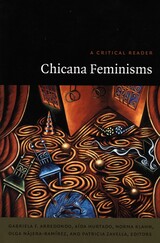
The contributors contemplate a number of facets of Chicana experience: life on the Mexico-U.S. border, bilingualism, the problems posed by a culture of repressive sexuality, the ranchera song, and domesticana artistic production. They also look at Chicana feminism in the 1960s and 1970s, the history of Chicanas in the larger Chicano movement, autobiographical writing, and the interplay between gender and ethnicity in the movie Lone Star. Some of the essays are expansive; others—such as Norma Cantú’s discussion of the writing of her fictionalized memoir Canícula—are intimate. All are committed to the transformative powers of critical inquiry and feminist theory.
Contributors. Norma Alarcón, Gabriela F. Arredondo, Ruth Behar, Maylei Blackwell, Norma E. Cantú, Sergio de la Mora, Ann duCille, Michelle Fine, Rosa Linda Fregoso, Rebecca M. Gámez, Jennifer González, Ellie Hernández, Aída Hurtado, Claire Joysmith, Norma Klahn, Amalia Mesa-Bains, Olga Nájera-Ramírez, Anna Nieto Gomez, Renato Rosaldo, Elba Rosario Sánchez, Marcia Stephenson, Jose Manuel Valenzuela, Patricia Zavella

Generation Anthropocene. Storms of My Grandchildren. Our Children’s Trust. Why do these and other attempts to imagine the planet’s uncertain future return us—again and again—to the image of the child? In The Child to Come, Rebekah Sheldon demonstrates the pervasive conjunction of the imperiled child and the threatened Earth and blisteringly critiques the logic of catastrophe that serves as its motive and its method.
Sheldon explores representations of this perilous future and the new figurations of the child that have arisen in response to it. Analyzing catastrophe discourse from the 1960s to the present—books by Joanna Russ, Margaret Atwood, and Cormac McCarthy; films and television series including Southland Tales, Battlestar Galactica, and Children of Men; and popular environmentalism—Sheldon finds the child standing in the place of the human species, coordinating its safe passage into the future through the promise of one more generation. Yet, she contends, the child figure emerges bound to the very forces of nonhuman vitality he was forged to contain.
Bringing together queer theory, ecocriticism, and science studies, The Child to Come draws on and extends arguments in childhood studies about the interweaving of the child with the life sciences. Sheldon reveals that neither life nor the child are what they used to be. Under pressure from ecological change, artificial reproductive technology, genetic engineering, and the neoliberalization of the economy, the queerly human child signals something new: the biopolitics of reproduction. By promising the pliability of the body’s vitality, the pregnant woman and the sacred child have become the paradigmatic figures for twenty-first century biopolitics.
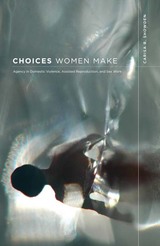
In Showden’s analysis, women’s agency emerges as an individual and social construct, rooted in concrete experience, complex and changing over time. She traces the development and deployment of agency, illustrating how it plays out in the messy workings of imperfect lives. In a series of case studies, she considers women within situations of intimate partner violence, reproductive decision making, and sex work such as prostitution and pornography. Each narrative offers insight into how women articulate their self-understanding and political needs in relation to the pressures they confront.
Showden’s understanding of women’s agency ultimately leads her to review possible policy and legal interventions that could improve the conditions within which agency develops and that could positively enhance women’s ability to increase and exercise their political and personal options.

Contributors. Jodi A. Byrd, Joanne Barker, Jennifer Nez Denetdale, Mishuana Goeman, J. Kēhaulani Kauanui, Melissa K. Nelson, Jessica Bissett Perea, Mark Rifkin
READERS
Browse our collection.
PUBLISHERS
See BiblioVault's publisher services.
STUDENT SERVICES
Files for college accessibility offices.
RECENTLY PUBLISHED





UChicago Accessibility Resources
home | accessibility | search | about | contact us
BiblioVault ® 2001 - 2025
The University of Chicago Press