logo for Harvard University Press
Casual Groups of Monkeys and Men
Stochastic Models of Elemental Social Systems
Joel E. Cohen
Harvard University Press, 1971

When many individuals aggregate and no special organization is imposed, casual social groups form among monkeys in tree tops and among human beings on sidewalks, beaches, and playgrounds. Joel Cohen shows that previously existing probabilistic models do not describe the details of available data on the sizes of such casual groups. He proposes a new family of models, called linear one-step transition (LOST) models, which predict observed equilibrium group size distributions, and also describe the dynamics of systems of social groups.

For the first time, he presents recorded observations of the dynamics of group formation and dissolution among human children in free play. These observations are consistent with the dynamics assumed by the LOST models. Such models suggest generalizations that may apply to epidemiology, the sociology of rumors, and traffic control. Within biology, this approach offers ways of linking the behavior of individuals with the population ecology of a species.

[more]

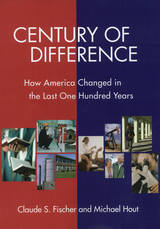
front cover of Century of Difference
Century of Difference
How America Changed in the Last One Hundred Years
Claude S. Fischer
Russell Sage Foundation, 1976
In every generation, Americans have worried about the solidarity of the nation. Since the days of the Mayflower, those already settled here have wondered how newcomers with different cultures, values, and (frequently) skin color would influence America. Would the new groups create polarization and disharmony? Thus far, the United States has a remarkable track record of incorporating new people into American society, but acceptance and assimilation have never meant equality. In Century of Difference, Claude Fischer and Michael Hout provide a compelling—and often surprising—new take on the divisions and commonalities among the American public over the tumultuous course of the twentieth century. Using a hundred years worth of census and opinion poll data, Century of Difference shows how the social, cultural, and economic fault lines in American life shifted in the last century. It demonstrates how distinctions that once loomed large later dissipated, only to be replaced by new ones. Fischer and Hout find that differences among groups by education, age, and income expanded, while those by gender, region, national origin, and, even in some ways, race narrowed. As the twentieth century opened, a person's national origin was of paramount importance, with hostilities running high against Africans, Chinese, and southern and eastern Europeans. Today, diverse ancestries are celebrated with parades. More important than ancestry for today's Americans is their level of schooling. Americans with advanced degrees are increasingly putting distance between themselves and the rest of society—in both a literal and a figurative sense. Differences in educational attainment are tied to expanding inequalities in earnings, job quality, and neighborhoods. Still, there is much that ties all Americans together. Century of Difference knocks down myths about a growing culture war. Using seventy years of survey data, Fischer and Hout show that Americans did not become more fragmented over values in the late-twentieth century, but rather were united over shared ideals of self-reliance, family, and even religion. As public debate has flared up over such matters as immigration restrictions, the role of government in redistributing resources to the poor, and the role of religion in public life, it is important to take stock of the divisions and linkages that have typified the U.S. population over time. Century of Difference lucidly profiles the evolution of American social and cultural differences over the last century, examining the shifting importance of education, marital status, race, ancestry, gender, and other factors on the lives of Americans past and present. A Volume in the Russell Sage Foundation Census Series
[more]

logo for Harvard University Press
Chains of Opportunity
System Models of Mobility in Organizations
Harrison C. White
Harvard University Press, 1970
The careers of managers and professionals in large bureaucracies are generally contingent and form an interacting system of mobility—individual moves occur in chains of vacancies as one man replaces another. Harrison White has developed a series of mathematical models for analyzing mobility and measuring vacancy chains. Detailed sampling and coding procedures demonstrate the application of the models to such existing data as personnel registers while formulas are also included for determining turnover and career distribution.
[more]

front cover of Chaos Theory in the Social Sciences
Chaos Theory in the Social Sciences
Foundations and Applications
L. Douglas Kiel and Euel Elliott, Editors
University of Michigan Press, 1997
Chaos Theory in the Social Sciences: Foundations and Applications offers the most recent thinking in applying the chaos paradigm to the social sciences. The book explores the methodological techniques--and their difficulties--for determining whether chaotic processes may in fact exist in a particular instance and examines implications of chaos theory when applied specifically to political science, economics, and sociology. The contributors to the book show that no single technique can be used to diagnose and describe all chaotic processes and identify the strengths and limitations of a variety of approaches.
The essays in this volume consider the application of chaos theory to such diverse phenomena as public opinion, the behavior of states in the international arena, the development of rational economic expectations, and long waves.
Contributors include Brian J. L. Berry, Thad Brown, Kenyon B. DeGreene, Dimitrios Dendrinos, Euel Elliott, David Harvey, L. Ted Jaditz, Douglas Kiel, Heja Kim, Michael McBurnett, Michael Reed, Diana Richards, J. Barkley Rosser, Jr., and Alvin M. Saperstein.
L. Douglas Kiel and Euel W. Elliott are both Associate Professors of Government, Politics, and Political Economy, University of Texas at Dallas.
[more]

front cover of Coding and Redundancy
Coding and Redundancy
Man-Made and Animal-Evolved Signals
Jack P. Hailman
Harvard University Press, 2008

This book explores the strikingly similar ways in which information is encoded in nonverbal man-made signals (e.g., traffic lights and tornado sirens) and animal-evolved signals (e.g., color patterns and vocalizations). The book also considers some coding principles for reducing certain unwanted redundancies and explains how desirable redundancies enhance communication reliability.

Jack Hailman believes this work pioneers several aspects of analyzing human and animal communication. The book is the first to survey man-made signals as a class. It is also the first to compare such human-devised systems with signaling in animals by showing the highly similar ways in which the two encode information. A third innovation is generalizing principles of quantitative information theory to apply to a broad range of signaling systems. Finally, another first is distinguishing among types of redundancy and their separation into unwanted and desirable categories.

This remarkably novel book will be of interest to a wide readership. Appealing not only to specialists in semiotics, animal behavior, psychology, and allied fields but also to general readers, it serves as an introduction to animal signaling and to an important class of human communication.

[more]

front cover of Competition in the Investment Banking Industry
Competition in the Investment Banking Industry
Samuel L. Hayes, III; A. Michael Spence; and David Van Praag Marks
Harvard University Press, 1983

Investment banks play a critically important role in channeling capital from investors to corporations. Not only do they float and distribute new corporate securities, they also assist companies in the private placement of securities, arrange mergers and acquisitions, devise specialized financing, and provide other corporate financial services.

After sketching the history and evolution of investment banking, the authors describe the structure of the industry, focusing on the competitive forces at work within it today. They explore patterns of concentration and analyze the strategic and economic factors that underlie those patterns. The authors directly examine the pairing up of investment banks with their corporate clients. They show that the market is sharply segmented, with banks and corporate clients being matched in roughly rank order, the most prestigious banks with the largest, most powerful clients, and so on. Vigorous competition occurs within each segment, but much less between them.

With the industry now confronting a changing regulatory environment, a growing tendency of clients to arrange their own financing, and increasing competition both from within and from commercial banks and foreign institutions, Competition in the Investment Banking Industry is essential reading for anyone interested in the future of investment banking.

[more]

front cover of Computational Analysis of Global Trading Arrangements
Computational Analysis of Global Trading Arrangements
Alan V. Deardorff and Robert M. Stern
University of Michigan Press, 1990
The Michigan Model of World Production and Trade, developed in the 1970s by Alan V. Deardorff and Robert M. Stern, has become a valuable tool widely used in research on the economic effects of national and multilateral trade policies. Computational Analysis of Global Trading Arrangements presents the recent developments and enhancements of the Michigan Model together with the major results that it has provided in the last seven years. The book provides a detailed exposition of the model, and chapters describe its applications to a variety of important issues of trade policy in the United States, Japan, and other major industrialized and developing countries. It includes an analysis of negotiating options in the GATT (Uruguay) Round of Multilateral Trade Negotiations. The Michigan Model discussed here provides an empirical framework within which to analyze the twenty-nine producing sectors that make up each of the world's major industrialized and developing countries. Hence, it allows the authors to demonstrate the impact upon a given country—on top of the effects of its own trade policies—of the tariffs and nontariff barriers of foreign countries. The authors of Computational Analysis of Global Trading Arrangements have compiled a volume that underscores the importance of economic interdependence in the global trading system.
[more]

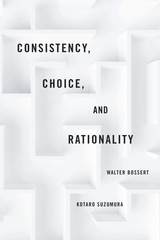
front cover of Consistency, Choice, and Rationality
Consistency, Choice, and Rationality
Walter Bossert and Kotaro Suzumura
Harvard University Press, 2010
In Consistency, Choice, and Rationality, economic theorists Walter Bossert and Kotaro Suzumura present a thorough mathematical treatment of Suzumura consistency, an alternative to established coherence properties such as transitivity, quasi-transitivity, or acyclicity. Applications in individual and social choice theory, fields important not only to economics but also to philosophy and political science, are discussed. Specifically, the authors explore topics such as rational choice and revealed preference theory, and collective decision making in an atemporal framework as well as in an intergenerational setting.
[more]

front cover of Constitutions of Matter
Constitutions of Matter
Mathematically Modeling the Most Everyday of Physical Phenomena
Martin H. Krieger
University of Chicago Press, 1996
In this insightful work, Martin H. Krieger shows what physicists are really doing when they employ mathematical models as research tools. He argues that the technical details of these complex calculations serve not only as a means to an end, but also reveal key aspects of the physical properties they model.

Krieger's lucid discussions will help readers to appreciate the larger physical issues behind the mathematical detail of modern physics and gain deeper insights into how theoretical physicists work. Constitutions of Matter is a rare, behind-the-scenes glimpse into the world of modern physics.

"[Krieger] provides students of physics and applied mathematics with a view of the physical forest behind the mathematical trees, historians and philosophers of science with insights into how theoretical physicists go about their work, and technically advanced general readers with a glimpse into the discipline."—Scitech Book News

[more]

front cover of Control-oriented Modelling and Identification
Control-oriented Modelling and Identification
Theory and practice
Marco Lovera
The Institution of Engineering and Technology, 2015
This comprehensive book covers the state-of-the-art in control-oriented modelling and identification techniques. With contributions from leading researchers in the subject, Control-oriented Modelling and Identification: Theory and practice covers the main methods and tools available to develop advanced mathematical models suitable for control system design, including: object-oriented modelling and simulation; projection-based model reduction techniques; integrated modelling and parameter estimation; identification for robust control of complex systems; subspace-based multi-step predictors for predictive control; closed-loop subspace predictive control; structured nonlinear system identification; and linear fractional LPV model identification from local experiments using an H1-based glocal approach.
[more]

front cover of Cracking the Einstein Code
Cracking the Einstein Code
Relativity and the Birth of Black Hole Physics
Fulvio Melia
University of Chicago Press, 2009

Albert Einstein’s theory of general relativity describes the effect of gravitation on the shape of space and the flow of time. But for more than four decades after its publication, the theory remained largely a curiosity for scientists; however accurate it seemed, Einstein’s mathematical code—represented by six interlocking equations—was one of the most difficult to crack in all of science. That is, until a twenty-nine-year-old Cambridge graduate solved the great riddle in 1963. Roy Kerr’s solution emerged coincidentally with the discovery of black holes that same year and provided fertile testing ground—at long last—for general relativity. Today, scientists routinely cite the Kerr solution, but even among specialists, few know the story of how Kerr cracked Einstein’s code.

Fulvio Melia here offers an eyewitness account of the events leading up to Kerr’s great discovery. Cracking the Einstein Code vividly describes how luminaries such as Karl Schwarzschild, David Hilbert, and Emmy Noether set the stage for the Kerr solution; how Kerr came to make his breakthrough; and how scientists such as Roger Penrose, Kip Thorne, and Stephen Hawking used the accomplishment to refine and expand modern astronomy and physics. Today more than 300 million supermassive black holes are suspected of anchoring their host galaxies across the cosmos, and the Kerr solution is what astronomers and astrophysicists use to describe much of their behavior.

By unmasking the history behind the search for a real world solution to Einstein’s field equations, Melia offers a first-hand account of an important but untold story. Sometimes dramatic, often exhilarating, but always attuned to the human element, Cracking the Einstein Code is ultimately a showcase of how important science gets done.

[more]


Send via email Share on Facebook Share on Twitter