
 A SCHOLARLY BOOK REPOSITORY
13 start with C start with C
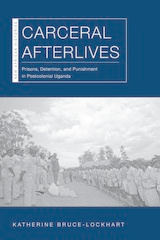
Drawing upon social history, political history, and critical prison studies, this book analyzes how prisons and other instruments of colonial punishment endured after independence and challenges their continued existence.
In Carceral Afterlives, Katherine Bruce-Lockhart traces the politics, practices, and lived experiences of incarceration in postcolonial Uganda, focusing on the period between independence in 1962 and the beginning of Yoweri Museveni’s presidency in 1986. During these decades, Ugandans experienced multiple changes of government, widespread state violence, and war, all of which affected the government’s approach to punishment. Bruce-Lockhart analyzes the relationship between the prison system and other sites of confinement—including informal detention spaces known as “safe houses” and wartime camps—and considers other forms of punishment, such as public executions and “disappearance” by state paramilitary organizations.
Through archival and personal collections, interviews with Ugandans who lived through these decades, and a range of media sources and memoirs, Bruce-Lockhart examines how carceral systems were imagined and experienced by Ugandans held within, working for, or impacted by them. She shows how Uganda’s postcolonial leaders, especially Milton Obote and Idi Amin, attempted to harness the symbolic, material, and coercive power of prisons in the pursuit of a range of political agendas. She also examines the day-to-day realities of penal spaces and public perceptions of punishment by tracing the experiences of Ugandans who were incarcerated, their family members and friends, prison officers, and other government employees. Furthermore, she shows how the carceral arena was an important site of dissent, examining how those inside and outside of prisons and other spaces of captivity challenged the state’s violent punitive tactics.
Using Uganda as a case study, Carceral Afterlives emphasizes how prisons and the wider use of confinement—both as a punishment and as a vehicle for other modes of punishment—remain central to state power in the Global South and North. While scholars have closely analyzed the prison’s expansion through colonial rule and the rise of mass incarceration in the United States, they have largely taken for granted its postcolonial persistence. In contrast, Bruce-Lockhart demonstrates how the prison’s transition from a colonial to a postcolonial institution explains its ubiquity and reveals ways to critique and challenge its ongoing existence. The book thus explores broader questions about the unfinished work of decolonization, the relationship between incarceration and struggles for freedom, and the prison’s enduring yet increasingly contested place in our global institutional landscape.

In Carceral Citizens, anthropologist Caroline M. Parker offers an ethnographic portrait of therapeutic communities in Puerto Rico, the oldest colony in the Americas. As nonprofits nested within the carceral state, therapeutic communities serve as reeducation and recovery centers for the mostly male drug offenders who serve out their sentences engaged in manual labor and prayer. The most surprising aspect of these centers, however, is that their “graduates” often remain long after the completion of their term, working as self-appointed peer counselors in a mixture of volunteer and low-wage positions.
Parker seeks to explain this dynamic by showing how, in these therapeutic communities, criminalized men find new and meaningful ways of living in the shadow of the prison. Through their participation in the day-to-day functioning of the centers, they discover and cultivate alternative forms of belonging, livelihood, and citizenship, despite living within the restrictions of the carceral state. Situating her study against the backdrop of Puerto Rico’s colonial history, and with findings that extend across Latin America, Parker challenges common assumptions about confinement, labor, and rehabilitation. By delving into lives shaped by the convergence of imperialism, the carceral state, and self-help, she offers a fresh understanding of the transformations of labor and social life brought about by mass incarceration.
In Carceral Citizens, anthropologist Caroline M. Parker offers an ethnographic portrait of therapeutic communities in Puerto Rico, the oldest colony in the Americas. As nonprofits nested within the carceral state, therapeutic communities serve as reeducation and recovery centers for the mostly male drug offenders who serve out their sentences engaged in manual labor and prayer. The most surprising aspect of these centers, however, is that their “graduates” often remain long after the completion of their term, working as self-appointed peer counselors in a mixture of volunteer and low-wage positions.
Parker seeks to explain this dynamic by showing how, in these therapeutic communities, criminalized men find new and meaningful ways of living in the shadow of the prison. Through their participation in the day-to-day functioning of the centers, they discover and cultivate alternative forms of belonging, livelihood, and citizenship, despite living within the restrictions of the carceral state. Situating her study against the backdrop of Puerto Rico’s colonial history, and with findings that extend across Latin America, Parker challenges common assumptions about confinement, labor, and rehabilitation. By delving into lives shaped by the convergence of imperialism, the carceral state, and self-help, she offers a fresh understanding of the transformations of labor and social life brought about by mass incarceration.
Pulitzer Prize Finalist
Silver Gavel Award Finalist
“A sobering history of how American communities and institutions have relied on torture in various forms since before the United States was founded.”
—Los Angeles Times
“That Americans as a people and a nation-state are violent is indisputable. That we are also torturers, domestically and internationally, is not so well established. The myth that we are not torturers will persist, but Civilizing Torture will remain a powerful antidote in confronting it.”
—Lawrence Wilkerson, former Chief of Staff to Secretary of State Colin Powell
“Remarkable…A searing analysis of America’s past that helps make sense of its bewildering present.”
—David Garland, author of Peculiar Institution
Most Americans believe that a civilized state does not torture, but that belief has repeatedly been challenged in moments of crisis at home and abroad. From the Indian wars to Vietnam, from police interrogation to the War on Terror, US institutions have proven far more amenable to torture than the nation’s commitment to liberty would suggest.
Civilizing Torture traces the history of debates about the efficacy of torture and reveals a recurring struggle to decide what limits to impose on the power of the state. At a time of escalating rhetoric aimed at cleansing the nation of the undeserving and an erosion of limits on military power, the debate over torture remains critical and unresolved.
College in Prison chronicles how, since 2001, Bard College has provided hundreds of incarcerated men and women across the country access to a high-quality liberal arts education. Earning degrees in subjects ranging from Mandarin to advanced mathematics, graduates have, upon release, gone on to rewarding careers and elite graduate and professional programs. Yet this is more than just a story of exceptional individuals triumphing against the odds. It is a study in how the liberal arts can alter the landscape of some of our most important public institutions giving people from all walks of life a chance to enrich their minds and expand their opportunities.
Drawing on fifteen years of experience as a director of and teacher within the Bard Prison Initiative, Daniel Karpowitz tells the story of BPI’s development from a small pilot project to a nationwide network. At the same time, he recounts dramatic scenes from in and around college-in-prison classrooms pinpointing the contested meanings that emerge in moments of highly-charged reading, writing, and public speaking. Through examining the transformative encounter between two characteristically American institutions—the undergraduate college and the modern penitentiary—College in Prison makes a powerful case for why liberal arts education is still vital to the future of democracy in the United States.
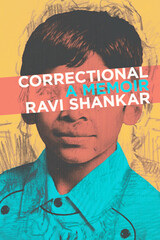
Shankar’s bold and complex self-portrait—and portrait of America—challenges us to rethink our complicity in the criminal justice system and mental health policies that perpetuate inequity and harm. Correctional dives into the inner workings of his mind and heart, framing his unexpected encounters with law and order through the lenses of race, class, privilege, and his bicultural upbringing as the first and only son of South Indian immigrants. Vignettes from his early life set the scene for his spectacular fall and subsequent struggle to come to terms with his own demons. Many of them, it turns out, are also our own.
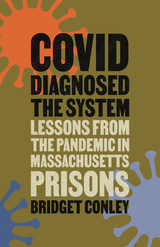
The American criminal justice system was in flux in 2020, a clash of possibilities for reform, retrenchment, and radical change—nowhere more so than in Massachusetts, which had just passed major criminal justice reform. The COVID-19 pandemic interrupted the moment with life-threatening force, ravaging people held in prisons and jails across the country. However, it did not so much create new deprivations and suffering as it exposed prisons as sites of physical, institutional, and psychological violence that do not make communities safer. At the same time, advocates for people in prisons—including many incarcerated and formerly incarcerated people—seized on the pandemic’s disruptions to demand change. Detailing the first year of the pandemic inside the Massachusetts state prison system, this book argues that the history of the pandemic inside prisons exposed both the cruelties of incarceration and the power of change when it is led by directly affected people.

A provocative analysis of how Christianity helped legitimize the death penalty in early modern Europe, then throughout the Christian world, by turning execution into a great cathartic public ritual and the condemned into a Christ-like figure who accepts death to save humanity.
The public execution of criminals has been a common practice ever since ancient times. In this wide-ranging investigation of the death penalty in Europe from the fourteenth to the eighteenth century, noted Italian historian Adriano Prosperi identifies a crucial period when legal concepts of vengeance and justice merged with Christian beliefs in repentance and forgiveness.
Crime and Forgiveness begins with late antiquity but comes into sharp focus in fourteenth-century Italy, with the work of the Confraternities of Mercy, which offered Christian comfort to the condemned and were for centuries responsible for burying the dead. Under the brotherhoods’ influence, the ritual of public execution became Christianized, and the doomed person became a symbol of the fallen human condition. Because the time of death was known, this “ideal” sinner could be comforted and prepared for the next life through confession and repentance. In return, the community bearing witness to the execution offered forgiveness and a Christian burial. No longer facing eternal condemnation, the criminal in turn publicly forgave the executioner, and the death provided a moral lesson to the community.
Over time, as the practice of Christian comfort spread across Europe, it offered political authorities an opportunity to legitimize the death penalty and encode into law the right to kill and exact vengeance. But the contradictions created by Christianity’s central role in executions did not dissipate, and squaring the emotions and values surrounding state-sanctioned executions was not simple, then or now.

Featuring articles by Alfred Blumstein and Allen Beck, Joan Petersilia, Anthony Bottoms, Douglas McDonald and others, Prisons provides reliable, up-to-date, and comprehensive overviews of policy issues and research developments concerning prisons and imprisonment. This timely collection of essays will benefit scholars, administrators, and policy makers alike.

In 1971, 586 patients were released from a Pennsylvania maximum-security hospital for the criminally insane. They were not considered officially "cured," but a federal court held that their commitments had been unconstitutional. Through exhaustive examination of hospital and police records and interviews with hospital administrators and the subjects themselves, Thornberry and Jacoby assess the processes by which the patients had been retained in confinement, the impact of their release upon their communities, and their ability to adjust to the freedom of community life.
The authors demonstrate that the patients did not display a significant level of violent behavior during confinement, nor did they pose a major threat to society after release. In fact, their social and psychological adjustment to community life is shown to have been comparable to that of non-criminal mental patients. Yet despite these findings the subjects had been retained in maximum-security confinement for an average of fourteen years because they were predicted to be violent and "dangerous" to society. The authors explain this inaccuracy by a process called "political prediction," in which clinicians avoid any potential risks to the community, the reputation of their hospitals, and their careers by consistently overpredicting dangerous behavior.
The Criminally Insane will stimulate response from professionals in a wide variety of fields, including law, criminology, psychiatry, and sociology, and from anyone concerned with society's responsibility to the mentally ill offender.
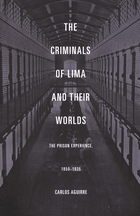
Drawing on a large collection of prison and administrative records archived at Peru’s Ministry of Justice, Aguirre offers a detailed account of the daily lives of men incarcerated in Lima’s jails. In showing the extent to which the prisoners actively sought to influence prison life, he reveals the dynamic between prisoners and guards as a process of negotiation, accommodation, and resistance. He describes how police and the Peruvian state defined criminality and how their efforts to base a prison system on the latest scientific theories—imported from Europe and the United States—foundered on the shoals of financial constraints, administrative incompetence, corruption, and widespread public indifference. Locating his findings within the political and social mores of Lima society, Aguirre reflects on the connections between punishment, modernization, and authoritarian traditions in Peru.
In the field of criminal justice, public policy is designed to address the problems brought on by criminal behavior and the response to that behavior. However, too often, the theories carefully developed in the academy fail to make their way into programs and policy. The editors and contributors to this second edition of Criminology and Public Policy highlight the recent development of “translational criminology” to address the growing movement in criminology to use the results of criminological research and theory to better inform policy and practice.
The essays in Criminology and Public Policy propose an in-depth look at both theory and practice and how they are integrated across a number of key criminal justice problems—from racial and environmental concerns to gun control and recidivism rates as well as police use of force and mass incarceration. The end result is an essential volume that blends both theory and practice in an effort to address the critical problems in explaining, preventing, responding to, and correcting criminal behavior.
Contributors include: Robert K. Ax, Michelle N. Block, Anthony A. Braga, Rod K. Brunson, Jennifer Carlson, Ronald V. Clarke, Shea Cronin, Megan Denver, Kevin M. Drakulich, Grant Duwe, Amy Farrell, Cheryl Jonson, Charis E. Kubrin, Justin Kurland, Megan Kurlychek, Shannon Magnuson, Daniel P. Mears, Robert D. Morgan, Kathleen Powell, Danielle Rudes, Cassia Spohn, Cody Telep, Natalie Todak, Glenn Trager, Jillian J. Turanovic, Sara Wakefield, Patricia Warren, David Weisburd, Michael D. White, Rob White, Lauren Wilson and the editors
The Cultural Prison brings a new dimension to the study of prisoners and punishment by focusing on how the punishment of American offenders is represented and shaped in the mass media through public arguments. The study is based on an analysis of 642 articles collected by the author from American popular journals and magazines, as well as newspaper accounts, films, and public speeches, spanning the years 1950 to 1992. By piecing together and studying these popular narratives, he divides the history of prisoners and punishment into four eras, each marked by a shift in value system. He argues that the discourse, or rhetoric, surrounding prisoners and punishment on the public level works as a historical force that shapes contemporary culture.
The author is concerned that the public seems to have an inability or unwillingness to question or resist cultural definitions of normalcy and legal behavior. He explains that ideally moral behavior should be a matter of public debate rather than of unquestioned perpetuation, and he urges increased understanding of institutional and cultural discipline and our questioning the ways in which the constitution of punishment and prisoners influences us culturally.
The"cultural prison" refers to the way in which this study acts as an investigation of "the discipline of discipline"; it is an examination of the way in which discipline is shaped and formed in public discourse. The volume concludes with a fascinating account of the move to electronic means of surveillance; coupled with the representations of the prisoner along the lines of race and gender, it explains what these new techniques mean to contemporary culture.
READERS
Browse our collection.
PUBLISHERS
See BiblioVault's publisher services.
STUDENT SERVICES
Files for college accessibility offices.
RECENTLY PUBLISHED






UChicago Accessibility Resources
home | accessibility | search | about | contact us
BiblioVault ® 2001 - 2025
The University of Chicago Press