
 A SCHOLARLY BOOK REPOSITORY
18 start with D start with D


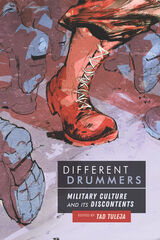
This multidisciplinary collection brings in the perspectives of scholars from folklore, literary studies, psychology, and media studies, as well as the first-person perspectives of veterans. It includes chapters on the vernacular genres of bodylore, folksong, personal narrative, and legend; literary items like soldiers’ memoirs and poetry; the artwork of soldier cartoonists; and accounts of defying the chain of command in the field. Ideally, the goal of military basic training is to replace recruits’ focus on their own individuality with an unquestioned devotion to group solidarity. In reality, unit cohesion is constantly challenged by humans clinging obstinately to their non-collective personalities. Different Drummers focuses on those in uniform who feel themselves to be both of the military culture and at odds with it. It shows how these loyal “discontents” find ways of communicating and interacting with others that sometimes defy institutional expectations.
Contributors:
Ron Ben-Tovim, Carol Burke, Richard Allen Burns, Catherine Calloway, James I. Deutsch, Ronald Fry, Angus Kress Gillespie, Christina M. Knopf, Jay Mechling, Matthew David Perry, Mark C. Russell, John Paul Wallis

Be sexy but not sexual. Don't be a prude but don't be a slut. These are the cultural messages that barrage teenage girls. In movies and magazines, in music and advice columns, girls are portrayed as the object or the victim of someone else's desire--but virtually never as someone with acceptable sexual feelings of her own. What teenage girls make of these contradictory messages, and what they make of their awakening sexuality--so distant from and yet so susceptible to cultural stereotypes--emerges for the first time in frank and complex fashion in Deborah Tolman's Dilemmas of Desire.
A unique look into the world of adolescent sexuality, this book offers an intimate and often disturbing, sometimes inspiring, picture of how teenage girls experience, understand, and respond to their sexual feelings, and of how society mediates, shapes, and distorts this experience. In extensive interviews, we listen as actual adolescent girls--both urban and suburban--speak candidly of their curiosity and confusion, their pleasure and disappointment, their fears, defiance, or capitulation in the face of a seemingly imperishable double standard that smiles upon burgeoning sexuality in boys yet frowns, even panics, at its equivalent in girls.
As a vivid evocation of girls negotiating some of the most vexing issues of adolescence, and as a thoughtful, richly informed examination of the dilemmas these girls face, this readable and revealing book begins the critical work of understanding the sexuality of young women in all its personal, social, and emotional significance.

The surprising story of the sixteenth-century Lutheran scholar who became Europe’s foremost authority on Ottoman Greece, shedding new light on the place of Greek culture and religion in the Western imagination.
In the late sixteenth century, a German Lutheran scholar named Martin Crusius compiled an exceptionally rich record of Greek life under Ottoman rule. Although he never left his home in the university town of Tübingen, Crusius spent decades annotating books and manuscripts, corresponding with the Greek Orthodox Patriarch, and interviewing Greek Orthodox alms-seekers. Ultimately, he gathered his research into a seminal work called the Turcograecia, which served for centuries as Europe’s foremost source on Ottoman Greece. Yet as Richard Calis reveals, Crusius’s massive—and largely untapped—archive has much more to tell us about how early modern Europeans negotiated cultural and religious difference.
In particular, Crusius’s work illuminates Western European views of the religious “other” within Christianity: the Greek Orthodox Christians living under Ottoman rule, a group both familiar and foreign. Many Western Europeans, including Crusius, developed narratives of Greek cultural and religious decline under Ottoman rule. Crusius’s records, however, reveal in exceptional detail how such stories developed. His interactions with his Greek Orthodox visitors, and with a vast network of correspondents, show that Greeks’ own narratives of hardship entwined in complex ways with Western Europeans’ orientalist views of the Ottoman world. They also reflect the religious tensions that undergirded these exchanges, fueled by Crusius’s fervent desire to spread Lutheran belief across Ottoman Greece and the wider world.
A lively intellectual history drawn from a forgotten archive, The Discovery of Ottoman Greece is also a perceptive character study, in which Crusius takes his place in the history of ethnography, Lutheran reform, and European philhellenism.

J. Lesley Fitton traces this exciting tale of scholarly discovery and weaves it into an engaging, in-depth portrait of Greek Bronze Age civilizations, from their dawning on the Cycladic Isles in the third millennium B.C. to their later flowering in Minoan Crete and then in the Mycenaean centers and finally to their mysterious disappearance in the twelfth century B.C. The result is an elegant assimilation of vast historical detail and a well-illustrated tour of the art and artifacts, the grand palaces and tombs, the mythical heroes and Trojan treasures that form at least one cradle of our own civilization.
Fitton begins with the early finds of travelers, advances in geology, and research into Homer's identity. She vividly recreates the heroic age of the first archaeological excavations, particularly Heinrich Schliemann's fascinating work at Troy and Mycenae, and Arthur Evans's pioneering excavation and restoration of the Palace of Minos on Crete. The persistent search for signs of writing among Bronze Age Greeks culminates in Fitton's description of the 1952 deciphering of the earliest script used to write Greek. And as her account extends into the present, it encompasses the important contributions of the archaeologists Alan Wace and Carl Blegen, the War's impact on research, and a concise summation of current scholarly trends.
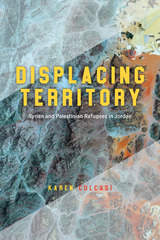
Based on fieldwork with Palestinian and Syrian refugees in Jordan, Displacing Territory explores how the lived realities of refugees are deeply affected by their imaginings of what constitutes territory and their sense of belonging to different places and territories. Karen Culcasi shows how these individual conceptualizations about territory don’t always fit the Western-centric division of the world into states and territories, thus revealing alternative or subordinated forms and scales of territory. She also argues that disproportionate attention to “refugee crises” in the Global North has diverted focus from other parts of the world that bear the responsibility of protecting the majority of the world’s refugees. By focusing on Jordan, a Global South state that hosts the world’s second-largest number of refugees per capita, this book provides insights to consider alternate ways to handle the situation of refugees elsewhere. In the process, Culcasi brings the reader into refugees’ diverse realities through their own words, inherently arguing against the tendency of many people in the Global North to see refugees as aberrant, burdensome, or threatening.
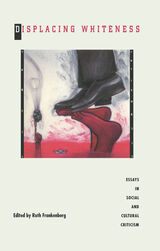
Approaching whiteness as a plural rather than singular concept, the essays describe, for instance, African American, Chicana/o, European American, and British experiences of whiteness. The contributors offer critical readings of theory, literature, film and popular culture; ethnographic analyses; explorations of identity formation; and examinations of racism and political process. Essays examine the alarming epidemic of angry white men on both sides of the Atlantic; far-right electoral politics in the UK; underclass white people in Detroit; whiteness in "brownface" in the film Gandhi; the engendering of whiteness in Chicana/o movement discourses; "whiteface" literature; Roland Barthes as a critic of white consciousness; whiteness in the black imagination; the inclusion and exclusion of suburban "brown-skinned white girls"; and the slippery relationships between culture, race, and nation in the history of whiteness. Displacing Whiteness breaks new ground by specifying how whiteness is lived, engaged, appropriated, and theorized in a range of geographical locations and historical moments, representing a necessary advance in analytical thinking surrounding the burgeoning study of race and culture.
Contributors. Rebecca Aanerud, Angie Chabram-Dernersesian, Phil Cohen, Ruth Frankenberg, John Hartigan Jr., bell hooks, T. Muraleedharan, Chéla Sandoval, France Winddance Twine, Vron Ware, David Wellman
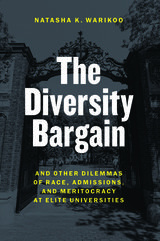
What Warikoo uncovers—talking with both white students and students of color at Harvard, Brown, and Oxford—is absolutely illuminating; and some of it is positively shocking. As she shows, many elite white students understand the value of diversity abstractly, but they ignore the real problems that racial inequality causes and that diversity programs are meant to solve. They stand in fear of being labeled a racist, but they are quick to call foul should a diversity program appear at all to hamper their own chances for advancement. The most troubling result of this ambivalence is what she calls the “diversity bargain,” in which white students reluctantly agree with affirmative action as long as it benefits them by providing a diverse learning environment—racial diversity, in this way, is a commodity, a selling point on a brochure. And as Warikoo shows, universities play a big part in creating these situations. The way they talk about race on campus and the kinds of diversity programs they offer have a huge impact on student attitudes, shaping them either toward ambivalence or, in better cases, toward more productive and considerate understandings of racial difference.
Ultimately, this book demonstrates just how slippery the notions of race, merit, and privilege can be. In doing so, it asks important questions not just about college admissions but what the elite students who have succeeded at it—who will be the world’s future leaders—will do with the social inequalities of the wider world.
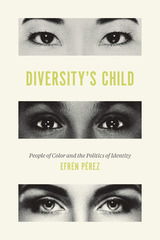
For decades now, pundits and political scientists have been pointing to a major demographic change that’s underway in the United States. Demographers project that whites will become a minority of the US population and that minority groups will jointly comprise a majority before 2050.
Diversity’s Child appraises the political ramifications of this change. Efrén O. Pérez deftly argues that America’s changing demographics are forging a new identity for many as people of color—that unifies the political outlook of assorted minority groups. Drawing on opinion surveys of multiple minority groups, social science experiments with minority adults, content analyses of newspapers and congressional archives, and in-depth interviews with minority individuals, Pérez makes two key points. First, a person of color's identity does exist, and we can reliably measure it, as well as distinguish it from other identities that minorities hold. Second, across a wide swath of circumstances, identifying as a person of color profoundly shapes how minorities view themselves and their political system. Diversity’s Child is a vital and engaging look at America’s identity politics as well as at how people of color think about racial disparities and how politics can best solve them.
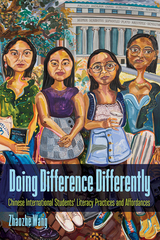
Doing Difference Differently provides an in-depth, nuanced understanding of the multifaceted literate lives of this often-marginalized cultural group, highlighting their diverse aspirations, personas, communities, challenges, and strategies. The book reconceptualizes the linguistic and cultural differences of Chinese international students as active processes of embracing, performing, resisting, negotiating, and redefining the identities that institutions impose on them through everyday literacy practices. Wang offers an analytical heuristic for researchers and educators to better understand these students’ backgrounds and to more effectively and ethically support and advocate for them. This case study critically engages broad and interconnected concepts that are essential to educators’ collective understanding of Generation Z students brought up in cultural and educational contexts outside of the European-American sphere.
This book appeals to scholars, researchers, teachers, and administrators working in North American higher education and English-speaking countries, particularly those in the fields of writing studies, second language studies, applied linguistics, multilingual education, literacy studies, and international education. Educators across disciplines seeking to better understand the growing population of Chinese international students in North America will likewise benefit.
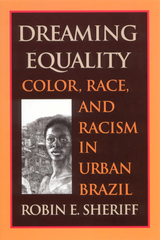
This myth contrasts starkly with the realities of a pernicious racial inequality that permeates every aspect of Brazilian life. To study the grip of this myth on African Brazilians’ views of themselves and their nation, Robin E. Sheriff spent twenty months in a primarily black shantytown in Rio de Janeiro, studying the inhabitants’s views of race and racism. How, she asks, do poor African Brazilians experience and interpret racism in a country where its very existence tends to be publicly denied? How is racism talked about privately in the family and publicly in the community—or is it talked about at all?
Sheriff’s analysis is particularly important because most Brazilians live in urban settings, and her examination of their views of race and racism sheds light on common but underarticulated racial attitudes. This book is the first to demonstrate that urban African Brazilians do not subscribe to the racial democracy myth and recognize racism as a central factor shaping their lives.

READERS
Browse our collection.
PUBLISHERS
See BiblioVault's publisher services.
STUDENT SERVICES
Files for college accessibility offices.
RECENTLY PUBLISHED





UChicago Accessibility Resources
home | accessibility | search | about | contact us
BiblioVault ® 2001 - 2025
The University of Chicago Press