
 A SCHOLARLY BOOK REPOSITORY
6 start with D start with D
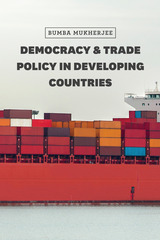
Mukherjee offers the first comprehensive cross-national framework for identifying the specific economic conditions that influence trade policy in developing countries. Laying out the causes of variation in trade policy in four developing or recently developed countries—Brazil, India, Indonesia, and South Africa—he argues persuasively that changing political interactions among parties, party leaders, and the labor market are often key to trade policy outcome. For instance, if workers are in a position to benefit from opening up to trade, party leaders in turn support trade reforms by decreasing tariffs and other trade barriers.
At a time when discussions about the stability of new democracies are at the forefront, Democracy and Trade Policy in Developing Countries provides invaluable insight into the conditions needed for a democracy to survive in the developing world in the context of globalization.
To answer that question, the contributors to this book draw upon their deep backgrounds in finance, social science, art, and the humanities to create a new way of understanding derivative finance that does justice to its social and cultural dimensions. They offer a two-pronged analysis. First, they develop a social understanding of the derivative that casts it in the light of anthropological concepts such as the gift, ritual, play, dividuality, and performativity. Second, they develop a derivative understanding of the social, using financial concepts such as risk, hedging, optionality, and arbitrage to uncover new dimensions of contemporary social reality. In doing so, they construct a necessary, renewed vision of derivative finance as a deeply embedded aspect not just of our economics but our culture.




The tasks of macroeconomics are to interpret observations on economic aggregates in terms of the motivations and constraints of economic agents and to predict the consequences of alternative hypothetical ways of administering government economic policy. General equilibrium models form a convenient context for analyzing such alternative government policies. In the past ten years, the strengths of general equilibrium models and the corresponding deficiencies of Keynesian and monetarist models of the 1960s have induced macroeconomists to begin applying general equilibrium models.
This book describes some general equilibrium models that are dynamic, that have been built to help interpret time-series of observations of economic aggregates and to predict the consequences of alternative government interventions. The first part of the book describes dynamic programming, search theory, and real dynamic capital pricing models. Among the applications are stochastic optimal growth models, matching models, arbitrage pricing theories, and theories of interest rates, stock prices, and options. The remaining parts of the book are devoted to issues in monetary theory; currency-in-utility-function models, cash-in-advance models, Townsend turnpike models, and overlapping generations models are all used to study a set of common issues. By putting these models to work on concrete problems in exercises offered throughout the text, Thomas Sargent provides insights into the strengths and weaknesses of these models of money. An appendix on functional analysis shows the unity that underlies the mathematics used in disparate areas of rational expectations economics.
This book on dynamic equilibrium macroeconomics is suitable for graduate-level courses; a companion book, Exercises in Dynamic Macroeconomic Theory, provides answers to the exercises and is also available from Harvard University Press.
READERS
Browse our collection.
PUBLISHERS
See BiblioVault's publisher services.
STUDENT SERVICES
Files for college accessibility offices.
RECENTLY PUBLISHED







UChicago Accessibility Resources
home | accessibility | search | about | contact us
BiblioVault ® 2001 - 2025
The University of Chicago Press