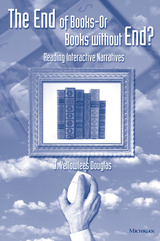
front cover of The End of Books--or Books Without End?
The End of Books--or Books Without End?
Reading Interactive Narratives
J. Yellowlees Douglas
University of Michigan Press, 2001
Of all developments surrounding hypermedia, none has been as hotly or frequently debated as the conjunction of fiction and digital technology. J. Yellowlees Douglas considers the implications of this union. She looks at the new light that interactive narratives may shed on theories of reading and interpretation and the possibilities for hypertext novels, World Wide Web-based short stories, and cinematic, interactive narratives on CD-ROM. She confronts questions that are at the center of the current debate: Does an interactive story demand too much from readers? Does the concept of readerly choice destroy the integrity of an author's vision? Does interactivity turn reading fiction from "play" into "work"--too much work? Will hypertext fiction overtake the novel as a form of art or entertainment? And what might future interactive books look like?
The book examines criticism on interactive fiction from both proponents and skeptics and examines similarities and differences between print and hypertext fiction. It looks closely at critically acclaimed interactive works, including Stuart Moulthrop's Victory Garden and Michael Joyce's Afternoon: A Story that illuminate how these hypertext narratives "work." While she sees this as a still-evolving technology and medium, the author identifies possible developments for the future of storytelling from outstanding examples of Web-based fiction and CD-ROM narratives, possibilities that will enable narratives to both portray the world with greater realism an to transcend the boundaries of novels and films, character and plot alike.
Written to be accessible to a wide range of readers, this lively and accessibly-written volume will appeal to those interested in technology and cyberculture, as well as to readers familiar with literary criticism and modern fiction.
J. Yellowlees Douglas is the Director of the William and Grace Dial Center for Written and Oral Communication, University of Florida. She is the author of numerous articles and essays on the subject of hypertext and interactive literature.
[more]

front cover of Enumerations
Enumerations
Data and Literary Study
Andrew Piper
University of Chicago Press, 2018
For well over a century, academic disciplines have studied human behavior using quantitative information. Until recently, however, the humanities have remained largely immune to the use of data—or vigorously resisted it. Thanks to new developments in computer science and natural language processing, literary scholars have embraced the quantitative study of literary works and have helped make Digital Humanities a rapidly growing field. But these developments raise a fundamental, and as yet unanswered question: what is the meaning of literary quantity?
          In Enumerations, Andrew Piper answers that question across a variety of domains fundamental to the study of literature. He focuses on the elementary particles of literature, from the role of punctuation in poetry, the matter of plot in novels, the study of topoi, and the behavior of characters, to the nature of fictional language and the shape of a poet’s career. How does quantity affect our understanding of these categories? What happens when we look at 3,388,230 punctuation marks, 1.4 billion words, or 650,000 fictional characters? Does this change how we think about poetry, the novel, fictionality, character, the commonplace, or the writer’s career? In the course of answering such questions, Piper introduces readers to the analytical building blocks of computational text analysis and brings them to bear on fundamental concerns of literary scholarship. This book will be essential reading for anyone interested in Digital Humanities and the future of literary study.

 
[more]


Send via email Share on Facebook Share on Twitter