
 A SCHOLARLY BOOK REPOSITORY
17 start with E start with E
An essential resource for scholars and students
Since the publication of the first edition of Early Judaism and Its Modern Interpreters in 1986, the field of early Judaism has exploded with new data, the publication of additional texts, and the adoption of new methods. This new edition of the classic resource honors the spirit of the earlier volume and focuses on the scholarly advances in the past four decades that have led to the study of early Judaism becoming an academic discipline in its own right. Essays written by leading scholars in the study of early Judaism fall into four sections: historical and social settings; methods, manuscripts, and materials; early Jewish literatures; and the afterlife of early Judaism.

A sweeping exploration of survival, resilience, and the fate of one family amid Europe’s most turbulent century
Echoes of Exile reveals the seismic disruptions of twentieth-century European history through the intimate lens of one family’s struggle to survive. Setting out to record the life of her mother, Ruth, Daniela Spenser unearthed personal facts and stories that additionally illuminate the shared traumas and experiences of millions of Czech, Polish, and German Jews who died in the Holocaust, as well as the stories of those who survived and lived under Communism and the Cold War. Her resulting work is a fascinating hybrid that combines family letters and interviews with deeply researched political history spanning from the collapse of the Austro-Hungarian Empire to the fall of the Berlin Wall.
Spenser’s fascinating work reveals the difficult choices her mother and family faced, the tests to their loves and loyalties, and the lingering scars of exile. More than a family history, it weaves personal and historical narratives with mundane and momentous threads to create a fresh, distinctive fabric. Spenser recovers fragments of the past that contribute to a map of the present and possibilities for the future. An engrossing account of survival, resilience, and the enduring human spirit amid the maelstrom of Europe’s savage twentieth century, Echoes of Exile will interest readers who value firsthand accounts of significant events and who seek to understand the complexities of survival, identity, and political change through intimate, lived experiences.
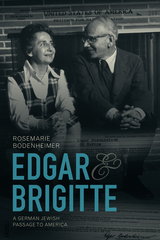
The couple’s encounters with the strange new dynamics of race, religion, and the workplace in their new American home offer a compelling account of the struggles that faced many immigrants with deep German roots. It is also an intimate portrait of a now-vanished German Jewish culture as it played out in the lives of Bodenheimer’s parents and her grandparents from the 1920s to the late 1960s, a story of emigration, assimilation, and the private struggles that accompany those forced shifts in orientation.
The Bodenheimers’ letters and journals offer engaging perspectives into their personal lives that retrospective memories cannot match. Braiding intimate biography together with history and memoir, Edgar and Brigitte will appeal both to historians of the European Jewish diaspora and to readers interested in the struggles and resilience of people whose lives were upended by Hitler.
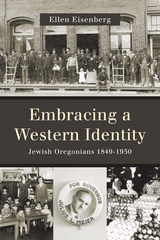
In Embracing a Western Identity, Ellen Eisenberg places Jewish history in the larger context of western narratives, challenging the traditional view that the “authentic” North American Jewish experience stems from New York. The westward paths of Jewish Oregonians and their experiences of place shaped the communities, institutions, and identities they created, distinguishing them from other American Jewish communities. Eisenberg traces the Oregon Jewish experience from its pioneer beginnings in the mid-nineteenth century to the highly concentrated Portland communities of the mid-twentieth century.
Drawing on extensive archival resources at the Oregon Jewish Museum, this historical commentary explores patterns of migration and settlement, the place of Jews in the state’s ethnic landscape, their engagement in politics, the development of institutions, and their relationship to Zionism. Departing from familiar treatments of the Jewish experience, Embracing a Western Identity provides a critical look at the impact of place and opportunity upon the identities of migrants both as Oregonians and as American Jews. Readers and scholars interested in western history—religious, ethnic, expansionist, and otherwise—will enjoy Eisenberg’s accessible writing style and rich photograph collection.
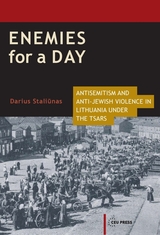
It begins by illustrating how widespread anti-Jewish feelings were among the Christian population in 19 th century, focusing on blood libel accusations as well as describing the role of modern antisemitism. Secondly, it tries to identify the structural preconditions as well as specific triggers that turned anti-Jewish feelings into collective violence and analyzes the nature of this violence. Lastly, pogroms in Lithuania are compared to anti-Jewish violence in other regions of the Russian Empire and East Galicia.
This research is inspired by the cultural turn in social sciences, an approach that assumes that violence is filled with meaning, which is “culturally constructed, discursively mediated, symbolically saturated, and ritually regulated.” The author argues that pogroms in Lithuania instead followed a communal pattern of ethnic violence and was very different from deadly pogroms in other parts of the Russian Empire.
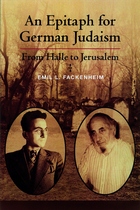
“An ‘epoch-making’ autobiography.”—Arnold Ages, Jewish Tribune

An Equal Share of Freedom sheds new light on several important and interrelated dimensions of American, Jewish, and world history in the World War I era. Paying close attention to the Balfour Declaration as a hub around which to explore the period’s unfolding and turbulent social, cultural, and political developments, this collection of essays covers a diverse range of topics including Jewish doughboys, Zionist women authors, and political elites such as Golda Meir and Woodrow Wilson. The volume demonstrates the complex nature of Jewish ethnonational consciousness in the American setting and the impact of Zionism on US wartime and postwar activity.
The essays in this volume overturn timeworn assumptions that have long shaped the fields of American history and modern Jewish history. Taken as a whole, they demonstrate the war’s profound impact on American Jewish life and the transformation of American Jewry’s relationship with wider American society. These essays also illustrate the centrality of Zionism to the American Jewish experience and the extent to which American Jewry’s national consciousness and the future direction of the Zionist project were forged in the crucible of the Great War. An Equal Share of Freedom is the first volume in the Jacob Rader Marcus Series on the American Jewish Experience. In this series, Raider, Segev, and Zola highlight the myriad possibilities for expanding and deepening scholarly understanding of American Jews and the shared history of American society and the Jewish people in the twentieth century, starting with a look at World War I.

Erasmus and the Jews discusses Erasmus' critique of Mosaic law and his view of the conflict between "Judaism" as legalistic morality and Jesus' teaching; his judgment on the Pharisees of Jesus' time; his emphasis on the importance of the study of Hebrew; and his opinions of sixteenth-century Jews. This meticulous analysis reveals an Erasmus who defended his vision of true piety by rejecting "Judaizing" Christians more than Jews and who saw the Old Testament as integral to the Christian worldview. As a Christian, he regretted nonbelief and pitied unbelievers, without vicious hostility toward any single people. His theological opposition to a form of religious thought which he identified with Judaism was not translated into crude prejudice against actual Jews. In general, his calm consideration of the strange and the foreign and his willingness to restrict his judgments to the philosophical realm were, Markish argues, early and significant steps toward enlightened toleration.
Markish's discussion of Erasmus is supplemented with an Afterword by theologian and philosopher Arthur A. Cohen, who offers a variant interpretation of Erasmus' writings and attitudes. The juxtaposed arguments of the two scholars make this an especially illuminating work for any student of Erasmus and his influence. Erasmus and the Jews also gives a necessary clarity to our understanding of the meaning of anti-Semitism and the history of religious toleration. Markish's profound knowledge of Erasmus allows him to demonstrate the fundamental importance of putting arguments and terminology in the context of a thinker's work and his own time.
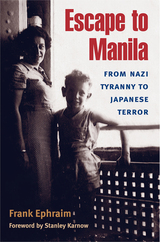
A harrowing account of Jewish refugees in the Philippines
With the rise of Nazism in the 1930s more than a thousand European Jews sought refuge in the Philippines, joining the small Jewish population of Manila. When the Japanese invaded the islands in 1941, the peaceful existence of the barely settled Jews filled with the kinds of uncertainties and oppression they thought they had left behind.
In this book Frank Ephraim, who fled to Manila with his parents, gathers the testimonies of thirty-six refugees, who describe the difficult journey to Manila, the lives they built there upon their arrival, and the events surrounding the Japanese invasion. Combining these accounts with historical and archival records, Manila newspapers, and U.S. government documents, Ephraim constructs a detailed account of this little-known chapter of world history.
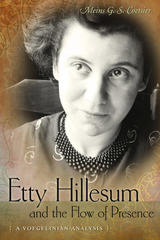
Although she died cruelly at Auschwitz at the age of twenty-nine, Etty Hillesum left a lasting legacy of mystical thought in her letters and diaries. Hillesum was a complex and powerful witness to the openness of the human spirit to the call of God, even under the most harrowing circumstances. Her life was as much shaped by Hitler’s regime as was that of philosopher Eric Voegelin, and as Meins Coetsier reveals, her thought lends itself to interpretation from a uniquely Voegelinian perspective.
Etty Hillesum and the Flow of Presence analyzes the life and writings of Hillesum from the standpoint of Voegelin’s views on consciousness—especially his philosophy of luminous participation in the transcendent ground of being. Through a careful reading of her letters and diaries, Coetsier reveals the inner development of Hillesum’s mystically grounded resistance to Nazism as he guides readers through the symbolism of her spiritual journey, making effective use of Voegelin’s analytics of experience and symbolization to trace her path to spiritual truth.
Intertwining the lives, works, and visions of these two mystical thinkers, Coetsier demonstrates his mastery of both Voegelin’s philosophy and Hillesum’s Dutch-language materials. He shows how mystical attunement to the “flow of presence”—Voegelin’s designation for human responsiveness to the divine—is the key to the development of Hillesum’s life and writings. He displays a special affinity for the suffering and grace-filled transformation that she underwent as she approached the end of her life and gained insight into the ultimate purpose of each individual’s contribution to the well-being and maintenance of the human spirit.
Retrieving one of the lesser-known but most compelling figures of the Holocaust, Etty Hillesum and the Flow of Presence is an original contribution to both Voegelin and Hillesum scholarship that reflects these writers’ strong valuation of the human person. It presents Hillesum’s life and work in an original and provocative context, shedding new light on her experiences and their symbolizations while further broadening the application of Voegelin’s thought
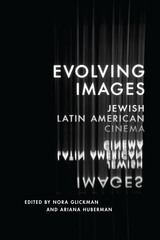
Jews have always played an important role in the generation of culture in Latin America, despite their relatively small numbers in the overall population. In the early days of cinema, they served as directors, producers, screenwriters, composers, and broadcasters. As Latin American societies became more religiously open in the later twentieth century, Jewish characters and themes began appearing in Latin American films and eventually achieved full inclusion. Landmark films by Jewish directors in Argentina, Mexico, and Brazil, which are home to the largest and most influential Jewish communities in Latin America, have enjoyed critical and popular acclaim.
Evolving Images is the first volume devoted to Jewish Latin American cinema, with fifteen critical essays by leading scholars from Latin America, the United States, Europe, and Israel. The contributors address transnational and transcultural issues of Jewish life in Latin America, such as assimilation, integration, identity, and other aspects of life in the Diaspora. Their discussions of films with Jewish themes and characters show the rich diversity of Jewish cultures in Latin America, as well as how Jews, both real and fictional, interact among themselves and with other groups, raising the question of how much their ethnicity may be adulterated when adopting a combined identity as Jewish and Latin American. The book closes with a groundbreaking section on the affinities between Jewish themes in Hollywood and Latin American films, as well as a comprehensive filmography.
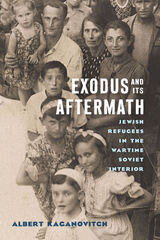
Albert Kaganovitch reconstructs the conditions that gave rise to this upsurge in antisemitic sentiment and provides new statistical data on the number of Jewish refugees who lived in the Urals, Siberia, and Middle Volga areas. The book’s insights into the regional distribution and concentration of these émigrés offer a behind-the-scenes look at the largest and most intensive Jewish migration in history.
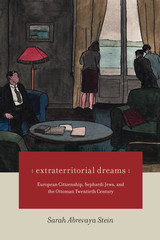
Sarah Abrevaya Stein traces the experiences of Mediterranean Jewish women, men, and families who lived through a tumultuous series of wars, border changes, genocides, and mass migrations, all in the shadow of the collapse of the Ottoman Empire and the ascendance of the modern passport regime. Moving across vast stretches of Europe, the Middle East, Asia, and the Americas, she tells the intimate stories of people struggling to find a legal place in a world ever more divided by political boundaries and competing nationalist sentiments. From a poor youth who reached France as a stowaway only to be hunted by the Parisian police as a spy to a wealthy Baghdadi-born man in Shanghai who willed his fortune to his Eurasian Buddhist wife, Stein tells stories that illuminate the intertwined nature of minority histories and global politics through the turbulence of the modern era.
READERS
Browse our collection.
PUBLISHERS
See BiblioVault's publisher services.
STUDENT SERVICES
Files for college accessibility offices.
RECENTLY PUBLISHED





UChicago Accessibility Resources
home | accessibility | search | about | contact us
BiblioVault ® 2001 - 2025
The University of Chicago Press